Objectivity

Recently I’ve had more than my share of time to think about museums and objects, and what they mean to me and why I love them, and have dedicated my life to them, albeit a bit accidentally.

Transferware in open storage, Metropolitan Museum of Art, May 2013.

In the hours I spent alone in a curatorial office, listening to the murmur of school tours on the other side of the door, I began to see that curation and registration are means of managing the evidence locker of the future. We collect, tag, and maintain the means by which the future will understand the past, and it’s our job to be a neutral as we can—to refrain from laying the thumb of our prejudices on the scale—as we collect objects, images, and documents. It’s a game of forecasting, trying to guess what will best explain us and our time to the future, as well as Monday morning quarterbacking as we both weed and augment what was collected in the past to better reflect how we understand history now.

I was always a stickler for good data and record editing (and have raccoon-eyed photos of a catalog launch to prove it), and I make unkind sport of museum databases on a regular basis when I see misidentified and misdated objects. Good data matters—it’s everything, really—because if you don’t know what you have, and where it is, you might as well not have it. But more than that, compendia of data can show you things you didn’t expect to find.

RIFA Record 4925

Yale’s Rhode Island Furniture Archive is a good example of how a massive amount of data can be used. Take this record of side chair possibly made by John Carlile and Sons, and scroll down. That’s a lot of associated chairs. And they all look very similar. Examining the materials, especially secondary woods, of a labeled chair and comparing the style, make, and materials with other very similar chairs can help identify chairs, associate them with a maker, and provide a sense of Carlile’s production volume.

And Carlile’s easy! Looking at hundreds of pieces of furniture with some location provenance, reading probate inventories and other documents helped untangle James Halyburton or “Ally Burton” as a maker.


James Halyburton in the RIFA

When you can see enough things at once, you can discern patterns and better understand exactly what it is you’re seeing. Good data makes that possible, makes concrete what was once solely seen as connoisseurship, and helps bring unknown stories, unrecognized people, to light. Data analysis is a powerful tool for better understanding the past: that’s why museum collections matter, and why I think it’s so important for museums to make their data accessible. It’s one of the ways we understand our collective past.

New England Spencers

You may recall how tortured I was (sort of) about making a Spencer for What Cheer Day, concerned that Spencers could not be documented to Rhode Island, let alone New England. I had the same worry about the Not-Quite-Good-Enough Coat.

JDK_8210_1

Things will come to those who wait, and what came this week was the long-awaited Proceedings of the Dublin Seminar for 2010, Dressing New England. In it I found an article by Alden O’Brien, Federal New England Fashion in the Diary of Sylvia Lewis.

Sylvia Lewis [Tyler], Diary (1801-1831), MSS 2899 in the Americana Collection of the NSDAR provides the basis for O’Brien’s article and my joy. It begins routinely enough with my favorite stuff– spinning!– and carries on to knitting: stockings, mittens, gloves, a hat or two, and even “comforters,” or scarves. Shag, or thrummed, knitting is mentioned, so at least those of us interpreting the world of 1801 and later can be war.

The real excitement comes on the third page: in the winter of 1803-1804, Sylvia Lewis cuts and sews a greatcoat. Then, in 1806, she makes a green Spencer, and in 1808, a black one.

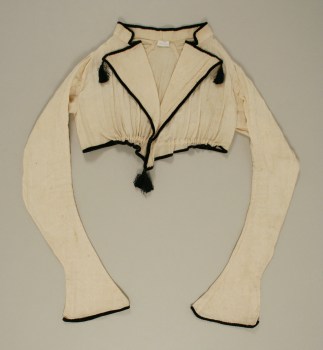
Spencer ca. 1800 French. silk. Purchase, Irene Lewisohn Trust Gift, 1991 1991.239.2
Spencer ca. 1800
French. silk. Purchase, Irene Lewisohn Trust Gift, 1991
1991.239.2

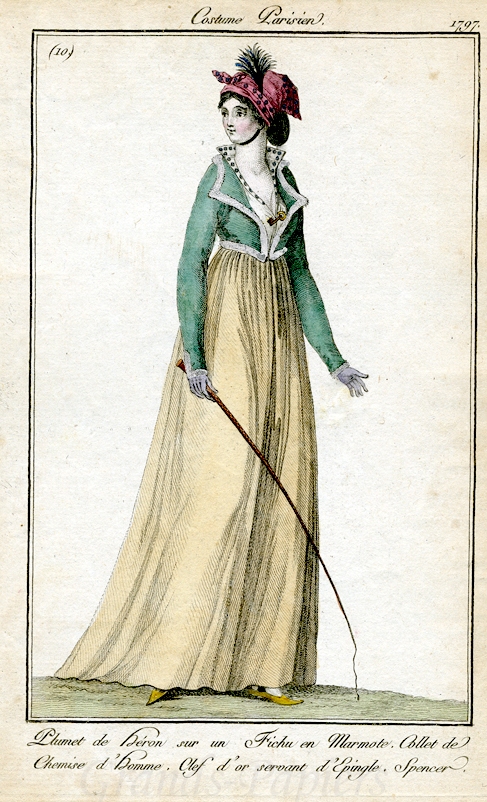
1806 is still later than I wore my Spencer. They’re shown in fashion plates of the 1790s, and here’s a pattern, too: so they’re clearly worn in Europe earlier than 1806. The similarity between the French silk spencer at the Met and fashion plates gives me confidence that they are being made and worn in the 1790s and early years of the 19th century; Spencers are also mentioned in tailoring manuals of this period.

1797, with a similar shape to the Met's French silk spencer.
1797, with a similar shape to the Met’s French silk spencer.

They’re placed in New England with written documentation, but how early are they here? And what did they look like? I know of one in a private collection which I am slavering to see, based on the description of the wool. The MFA has a few that seem to be local to Lexington, and there is one in Maine with a catalog record that shines with passive aggressive crankiness, and delights when compared to another in the same catalog. And no, I’m pretty confident that gentlemen did not wear spencers, or tailed spencers, at any time.

But there’s really good stuff in Sylvia Lewis’s diary for anyone who wants to know more about clothing production, use, and costs in early Federal New England. Even if your Library doesn’t have it, your Librarian can get a copy of the article for you through ILL or you can buy the entire proceedings here.

Animated Nature

LWL-Animated Nature
LWL-Animated Nature

Let’s just have some fun, and enjoy this image. Crush that surge of jealously that you’re not cataloging with “Temporary local subject terms: Dogs — Hats — Kittens — Monkey — Muff — Squirrel.”

I am so going to catalog our carved squirrel, just so I can add squirrels to the subject headings. Look, pages of squirrel subject headings! “Squirrel Bait–Musical Group.” The Library of Congress makes everything so–logical. Safe. Controlled.

Don’t you feel better now?

Caps and Randomness

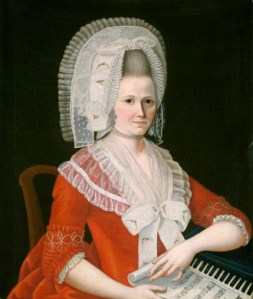
NGA- Lady Wearing a Large White Cap

Sweet cap, right? It all started because it’s cold this morning here in RI and I thought about skating when I went out to get the Times, and that led to Gilbert Stuart, which led to the National Gallery.

They have a fun search option, similar to the Tate Britain’s subject-search, but not quite as elegant.
You can start with a subject search, and then add a sub category. Results (stability not guaranteed) show you things you would not have otherwise expected, and that’s one more reason to love online catalogs & databases.

NGA Screenshot
NGA Screenshot

The results give you little unexpected galleries, and the juxtaposition or similarities of the thumbnails help you see the work differently. Black dresses and white collars are prevalent on this page: why? Is this fashion alone, or are these mourning garments? they’re earlier than the Civil War, but maybe it’s time to re-read This Republic of Suffering.

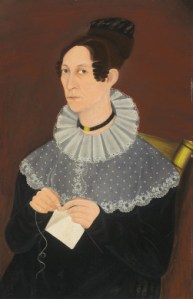
NGA- Sarah Cook Arnold knitting

But wait–who is this? It’s Probably Sarah Cook Arnold, Knitting. (Probably is not her name, smartypants, it’s an adverb.)

She’s knitting in the round, by the way, on three incredibly tiny pins from an invisible ball of yarn, possibly swallowed by the cat hidden in her skirts. (I know a woman who can knit with these skinny quadruple-ought pins, but they are a hazard in my hands.)

I would not have found Sarah Cook Arnold knitting without using the random subject search, nor would I have found Fabulous Cap at the top. Sometimes you need to enjoy the journey as much as the destination.