
Camp Life

The Jolly Landlady in Hyde Park. Paul Sandby, 1780. British Museum 1904,0819.622
The Fair Stationer in Hyde Park, 1780. Outline engraving by Paul Sandby. British Museum 1880,1113.1915

Still wondering what to do in camp that’s not cooking or sewing? Technically, you shouldn’t be cooking if you’re a woman: that was a soldier’s job, though I recall seeing a reference to women cooking when all the men were pulled into the line during an engagement. A card file would help me, but for now, all I have is my scattered memory.

But if you’re tired of mending and making shirts (one of the most boring tasks, I find– all straight seams and very predictable), there’s more to do than laundry.

If the event represents a longer encampment, you could run a traveling coffee house or tavern. There’s the Widow Black in the Mid West, but I haven’t encountered this yet in New England. You could be a Jolly Landlady, or as the British Museum has it,  “a voluptuous lady stands in foreground to left, holding up a glass to a soldier on horseback.”

The Fair Stationer in Hyde Park 1780. Outline etching with watercolor, Paul Sandby. British Museum 1904,0819.576

The Fair Stationer shows us Lloyd’s Coffee House and what looks like a carriage body on blocks, converted to a news stand. You could sell newspapers and writing paper, pamphlets and poem and songs. It’s an impression that would take a lot of thinking and research for the American colonies, but could be very interesting. the transmission of news and information and the transport of mail and packages presented challenges. How were they overcome?

I’m also struck by the number of dogs in Sandby’s images. If it’s not the same dog, over and over, I would guess that in the 18th century as in the 20th, soldiers had pets that traveled with them, both common soldiers with common curs and officers with hunting dogs. The camps must have been disastrously messy, with fatigue details to clean them.  We can’t have dogs at reenactments, but we could have more outraged sergeants. It’s hard, though, because to do these things well, you have to know and trust the people you’re doing them with (and that includes yourself).

“All sorts and conditions of women”

img094

Ever on the track of laundresses and working women, I came upon The Project Gutenberg EBook of The History of Modern Painting, Volume 1 (of 4), by Richard Muther. I was rewarded with  a laundress and a cook holding a spider. Daniel Chodowiecki, a German artist, seems to have been as drawn to the common people as Paul Sandby. The caveat of course is that is he German, so details may not always be correct for American interpretations (pinner aprons, for example).

Still, we have the classic washtub-on-a-table set up, and the laundress is barefoot, which makes very good sense, though my feet hurt just from thinking about standing barefoot on the stubble of the field at Saratoga.

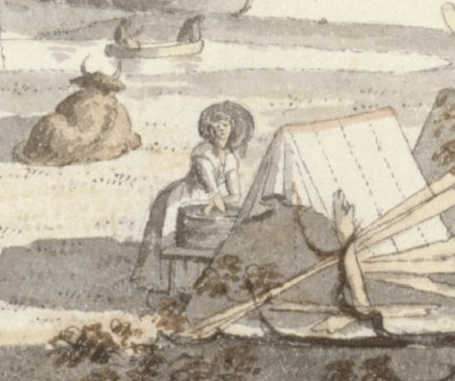
Encampment of the Loyalists at Johnstown, a New Settlement, on the Banks of the River St. Lawrence in Canada, taken June 6th 1784, James Peachey.

Laundresses come with style, too, though I am asking myself, “Is that a fabulous hat, or is your head just in front of some balled-up, sleeping livestock?” Was is discernible is that her hair is down, and she is leaning on the washtub. The tent seams are also clearly visible, and she does have the iconic washtub on a table set up.

Encampment of the Loyalists at Johnstown, a New Settlement, on the Banks of the River St. Lawrence in Canada, taken June 6th 1784. James Peachey

In another detail of the same image, we have a woman who is clearly wearing a black bonnet, tending a kettle on a fire. Here’s yet another piece of evidence for the three sticks-two kettles-no matches set up, and for the tinned kettles being left to get black on the outside.

What is she wearing on her body? There’s a white (or a least white-grounded) kerchief, and what looks like a grey or drab petticoat. But is that a short gown, jacket or bed gown? I’d say jacket, mostly because of the fit, but it’s hard to say at this distance. Whatever word you care to use, she’s wearing a reddish-brown garment fitted to her torso that appears to have a side-back seam.

Once again, tent seams are visible. This tent, just like the one in the other detail, also has some large off-white item thrown over the end. Could it be a blanket, out to air in the sun?

I do also appreciate the short blue jacket/white trousers of the man or boy to the left of the woman, since I know a guy who possesses those clothes and prefers trousers to breeches. He appears to be drinking from a cup as he carries a kettle, presumably of fresh water.

Encampment of the Loyalists at Johnstown, a New Settlement, on the Banks of the River St. Lawrence in Canada, taken June 6th 1784, James Peachey.

The entire view of the Loyalists’ camp is here, with a zoomable image. The drawing is full of details applicable to camp life interpretations, from women’s bonnets to fishing rods.

As I contemplate the troublesome Bridget Mahoney, I find the detail below of a solder and a woman rather pleasing.

Does she solemnly swear she is up to no good?