In more exciting news, there’s a map of the American camp so we’ll know where we’re stumbling to in the dark. (We can’t leave town until about 3:00, when the Young Mr will finally be released from school.)
We’ll be with the Lights, in two of those proposed eight tents, near the oval designated “horses.” With a sketch map in hand, we won’t have to remember Lochee while grappling with mallet and flashlight. Well, not too much, anyway.
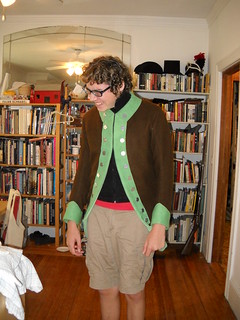
The coat is done, and while I would have had time to make another for the Young Mr, I took a three-day break from sewing instead. The finished size 40 fits him, in any case, so if there is a spare, he can appear in brown and green with the rest of the company. Now that he’s swimming two days aweek, I don’t epxact him to stay a size 40 for long enough to justify his own hand-sewn, two-events-per-year-max coat…yet…
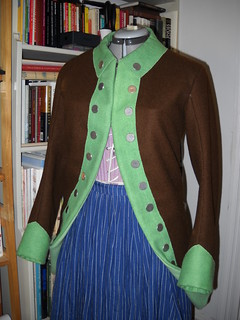
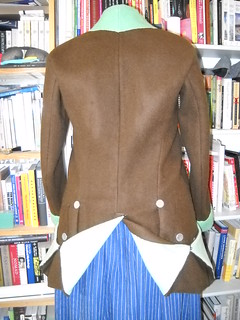
Front view on Cassandra.Back view, over petticoats
That’s right, it’s done, in all its brown and green glory, with not one buttonhole in sight.
I imagine Henry Cooke will tug on it, the same way my grandmother used to tug on my clothes, and find the things I need to fix that I can’t even see until he points them out. But that’s OK– what better way to learn?
You can see the progression on the project here, but there’s no tutorial or instruction manual, just visual notes as I went along. It’s Mr Cooke’s pattern and kit.
I think they’ll be glad of wool coats up at Saratoga, and if I didn’t have a new gown and petticoat, and possibly even stays, to make by October 5, I would think hard about making John Buss’s “red Queman’s pattern jacket” and “striped woolen trowsis” for the Young Mr to wear. With luck, he’ll have a borrowed coat to wear; I doubt a hunting frock will be as warm as he’d like by late September. No one, not even Mr Cooke (and I did ask), knows with certainty what a “Queman’s pattern jacket” is, but it might be a short coat or jacket. What I do know is that visions of a short red coat and grey striped trousers dance in my head, and the list of things I want to make just gets longer.
For now, though, this 1777 10th Massachusetts coatee is done, or nearly done, though on Mr S, I predict center back pleat tweaking.
In 1777, the uniforms of the Continental Army remained largely uncodified and, well, non-uniform. At Ticonderoga, German accounts from the spring of 1777 state that “Few of the officers in General Gates’ army wore uniforms, and those that were worn were evidently of home manufacture and of all colors. For example, brown coats with sea-green facings, white linings, and silver dragons(epaulettes or shoulder knots), and gray coats with yellow buttons and straw facings, where to be seen in plenty.”
Brown coats with sea green facings. There’s one in our regiment, and it is a lovely thing. The Adjutant thought it would be interesting for the troops to turn out in these coats at Saratoga, an event to which the coat can be documented (being soon after Fort Ticonderoga) and an event that will take place on the historic site. So we’re making them, in a project that started Saturday, and here we are: ready to have the lapel width adjusted, because my eye tells me it is too big, and yes, I’m told that it was cut a but wide. So this morning, a lapel trim is in order.
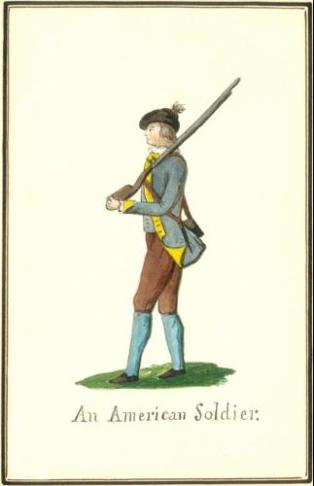
An American Soldier. ca.1852 copy of a ca.1777 watercolor by Hessen-Hanau Captain Friedrich von Germann. Niedersächsisches Staatsarchiv, Wolfenbüttel, Braunschweig
But really, these coats.
Here you can see the style that we’re making, with applied lapels and shanked buttons, simple turn backs on the front skirts, and flat collars. The cuffs are also applied, non-functioning cuffs that come to a point in front. (Also, documented blue stockings!)
These coats will be worn with overalls, waistcoats and shoes, because we know from John Buss’s letters that the regiment was issued overalls and shoes in the summer of 1777. No visible stockings, sadly.
This is the kind of project I can get pretty stoked about, with its combination of aesthetics and documentation. A coat described in a German diary, made in pettable wool broadcloth that will be unlike anything else on the field? Of course I want to help make that vision real.
Imagine a moment on the field, with these documented coats, so unusual (the sea green may have been a faded blue, but sea green is what was seen), worn in a place where they were worn. I don’t need to remind you about the authenticity/commemoration thing, do I? Because it’s pretty clear that’s what’ll happen three weeks from now in New York.
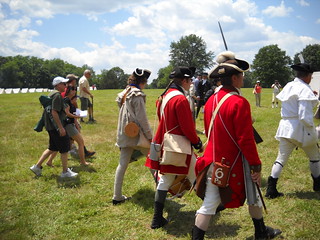
No stanchion here: the public marches with the exhibits
The more I think about issues of authenticity in re-enacting, the more I think about museums. Reenactments can be seen, as scholars have suggested, as “mobile monuments,” part of a culture of memorialization and commemoration of the past. “Recreated” battles, or battles staged on historic sites are not just the tactical weapons demonstrations they’re billed as, but rather ritual performances that commemorate notable events and connect practitioners with the past. They’re almost priests of the past, those men in uniform: they wear special robes, carry special equipment, and engage in practices arcane and exclusive–and denied to most women. (Indeed, the practice of women fielding reminds me of the history of women as deacons and eventually priests and bishops in the Episcopal church, but more about women in this hobby another time.)
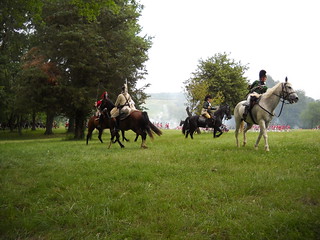
Dragoon battles are highly staged, for safety
That’s just the battles, though they are also museum theatre, vivid, smoky demonstrations of the ways of the past: what about the rest of the event?
Reenactments, with their ranks of tents, kitchens, and varied participants, are in many ways mobile museums that set up at sites and provide “this weekend only!” semi-immersive experiences for visitors. There’s often a gift shop: the sutlers are there, and the site itself may have a shop, and push re-enactment themed items.
Each vignette or camp is like a gallery or object within a museum. Not all appeal to every visitor, some like Rangers, some like Redcoats, some like Rebels.
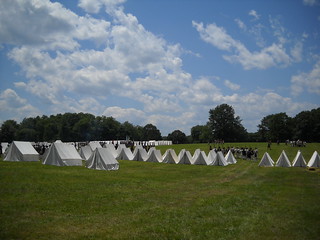
Continental camp at Monmouth
But in a world where museums and libraries are among the most trusted sources of information (online and otherwise), there are repercussions for the “mobile museums” of reenactments. If we accept a museum-like role, and see ourselves as custodians and practitioners of the past, we will need to also accept high(er) standards for material culture and presentation. That does not mean first-person interpretation by everyone at all events and it does not mean carrying actual 18th century goods into the field. That’s not good cultural stewardship.
It does mean doing the same hard work that museums do, researching and presenting oneself and one’s chattel with as much thought and care as possible. Who are you? Why do you have what you have? Where did you get it? Why does it look like that?
It means making one’s clothes and kit and accouterments as near to original as possible. The things we carry into the field, onto the stage of the mobile museum, should not look old. They should look used, but they will lack the patina of 235-year-old objects. They’ll represent the prelapsarian past of the objects, a time before they were painted with latex paint.
Can we, all of us, reach the highest levels of presentation? No. There are as many kinds of reenacting units as there are museums. Some are the Met, and have their owned branded truck. Some are your local historic site. Resources vary.
But just as most museums look to national accrediting organizations like the American Alliance of Museums for information on ethics, standards, and professional development, so too can the reenacting groups look to the umbrella organizations like the Brigade of the American Revolution, the British Brigade, and the Continental Line (the Big Three of 18th century reenacting). The BAR has an inspector, and unit inspection and re-inspection has a function similar to AAM accreditation.
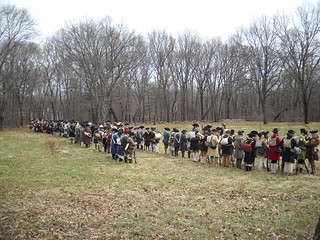
At Battle Road 2013
It’s not easy to become an accredited museum, but each museum that goes through the process learns, improves, and becomes stronger for having gone through the process of self-examination and, often, improvement. They meet standards. And like AAM, umbrella organizations can and do have standards, and the individual units have standards. Those are often online, and as individuals and other units strive to improve their impressions, following others’ well-researched and documented standards helps improve the entire field.
Peer-to-peer learning, public distribution of information, detailed and published standards of appearance, presentation and behavior: these exist, but not systematically, in the reenacting community. The more the Big Three can do to function the way the AAM does, the more I suspect we will see authenticity increase in the field.
Because it does matter: if museums and reenactors are trusted sources of information, we owe it to the public and our pride to create the best representation of the past that we can.



 Kirsten Hammerstrom
You must be logged in to post a comment.