Mansplained in the Museum+

+ Edited to correct typos and to add this link to Sheldon Cohen on Divorce in Providence County, 1749-1809.

I’ve been at a conference the latter half of this week, peering inside the workings of Cambridge and Boston cultural institutions, and most enjoyably, hearing about authenticity and disruption at the Bostonian Society: let’s get this party started!

Except: there I was in the elegantly and intelligently* done “Seat of Power” exhibition in the Council Chamber, pulling the label out from the chair seat to read about a Boston woman shopkeeper in the 18th century when a man had to explain it to me, with a special “feminist” bent that was supposed to, somehow, make this disruption of my visit okay.

I had been telling a young woman next to me, also part of the conference, that I wasn’t sure if this woman was the Boston woman who had been widowed three times and accumulated a great deal of wealth despite the interference of her husbands, and despite the property laws of the time.

The man, not part of the conference, needed to tell me that of course the woman had owned nothing herself, that being the regrettable law of the time, but in balance it was okay, because men were required to care for, and pay for the keep of, their wives and children.

Reader, this is where I made my mistake: I engaged.

“Not always,” I said. “There are certainly examples of divorce and bigamy, and women unable to get their bigamist husbands to pay heir children’s keep.”

“Oh, those were the exceptions. Men were even imprisoned and beaten for not neglecting their families.”

“Except when they advertised that they would not be a responsible for their wife’s debts, and forswore them; we see that in newspapers of the time. So it’s not universal.”

Do you hear the warning klaxon here? Because I surely missed it.

“I’m a history teacher, and I know. You cannot use the extreme exceptions of 1% of the population to justify your absolutist argument. You can’t make statements like that.”

Well, obviously I can: any of us can be as wrong as we care to be, whenever and wherever we like, if our skins are thick enough.

I replied that I thought I was trying to qualify his statement, and nothing more: that he had taken the absolutist position and I was interested in sticking up for the “predominately” and “mostly by not always” corners of history.

It devolved from there until I finally thanked him, told him he’d surely shown me the error of my ways, and I appreciated his comments.

He reemphasized his point that our forefathers had been wrong; I said they’d been right by their lights and in their time, and that it was important to remember that.

His rejoinder was that it was wrong, of course, and women should have rights, etc. etc.

Gentlemen: let me tell you now that this approach will not endear you to the ladies. These are bad pick up lines.

So there it was, mansplained in the museum, by a feminist history teacher.

It’s enough to make me stop talking to people. And best of all: I think he was a reenactor I’ve met before, unable to recognize me because I am a woman, and not a soldier. Also, no bonnet.

May your day be amused by this anecdote, even as I puzzle over it. References to divorce articles later– I am in a cafe before another session.

*thanks to T. S. Eliot for binding these words together in my mind for ever

History is Not a Competition

IMG_1583
Drilling by the Sergeant

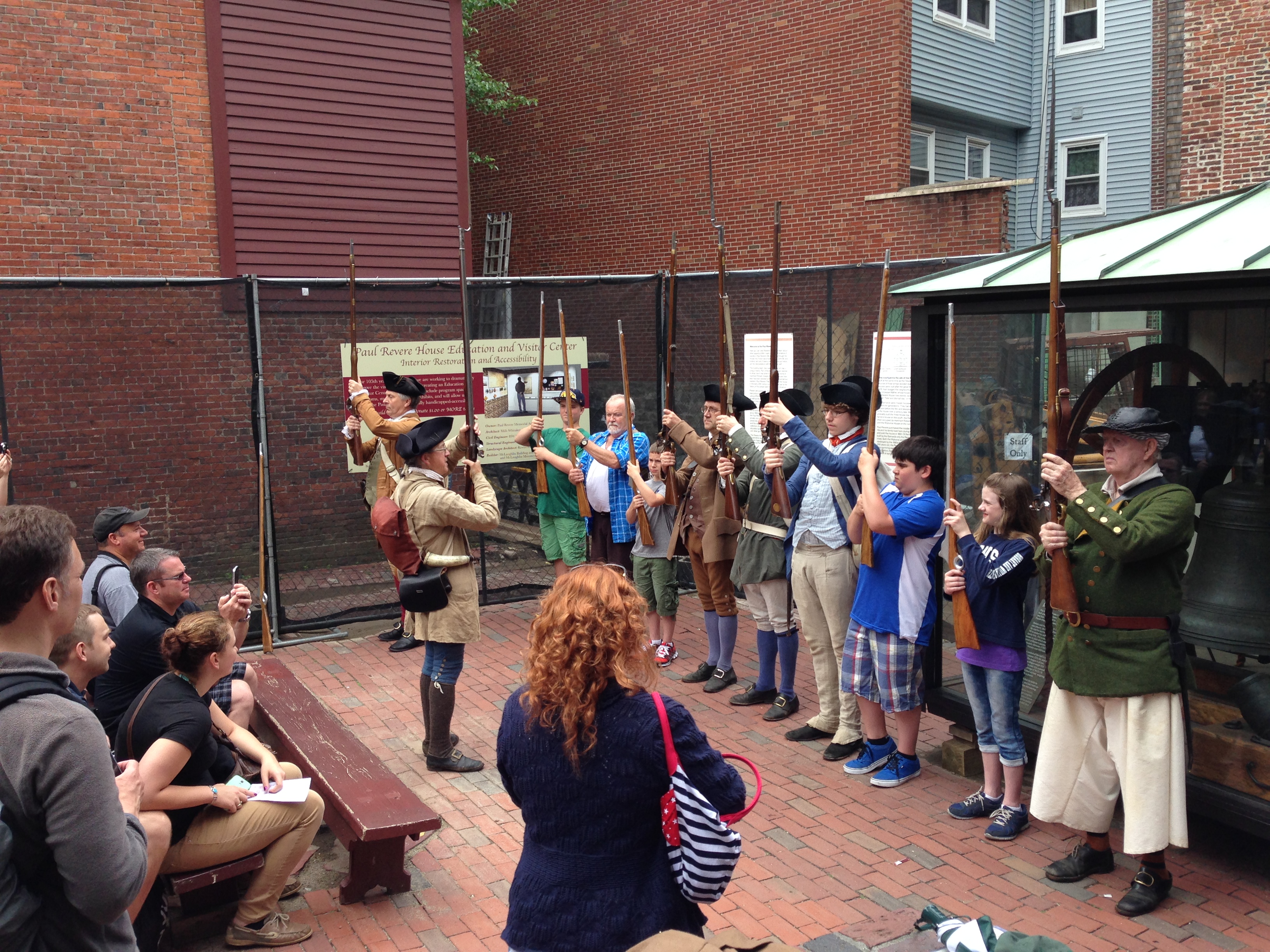
Saturday was my first post-operative foray into costumed interpretation, up to Paul Revere House on Flag Day. This went much better than my first attempt at Paul Revere House, which ended in ignominy as I missed the train. In April, I managed to convince Mr S to drive in Boston, which he usually refuses to do (in fact, he nearly abandoned me once at the Old State House one Saturday after a miserable drive that had us stuck in the Downtown Crossing vortex).

I’m so glad we managed this, Despite anticipatory near-tears and epic pouting by the Young Mr, we managed to have a rather nice time.

Poise, with extra elevation by the Young Mr

We were in the courtyard, and Mr HC and Mr FC told the story of Amasa Soper’s company and its members several times to the streams of tourists. They solicited recruits and ran them through the 1764 drill using the nicest wooden muskets I’ve ever seen, though with mixed results. Some new volunteers held their muskets backwards, and the Young Mr’s ramrod got stuck in the barrel, though that is a known issue with that particular musket.

I sat on my ladder-back chair near the house and made the tiniest hems I could on Mr S’s next shirt, which will be for best. People asked about the sewing and my clothes, and I had a chance to talk about what women wore, typical fabrics and fibres, supplying the army, and who made what.

The day was warm, but fortunately not overwhelming, and as a museum person, I found the crowd quite interesting. This is a facet of Boston I don’t usually see: the tourist experience.

In one memorable moment, a pair of young women stood just outside the door to the house.
Young Woman Number One: “Is this really his house?”
Young Woman Number Two: “Yes, this is where Paul Revere lived.”
YWNO: “Oh, my God! I’m so excited! This is so neat!”
Kitty Calash: <eats heart out with jealousy> “Why can’t my museum do that?”

The celebrity factor of Paul Revere is undeniable. There were tourists with guide sheets in Chinese, and tourists who made me wish I still remembered my college German. Some seemed to be hitting every Boston landmark they could in one day, carrying white cardboard pastry boxes; some seemed to be going more slowly, looking, and trying to figure out what they were seeing, and what it meant.

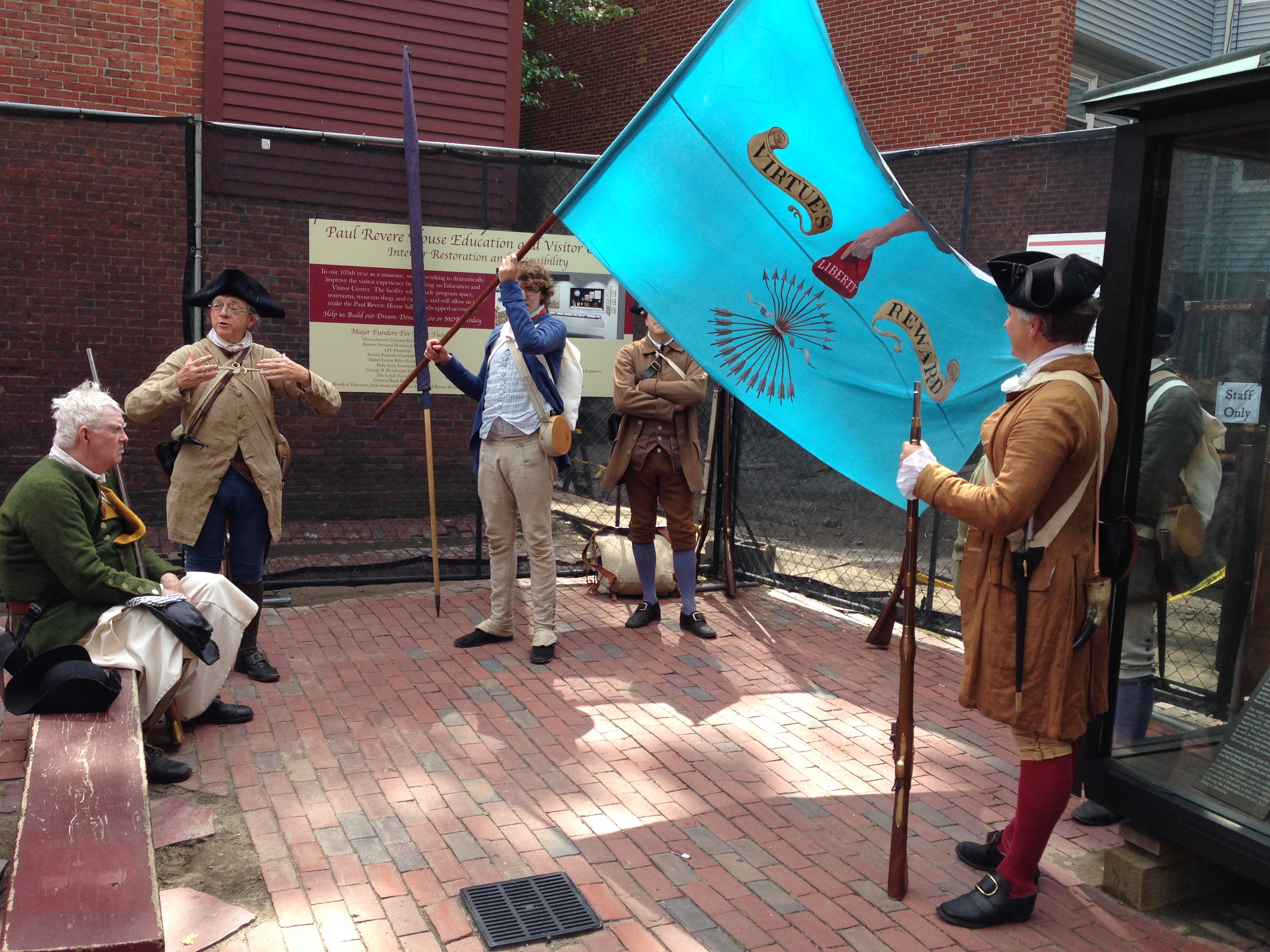
Virtue Rewarded
Virtue Rewarded

What living history means is something I’ve been thinking about lately, or trying to. It’s tangled up with questions of authenticity and appropriateness, but what I learned on Saturday, or re-learned, was how very happy this business makes me. I like history, and historic costume. It doesn’t matter to me if we are talking Revolutionary War or New Republic or Lewis and Clark.

My favorite visitors were a mother and daughter from Steamboat Springs, Colorado, visiting Boston for the first time with a young man from New Hampshire. The mother said, “There’s so much more history here than where we’re from. Our town’s only 100 years old.”

That’s a challenge I’m always ready for, so I asked where they were from. Colorado to me means Native American settlements reaching back a thousand years, Spanish explorers and conquistadors, French, and then American, fur traders. It means hundreds of years of history, and a chance to remind people this isn’t a competition for “oldest” or “mostest.”

Knowing where our country came from is important: so yes, please visit Boston, and Paul Revere House, and Providence and Newport, too! But knowing where you are is just as important. There’s history all around you, and your local historical site, society and museum would love to tell you about it.

Ballet Arthritique

Three men wearing orthopedic apparatus. Etching and engraving by Paul Sandby, 1783. Wellcome Library image L0019751

How was arthritis pain treated in the 18th century? One option was the mustard plaster, which operates on the principle that heat generated by the plaster increases blood flow, which will reduce inflammation. Frankincense supposedly inhibits the production of molecules that cause inflammation and break down cartilage tissue, which leads to joint pain, at least in knees. This level of scientific knowledge wasn’t available to the 18th century physick, but frankincense is an edible aromatic resin with a long history of use in treating ailments including arthritis. At least you (or your breath) would smell good.

The primary ailment treated of was gout, and the remedies above are mostly directed at inflammatory arthritis, the kind where joints grow red and swollen. Think of wealthy, overweight men drinking port with swollen feet propped up on footstools: that’s gout.

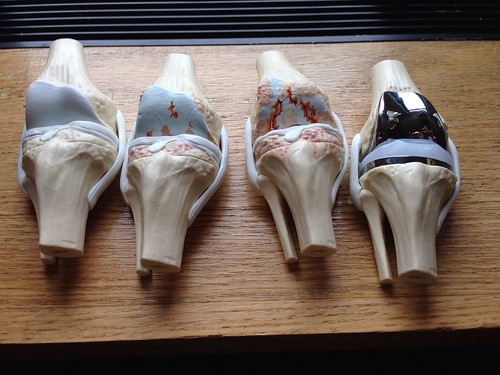
Models showing progressive arthritis in a knee, followed by joint replacement.

Then there’s osteoarthritis, or degenerative joint disease, once included in the catchall and obsolete term, rheumatism. This is a different matter, where changing your diet and icing the joint generally won’t bring much relief. When your cartilage is gone, your bones rub together. Osteophystes or bone spurs form is response to damage or inflammation, and cause both pain and noise.
In the pre-joint replacement era, treating this kind of arthritis was treating chronic pain. (In this era, that’s still the case: absent a TJR or resurfacing, all that’s treated is pain. Once the joint is replaced, there’s nothing left to hurt. It’s a neat little trick.)

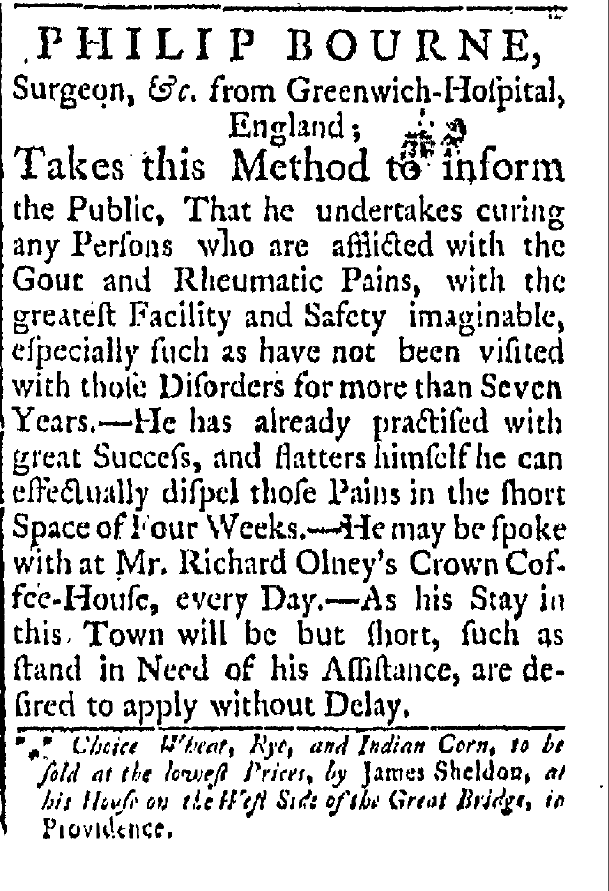
Providence Gazette and Country Journal, June 16, 1764. V II, Issue 87, page 3

In pre-Revolution Boston and Rhode Island, there were various cures advertised promising far more benefit than they were likely to deliver. Phillip Bourne, from Greenwich Hospital in England, promises to “undertake curing any Persons who are afflicted with the Gout and Rheumatic Pains, with the greatest Facility and Safety imaginable.” The caveat about “especially such as have not been visited with those Disorders for more than Seven Years” is particularly nice, since the longer pain persists, the harder it is to treat. He knew his limits, I suppose, if only of his patience, or the amount of time he could safely ‘practice’ in any location.

Boston Gazette, February 14, 1774.

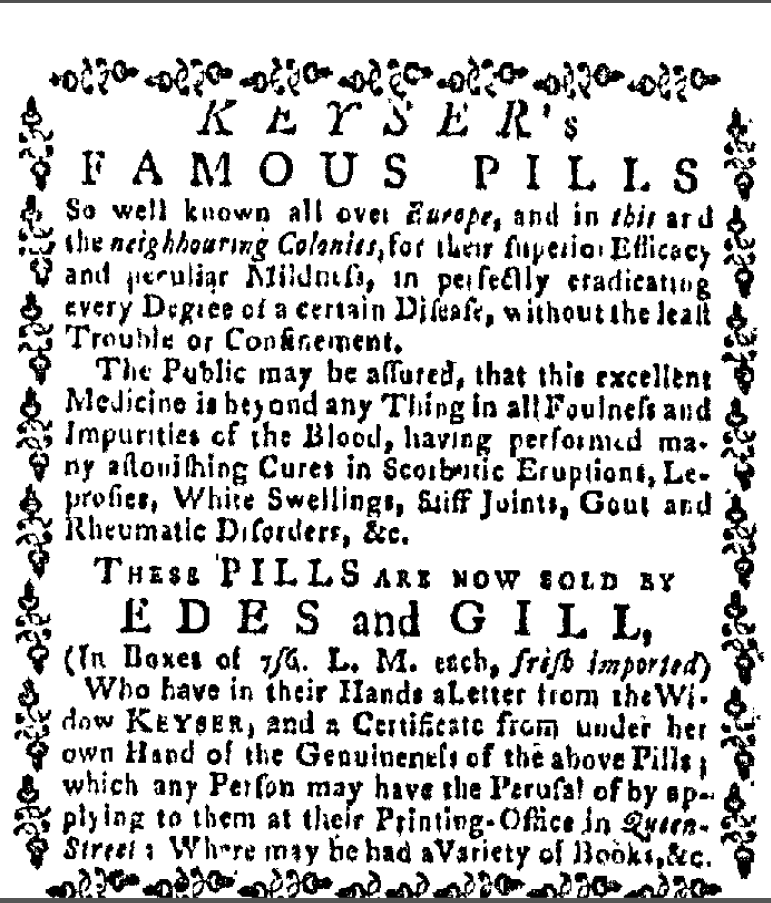
Edes and Gill sold Keyser’s Famous Pills, “So well known all over Europe,” and promising much, like Cures for Scorbutic Eruptions, Leprosies, White Swellings, Stiff Joints, Gout and Rheumatic Disorders, etc.” I don’t know about you, but I think I’d prefer to have my scurvy treatments separate from my arthritis treatments.

Ultimately, the best option was probably a crutch or cane, though braces were devised and are still used, along with crutches and canes. All that prevents their use or efficacy is the vanity of the user.

Book Review: Book of Ages

Book of Ages, by Jill Lepore.

This is a book about reading and writing as much as it is a book about Jane Franklin, Benjamin Franklin’s little sister. Book of Ages has been reviewed elsewhere, and Lepore wrote a really lovely piece in the New Yorker called The Prodigal Daughter that is unfortunately behind a subscription firewall, but which I have read on actual paper. If you can get hold of it, I do recommend reading it before you read Book of Ages. It makes the book all the more poignant to know something about Lepore’s process.

This is, in many ways, another book about mud and misery (see the best bits of Longbourn). Because Jane Franklin Mecom (her married name– she married at 15) left behind so little, Lepore builds much of her story out of the context of Boston and New England in the mid-18th century.

It’s not exhaustive in its detail, and that’s fine: the book is an easy, comfortable read that still provides well-researched information about the lives of women in the 18th century. I finished it over a week ago, but details still remain (and that is a testament to Lepore– these could have been supplanted in my mind by details of exterior water meters, skunk removal techniques, or indexes for early vital records). Among the details I recall: Funerary and mourning customs, from published sermons to the distribution of mourning gloves and rings; soap making and trades practiced by small holders in home workshops; Jane Franklin Mecom’s wartime flight to Rhode Island; the power and practice of extended family networks.

It also reminded me of the differences in educational methods or standards for boys and girls, which helps remind us all of the importance and significance of the ideal of free public education for all. (We had some early proponents here in Rhode Island.) What might Jane Franklin’s life have been like in other circumstances? Honestly, even if she’d been well-off and well-educated, as as woman in the 18th century, she would never have had the same chances as her brother, no matter how evenly their intellects might have been matched.

If anything, that’s reason alone to read Lepore’s book, to celebrate the life of a woman who was both ordinary and extraordinary, and to recognize how much closer to all the anonymous, disappeared women of the past we can get through this example.