
Bonnet, found

Readers may recall that I have a bonnet problem. It’s a problem I think can only be solved by more bonnets!
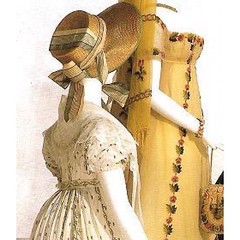
I’ve long admired and coveted the bonnet shown left in the Kyoto Costume Institute.

Well, see this bonnet? It’s called an 1812 Sun Bonnet over at HistoryHats.com. It is based on the KCI bonnet.

It is also similar to this ca. 1810 bonnet sold by Meg Andrews.

I’ll be spending time out in the sun in September, dressed for 1799. Black silk bonnet, yes, but, it could be hot and not so shady. Big plate of a straw hat? I guess so, but it’s a little too big for 1799. Straw bonnet? I wish….

But wait! Trapped on Amtrak, scrolling through Dames a la Mode,  what do I find? This! Check out that bonnet on the woman seated at right.

(Click through for larger version.) Similar cut out at the back of the neck to both the 1812 sunbonnet and the KCI bonnet. Interestingly, the woman in the straw ‘sun bonnet’ is wearing a dress with sleeves like those found on a chemise a la reine. She can’t be less fashionable than her companions, can she? How can that be in a fashion plate? I think this speaks to the persistence of fashion details longer than we might otherwise credit them. It only makes documentation trickier– or more fun, depending on who you are.

It’s 1794. By 1799, that bonnet might very well have made its way to Providence. We know girls and women were dismayed by the Jeffersonian embargoes, and driven to make their own straw hats in Providence. That means they had them, they’d seen them, and they’d seen fashion plates before the 1807 embargo.

Yes, I need a broadside or a newspaper ad to clinch the deal, but there’s an extant hat, a fashion plate in English, and I know by the early 1800s women are weaving straw for hats in Providence.

I think I might be able to have that hat after all…but I still have to finish that shirt I started for Mr. S. It simply will not sew itself!
Put a Lid on It!

Yes, I have a bonnet problem.

I don’t know how I find all the sites and blogs I find, but I came across another interesting one today while waiting for data to load: An American Seamstress, finishing a waistcoat and struggling with a bonnet.

Have I fought with bonnets! I love bonnets, and I come by this honestly: my grandmother had a shoes thing and a hat thing, and the hat thing came with “hat face,” a particularly foxy-grandma face she make when trying on hats. So while I thought I ought to write about tent research, or the cool ad I found for a shop in Newport selling dry goods and haberdashery, now I think the heck with all that. Bonnets!

Here’s what I’ve learned, and what I’ve used. (for all images, click for a larger version)

Buckram. What they sell at Jo-Ann’s is not what you want. It is too thin to be much use unless you glue it to chip board (today’s equivalent of paste board). For more on chip board, see Kannik’s Korner on bonnets. I buy mine at Utrecht because  they’re in town. Dick Blick has it, buy the single ply.

Better buckram. I ordered a kit from Timely Tresses just to get my hands on a proven pattern and real millinery supplies. They’re hard to find in real life, and ordering online when you can’t touch stuff is hard. I did find some very sturdy buckram locally at Ryco, a mill store selling quilting fabrics, and lots of other stuff.

Millinery wire. Accept no substitutes in wire. Just trust me. I have successfully used cane originally purchased for stays. I had left overs, it curves, it worked when stitched to buckram.

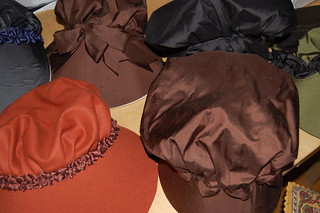
Silk. The difference between taffeta and dupioni is visible and tangible (dupioni left, taffeta right). Use taffeta. I don’t always, and I still like my dupioni bonnet but most of why it works is its size and the fact that my impression is middling-trending-lower. (And saucy. I sometimes think a raised eyebrow and a loud handkerchief can make up for a lot, especially crooked petticoat hems.) But the runaway ads include stuff (wool) and linen bonnets, so read them closely for ideas.

Make a muslin first: we all know, it applies here, too. For cauls, bigger is usually better for the 18th century. For some of the bonnets, I use the lighter weight buckram to sew an insert between the caul and the lining to keep the crown more erect and poufy. At the end of the day, you might deflate, but why should your fabulous bonnet?

Trim it up. I often use strips of self fabric folded over and looped to make “bows,” because that’s how the Williamsburg bonnet looks to me. I’ve also used ribbon, so this: use silk. Less silk is better than more poly, really really, it will handle and feel and look better, and so will you. I use Burnley & Trowbridge  and Wm Booth Draper silk ribbons, and bought some from a sutler who sold herbs and hand-dyed silk ribbon.

My next bonnet will be a black silk lined with red with the red-hand dyed silk ribbon trim, based on a runaway ad. Will it be done by OSV? Probably not, but once you have it down, a nice hand-sewn bonnet is about a day’s work.