The Ladies Magazine, v/ 4, plate 53, Wednesday July 1, 1812. Casey Fashion Plate Collection, LA Public Library
I don’t know which I like best: the green and white bonnet, the green silk Spencer, or the suspicious and candid glance of the woman on the left. Perhaps its the date: mere weeks before the purported milliner’s store this coming August. Have I already purchased green silk and white cotton organza? Of course I have. Never let a fashion plate or an event keep you from a new and slightly mad project to make something new.
For this challenge, I initially thought I’d be working on the compere fronts for a silk sacque, but then I took another look at the calendar and realized March was awfully close! Instead, I opted to spend the past week working to better understand the Quakers, especially Quakers in Rhode Island, in advance of a program in early March. (I did do #1, Make Do and Mend, but do you need to know about re-stitching a petticoat binding?)
‘Quaker’ bonnet
To help get myself out of a sewing rut and panic, and a general malaise, I made a bonnet. A ‘Quaker’ bonnet. Bonnets are like cupcakes: delicious, sugary, but lower in calories and committment than a full garment.
Quaker bonnet ca. 1800, Nantucket Historical Association, 1928.54.7
Quaker women in the late 18th and early 19th century did not, as far as I can tell, wear the black ‘sugar scoop’ bonnet we now associate with Quakers.
There are numerous entries in Amelia Gummere about bonnets, and types of bonnets, and the reflection of particular sects of Quakers in the pleating of the bonnet caul. But early in the 19th century, at the dawn of the Age of Bonnets, Quaker and non-Quaker styles seem to have been closer.
Fashion Plate: Promenade Dresses, 1801. Museum of London. 2002.139/1397#sthash.YsOpwKG2.dpuf
The fashion plate from the Museum of London presented a style that I thought I could approximate, and that made sense to me for 1800-1810ish, but I chose an olive green silk (actually yellow and black sort-of-changeable taffeta) because I have seen Quaker bonnets in olives and tans, especially earlier bonnets. Going with a color that was less distinctive, and a form that was undecorated, seemed to me to strike the best balance between plainness and style in this time period.
I chose this for innovation because the new bonnet forms of the early 19th century are departures from the full, round, pudding-on-the-head styles of the late 18th century, and the Quakers took it a bit further. In standardizing the appearance of their bonnets (simple, unadorned, eventually ossified in form and signaling sect in pleat patterns), the Quakers were innovators in clothing as outward symbol and sign of inner faith and affiliation.
There’s your rationalization, how about some facts?
The Challenge: HSF # 2,Innovation
Fabric: Sort-of-changeable black and yellow silk taffeta in olive green for the body and ribbons, white linen for the caul lining and brim interlining, white poly taffeta for the brim lining, and pasteboard for the brim.
Notions: Thread, PVA (acid-free white glue for book binding)
How historically accurate is it? Well, white poly taffeta aside, pretty accurate. All hand-stitched and assembled in a period method. Gentlewomen can disagree about accuracy of style, but we could call this a plain bonnet ca. 1803 and be safe. After March, I can decorate the bonnet. The poly will remain, so, well, 60%? (How many points from Gryffindor for using the right weave in the wrong fiber?)
Hours to complete: Five, perhaps? These are quick, so five would be from start to finish, not including agonizing in advance.
Mr S’s day took a bit of turn.
First worn: First by Mr S, who wasn’t feeling well, but to be carried along by me on March 7.
Total cost: All supplies came from the Strategic Fabric Reserve and chip board depot. It takes so little of anything to make a bonnet…maybe $2.50 in silk, $3.00 in linen, .50 in chipboard, so $6.00? (The silk came from the remnant table at $10/yard, chipboard is $2.00 a sheet, and linen about $12/yard.)
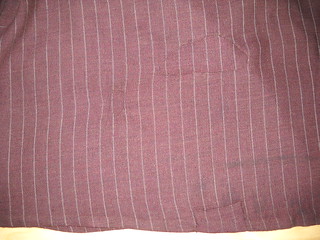
I managed to mend my dress this weekend, motivated primarily by its odor and the desire to hang it up for an airing. The holes at the hem were such that the patch had to be applied over the fabric and not behind. It tends to wiggle, but the mends are done and the dress is hung up to “air,” which means it is “in the drafty front hall trying to make my coats smell like wood smoke, tallow, and animal secretions.”
I told you my feet were big.
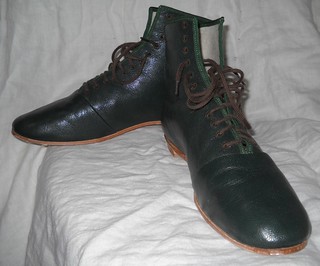
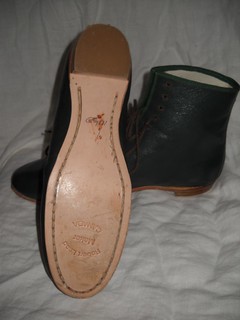
The Robert Land shoes arrived on Saturday, along with a heavy box of wool. That’s tucked away for now (trousers and overalls come first, oh my) but not the boots. Ignore the size marked on the sole–that’s a vanity size–but note the smears. I believe that for the shoemaker, as for so many of us, the historic item is not done until you have bled upon it.
I should note here that the shoes really make ones feet look like the feet of women in fashion plates. Those trippy little poses with dainty toes are achievable in these, and the minute I find someone to photograph that, I will. It’s a very different foot experience from 18th century buckle shoes.
It’s not done until you’ve bled on it.
In a mark of solidarity, I bled on the ribbon that’s going on my new bonnet. I spent Saturday making, and unmaking, a remaking, a late 1810s bonnet. I’m still not quite satisfied with the shape, but have the silks and ribbons ready for when I convince myself to go ahead and stitch it up. Sunday I made a late 18th century/early 19th century bonnet. After bleeding on the trim, I finally had the sense to stop.
When all else fails, sew! The Harvest Fair at Coggeshall Farm Museum approaches and quite aside from the real work that’s gone into a quilting frame, and buttons on breeches, it’s been an excuse for a new bonnet.
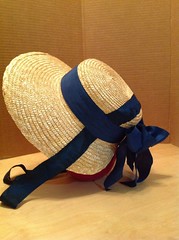
A few weeks ago, I found the modern, not-as-fine bonnet based on the KCI bonnet, and similar to one sold by Meg Andrews.
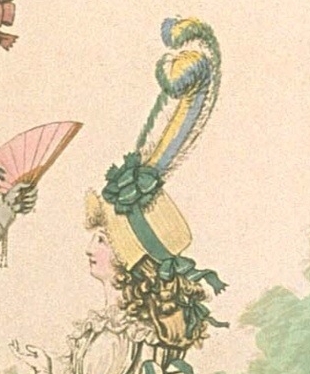
In a 1794 fashion plate, there is a similar bonnet with blue ribbons and an enormous feather. I don’t rate a feather as John Brown’s maid, or the Continental Army veteran’s wife, but blue ribbons seemed OK. Plus, I had them already.
The bows and the band and the strap don’t match, and my dress isn’t blue, but I think that’s all fine. The most I can say is that I’ve found two extant examples of this bonnet, and the fashion plate, which predates the farm’s interpretive year.
As a striving resident of Providence, Rhode Island’s busy port city, I’d have access to more goods than a Greenville woman. Bristol (where the farm is located) was also a thriving port, and again, boats from Rhode Island are sailing around the world bringing back china, silks, teas, spices, shawls and other goods, as early as 1787.
Now, pass me a boilermaker, please, because I’ll need a drink when the mechanical contractor tells me what the boilermaker will charge for a new Library boiler.
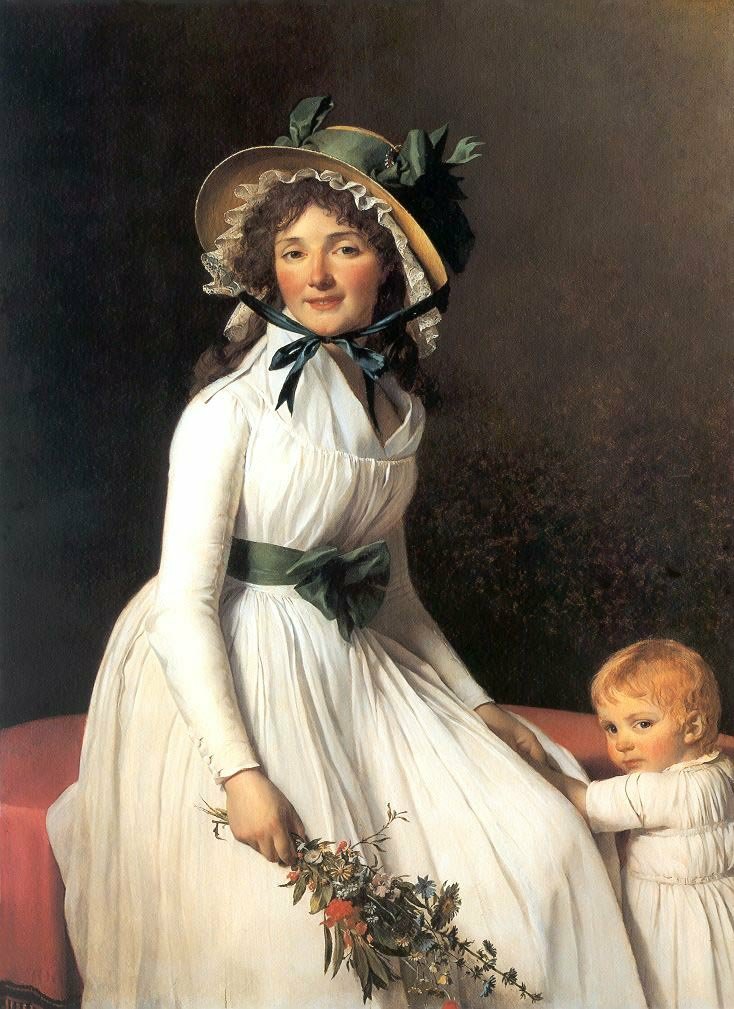
ETA: Aaand there’s this painting, Mme Seriziat, by David, 1795. Click for larger version, but she’s the reasoning behind the choice of blue ribbon. The placement seemed to agree with the KCI and fashion plate ribbons, and joy! the color was in my ribbon box. I tried to get my ribbon to do what her ribbon is doing, but the bows and loops looked like sad blue silk dog ears– not so nice. So I switched them around to the back, based on the other images.




 Kirsten Hammerstrom
You must be logged in to post a comment.