Frivolous Friday: Flip your Lid

Print. Drypoint by John Theodore Heins, Jr. 1747-1771. British Museum 1858,0417.362
Drypoint by John Theodore Heins, Jr. British Museum 1858,0417.362

Bonnets. Who doesn’t like them? They’re the cupcake of costuming, just enough sugar to be delicious, not enough trouble to count. I know I have far too many, they fall from the hall shelf nearly every time I get my coat.

But I started asking myself questions about bonnets when a friend asked me questions about bonnets: shape, color, and how they’re worn (rakish angle? pulled down low?).

We’re planning on going to an event in March, and I’ve been thinking about head wear, especially bonnets. Now that the question’s been asked, I don’t want to randomly cram black silk taffeta on my head and call it a day: I’m back to “don’t know mind.” Time to start looking. So far, I’ve searched the Tate, the British Museum, the National Portrait Gallery UK, the Lewis Walpole Library, the Yale Center for British Art, the Met,  the V&A, and the BBC’s Your Paintings site.

I started at the British Museum. Here are the results for a collections search using the term bonnet and the production dates 1765-1772.  Hmm. No classic black bonnet. Dammit, actually, because I really like mine.

Print made by James Caldwall, A Ladies Maid Purchasing a Leek, 1772, Line engraving and etching Yale Center for British Art, Paul Mellon Collection. B1977.14.11105
James Caldwall, A Ladies Maid Purchasing a Leek, 1772, YCBA, B1977.14.11105

Yale Center for British Art, same search parameters. I know you know this print.

Man, this is a pain, right? Where are the bonnets? 1772 is actually too late for my purposes in this instance.

The Lewis Walpole Library Digital Collections lack a feature for limiting or sorting by date, but they tag bonnets in their prints. Still: no big black bonnets in early prints.

I’m starting to think it’s lampshade or saucer for the 1765-1770 period. You remember lampshade, don’t you? One of my post-operative slightly narcotized creations based in part on the Marquis of Granby (Relieving a Sick Soldier).

The Marquis of Granby (Relieving A Sick Soldier) Oil on canvas by Edward Penny after 1765 (c) Royal Academy of Arts
The Marquis of Granby (Relieving A Sick Soldier) Oil on canvas by Edward Penny after 1765 (c) Royal Academy of Arts

Lampshade seems pretty fashionable in 1760. There are more portraits at the National Portrait Gallery (UK), but bonnets are scarce in them, primarily, I suppose, because they are not indoor wear.

Lady Fenoulhet is wearing a lampshade. Nelly O’Brien is wearing an interesting, more hat-like device. Her imprint is ca. 1765-1780, but other impressions are dated ca. 1760. The 1762-1764 seems plausible. But that’s still early for my purposes. The lampshade really is, too; Mrs Mary Smith of Portsmouth may be wearing one, but considering that the artist who drew this plate died in 1766, I think we can place this form in the 1750s to early 1760s. Lampshade is too early. The”Lady’s Maid buying a Leek” is too late.

Next, please.

Frivolous Friday: Silken Cone of Shame

La famille Anglaise à Paris.Plate 11 to 'London und Paris', x, 1802 [1803]. Explanatory text, pp. 90-5. Copy of No. 11 in 'Le Suprême Bon Ton' series, see BMSat 9957. An English John Bull stands stolidly full face with clasped hands, a grown daughter on his right arm, his wife on his left arm. With them are two tiny little girls and a grown-up son, also stolid. A Frenchman and a lady attitudinize elegantly on the left. 1802 Hand-coloured etching. British Museum  1856,0712.605
La famille Anglaise à Paris.Plate 11 to ‘London und Paris’, x, 1802 [1803]. Explanatory text, pp. 90-5. Copy of No. 11 in ‘Le Suprême Bon Ton’ series, see BMSat 9957. An English John Bull stands stolidly full face with clasped hands, a grown daughter on his right arm, his wife on his left arm. With them are two tiny little girls and a grown-up son, also stolid. A Frenchman and a lady attitudinize elegantly on the left. 1802 Hand-coloured etching. British Museum 1856,0712.605

Mr JS and I have amused ourselves of late not just with thimble chatter, but with this satirical print of the English family in Paris.

I’m not nearly as funny as Mr JS, who pointed out that the bonneted girl on the far right is “I literally can’t even right now.” I think of her as Lisa Simpson, 1803. That’s the voice I hear reading the line texted to me: “I just want to pull this chemise dress over my head and die. Could someone with yellow fever cough on me?”

The father is Homeresque in his proportions, and nearly as befuddled. The artist is clearly mocking this poor family, contrasted with the graceful Parisians at left, but only the two youngest are aware, hiding in their cones of shame.

That deep coal-scuttle-like bonnet is mocked in other engravings; it is probably closer to the actual form of Julia Bowen’s cold scoop of 1799 than my approximation this fall. Julia would surely have known the shaming purposes of those grandiose and over-sized calashes: “Go sit in your calash and think about what you’ve done!” Mr JS quipped.

Appropriately enough, the silk I ordered to make my own calash of shame has arrived at the post office. Dark green taffeta envy lined with the bright magenta of embarrassment: clothes are so emotional.

Half Robe or Jacket: How Do You Wear One?

Half robe, 1790-1800. National Trust Inventory Number 1348749,
Half robe, 1790-1800.
National Trust Inventory Number 1348749,

What Cheer Day is coming, and I hate to miss an opportunity to make a new gown (despite having just made one, and despite needing to make some waistcoats and trousers for the event). While I lay awake last night, I pondered my options, and whether a half gown would be suitable.

Although I have concluded it probably is not, I was curious about how these should be worn. Where can you wear such a garment? Is it only suitable for at-home use?

This is the robe from Nancy Bradfield’s Costume in Detail, replicated by Koshka the Cat here, and approximately by me, here.

Since I will be a housekeeper again, I think a gown is more correct for me, but that doesn’t stop me thinking about half robes, and whilst scrolling images by year at the Yale Center for British Art, I found this by Cruikshank:

ladies in a lending library
Isaac Cruikshank, 1756–1810, British, The Lending Library, between 1800 and 1811, Watercolor, black ink and brown ink on medium, lightly textured, beige wove paper, Yale Center for British Art, Paul Mellon Collection

There’s a lot to love in this image, even with its fuzzy “between 1800 and 1811” date. Not only do we get an array of reading material (Novels, Romance, Sermons, Tales, Voyages & Travels, Plays), we get costume tips and– special bonus– a dog gnawing its leg.

(If you are curious about some of the books in the Library at the John Brown House, check out this tumblr bibliography. I’ve been using it of late, and the representative genres are quite similar to what we see in the Cruikshank.)

We also get a chemisette on the lady at the counter, along with a very dashing hat, a fancy tiered necklace on the lady in pink, who also carries a green…umbrella? Parasol? With just a veil, that seems likelier than the longest reticule ever.

I like our Lady in a Half-Robe and her deep-brimmed bonnet showing curls at her brow. She and her companions show the range of white and not-white clothing seen in early 19th century fashion plates, and the range of head wear, too.

Undress for August, 1799. Museum of London

The last question I’m asking myself, though, is whether the yellow garment is a half-robe or a short pelisse or a jacket. And can you wear a half robe out of doors? And what did the ladies of the period call that garment?

In this fashion plate (featured by Bradfield on page 84, found by me at the Museum of London), the lady on the right is certainly wearing a short upper body garment, and I’d wager that she’s out of doors or headed that way, since she’s carrying a (green) parasol. Bradfield calls her garment a “jacket,” and until I can find the text of the Ladies’ Monthly Museum for August 1799, perhaps that is the term we should use instead.

While two images aren’t a lot of evidence, it does appear possible to wear a half-robe or jacket out of doors for informal visits in clement weather, and finding two is as good a reason as any to look for more.

The Milliners’ Shop

One of the Milliners Stands in the Doorway

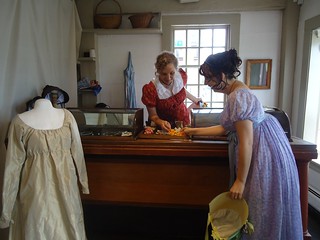
On Saturday last, Sew 18th Century and I set up a milliners’ shop for the Salem Maritime Festival. This was a fun event made even better by the opportunity to set up shop in an actual shop!

We started working on this project in the Spring, and kept working on it almost until it was time to pack for the trip.

Some of our goods, with the delightful Miss A

Milliners carried a wide range of goods designed to entice customers into the shop where they might purchase a new trim, ribbon or sash while admiring newer bonnet styles or fresh yard goods. Even in the 18th and 19th century, retailers new the value of repeat customers and impulse purchasing.

DSC_0238

Customers of all kinds came to our shop, some for retail trade, and some for wholesale. Mr JS is a weaver, and has offered plain and check linens by subscription– and I think our shop can do well referring custom to him. He was far more genteel than the sailors who came in– three times they visited, offering us money, but not for our bonnets!

Fresh from a privateer, Mr G and his crew mate stomped up the steps and made several untoward propositions, even daring to shake a bag of coin! Later they tried to entice a studious apprentice to join them, but fortunately he is a dutiful and serious lad with a thought for his future, and he declined their offer. At last Mr S was forced to confront these sailors on the waterfront– I think we shall soon require a committee of safety to patrol our streets and regulate the ruffians.

Mrs B examines some of our trims

Other customers shopped for trims and accessories. Mrs B is always fashionable, and one of our best customers. She sets a standard for refinement and style in our town that few can match.

cropped_Matt

Her husband is an officer in the Navy, and I fear sometimes he is startled by the bills– though he always pays, I think he may be surprised to see how fashionable we have become in Salem.

The bandbox maker, Ms M, set up in our shop as well. I do highly recommend her boxes as the finest made and best decorated that can be had. Bonnets and hats do not come cheap, and you do well to protect them.

In the late morning, I paid a call to Mrs B, and took tea. The coffee jelly was exquisite, molded in the shape of fish– very clever indeed– with marzipan fish and a rice pudding. It was a delight to all the senses, though sadly I had to hurry back to the shop. It is a great responsibility to keep a shop.

Shop window at the West India Goods Store

Thank you so much for visiting and for trading with us! Do come back soon, as we are certain to have new goods of interest to delight you.