I came, I saw, I sighed

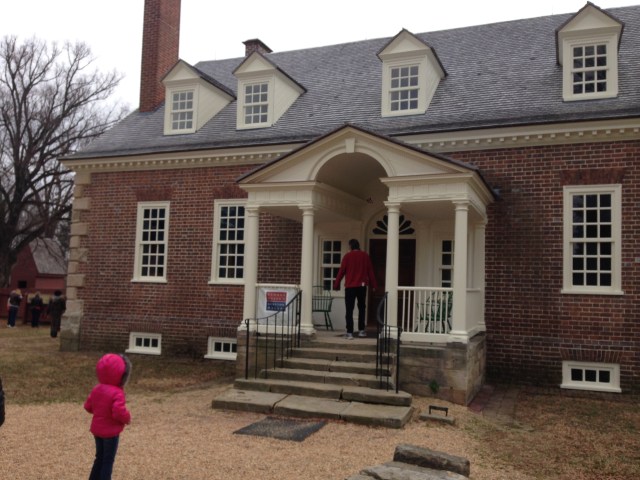
img_8909

Gunston Hall has been on my list of must-visit places for some time, and now I can cross it off my list. I was impressed by their Room Use Study and remain so. They’ve also done some decent work on slavery, and it shows on their website. So my hopes were high. You know where this is going, right? Yup.

The room in which Martha Washington and Mrs Mason may have had a "chit-chat" about the two Georges.
The room in which Martha Washington and Mrs Mason may have had a “chit-chat” about the two Georges.

Pretty sure the guided tour is dead. Also pretty sure most museums need to look long and hard at the actual execution of their mission. Granted, this was another one of those January R&R visits, when it is entirely likely that the multiple “Out of Order” signs were a mere mid-winter fluke. But day-um, I was underwhelmed.

Granted, this house is older than “mine.” And smaller. And I didn’t ask any questions on the tour because I fear my tone will be far too telling. But there was a small, excited-in-a-good-way child on the tour, and several other adults. When asked by the docent what we were interested in, the group settled on “life.”

WHO touched that railing?
WHO touched that railing? THAT’S why I should care?

We ended up with the incantation of “many famous people have sat in this room.” “Many famous people have touched this stair rail.” I might have heard an audible intake of breath when we were told something was original; my right eyebrow shot up in an expression well known to my friends.

The house is lovely, of course, Georgian balance and all that, and nicely decorated, whether the chinoiserie paper in the dining chamber or the Virginia-Chesapeake Neat and Plain office. But why the default emphasis is on famous people touched this, stepped here, slept here, I do not know. My docents do it, too, sometimes. But what troubles me more is what I came away without: A sense of George Mason and his family.
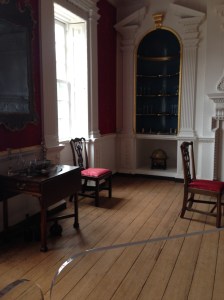
Red damask on the walls, because "they could have had it." Infelicitous phrasing.
Red damask on the walls, because “they could have had it.” Infelicitous phrasing.

Most troubling to me, being Of a Certain Age, was the statement that Mason’s second marriage, to Sarah Brent, was “for friendship and companionship.”

Really?

George and Sarah sign a marriage agreement several days before they are wed, protecting in a limited way Sarah’s individual property. Under the terms of this contract, Sarah gives ownership of her slaves to her husband for the length of her marriage, but regains possession of them should her husband die and there be no offspring between them. Under these same conditions, Sarah is promised as dower 400 acres of her husband’s land at Dogues Neck.

Over the years, it has been pointed out that the marriage agreement between Sarah and George indicates that their relationship was more business-like and convenient, rather than loving. However, the marriage compact also can be seen as a fair solution between two practical people who want to safeguard their property for future generations — Mason for his children and Sarah for the sons and daughters of her sister Jean in Dumfries. In Sarah’s will of 1794, she indeed does pass on to these children and one of their offspring the slaves she regains upon the death of her husband.

Really?

That looks to me like a sensible arrangement between two mature adults. The way that a 50-year-old approaches marriage and relationships in any century will be different. Even in the 18th century, a woman of 50 has an established identity, knowledge of the world, and experience in running a household, if not a business.

Why yes, I may well have some baggage, why do you ask?
Why yes, I do have some baggage, why do you ask?

To suggest that sensibility excludes or precludes sex is to miss the point of Jane Austen completely, and is ageist in the absence of evidence. In all likelihood, Sarah is peri-menopausal at least and menopausal at most (it varies widely; some 50-year-old women are still fertile, shocking though that may seem). That doesn’t mean she’s asexual, and while George Mason may well have (probably did) take sexual advantage of the women he owned, that doesn’t mean he’s not interested in, and expecting, a sexual relationship with his second wife.

What all of this suggests to me is a reluctance in museums to talk about sex, unless there are children from a marriage, in which case one can just assume the couple were busy in bed and not actually address it…all in all, a weird thing, and one that turns up in my own museum from time to time.

This is not to suggest that I didn’t enjoy the tour, the house, or the landscape. But I felt dissatisfied, as if the real meat of the place was not to be found on the tour. Exploring the upstairs on our own was much more fun– I would have liked some object labels up there, and downstairs, too– and had more of an air of exploration and discovery.

And that’s what the guided tour kills: discovering for yourself. It doesn’t have to be a full-blown you-paid-for-it Museum Hack bonding experience. It doesn’t need to be a handout with “How many squirrels can you find?”
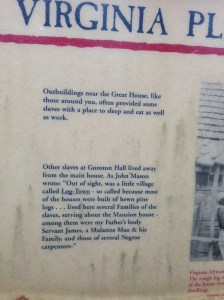
img_8950

Exploring, reading labels, listening, smelling, touching: using our senses to learn about a place, a space, an object, a person, will be engaging enough.

With so much good, deep, content on the website, I know Gunston Hall has the material a great tour and historic house museum is made of. I know, from reading the labels about slavery at the site and reading the text about slavery on the web, that they know more, do more, and understand more about the enslaved people than their permanent exhibitions indicate.
Occupy Princeton

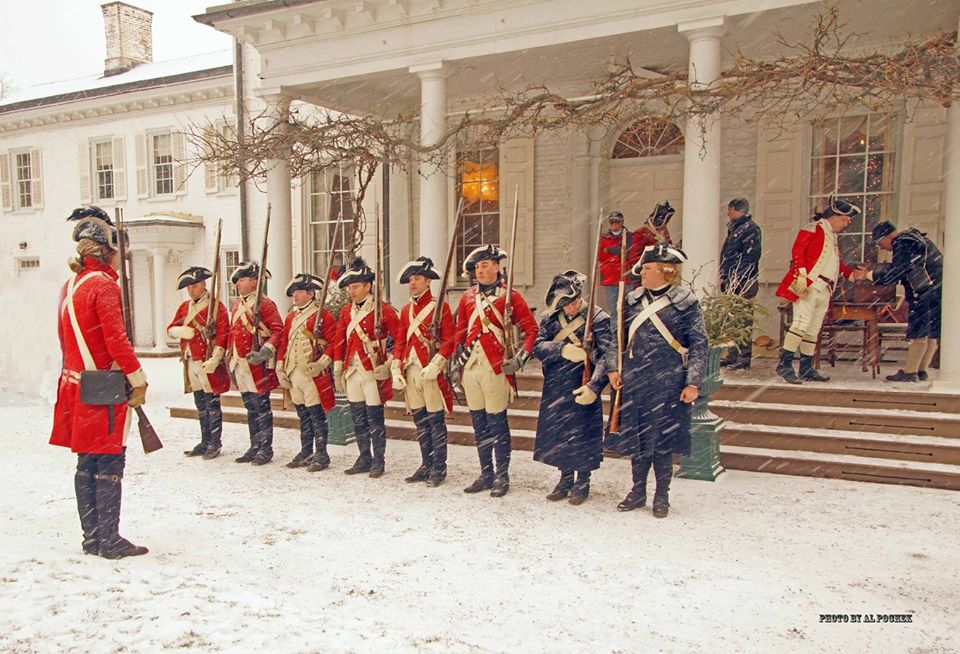
Morven Museum (Richard Stockton's house) under occupation. Photo by Al Pochek
Morven Museum (Richard Stockton’s house) under occupation. Photo by Al Pochek

What if they had a reenactment and there was no battle? Can you really interpret military history without a battle?

Why yes; yes, you can. And you can do it well, engaging and exciting visitors and interpreters alike.

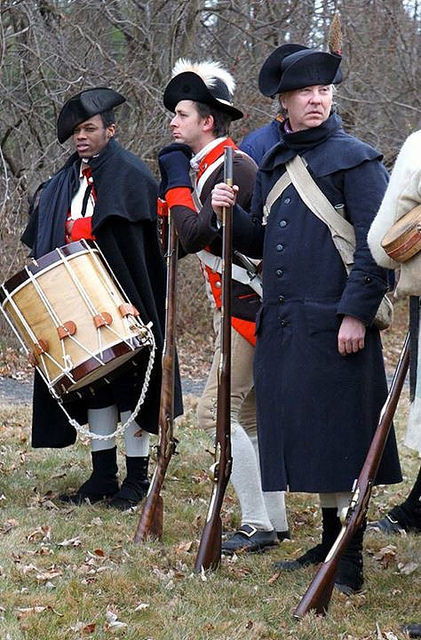
Last Saturday, Princeton was under British occupation once again, as we recreated the winter of 1777 this past weekend. I joined the planning for this  back in October– I double checked– and it really started months before that. Many hands (and imaginations) make events like this work, but for me, the most exciting part was helping to produce an essentially civilian day of programming that interpreted the Revolutionary War in New Jersey. Yes, there was “a musket thing” mid-day, but that wasn’t the focus of the action.

The ink froze, but oaths were to be signed anyway. Photo by Al Pochek.
The ink froze, but oaths were to be signed anyway.

HM 17th Regiment made their base of operations/occupation the porch of Morven House (formerly Richard Stockton’s residence) while the populace of Princeton attempted to go about their daily lives in Palmer Square. Quakers found themselves pressed to sign the Oath of Allegiance to King George III, despite their protestations that they could not take sides in a war.

Quakers and citizens, surrounded by occupying troops, listen to the officer's exhortations. From instagram @thebentspoon
Quakers and citizens, surrounded by occupying troops, listen to the officer’s exhortations. From instagram @thebentspoon

Some citizens seemed all too eager to sign the Oath, though rumor had it that one had previously pledged his loyalty to the rebel cause. (Sources have it that by the summer of 1778, this miscreant will be exacting revenge upon his neighbors as a Retaliator.)

Vignettes were drawn from documentation like the Brief Narrative of the Ravages of the British and Hessians at Princeton, 1776-1777:

“Triumph on that Days Victory the noted third day of January 1777 when they took two men and a Woman that could not stand Prisoners one of the men being much younger then the other & haveing shoes on made his Escape The Woman being unable to march they left her so they had in truth none from Princetown to Crown their Conquest with but the poor Old Captive without shoes. This is the Renowned Victory Obtained that day near Prince- town Which (it is said) is amply set forth in one of the New York newspapers 1 to be a Compleat victory obtained by the Regulars over the Continental Army so far as I have Related is true according to best Information that I can get, And so far I agree with that news Paper that the Regulars gained a Victory over two men and one woman. …. In takeing these three Prisoners they violated three of their Officers Protections for the two men had Each of them one, and the Womans Husband had another Besides they are all Reputed Quakers…” (Brief Narrative pp 18-20)

Lance Corporal Becnel proved himself in the afternoon.
Lance Corporal Becnel proved himself in the afternoon. Photo by Al Pochek

The constant snow kept our shoes on, but goods were stolen, occupants assaulted, soldiers beaten, prisoners taken, and justice served.

Hardy visitors followed us from Morven to Palmer Square and back, and one of the most exciting moments of the day for me was when a visitor said, “Wow, so the [British] soldiers didn’t really protect you, did they? You couldn’t count on them to keep you safe!” This seemed a pretty good summation of our interpretive goals:

  • The British failed to win the “hearts and minds” of New Jersey residents because they turned liberation into occupation.
  • The British lost the war in New Jersey because they treated everyone as a traitor.
  • The revolutionary war in New Jersey was as much a civil war as a rebellion against the crown.

I count that a major win for living history.

Trigger Warnings

Reenactors portraying Philadelphia Associators take part in the real time tour of the Battle of Princeton, Princeton, NJ, January 3, 2015. Beverly Schaefer, Times of Trenton
Philadelphia Associators January 3, 2015. Beverly Schaefer, Times of Trenton

It’s upon us, this Princeton event, and Peale’s, too. And the overnight march I missed two years ago. I’m so glad to be part of this, and I’m interested in seeing where it goes from here– partly for me, and partly for the way we do living history. Now, I’ll miss some of what I’d like to see (like Mr. White’s tour of the second battle of Trenton, but when you’re plundering in Princeton, you’re committed.) A formal media release may be downloaded here.

A little more than two years ago I was asked if I wanted to join the Peale’s March to Princeton. I said no, because women couldn’t march and that was the experience I wanted. Someday, I will have the hallucination that allows me to square experiential learning with authenticity, and, at the same time, the world will care about having a women’s Tour de France.

Anyway: there’s a point. This event became a pivot point for me in thinking about accuracy and authenticity of all kinds.

Accurate impressions rendered in a place of shared value will transport you to the past, and give you insights you did not expect. That is the point of these exercises: insight and understanding. It’s how to get high on history.

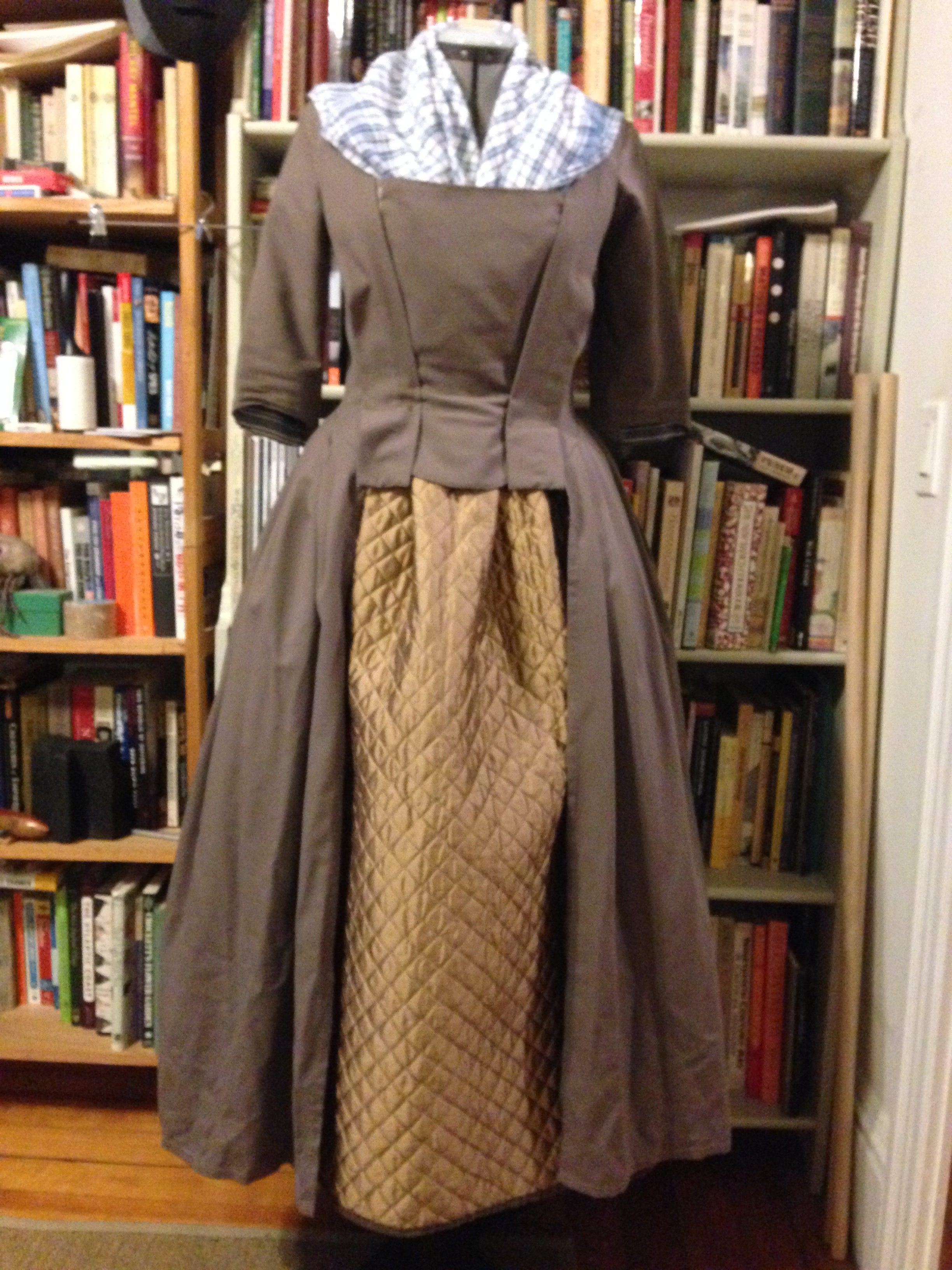
Test run: bedspread petticoat. Girl's gotta keep warm.
Test run: bedspread petticoat. Girl’s gotta keep warm.

In Palmer Square and at Morven, that means stealing (from each other), soldiers arresting Quakers, Loyalists and Whigs insulting each other, arguments about loyalty oaths, and women being attacked. (When you see the grey gown grabbed off the square by the red coat, please know that this is acting.) It means rough justice in a drum head court martial.

Will it work? I think so. Will it change my life, the way not attending two years ago did? That will depend on what I regret.

Museum Fail: Icon, not Replica

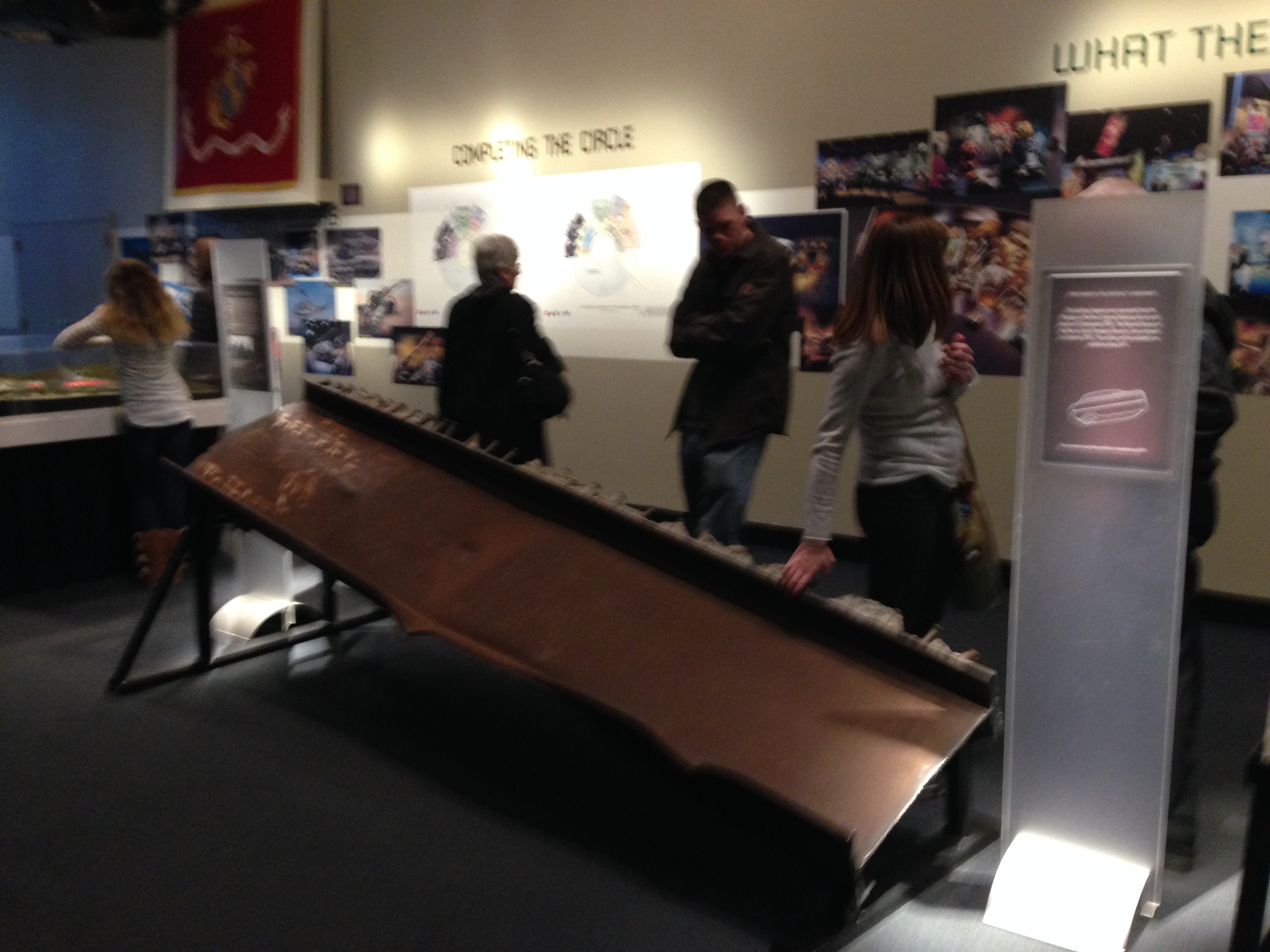
img_8606
What am I?

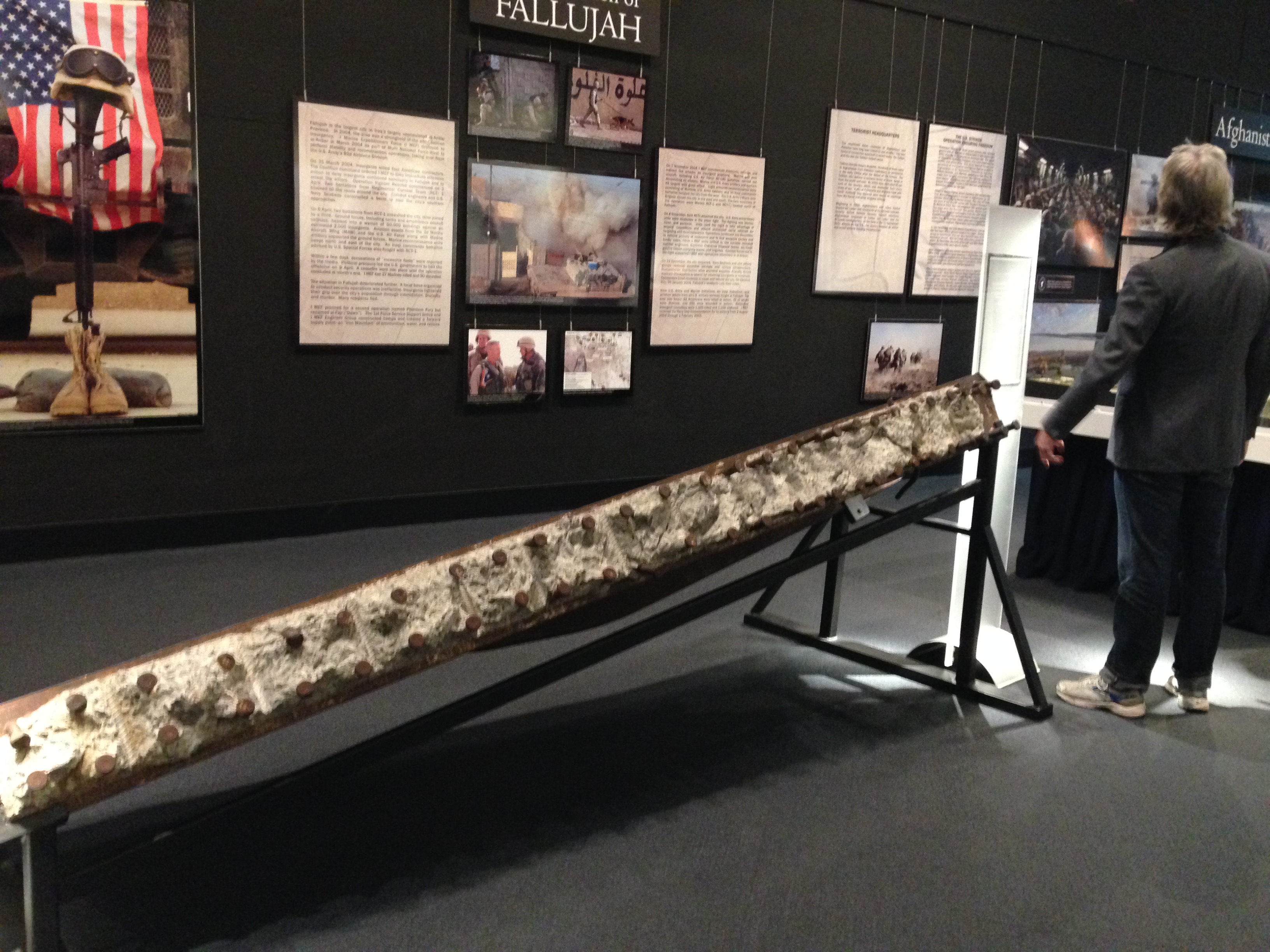
Do you know what this is? Do you think it’s real? Here’s a clue: it’s a relic of an iconic event in early 21st-century North America.

On the last visit to the National Marine Corps Museum, I watched the tourists circle objects at the end of the traditional galleries and displays, and overheard a woman ask her companions:

What’s this a replica of?

Reader, I cringed– and not for the sentence construction.

What's this a replica of?
What’s this a replica of?

And then I stepped back. I thought that for someone my age it would be obvious. Here, have some additional museum context.
img_8604

In a museum where everything is real, how does a visitor come to ask not only if that World Trade Center steel beam is a replica, but what is it replicating? I’m not sure semiotics can save us here. My first, New York Times-reading, media-soaked, Northeast Corridor response was, How can you miss that? How can you not recognize that, let alone mistake the steel and concrete relic for a replica?

img_8603

Ah, hubris. There is a label, though I have seen better. Would it be more helpful in a larger font, turned perpendicularly to the I-beam? Possibly. But the lesson that’s deeper than label formatting and placement is recognizing how much we take for granted. Our visitors, even those we assume to be educated consumers of media and information, may not share our knowledge base. They may not read objects or images as readily as we think they do; we certainly cannot assume they’re all taking away the same information– and that has nothing to do with education or background.

Everyone truly sees the world differently. How, and what, we choose to put on a label should always be grounded in remembering that we do not all share the same information. Context is critical, and probably would have made these relics more real, and less replica.