Stick-to-it-iveness

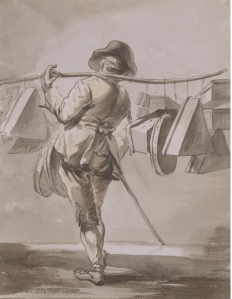
Band Box Seller, pen and watercolor by Paul Sandby, n.d. The Huntington Library, Art Collections, and Botanical Gardens, 67.18

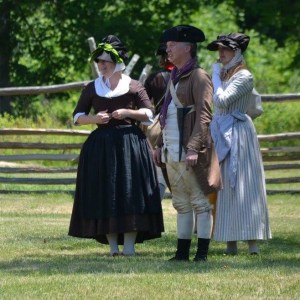
It has been a long time since I participated in a traditional “reenacting” event, the kind with tents and pew and kettles and a TWD but here we go, borne back into the past to where it all began, more or less. I remain as uncomfortable as ever in the camp follower role, constantly questioning the likelihood of my being a follower, and the activities I would participate in. It’s a historical personality disorder, trying to figure out who one was, complicated by all the modern politics of gender roles, relationships, and unit rules.

Now that I’ve switched sides, Bridget Connor is no longer open to me. By nature I’m a townie, happiest in a mercantile endeavor if I’m not able to take on the role of an officer’s servant.

So what to do? Petty sutlery is much on my mind, for I have need of the money and a habit of making things. Lately, i’ve been band-boxing, so I was delighted to find the Huntington had digitized this Sandby drawing of a band-box seller, placing the trade firmly in the middle of the 18th century. Triangular boxes for cocked hats, circular boxes for bergeres, rectangular boxes for gloves and (neck)handkerchiefs, I presume.

I’ll have band boxes and a bonnet or two in addition to a custom order delivery, coral, glass, and garnet necklaces for girls and women, pincushions, handkerchiefs, possibly garters, and, if my hands hold up, boxes for hats and bergeres, all on a stick. Look for me between the 17th and the 7th, hindering or helping laundresses.
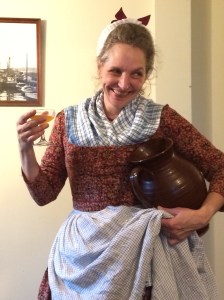
An Introduction, or Re-Introduction, of Sorts

No, I won’t say how many cups I’ve had.

What is this thing, and who am I?

It’s Costume Blog Writing Month (inspired by NaNoWriMo), and I’m Kitty Calash. I used to post much more frequently, but life caught up: I moved, which meant I didn’t sew at all for over a month* and thus didn’t have much to write about, since this isn’t a packing and moving blog.

But even before that, posting had slowed as I began to wonder why I wrote, and why I sewed. Costume Blog Writing Month, with its 31 flavors of posts, is a chance to reacquire the writing habit, and to think again about what I do, and why– and thus proved irresistible.

I’m a curator in search of a collection, a fugitive from architecture school, a compulsive editor, and a cat wrangler. I started sewing as a child with help from my mother and grandmother** who made clothes for me and my favorite doll, Moira. Although I graduated from two art schools, my interest in history is deep: I craved china dolls, collected antique quilts and tools, and insisted my bicentennial Samuel Adams costume have functioning knee bands– and yet, it’s taken me years to admit I’m “detail oriented.”


Some days Drunk Tailor asks me if I really enjoy sewing– my face betrays my frustration, and I do not play poker–but I get both distraction and satisfaction from it. Most of what I make I wear at living history events, so I hand-sew everything I can. I fall into the “progressive” reenactor/enactor/costumed interpreter camp, and strive for authenticity and accuracy in what I make, how I wear it, and what I do.

I’ve come to realize that I’m chasing art: my thesis work looked at what it means to be an American. What does “America” look like, what does the myth of America and our founding story mean? How do we portray it? Yes: I costume and organize events in pursuit of an experience for myself and participants that helps explain this nation, and how it came to be the way it is.

Not every post gets into this kind of theorizing— really, most don’t– but at core, my costume pursuits do chase the myth of an American Dream as I try to understand the people of the past, how they thought, what they made and wore, and how the past continues to inform the present.***

*During this time, I lost the distinctive callouses that will help a detective identify me as a seamstress when my murdered corpse is found in a Paris hotel doorway in the Georges Simenon novel I write in my head. I watch a lot of murder mysteries while I sew.

**Elsa turns up here from time to time; she was a style maven, the doyenne of design in a small Southern Tier town, who, for 50 years, ran the shop that dressed the maidens and matrons of the nearly best classes in a community of striving Swedes aching to assimilate.

*** And that, friends, is what working in history museums for two and half decades will get you: your own personal mission and an empty bank account.

Cross my Heart

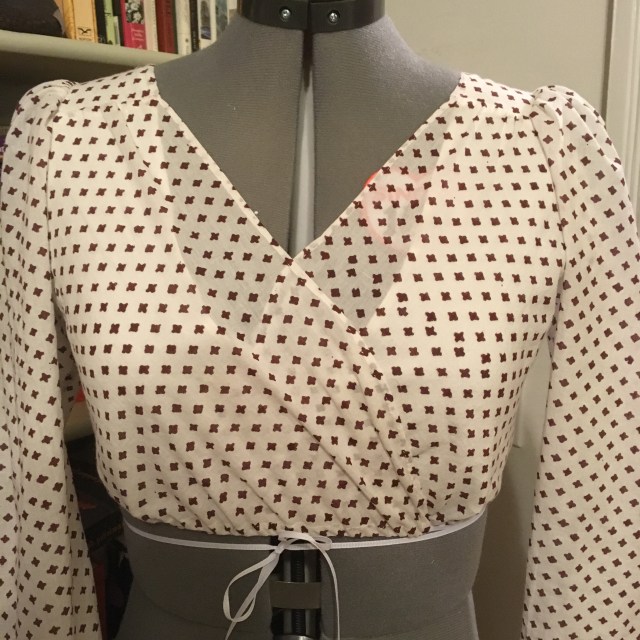
The goal is on the left. How far have I made it? Well… I have been busy. We started on the right, remember?

In executing the final plan, I did choose to cut a lining to support the lightweight fashion fabric; I didn’t think it would look, drape, or wear well without a lining.

The adaptation is truly that, and not a copy, in this instance. The lining means that the finished piece will have more of the appearance of a drawstring fitting than an actual drawstring across the back.

The sleeves, thankfully, were pretty straightforward, and I’m one of those odd people who really enjoys cutting and setting sleeves, so there you are. It took me about six days to get to this point, and then work came to a halt. I have other centuries I’m playing in, and am determined to finish that yellow dress to wear this weekend. When and where else can I look like a person of means than the Fort Frederick Market Fair?

Rethinking Reenacting Redux

Some of you may recall my friend from the antediluvian age, Dread Scott. He was in town briefly and while I wasn’t able to attend his talk, I got my own special artist’s talk over breakfast.

Scott’s working on a Slave Rebellion Reenactment, (additional info here) so we had a lot to talk about.

Scuffle in the Square, Princeton, 2017. Photo by Wilson Freeman at Drifting Focus Photography

He had some great questions about what we do, and why we do it, especially around Princeton, and in talking about my end goal (getting the public to understand how the past informs the present), I said something about how in Newport in 2014, the cars disappeared and we forgot we were in the present.

Scott’s great reply was about keeping the present present, occupying two time periods simultaneously, to recognize that the past made the present. I know that seems obvious, but it isn’t always when we’re out in our funny clothes. It’s another layer of interpretation that we can build onto our reenactments and recreations, particularly when we are trying to talk about slavery. Slavery built the institutions we have today– like Aetna Insurance and Georgetown University– so if we acknowledge our surroundings in a place like downtown Princeton or Newport, we can talk about more than just the moment we are recreating.

Some of us seek historical transcendence. Some of us enjoy a social experience. And some of us seek ways to connect the present to the past in ways that help us understand how we got here, and how to make a better future.

The more I contemplate what matters to me, the more I think I’m seeking that last more than I am even transcendence.