Poetry in Papers

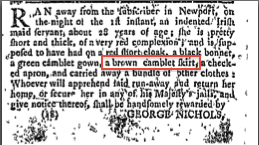
From the Newport Herald, 6/26/1788

It’s quite the poem, isn’t it? In October, I’ll be part of an 1800 event at work, and I will be portraying a housemaid, if not quite the housekeeper (we are still trying to sort out the domestic staff; what we can document is far too small a staff for the size of the house).

One of the things I will need is a name, and I thought perhaps I should check my instinct that “Kitty” was an acceptable name for women in the 18th century, and not just for sloops. So to the newspapers I turned, and among listings of the graduates of Philadelphia Seminaries for Girls, and ships cleared through the custom house, I found this poem. It reminded me of Mr S, and I recommend you read it aloud.

The early nineteenth-century maid. By William Brocas (1762-1837), pencil drawing c.1800 (National Library of Ireland)

So, a name: we’ll go with Kitty for now, and I can imagine building a complicated back story that pulls together all of the things I do, from running away outside Philadelphia to encountering soldiers and following them, to ending up a maid in a house in Providence. Except that what I believe about a life like that is this: It would be highly improbable, and I would look wa-a-a-y older than my actual years.

Instead of getting carried away with extreme historical fictions, let’s look at what we can know.

For one thing: clothing. Do you find yourself concerned, ever, that you focus so much upon your historic clothing? Well, you can stop. After a long and excellent conversation this week, think of this: the historical clothing you wear to events of any kind requires a lot of lead time. So you do have to think it through carefully, because every minute will count. It is also a visitor’s first impression of you, from a distance and up close. Getting it right matters, and since that takes so much time, you have to think a lot before you commit scissors to cloth. It does not necessarily mean that you’re a shallow, clothes-obsessed freak. There’s no 18th century mall to go hang out in and watch the leather-breeches boys  posing while they smoke clay pipes.

Benjamin West, Characters in the Streets of London, 1799, YCBA, Paul Mellon Collection, B1977.14.6314

I’ve just about convinced myself that the silhouette we’ve been wearing at the house and formerly at the farm is acceptable. I went looking through the turn-of-the century images I have on Pinterest and I think that a maid would have worn the fashionable silhouette. Another question is age (sigh); all the women in the Benjamin West are younger than I am.
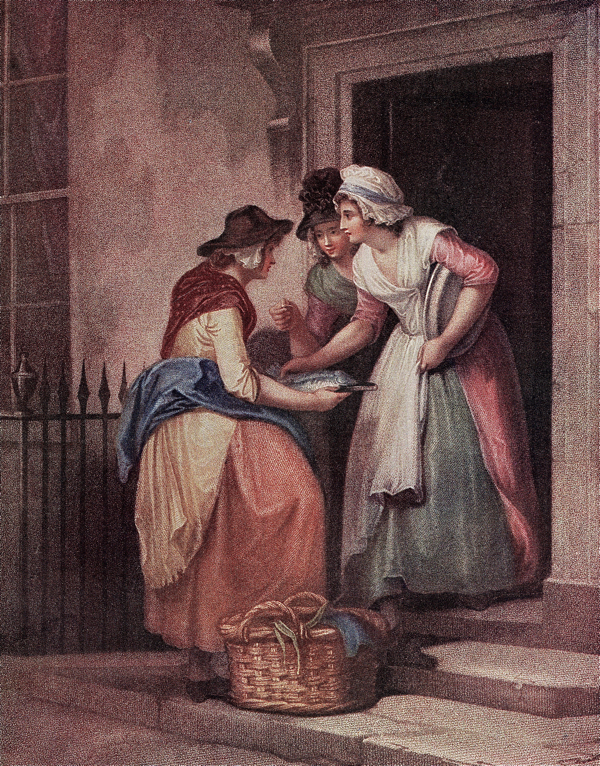
Francis Wheatley, Cries of London. New Mackerel, New Mackerel.

This print from a Wheatley (1792-1795) is useful, though he is such a genre painter and idealizes so much that I use him with caution. (Think of how much grittier–and funny–Sandby is: I trust Sandby more.) But, what can I learn from this? One thing is that I often think and dress more like the people in the street than the people in the houses. This will happen when you spend a lot of time outdoors, with soldiers: you are one of the people in the street. It can be a bit of a trap, historically speaking, and it’s good to challenge yourself to think about another class from time to time.

Back to the doorstep: what I learn here is that I need a white apron that I haven’t spilled on, a white kerchief, and a fancier cap. That cap will tie under my chin, because that’s the cap I see in Providence most often, and that’s the cap that will stay on. I’m not sure if these are maids–I think they are– but they’re women in a brownstone city house. And I can see from the clothes around me that they’ve been made for a woman who sells milk in the street, or works on a farm, or cooks over a fire. They’re not what the richest man in Providence would want his maid to wear answering the door.

You’ll have noticed, too, the different waistlines. The drawing from the National Library of Ireland and the Benjamin West have higher waistlines than the women in the Wheatley. Some of this will depend upon the available corsetry: I have stays that will work for the higher waistline, and I have stays for 1770.  I have a not-quite-right 1790s pair that need revision, but that’s not likely to happen: I have a brown and sea-green coat to make.

Documenting Mr S

The guys are usually easy: they wear what the sergeant tells ’em to wear, and they like it, because that’s what soldiers do.

Mr S in Cambridge

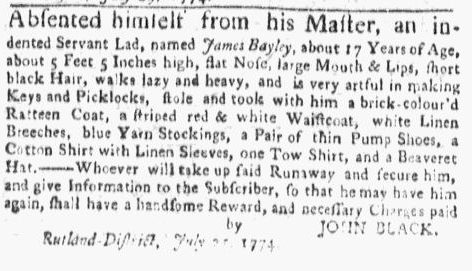
Sergeant’s not a sergeant in quite the same way in 1774-1775: he’s a militia sergeant, and while we can still get up to tricks that get us yelled at, the clothing we wear is more personal. Mr S’s clothes seemed, at first, to be completely undocumentable.

Really? Yes, I have been known to have some anxiety issues over small matters. So I calmed down, re-read the standards, and looked again.

The shirt is checked linen, see here for details. The stockings, which will be replaced by hand-knit blue stockings, are also documented to Rhode Island.  But wait! That’s 1777, can it count for 1775? How long do stockings last, anyway?

I’ll own up to having been described as “literal and precise,” and I’m taking that comment to heart. Reader: literal is where one gets into trouble when one is precise. Literal interpretations can lead you, almost hubristically, into creating replicas of runaway ads  or extant garments that don’t reflect who you are, or what time you are portraying, not really.

bluestockings_whitebreeches
Boston Post Boy, 7/25/1774

But not to worry, I dug up the blue stockings. This is from the Boston Post Boy, July 25, 1774. “White Linen Breeches, blue yarn stockings.” This is not too bad: Mr S has got his basic extremities covered now. It’s hard not to be distracted by the Cotton Shirt with Linen Sleeves, which reminds me of women’s shifts with finer sleeves, or sleeves to pin on.

browncamblet Waistcoat 7-4-1772 providence
Providence Gazette, 7/4/1772.

Keeping focused, let’s get Mr S more fully dressed, more proper, and warmer, since this is late August. You can’t see his waistcoat under the green jacket, but here you can. I know this broadcloth fabric, and its color, are from the acceptable palette for the last quarter of the 18th century, but can I find one in Providence or Massachusetts? Just about. The waistcoat described in this ad is camblet. There’s no goat or camel in Mr S’s camel-colored waistcoat, but I think we’ll call it found and be grateful that Mr S has not taken any action despite the numerous photos I have posted of him in various “poofy shirts” and “funny outfits,” as some of my friends describe them.

What’s left? There’s John Appleton’s ad in the Essex Gazette of May 17, 1774 for “blue, green and cloth colored bandannoes,” which pretty much takes care of the neck cloth; we’ve a brownish one, and a blue one; the Young Mr likes the orangey one, but I think we have those documented.

1774_greenJacket
Essex Gazette, 12/6/1774
1774_Prov_greenJacket
Providence Gazette, 1/29/1774

The green jacket, that’s what’s left. In the Essex Gazette of December 6, 1774, we find a “green jacket, light breeches, and yard Stockings,” much like what Mr S is wearing.  Nice! Multiple sources of documentation for items are always welcome chez Calash.

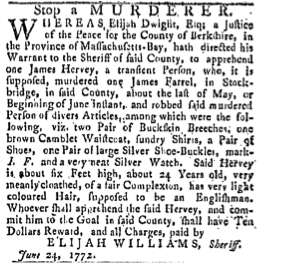
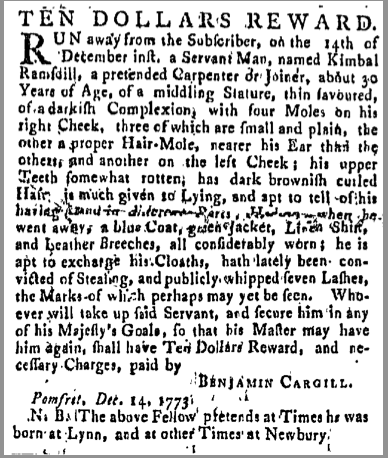
And, knowing that, you will not be surprised that I have found another jacket, closer to home. In the Providence Gazette of January 29, 1774, the man with the “proper hair mole” runs away in a green jacket. He’s also got leather breeches, and they’re on my wish list, though other things must come first, given their expense–things like tires, and allergy drops for the Young Mr.

Authenticity, Reenacting, and the Mobile Museum

No stanchion here: the public marches with the exhibits

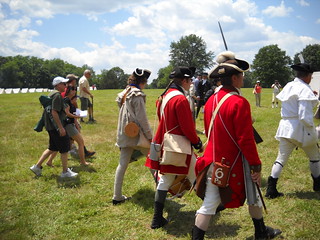
The more I think about issues of authenticity in re-enacting, the more I think about museums. Reenactments can be seen, as scholars have suggested, as “mobile monuments,” part of a culture of memorialization and commemoration of the past. “Recreated” battles, or battles staged on historic sites are not just the tactical weapons demonstrations they’re billed as, but rather ritual performances that commemorate notable events and connect practitioners with the past. They’re almost priests of the past, those men in uniform: they wear special robes, carry special equipment, and engage in practices arcane and exclusive–and denied to most women. (Indeed, the practice of women fielding reminds me of the history of women as deacons and eventually priests and bishops in the Episcopal church, but more about women in this hobby another time.)

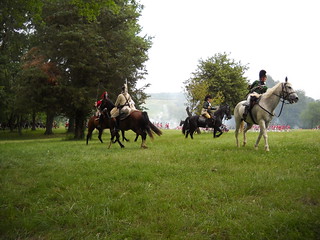
Dragoon battles are highly staged, for safety

That’s just the battles, though they are also museum theatre, vivid, smoky demonstrations of the ways of the past: what about the rest of the event?

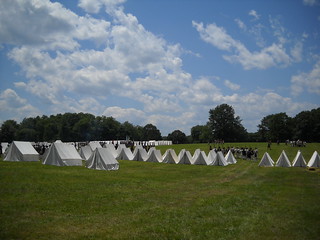
Reenactments, with their ranks of tents, kitchens, and varied participants, are in many ways mobile museums that set up at sites and provide “this weekend only!” semi-immersive experiences for visitors. There’s often a gift shop: the sutlers are there, and the site itself may have a shop, and push re-enactment themed items.

Each vignette or camp is like a gallery or object within a museum. Not all appeal to every visitor, some like Rangers, some like Redcoats, some like Rebels.

Continental camp at Monmouth

But in a world where museums and libraries are among the most trusted sources of information (online and otherwise), there are repercussions for the “mobile museums” of reenactments. If we accept a museum-like role, and see ourselves as custodians and practitioners of the past, we will need to also accept high(er) standards for material culture and presentation. That does not mean first-person interpretation by everyone at all events and it does not mean carrying actual 18th century goods into the field. That’s not good cultural stewardship.

It does mean doing the same hard work that museums do, researching and presenting oneself and one’s chattel with as much thought and care as possible. Who are you? Why do you have what you have? Where did you get it? Why does it look like that?

It means making one’s clothes and kit and accouterments as near to original as possible. The things we carry into the field, onto the stage of the mobile museum, should not look old. They should look used, but they will lack the patina of 235-year-old objects. They’ll represent the prelapsarian past of the objects, a time before they were painted with latex paint.

Can we, all of us, reach the highest levels of presentation? No. There are as many kinds of reenacting units as there are museums. Some are the Met, and have their owned branded truck. Some are your local historic site. Resources vary.

But just as most museums look to national accrediting organizations like the American Alliance of Museums for information on ethics, standards, and professional development, so too can the reenacting groups look to the umbrella organizations like the Brigade of the American Revolution, the British Brigade, and the Continental Line (the Big Three of 18th century reenacting). The BAR has an inspector, and unit inspection and re-inspection has a function similar to AAM accreditation.

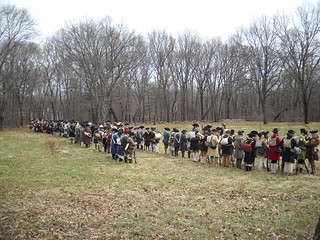
At Battle Road 2013

It’s not easy to become an accredited museum, but each museum that goes through the process learns, improves, and becomes stronger for having gone through the process of self-examination and, often, improvement. They meet standards. And like AAM, umbrella organizations can and do have standards, and the individual units have standards. Those are often online, and as individuals and other units strive to improve their impressions, following others’ well-researched and documented standards helps improve the entire field.

Peer-to-peer learning, public distribution of information, detailed and published standards of appearance, presentation and behavior: these exist, but not systematically, in the reenacting community. The more the Big Three can do to function the way the AAM does, the more I suspect we will see authenticity increase in the field.

Because it does matter: if museums and reenactors are trusted sources of information, we owe it to the public and our pride to create the best representation of the past that we can.

The Authenticity Challenge

We’re going up to Minute Man on August 24, or at least that’s the plan. We have hostages to exchange (one ends up with other folks’ spoons and bowls when one does the dishes) and drilling to do for the September 28 event in Boston.

Immediately after Sturbridge, the authenticity question blossomed on the interwebs, as there was an unusually fine crop of bodices on view in the village that weekend. (To be clear, I am pro-authenticity and anti-bodice, but I am still working over my thoughts on authenticity, which veered into hermeneutics, and are therefore not really germane to the conversation.)

Authenticity and standards are in the ether, and for this year’s event, all participants are asked to provide documentation, not just the people taking part in the challenge. I plan attend but not to partake of the challenge, as I have no desire to relive my childhood of never-even-third-place, thank you. Instead, I’m merely queasy and scrambling, as the only person in our household who seems really documented to me is the Young Mr, with his snuff-colored trousers  currently under construction, and two jackets from which he may be able to choose (presuming I get all buttonhole inspired). So he’s good. Run away!

I’ve been working on a ‘secret’ gown that’s not totally secret, but don’t feel I can adequately document it for this event. I have examples of the fabric advertised for sale, and a period print. But so far, the only gowns of this fabric type described in runaway ads have dark grounds. Granted, servants might tend to wear darker, more dirt-hiding colors, but I don’t feel that one print and some wrong-ground ads are enough. Next!

Anne Carrowle is Philadelphia, not New England: she’s passable for Monmouth and other Mid-Atlantic events. Chintz jackets: also fine for those runaway Dutch servants in NY and Philadelphia. Next!

Brown wool seemed too heavy for August, but the way the weather has been of late, maybe not. Well, anyway, it could get hotter. Next!

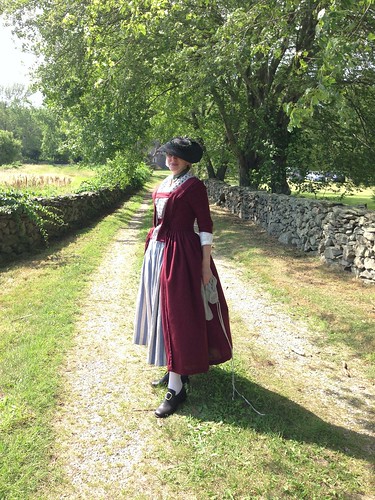
1772 red pompadoreThat leaves me with the New Favorite Gown, which I like, but which is based on an earlier British watercolor, so must be slightly altered at the sleeve or cuff as well as documented. At first I could find nothing to suggest that the color and fabric were within the realm of documentary possibility. Eventually I did find an ad in the Newport Mercury for what might be a likely candidate.

“Ran away on Sunday the 19th instant, from the subscriber at Newport, an Irish indented maid servant, named Elioner Clievland, pretty tall, who is very corpulent, with a red complexion, brown hair, and has a scar and a large dent in one of her arms, had on a red pompadore gown, and light broadcloth cloak: ” Newport Mercury, 8-10-1772

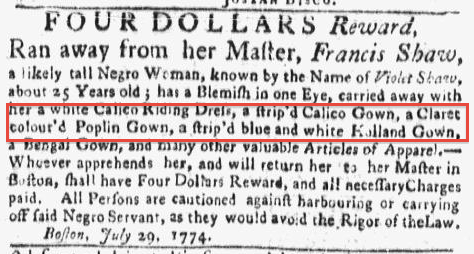
claret poplinTwo years later, “ a likely tall Negro Woman, known by the name of Violet Shaw, about 25 years old; has a Blemish in one Eye, carried away with her a white Calico Riding Dress, a strip’d Calico Gown, a claret colour’d Poplin Gown, a strip’d blue and white Holland Gown, a Bengal Gown, and many other value Articles…” Boston Evening Post, 8-1-1774

Well, I’m tall, and far from 25, but thankfully, I am not corpulent. But here are two wool or wool-blend, gowns, in reddish colors, in the right time period and place. Unfortunately, I have not yet found striped, or striped linsey, petticoats in Rhode Island, Connecticut or Massachusetts in 1772-1775—plenty in Philadelphia, where there are more servants running away—so what to do? I’ll look a damn fool without a petticoat.
brown petticoat newport

ShortGown There’s the brown petticoat solution. There is one in Boston (Weston), in August, 1774, and another in Newport, in January, 1773. I like the “brown camblet skirt;” I don’t have camblet, but at least the drape of the lightweight wool and cotton will be closer to camblet than to wool. I can agonize over the suitability of fabrics (and the vagaries of style) in some other post.

I made the gown intending to wear it with a blue and yellow striped as-yet-unmade petticoat (to look like the watercolor), but have some brown wool I can make up instead. Better documented than not (or nude).