Sacque Rationalizations

Before I get any farther along in the process of making a sacque (and I have not made much progress) I thought I should start to really look at gowns, and try to understand them.

Not only do I need to understand how they’re made, I want to understand how they change over time, and what’s appropriate for different time periods and situations. This will, or could, have some bearing on what I make for the gentleman accompanying me to the celebrations for which this gown is being made. If I start from Mr S, whose best coat right now is the 1777 Saratoga private’s coat, then I ought to have nothing better than a second-hand sacque several years out of date, and that is reaching indeed.

SacqueBySacque_back
What good fortune it is that the LACMA dress seems to be a gown in flux! This is the brown silk cross-barred gown with an assigned date of ca. 1760, which seems to have been abandoned in mid-alterations. Trim down the rights and left fronts ends abruptly at the waist, and two halves of what might have been a compère front lack any trim but boast plenty of holes. The front skirts come close together, but it’s hard to tell if they are meant to nearly close, or if the gown is fitted to a mannequin that’s too small and not adequately padded out.

Replicating a gown in mid-alterations would be interesting, but not what you’d wear to a ball, so I kept looking. In Hamburg there is another cross-barred sacque-back gown from about this era. There are similarities and differences, and never as much information as you’d like to have. Who owned and wore these? Who made them? When and where were they worn? We’ll never know, but at least with two similar gowns one can fill in some details for another, or help us understand them both.

The serpentine trim on the pink gown in Hamburg makes clear how unfinished or mid-alteration the brown gown in LA really is despite the visual interest created by the fabric itself.

Sacque_by_SacqueFront

So, what to do for my gown? And when will it be from? LACMA is hedging their bets with ca. 1760. I think Hamburg is pushing it a bit late with ca. 1775, but a ca. 1770 date for a gown based on the two seems reasonable. That would mean that the coat Mr S wears should also be ca. 1770, or newer than his green linen coat and older than his Saratoga coat. And luckily, I already have a plan, some fabric, and a pattern as a place to start.

While the ball itself has no date per se, it is in celebration of Washington’s Birthday, which puts it after 1775 at the earliest (think transfer of command of the Continental Army in Cambridge). Does that make a ca. 1770 gown too early? It would depend, I think on how one imagined the ball and oneself. If you’re a frugal woman who has lost much in the war, you’ll remake your gown; should the flounces become the shirred cuffs of later gowns? Could the kind-of compère front of the LACMA gown be a stomacher cut in half and stitched to the sides, with the pin hole indicating where trim had been removed from a once-was stomacher? Is it reasonable to make a compère front for a ca. 1770 gown? I want one mostly to avoid the stomacher angst I always seem to have, and in a way it marks a place between stomacher-front and front-closing gowns.

These unprovenanced gowns stand without the particular context and personality of their owners; the fun and the challenge for us, as costumers and reenactors, is in trying to bring our personalities to the fact-based garments we create.

Green Indeed

Regency Green: Kochan & Philips + Robert Land = Matchy-matchy.

As expected, Mr Najekci dispatched the K&C wool before the Hook, so last Thursday evening when I arrived home after Gallery Night, there was a box of delicious waiting for me. And, also as expected though mostly hoped for, the wool and shoes were super simpatico. This will be a fun project when I get myself sorted to it.

I have not yet had the time to put all the projects into a spreadsheet, but I think it would help keep things organized and on schedule. For example, I have:

  • to work out the details and rationale of the sacque, vis-a-vis date and style
  • to finalize the Spencer pattern
  • to pattern and fit a frock coat, waistcoat and breeches for Mr S ca. 1775
  • to ask about the regimental for Mr S, which will be wanted eventually
  • to face making a tent by next summer
  • a plan for kettle bags, since I’d like us to pack lighter & more authentically
  • to fix my stays situation
  • an inordinate desire for a splashy bonnet to go with that Spencer
  • two shirts to make up for Mr S and the Young Mr
  • a red short cloak, for easier movement

Once I have a schedule and a plan, making things by deadline is somewhat easier. It’s “bridge” season now, between cooling and heating, summer and winter fashion collections, and that’s as good a time as any to work out plans for the winter. There’s nothing the guys must have for an event that they haven’t got already–for Fort Lee, they can wear their short wool jackets under their 10th MA hunting frocks and be perfectly authentic and warm. (The brown and green coat is 1777, and the Fall of Fort Lee is 1776. The blue and white short-tailed regimentals are 1781. No coat for you!)

So it’s worth taking the time to regroup, even as I rush headlong into projects…and considering I have jury duty (no scissors!) this week, maybe I should add hand-knit stockings to that list.

The ‘Bigger’ Issues

What of those wardrobe issues?

1. The Cross-Barred Gown is Too Big. I will have to take it apart and make it smaller as it is too wide across the back in general and the shoulders. This is fairly simple.

2. The stays are Too Big. I can lift them up and do the shimmy inside them. Seriously. Eighteen months ago, when they were made, I had a two inch gap at the back and the front did not lace closed. Now I can lace them shut front and back.

Whether I have some body image issues or am just a crack-addled monkey can be debated among impolite company some other time, but to solve these problems, here’s the half-baked scheme plan I have in mind:

I re-cut and re-fit my bodice block for an open robe and made it smaller. (For the sacque, I need only trim the sides of the back because I haven’t gotten any farther than that, thank goodness! Now I have a better sense of the shoulder width I need to fill with pleats, also good.) For the Cross-Barred Gown, dis-assembly and re-construction can happen in the spring. Simple enough, and adjustable, too but…

Stay pattern mock-up, measured.

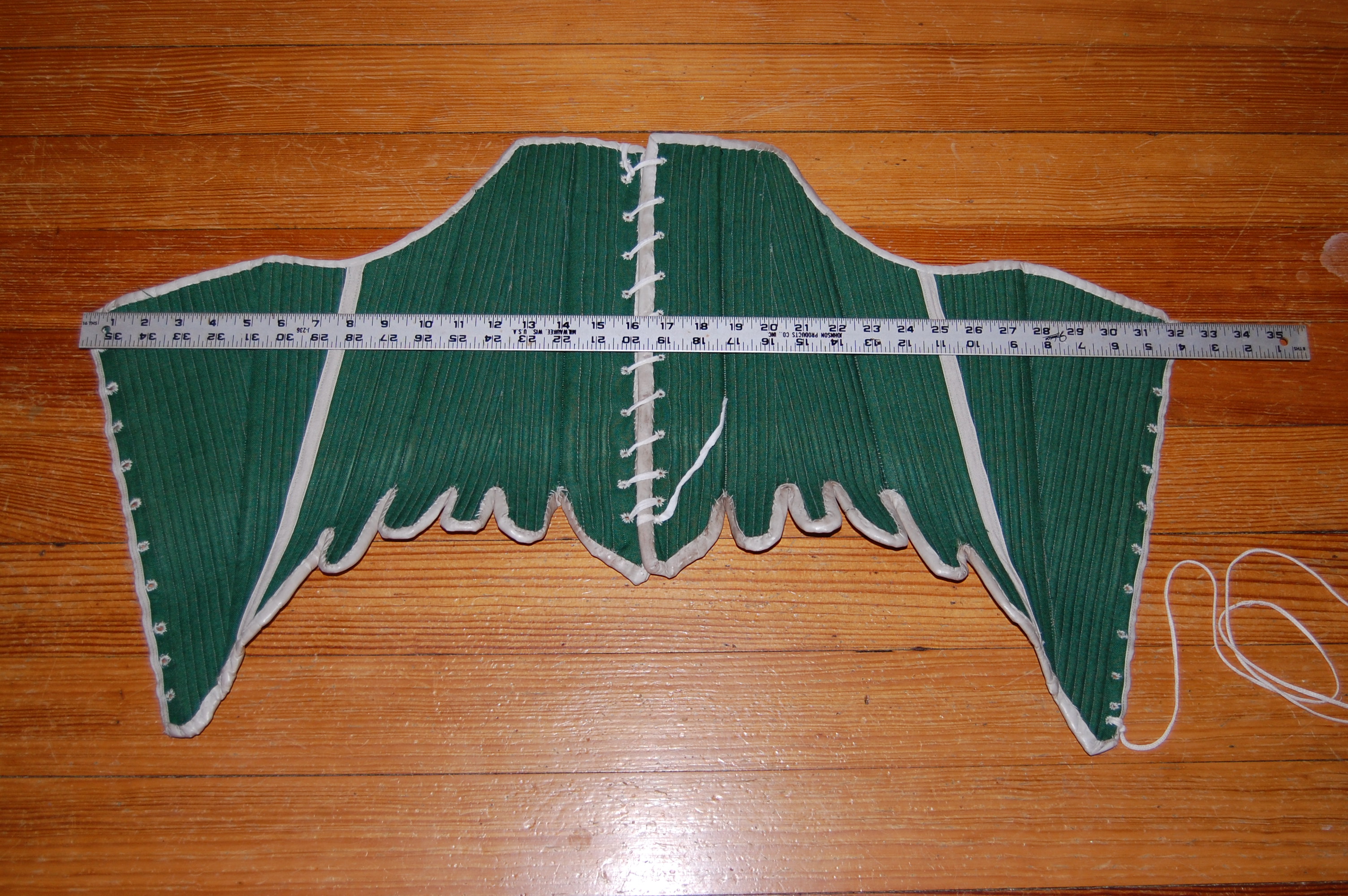
The stays are a little different, and much more serious. I’m not yet sure what to do. I could unstitch the binding and the panels and remove some bones, re-stitch the seams and re-apply the binding…or I could start all over, but make the stays a size smaller. The cardboard mockup measures 33 inches across. With a tape measure snugged up, I measure 37 inches around. Seems like all should be well, no? Two inches, front and back?

32 inches, but they don't fit.
32 inches, but they don’t fit.

It is not. Here you can see the green stays and the yard stick: 32 inches. I should have five inches altogether, right? No. These lace shut front and back (see the back lacing, kindly trust me on the fronts).

How did I not notice this before?
How did I not notice this drop before? (The pale line is the tide line of petticoat waistbands & ties)

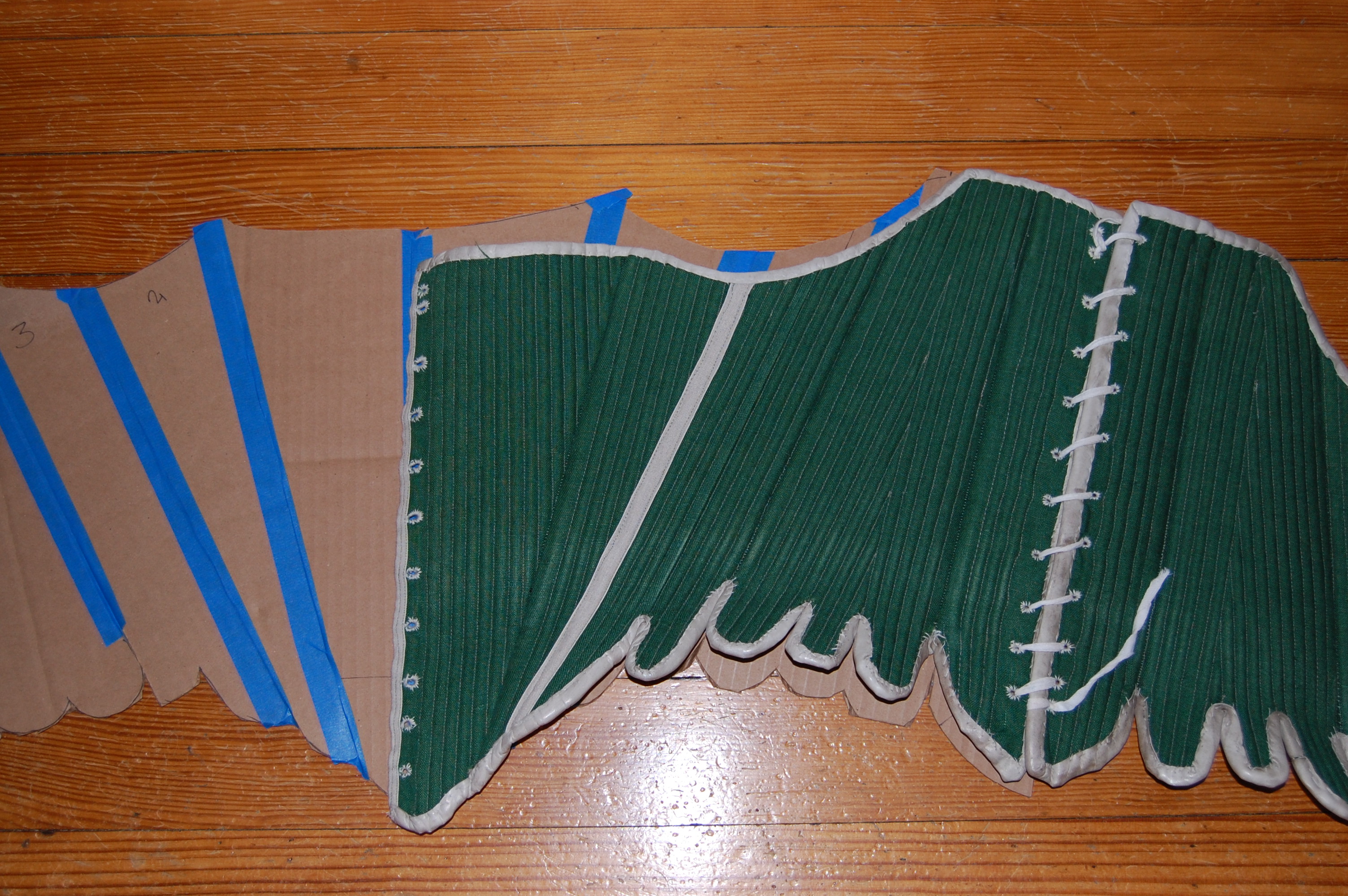
Then I compared the mock up and the stays. Curiouser and worser!

Somehow when I assembled this hot mess, I mis-aligned the pieces,and the fronts are lower than they should be. This explains much about the increasingly poor quality of fit as these slide down my ribcage…as you can imagine, the stays can’t do their job when they’re not in the right place to do their job.

If I am to reclaim these and my decorum, the first step will have to be dis-assembly simply to get the various panels into the their proper places. I think it would be fairly simple to do to the fronts, and then I could end some of the madness by sewing the front panels shut and converting these to back-lacing stays. It might be only a temporary fix, but that alone would be worth the effort. Fortunately, I won’t require these until November 23, and in the meantime, I know which gowns are too big, and need to be smaller. With open fronts, at least they’re pretty adjustable.

What (Cheer) to Wear?

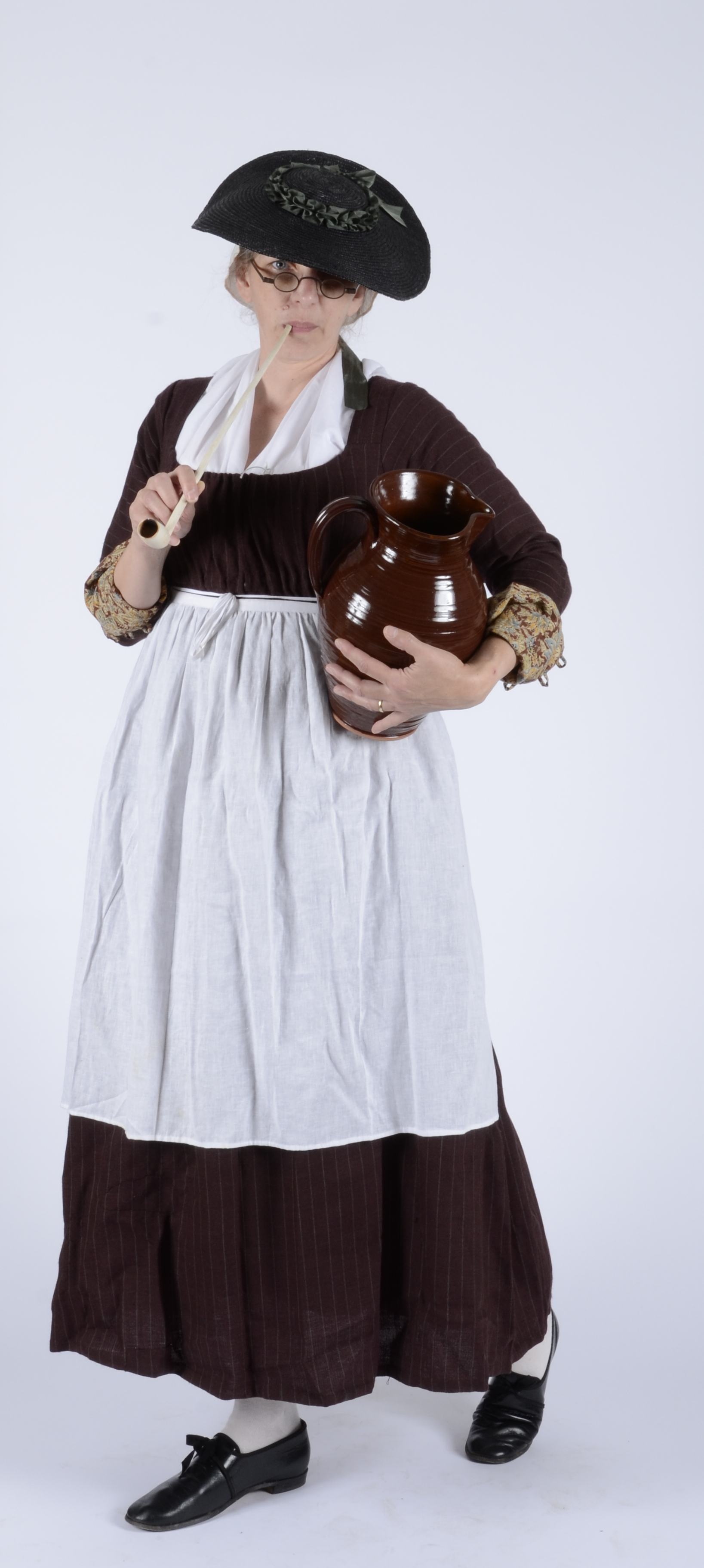
JBs HousekeeperIt’s 1800. Do you know what your housekeeper is doing? I don’t. Or, more accurately, I can’t decide.
I’m hung up on stays, and not wanting to make another pair. I’m indecisive about style, and though Mrs Garnett has her charms, it’s her bonnet I love more than anything.

Here’s what I’ve found, in servant-land:
18th-century-kitchen-servants-prepare-a-meal-jane-austen-cookbook-cover-page

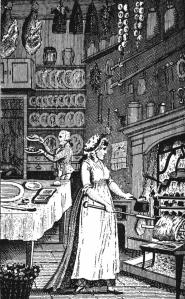
Note that this woman is, in the kitchen, wearing an open robe and quilted petticoat.The style of her bodice–which looks  like a cross-over bodice–and the train of the robe suggest the 1790s. Score one for style.

That open robe, where have I seen that before? Why, yes, Mr Sandby showed us that style for a nurserymaid. (It’s interesting, too, that both images show women with their hair quite visible under their caps, and not pulled up and out of sight.)
20130109-061710.jpg

Why does “robe stye” matter? Because I only found 3 and a quarter yards of a brown fabric I like, and even with the most careful cutting, that’s unlikely to make a full gown. However, I have some lightweight black wool that will make a decent petticoat. The bodice style is a bit of a stumper, though: the wool has good drape, so it might work for something other than the usual bodice I make. I did consider whether a very smooth, edge-to-edge, front-closing style of the 1780s would be more appropriate, but I think that I can move the bodice style forward, style-wise, and be correct.

138263

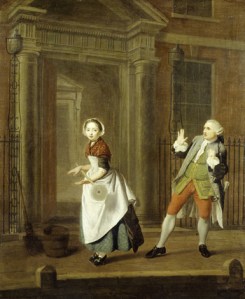
Brown gowns are a fine tradition in the sartorial habits of questionable servants. This young housemaid twirls her mop dry while wearing a brown gown over what could be a dark blue or a black quilted petticoat. The red “bandannoe” is a nice touch, though I don’t think I’ll wear one myself for this event.

In all this there is a compromise: using fabric I like, in a style I know I can make and document, perhaps even without having to make new stays. That would be ideal, because although it’s four weeks to the event, I’ll lose a week of sewing time to other commitments. Three weeks to pattern and hand sew a petticoat, gown, apron and cap seems just manageable.