Cold Scoops

What Cheer Day preparations must begin in earnest now, no matter how distracting I might find orderly books or silk shoes (not in my size, alas: no last can be found). I already have clothes enough for a housekeeper, though I still crave a broadcloth Spencer and am working on a petticoat. I’ll hardly go outside that day, so why am I thinking bonnets– especially when I have a known bonnet problem?

One of my favorite resources for Federal era Providence is Julia Bowen’s diary. Born December 1, 1779, Julia’s diary records her life in Providence in 1799, when she was 19. She records the daily activities of the second set of Providence women– daughters not of the most elite merchants, like John Brown and John Innes Clark, but the Bowens, Powers, Howells, and Whipples. Distinguished, but not super-elite. Many of the entries are as prosaic and superficial as you’d expect from a young woman in late adolescence, and thank goodness they are, or we’d never be able to imagine life in such fine detail.

Julia got me thinking about bonnets with her entry of April 12:

found the Major & Citizen Sarah & C. Angell altering their cold scoops into Rosina hats, so busily were they employed that the Major could not go a visiting, which deprived me at once of the greatest pleasure I anticipated in my visit.

(She used code names for her friends; some we can decode, and some we cannot.)

I haven’t been able to decipher what “Rosina hats” were, but cold scoops I could handle: coal scoops.
That colloquialism fits not just fashion plates but extant coal scoops and buckets.

You just have to imagine them turned over.

The Gallery of Fashion, 1797, Bathing Place, Morning Dresses.

I went for cold scoop, with a pasteboard brim and olive green taffeta brim and caul. The mannequin is a 3-D sketch, if you will, of what the housekeeper plans to wear this autumn. At least until she can figure out what a Rosina hat is.
Malaise or Ennui?

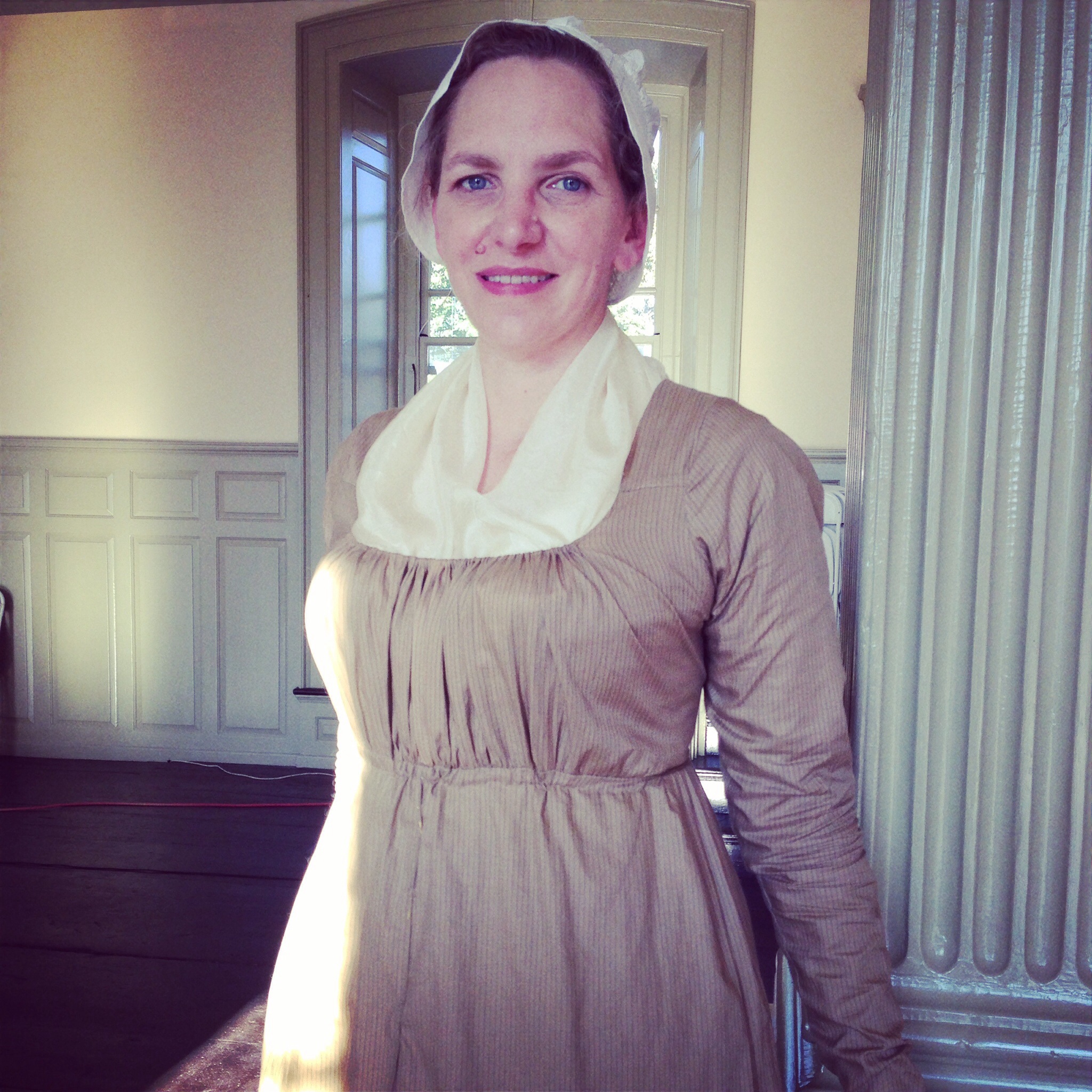
image Hard to say which, but I am ill at ease and dissatisfied with my costuming. You might even call it bratty. But I don’t wanna be like Bridget Connor!

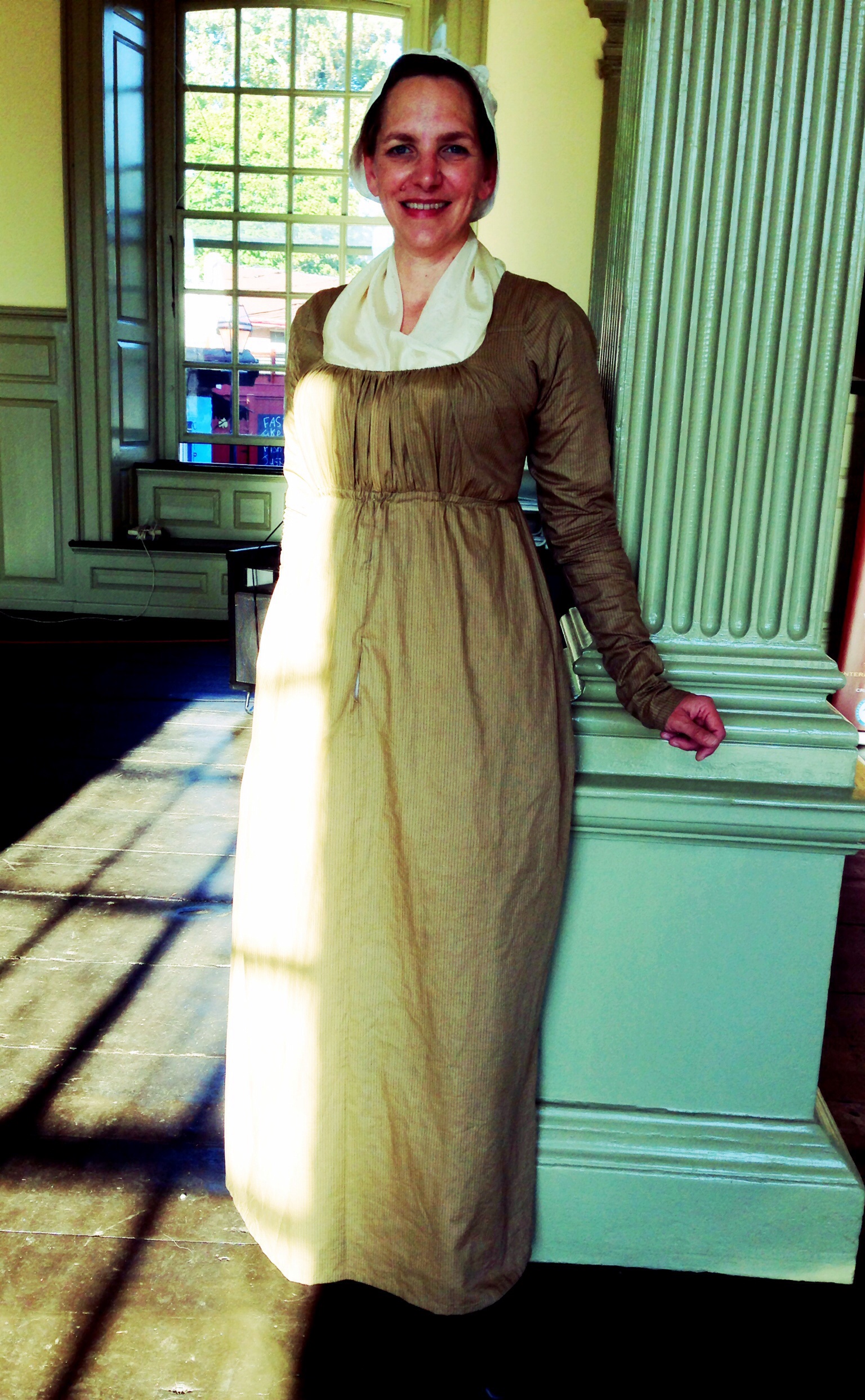
It started the week of the Stamp Act protest, when I felt quite tired of being the shabby, unrefined woman of the regiment and street vendor, and wanted a nice cozy shop like the milliner had. I was also looking forward to being a housekeeper again, and several weeks of moving boxes and volumes with red rot at work had me feeling generally filthy and unappreciated. Bratty.

When in doubt, sew. A new dress can’t help but cheer you up, right?

Well… sort of…

Last Thursday, we did a reprise of the Williams family letters program at the Newport Historical Society. The Williams family were Quakers, and the letters were from the early part of the 19th century, so for the program in March, I made a green silk cross-front gown based on the Quaker gown in the back of Costume in Detail. (Check out the schematic on the 19thus.come page; I didn’t see this until I was mostly done with the dress, but thank goodness I got it right!)

But it’s September, and Thursday was expected to be quite warm, so I salved my bureaucratic wounds in the $1.99 loft at the local mill store, and made a new Quaker gown, also suitable for a maid.

I ask you! Even though it’s my very own pattern based on sketches of original drawings, even though it fits, even though it cost $10, even though every seam is overcast and the whole thing is made with period correct stitches, it still fails to make me happy and cheerful and delighted.

image

This brattiness has resulted in a reappraisal of my approach– and a trip to Sewfisticated in Framingham. What did I buy there? Yards and yards of pink taffeta? Gold taffeta? Blue taffeta?

No.

Because they didn’t have the right colors in the right weave– too slubby– or in enough yardage. Brace yourselves: I bought brown.

Many thanks to Sew 18th Century for taking the photos!

It appears I do not learn from my mistakes. When I think, “Gee, I’d like a pretty dress,” I end up buying fabric based on the texture as much as the color, and I have to tell you, that brown taffeta has the most wonderful l hand and sheen, and I will look much more like a Copley portrait than I ever have before, so that’s something.

It seems I have created a set of mental rules for myself, a mission, if you will, for the historic clothing I sew and the roles I take on, and I only play within those rules.

Boil and Not Too Much Trouble

Camp cooking can get old. Stew, sigh. Bread, sigh. Cheese, sigh. Apples, sigh.

Don’t get me wrong: all of the above are delicious today. Historically, New England troops are all about cheese and cider, and have much to say about the quality of beef, but menu can be repetitive and lacking in challenge.

Ever since I had boiled flour pudding at Coggeshall Farm, I’ve wanted to make it since I so much enjoyed the texture.

When I found it mentioned by Enos Hitchcock, I was particularly excited.

1777 May 24
Dined upon flowr puding & Venison Steak.

Flowr puding? I love that guy! But there it is, documented, even if eaten by the officers and not the private soldiers. It’s common enough that I think it likely almost everyone knew how to make it. The trick would have been getting hold of eggs and milk, which is easy enough for me, if not for the soldiers of 1777. Fortunately, as we drove down Cottrell Road headed for home, a flock of Plymouth Rock chickens crossed the road in front of us: there were the eggs, at least in our time.

postcard of kittens eating christmas pudding
Not your chaplain’s pudding.

The method I had tried at home worked: I beat three eggs and four spoons of milk in my tall redware mug, and added the liquid slowly to the flour and salt mixture. The whole mixture went into a cloth bag, which I tied with a string and boiled in the smallest kettle, not want to risk any damage to the beef stew. I’ll test the works at home on my nearest kin and willing victims before I loose it upon a regiment and hungry guests.

Although the pudding was a strange shape, it cooked up quickly in about 45 minutes, had a firm texture and a satisfactory enough flavor. I would have liked it to rise a bit more, which is an argument either for beating the eggs with a fork in the confined cylinder of the cup, or risking the splash of the whisk in a bowl, or, finally, for a smaller whisk.

Still, not too bad for expanding the camp cooking repertoire of Things That Can be Boiled and Eaten.

When in Doubt, Bake

There was a Very Bad Summer when much was awry at work, the flat we were living in was for sale, my father was moving far away, and the Howling Assistant was sick. In response, I baked.

Things are roiling in the world of late, both at work and in the wider world (I am from St. Louis, and cannot ignore the news from Ferguson), and so again, I turned to baking. Eggs, flour, sugar: what could be sweeter?

A friend tried Amelia Simmons‘ Diet bread a few years ago, with limited success, but the simplicity of the receipt has always appealed to me.

recipe for diet bread
Diet Bread

Once again, I risked early morning baking, but I think this has turned out OK. I had to leave for work before it was cool enough to really eat, but a corner was delicious! The intense amount of sugar– a full pound!– was intimidating, the rose water curious when tested, but combined with the cinnamon, seems to have a pleasant and slightly exotic flavour.*

The simplicity of the ingredients was encouraging, but I probably would not have jumped into this had I not found someone else had leaped before me.

Kathleen Gudmundsson on the Historical Cooking Project blog tackled diet bread in May. From her work, I took the tip to use only six eggs.

Following Gudmundsson thoughts at the end of her entry, I beat the egg yolks separately, intending to add the stiff-peaked whites at the end. Half way through adding the flour, the batter became extremely stiff and sticky, and nearly unmanageable, so I beat a whole seventh egg and added that, followed by a little flour and 1/4 of the beaten whites. I alternated flour and egg whites, finishing with egg whites, and found the mixture retained pliability and texture.

Like Gudmundsson, I also lined a glass pan with parchment paper, but my (electric, rental-quality) oven runs a little slow, so baked for 30 minutes at 400F.

diet cake made of sugar, flour and eggs
Diet Cake, from American Cookery by Amelia Simmons.

The results look like hers, and since she thought the cake was as good or better three days after she’d made it, my hopes for an interesting dessert remain intact.

The other, less distracting, project I’ve taken on this week is a set of bags for coffee and food stuffs.

handsewn linen bags in white and check
Linen bags for foodstuffs

After all, there are no ziplock bags or plastic tubs in 1777, and full complement of graduated tin canisters seems unlikely to plummet into my lap anytime soon. The two slender bags are for coffee: tied at the neck, they’ll hold enough for cold coffee and fit the slender tin coffee pot we have, sparing the larger cloths, wrangling grounds, and giving us clear, cold, caffeine. Another is for flour, one could be for oatmeal, another for sugar. In any case, things to eat are getting wrangled in a way that can remain visible in camp.

I know: a trifle mad, but the time I spend now makes living in public so much easier when there’s less to hide. And yes, before you ask: that will be a real fire.

*Fellow eaters, you’ve been warned.