I think it will take a fresh generation with no memories of the 1970s to revolutionize studies of the American Revolution. What do the rest of you think, those of you who remember the 1970s as well as those of you who don’t?
They are half my age and already exceed me in sewing skill. They find new cultural nuggets I have never seen before.
I’ll see your camp kitchen and raise it a malnourished goat and acorns. (image from Drunk Tailor)
And that– younger people are finding new things–reminds me of Historiann’s post.
I could say we’re all standing on the shoulders of giants, but it is more about perspective, different ways of looking, and openness. The schisms are not just generational, but philosophical.
None of these breaks fall neatly, of course, but crack and splinter along desires and motivations. As long as you are willing to keep learning and changing (i.e. researching and making) then you’ll keep pushing at the edge of the interpretive envelope and that can only help push understanding of all kinds forward.
Numerous labels are fly around the interwebs and out of people’s mouths as they encounter reenactors/living history practitioners/interpreters like and unlike them. In the right mind frame, I could argue that the ultra-authentic folks in their perfectly sewn clothes with perfect accouterments who cannot and do not interact meaningfully with the public are closer to historical costumers than historical reenactors and then watch the fur fly.
Without pasting on a label, I can say that what I like best is always learning more, and that I enjoy playing with other people who also enjoy doing research and evolving interpretation. Not, We’ve already done that, dismissively but, We did that once; how can we do it better?
But what about those folks who we know aren’t doing that? By their Nikes ye shall know them, and their riding habits worn without stays. How is it that some people are interested in change, and others reach a place from which they never move, clothing or research-wise?
Kitteh says, My melee weapon
What about you, gentle reader? I know you’re not all reenactors; some of you are more on the costume end of the spectrum, but from reading around, I know there are costumers motivated not just by new dresses or character ensembles but by better new dresses and character presentations. What motivates you to change and improve, and what keeps your hobby fresh for you?
I wrestle a lot with myself, which sounds much sexier and more athletic than it is, when it’s your patience and conscience. It’s a constant fight with my own brain and animal nature, like Snowy pondering a bone.
It’s hard to keep sewing for an ever-taller young man who refuses almost all attempts at fitting. (Especially when your calloused fingertips and split thumb keep catching on the silk buttonhole twist.)
It’s hard to have program ideas and then realize you will end up as the maid, serving a meal to a group including some people you might not like. (Don’t you think that must be a fairly authentic emotion, historically?)
It’s hard to put aside plans for your first pretty silk dress because someone doesn’t want to go where you want to go.
It’s hard to embrace the importance and meaning of interpreting the ordinary in a culture that celebrates the unique.
I come to that and stop: mission.
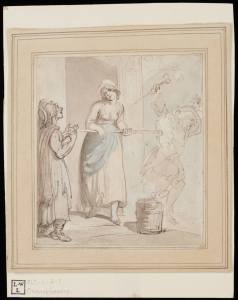
Watercolor by Thomas Rowlandson, 1785? Lewis Walpole LibraryDrawings R79 no. 7
You can take anything too far, of course, and an occasional silk gown and turn around a dance floor might make being the maid a little easier, but in the end I know that what’s important to me is representing the people who have been forgotten.
That same impulse may be part of what drives the splintering into ever-smaller groups with every-different coats, but walking the cat back also leads me to think that lace, tape, and shiny buttons may be part of the equation, too. Are those uniforms the gents’ equivalent to cross-barr’d silk sacques? As in any culture, it is easier to have your cake and eat it, too if you’re a guy.
For most of us women inhabiting the past, if we’re not baking cake, we’re serving it.
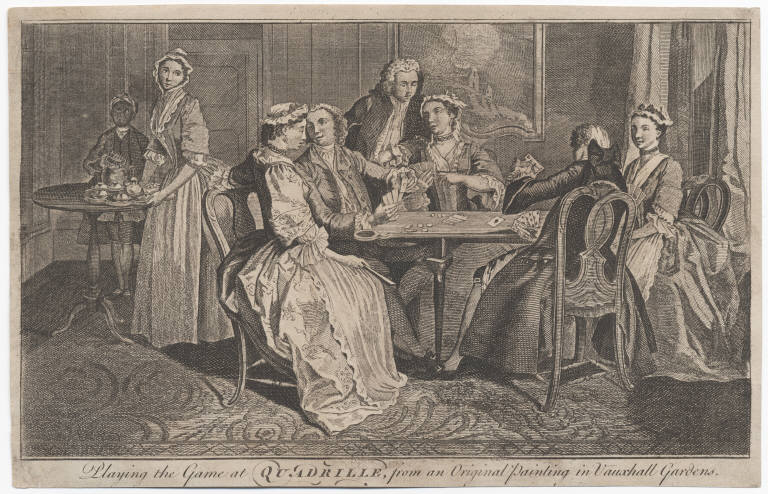
Playing the game at quadrille : from an original painting in Vauxhall Gardens. London : Robert Sayer, ca. 1750. Lewis Walpole Library, 750.00.00.14
It’s a funny thing to want a break from work you find important, but as with anything, variety and perspective are important.
She looks wistful, doesn’t she? The others are whist-full.
In a world of individualists, each trying to stand out, quotidian celebrities– cast a skeptical glance at your social media feed and tell me I’m wrong–our impulse may not be to inhabit the background. But most of us are the background. We’re large only in our own minds, stars of the movies of our lives that flicker past our eyelids. And that’s ok: that’s noble, even, to live a small, thoughtful life.
Silver Pocket Watch of Meriwether Lewis, 1936.30.5
Once upon a time, when I worked in Missouri, I was fortunate enough to spend a lot of quality time with some amazing artifacts.
Meriwether Lewis’s refracting telescope.
William Clark’s compass.
Meriwether Lewis’s pocket watch.
William Clark’s Account with John Griffin for thread, cloth and other articles including a hat for George and shoes for Mary. (July 1820, William Clark Papers, B13/F5, MHS)
Account of expenses in “horse keeping,” 1829- 1831. Request to Clark to pay to Mrs. Ingram, with request to serve as receipt. On same document: ADS Dashney to Major Graham, 26 June 1826. Order to pay William C. Wiggins. (1831 Dec 13, William Clark Papers, B14/F2, MHS).
There are letters to one of Clark’s sons, trying to get him to stay at West Point. There are bills for bolts and iron work for Clark’s house. Yes: there are amazing things in the collection as well, and historians of all kinds can do amazing work in the papers.
But they are ordinary. They are daily life played out in the first third of the nineteenth century in St. Louis, bills and accounts punctuated by letters from famous people and news of wars and explorers. But after processing the family’s collection, what struck me more than anything was how ordinary they were, how quotidian.
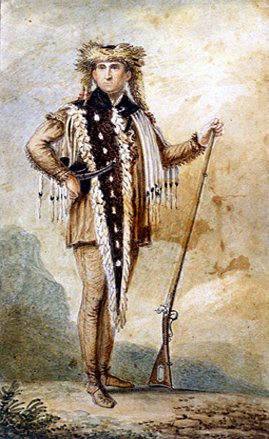
Meriwether Lewis in Indian dress. engraving after St. Memin, 1807.
Lewis was fabulous, interesting and mysterious. I don’t know what really happened on the Natchez Trace, but I know what happened in St. Louis. William Clark kept living, paying his bills and stumbling sometimes, refusing a role as territorial governor before accepting it. He got boring. And for that, I love him more than Lewis.
There’s real value in interpreting the everyday, ordinary people, in bringing work and working people to life in the past. I don’t always love repressing my ego, but I know that a nostalgic view of the past can be dangerous. I meant backwardly aspirational when I first wrote it, and I mean it now: most of us would not have been merchants wearing silks and velvets and superfine wools.
After wrestling with my ego and silk dress disappointment most of this afternoon*, I’ve found satisfaction in the thought of expanding my understanding of working class women. If really digging into interpreting the world of the marginal makes me uncomfortable, it must be worth doing, and doing well.
*Thankfully whilst performing useful tasks like running errands and thus wasting little real time on this nonsense.
“For one thing, it’s “anti-fashion”, if fashion is defined by what’s newest. Likewise, where do we see more punks within the reenactor subpopulation? Authentics/Progs – which is an even more stringent ideology where the clothing worn is atypical of the general masses (and hand-made, to boot! *uniqueness intensifies*). The list of similarities goes on and on…”
If that’s TL;DR for you, Agnostic Front summed it up thusly:
Talk about unity
Then talk about conformity
You don’t want to support the scene
Why don’t you get the fuck away from me?
It’s that last line I’m interested in: what’s with all the sub-groups and sub-sub groups and not playing together? Someone brought a similar phenomenon up to me this morning, and in my half-awake haze, I sent him this: Kelefa Sanneh on the NYHC scene from the March 9th New Yorker.
Here’s why: my friend said,
“The progressive “need to do your own thing and go your own way” leads to a constant parade of new units. Established Progressive units are always looking for new blood, but there are more splitters than lumpers…. There are huge farb units where quantity has a quality all its own.”
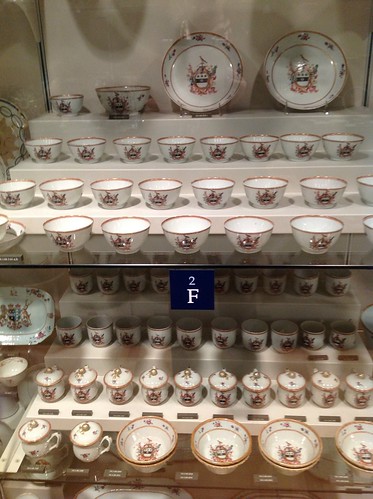
Guys in uniforms, plates on shelves: comes to the same thing. When you get ‘em all together, they create a mass that gives an authentic presentation of force, while a handful of guys in super-accurate to the last rabbtre stitch might not—at least, not unless they’re a detachment from a light company or a scouting party, right? And what, then, of context?
So what’s happening? Are we cutting fine distinctions between groups that are actually very similar? Yes. “This new unit and uniform is totally different from your established unit: our buttons have a different number on the center.”
That raises my hackles. The more we divide, the less we conquer. It’s harder to win when you purposefully make it harder and more elite, and that’s happening as the units represented become more obscure, smaller, and more insular. It’s starting to look like show boating.
It may well be that the politics of the existing units are so awful that you have to splinter, and splinter again, but I also know units that have multiple impressions … of the same unit that show change over time. Is the sole reason this is not possible to replicate in other units the politics of these groups, or is there a badge of rank, a sense of accomplishment and uniqueness (dare I say a sense of elitism?) that comes from splintering to form ever smaller cadres of like-minded men?
“Most of all, being hardcore means turning inward, ignoring broader society in order to create a narrower one. In that narrower society, one’s ideological convictions can matter less than conviction itself—a sense, however vague, of shared purpose. In the New York hardcore scene, a wide range of characters—from Rastafarians to Republicans, street rats to suburbanites—came to see themselves as part of the same movement. That flexible spirit lives on in the genre’s famous suffix, which is now used to tag an array of movements, not all of them musical: rapcore, metalcore, grindcore, nerdcore, mumblecore, normcore.”
Ranks upon ranks of porcelain. Open storage, Met Museum May 2013
This is what we may have now: reenactor-core, instead of corps, if we fail to see ourselves as part of the same movement.
Groups, like egos and porcelain tea bowls, can be fragile. If we could handle each other with greater care, we might get more fun out of this business.
Ultimately, though, what this all makes me think of, as I lose patience watching the TWD mosh pit, is Woody Guthrie. The women may be ahead of the men, if only because there are so few of us, we must work together.






 Kirsten Hammerstrom
You must be logged in to post a comment.