As you would expect from recent reports, the Young Mr has outgrown almost everything he owns, with the exception of his shirt. I put a lot of time into that blue wool jacket, so I’m not ready to sell it on Etsy yet, but I do have to replace it. Sewing new things means I get a chance to look again at sources for inspiration, and to do better this time around.
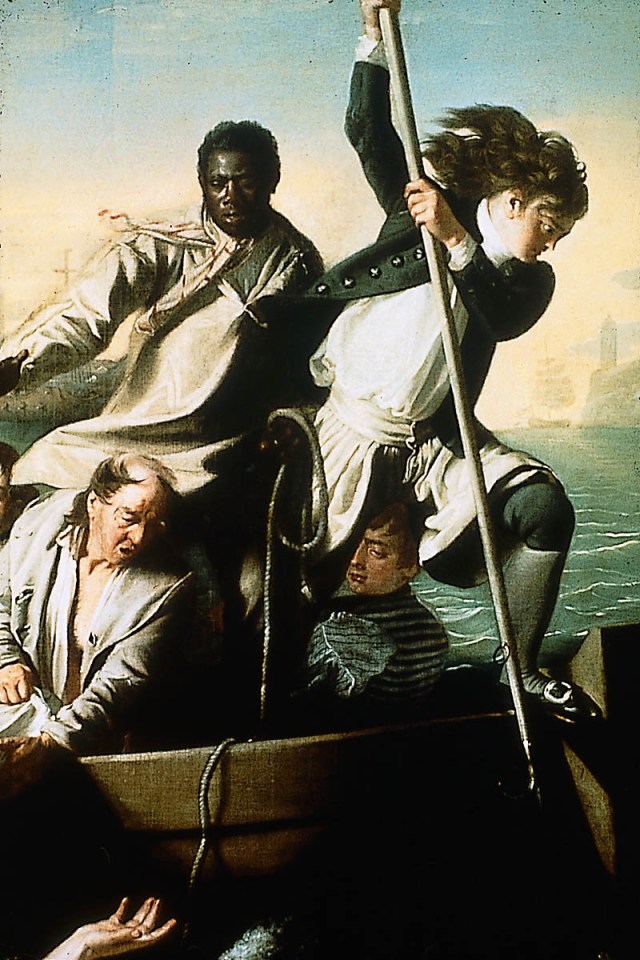
Since we’re in summer, I’m thinking blue linen, since I have access to very local inspiration in the form of Oliver Hazard Perry’s short jacket. But for earlier ideas, there’s Copley. I particularly like the horizontal stripe on the waistcoat, and what seems to be a striped shirt. Striped shirt! How exciting is that?
I’m thinking striped trousers, based on a Massachusetts letter, but we’ll see how far I get with that. The final deciding factor in wearing, of course, could be striped trousers are better than no trousers.
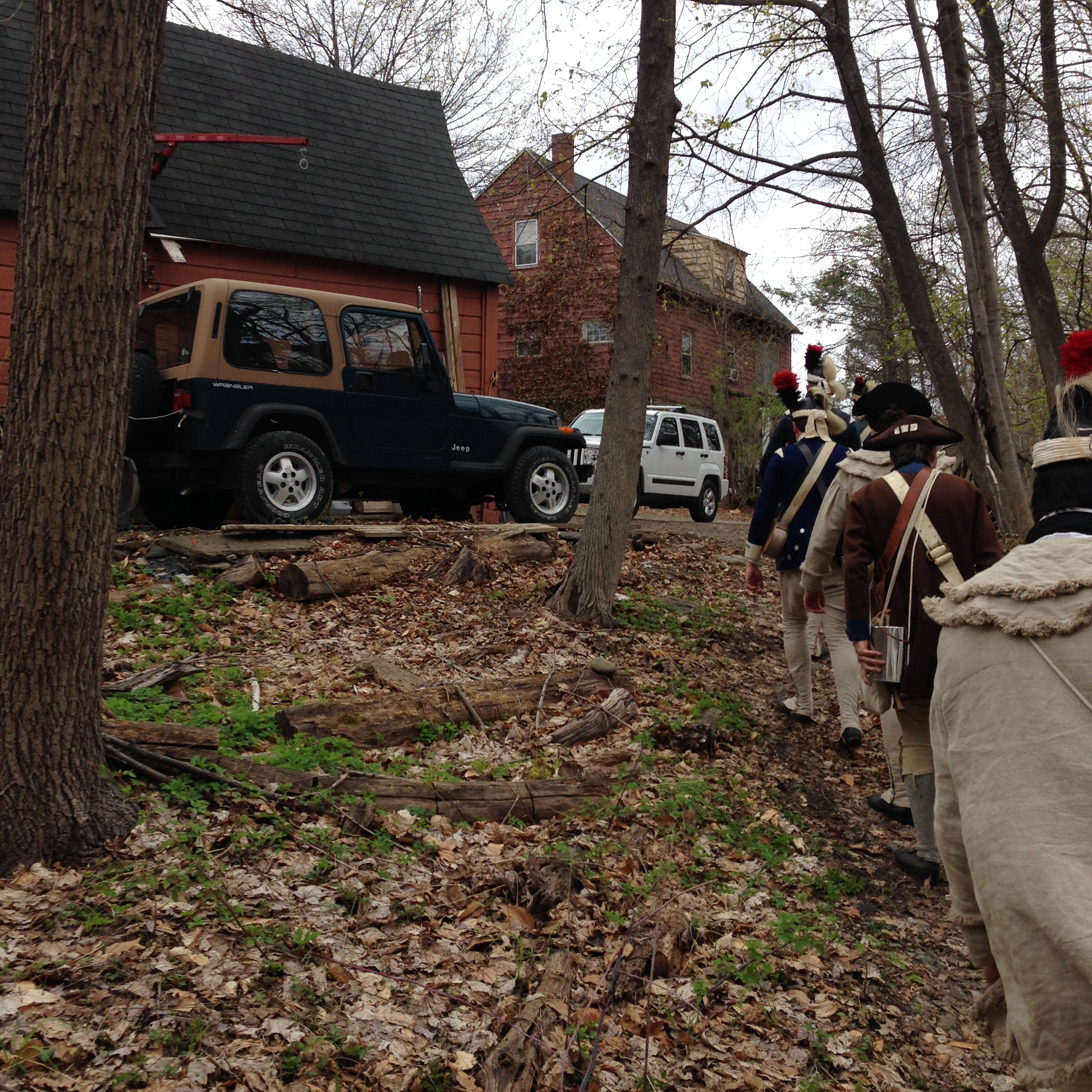
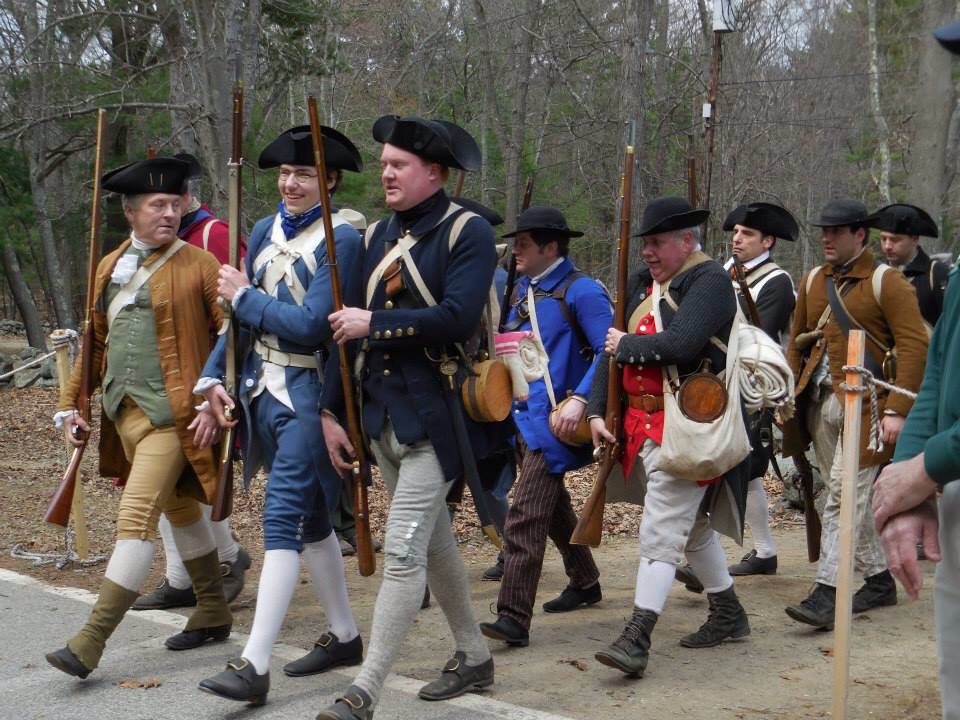
The School of Instruction is always interesting, and this year was no exception. One of my favorite activities is walking with the troops (well, behind). The experience is usually surreal, and the walk we took behind Knox’s Headquarters met expectations.
Clash of the Time Periods
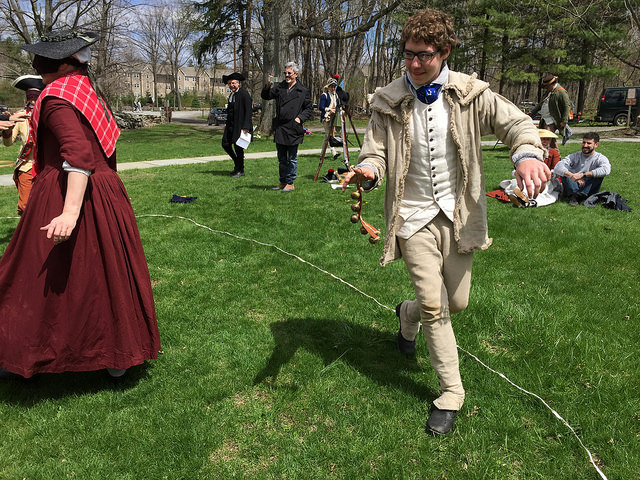
Knox’s Headquarters was a new location for us, with new activities: we played a Jingling Match, which resulted in as much giggling as jingling, and felt like the Walking Dead met the 18th Century.
Jingling without Giggling is the hard part
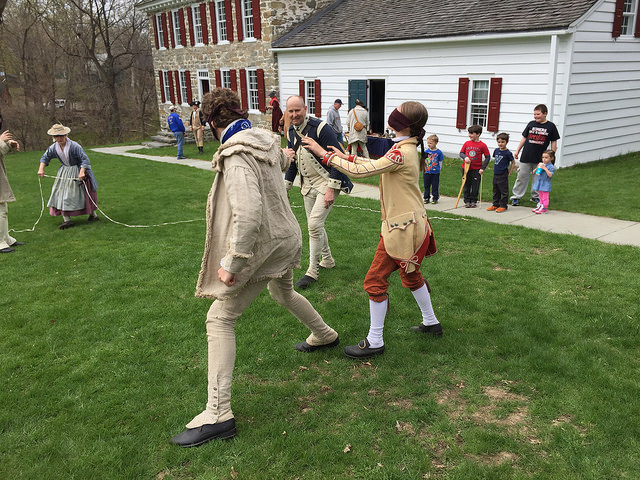
The game is pretty simple: mark out an area, blindfold as many as are willing to play, and set one without blindfold loose. The object is to touch the person ringing the bell, and it is a hilarious and merry game indeed, though I do agree with Mr McC that playing with a number of men full in their cups, or at certain sites (Stony Point comes to mind) would be too dangerous.
Still, it’s simple and fun, if a little Kubrickian when you first tie on the blindfold. The person who catches the jingler is the next one to taunt the blindfolded.
Next stop? Bell research, of course. I definitely want to play this in Newport later this summer.
Well, sort of. The Young Mr sported a brand-new, all-hand-sewn frock coat and breeches, as well as brand new size 15 shoes (thank you, USPS Priority Mail and Robert Land’s stock of the raraavis size 15.) He was spotted in photos that were shared with me later, and there he is, front and center, in his new, blue wool broadcloth suit. (I do like the side eye Mr C is giving as he checks on the second row.)
When he was dressed on Saturday, the Young Mr had a real presence. There is something about a suit that changes a man– well, in this case, a boy into a man. On the ride home, he told his father, “Now that I’m growing up, it feels weird to call you mom and dad. I think I should call you by your first names.” (I’ll wait here while you finish laughing. Yes, it is funny. No, we did not laugh at him.)
It’s a curious idea to us now, marking transitions with clothes. For some, coming of age is marked with a car or at least a driver’s license. For others, it may be a first job, or apartment. But once, stages were marked in clothing, as boys moved from gowns to breeches, and later from dresses to short pants to long pants.
Our clothing is so much less formal, that we are less accustomed in most cases to seeing men in suits. Even as young as I was in those last “Mad Men” years, I remember more formal times, and shopping with my parents, seeing coats marked up in chalk and thread for my father, and the ranks of shirts and heavy-hangered trousers and coats at Brooks Brothers downtown in Chicago. (I went there once as a teenager with a friend to buy a present for her father; we were not warmly welcomed in our punk clothes, but the glass cases were unforgettable.)
For the Young Mr, that kind of formality is lost. There’s not much point in buying him a modern suit: he’s all t-shirts and hoodies and hand-me-downs from a friend at work he’s rapidly growing past. He’d never wear a suit, except as he steps into the past, and his fittings happen in private homes or workshops, and not in front of a three-panel mirror.
The Young Mr steps into the past to step into adulthood, and comes back to a present where he has many more years and rites of passage before he will truly be an adult.
Thomas Cromwell, Hans Holbein the Younger. The Frick Collection,1915.1.76
At last it has arrived: Wolf Hall. I waited, and did not use a proxy server to watch it early. Just as well that I watch PBS online as I have, thus far, watched the first episode three times.
At last I can understand people’s enthusiasm for historical programs some of us seethe at and cannot watch: my knowledge of the Tudors and their material world is limited enough that I am captivated and not annoyed (except by Anne Boleyn’s wrinkled silk satin bodice, which is striking in its puckers) and I read the books when they came out, and have thus forgotten enough of the details to be merely annoyed and not enraged at changes. (Other, real, critics have caught the language changes in the scene with Wolsey; Mantel is better, of course.)
The third Wolf-watching was with Mr S, who was suitably impressed by the low-light filming. As a former photographer who did a lot of night photography, improper and unbelievable lighting in film does cause an outbreak of caustic commentary. Not this time (he merely noted the fill light on Liz Cromwell’s face in one scene). With 20,000 pounds spent on candles, the BBC did this one right– and lucky for them the advance in camera technology.
But forgot the astronomical cost of all those tapers, that’s not the point: the point is what was believable and how the staging and lighting were used. I believed Wolf Hall all the more because of the low light, indoors and out, matching the time of day. I know how dim it is to light only with candles, and what a pain it is to make them, and how expensive. Light is money, whether you’re paying Ameren, National Grid, or the candlestick maker.
Aside from Hilary Mantel’s brilliant stories and all those candles, what makes this Wolf Hall good television? You know what I’m going to say: the authenticity. No, there are no Tudor accents, late or otherwise; these folks use our vernacular. And excellent arguments can be had about the historical accuracy of Mantel’s characters.
“The dull palette used – presumably in conscious contrast to The Tudors – created an ambience which, at worst, was lacklustre or, at best, homely. And it is that homeliness that concerns me most.
The homely is unthreatening. So, we are invited to view a ‘Tudor world’ as we know it or, rather, as we would like it to be. For instance, I was struck by how classless the society was – social gradation seemed to have disappeared both in the interactions and the interiors. There was little sense (as there is in the novels) of the heavy distaste for a man of such lowly birth as Cromwell’s; there was limited hauteur in a Norfolk or, indeed, the king. Meanwhile, the buildings which were home to Cromwell – still, at this point a lawyer in Wolsey’s service – seemed to lack none of the late-medieval conveniences afforded to the higher born and bettered housed. This is a world which has been domesticated for us so that it is tame, familiar and quintessentially English.”
Anne Boleyn by Unknown artist oil on panel, late 16th century (circa 1533-1536) 21 3/8 in. x 16 3/8 in. (543 mm x 416 mm) Purchased, 1882. NPG 668 [Britain}I will say that I was struck not just by the cleanliness of everything in an age before detergents (the blacksmith’s yard is remarkably pristine) and the amount of stuff in Cromwell’s house, but also by the softness of class lines. An argument could be made that depicting that much background detail would distract from the larger story, that of Cromwell and Anne and Thomas More, and the dissolution of the Catholic church in England.*
I know Cromwell ended up with riches but on the BBC he seemed to start ahead of where I thought he was at the start of the novel, mercenary and mercantile background aside.
Still: the spirit of the story and of Mantel’s Cromwell seem well-drawn here, and that’s what makes the difference between a series of living Holbeins and a gripping tale. That’s also what makes the difference between museum mannequins and costumed interpreters: emotional authenticity.
No: you cannot get costume and material culture wrong and still claim emotional authenticity as your defense. But the factor that makes a good event or site great is the believability of the characters, and that means more than a lecture on fine details. It means understanding the past, and even admitting what we don’t understand, and seek still to learn.





 Kirsten Hammerstrom
You must be logged in to post a comment.