The recent BBC video making the rounds on social media got me thinking about how we live our lives, and what commitments we make to being our true selves, how we follow our bliss, if you will. It takes a lot of courage, willpower, and hard work to achieve one’s deepest inner dreams and although I have taken some steps towards mine, I have not let go all the way (as one does not when one is putting a child through college).
I think about this desire to be true to one’s own internal vision, and I think about my friend Justin, who found a place and fell in love with what he saw, past and future. It’s hard work to run a farm and a business, but Justin does it beautifully, with grace and integrity. What he achieves makes me ache with want, not for the house, or the frozen cat’s water dish, or the work, but for the courage.
Working with Justin pushed me into places where I found, if not fear, at least discomfort. As we said, It isn’t history till it hurts. The first What Cheer Day we ran, I remember standing behind the door on the second floor landing of the servants’ quarters, knowing it was show time. I looked at Justin and said, “What the hell have we done?” terrified to go out and “be” John Brown’s housekeeper. But, out we went, and it was amazing. That work inspired me to push myself harder, to try the things that scared me and made me uncomfortable. That’s where the meat is, and the truth: where things hurt.
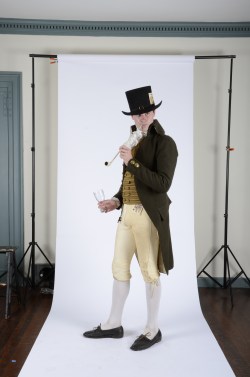
The housekeeper was caught reading naughty novels. Photo by J. D. Kay.
As with all things I tackle, I could push myself harder, not to sew better or more authentically (that’s the easy part, really) but to live the way I want to, authentically. To decide what matters and what doesn’t, and stick to it. That’s the real lesson of these men, and why they’re inspiring. I just happen to prefer the one with mud.
Print made by James Caldwall, 1739–1819, British, A Ladies Maid Purchasing a Leek, 1772, Yale Center for British Art, Paul Mellon Collection
“It is a truth universally acknowledged that if a bonnet existed in the 1770s, it was black taffeta” has long been the rule reenactors have followed, particularly those wanting to adhere to the strictest standards of well-researched impressions based on primary source documents and period material culture. Truth examined is more subtle, showing that bonnet colours, materials, and shapes varied from decade to decade—and year to year—and that these factors seem to have varied by region. What worked in Boston would not be comfortable in the Carolinas, and people adjusted accordingly.
I was asked recently about Boston-area bonnets in the first half of the 1770s. My impression of this decade is that it is one in which there is a stylistic change in women’s headwear, as the “sunshade”* and “Bath” bonnet terms fade from use, giving way to plain “bonnet” or “chip” bonnets. These appear to have been made from “bonnet paper,” seen in both blue and white** in newspaper ads, though prints and paintings show brims in both boned and paper forms.
The Rival Milleners. Mezzotint after John Collet, 1772. Colonial Williamsburg Foundation, 1955-125
Brim shape and bonnet material— fabric and colour– vary by period (and region). So let’s look at Boston in the first years of the 1770s. One tricky bit is that there are fewer indentured servants and enslaved people in Boston than elsewhere in the American Colonies in this period, so runaway ads are scarce, giving us fewer clues than we get in Pennsylvania and points south. Still, there are plenty of ads to help guide us.
The best statistics around for bonnets are currently tabulated for Pennsylvania, and definitely show the preponderance of bonnets are black (52 of 75 tabulated, or 69%). So don’t give up on black silk bonnets! They are the most common color. If we extrapolate these statistics, for a Pennsylvania event in the 1770s, of every 10 bonnets, seven should be black, one should be white, one should be green, and one should be blue. In larger groups, we’d also see red and brown bonnets, but again, just one in 20 or 30.
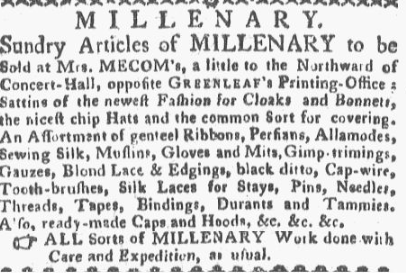
The Boston Gazette, April 4, 1774. Benjamin Franklin’s sister advertises “Sattins of the newest Fashion… for Bonnets.”“A few sarsnet taffety bonnets,” in the Boston Evening Post, September 28, 1772.
For Massachusetts, statistics are more difficult to compile, given the dearth of runaway ads and the fact that I haven’t yet dived into inventory and probate records. Merchants’ ads give us some clues as to materials, and one thing I find is that “sattin” shows up, as well as “sarsnet taffety” or pelong. Sarsnet or sarcenet was a “think transparent silk of plain weave,” according to Textiles in America. Thicker than Persian, sarcenet was woven both plain and twill, and could be plain or changeable. Pelong is a kind of silk satin, again according to Textiles in America, and in The Dictionary of Fashion History, described as a kind of “thin silk satin,” but I have also seen it described as a ribbed silk. Joshua Blanchard advertised “Pelong sattins of all colours” in 1768. Where does that leave us with materials? Probably with the need for more bonnets to be made of silk satin than of silk taffeta, though the proportions are difficult to calculate yet.
Miss Theophila Palmer (1757-1848), oil on canvas, attributed to Sir Joshua Reynolds ca 1770.
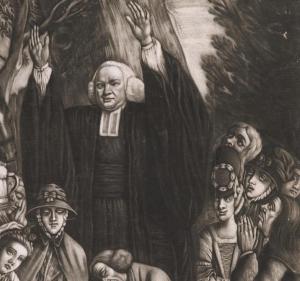
What about shape? For those dressing a la mode, we are past the deep-brimmed, small-cauled “lampshade” of the 1760s, and into a smaller, tighter bonnet with a larger caul and more trimming. In the portrait of Miss Palmer, we see how the brim stands away from the face, and the caul or crown poufs up. “A Lady’s Maid Purchasing a Leek” and “The Rival Milleners” (aee above) both depict women in similarly tight-brimmed and round-crowned bonnets trimmed with bows. These are shapes that I am confident appeared almost universally (with variations) in the American colonies in the first years of the 1770s. Now, there are different shapes to be sure, but these seem to predominate. I do think we need to see more brims that wrap around the head, as seen in the 1774 mezzotint of George Whitefield (Anglo-America’s most popular preacher) and his followers.
Detail, A Call to the Converted. Publish’d April 15, 1774, by W. Humphry . Lewis Walpole Library, 774.04.15.01+
So what’s the take away, if we are looking specifically at Boston and environs in the first half of the 1770s?
Most bonnets (70%) were black, but a few white, green, crimson, and blue were seen.
Most bonnets were made of silk satin, with others of taffeta or sarsnet (sometimes twilled silk).
Most bonnets would have a shorter, higher brim that curves across the face just above eye level, with a high, rounded crown/caul and bow trims.
Bonnet brims would vary between bonnet (paste) board and boned
Each place has a local style– which, if you think about it, is still true today. When I stand on the Metro platform in the red wool coat I bought in Providence, these folks know I’m not from here. The way we dress for the past should reflect the place and the time we are representing as best we can. And that means we need accessories to match those times and places, as well as clothes.
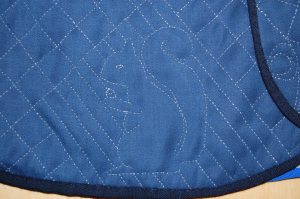
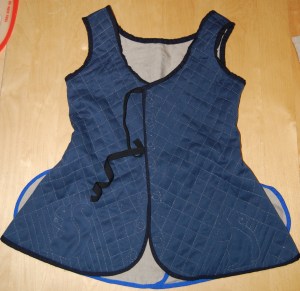
I updated that garment and wore a nearly-completed version at Ti last February but never wrote about the new version: the Squirrel Waistcoat.
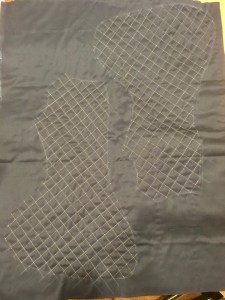
Wool hand-quilted to a wool backing and lined with wool, I wore this almost finished at Fort Ti last February, and found it comfortable and cozy. I had imagined its state to be far worse than it was: with a lining in need of piecing, mangled seams, your worst nightmare come true. But no: all it really needed was some binding adjustment, not surprising considering that I stitched the binding by candlelight while chattering away with friends over cider.
The back pieces weren’t bound at all, but because I’d imagined this needed so much more work than it did, I put it aside until now, when I know I will want it for a weekend in Trenton, and another at Ti in December. All it took was a little time, and accepting that the bindings will not match.
This wasn’t a long, involved project, really, though I spent lunch hours and evenings working on it last January and February. It is, as so many things are, about patience. Patience and good needles.
The construction was based on the quilted waistcoat I made two years ago, with a pattern derived from Sharon Burnston’s research, using fitting adjustments I’d made to an earlier jacket pattern (long since abandoned due to living in New England).
I don’t fully remember how it fits best, over or under my stays, but I’ll get a couple of opportunities to test drive the layers in the next two weeks. And in the meantime? Squirrel!
My assistant misunderstood the exercise, and is disappointed that we will not be turning the government over to him.
Data Cat says it’s clear: Cats Rule.
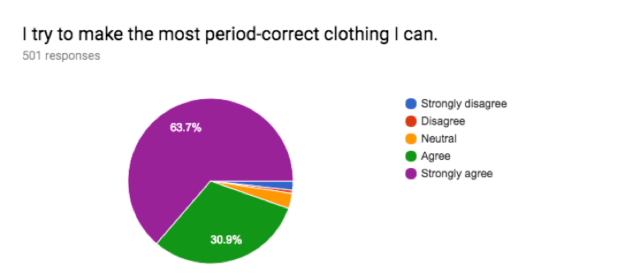
What is clear is that 501 people from around the world (really: people responded from the US, Canada, Australia, Europe, Great Britain) were interested enough to see what we could find out by asking questions about what, how, and why we make and wear these funny clothes. I’m immensely grateful that Google tools are easy to use, as I can present Graphs Without Tears:
Here’s how that breaks down: Strongly disagree: 1.8%
Disagree: 0.6 %
Neutral: 3%
Agree: 30.9%
Strongly agree: 63.7%
That is, 94.6% of respondents agree that they try to make the most period-correct clothing they can. The “strongly disagree” folks (9 of them) are interesting to me, because it’s a position that’s foreign to me. (This is why recording your email was an option, so I could clarify the data.)
Next, let’s look at Authenticity:
Here’s how that breaks down: Strongly disagree: 2.6%
Disagree:.2 %
Neutral:1%
Agree:32.3%
Strongly agree:63.9%
And on the use of Primary Sources:
Yes: 94.4%
No: 5.6 %
When I dug into what sources people use, and consider “primary sources,” I realized I have more questions to ask, and there are some folks who could use some research help. Not handed to them on a plate or in a slideshow, but in terms of process, and in recognizing primary versus secondary sources, and how they can be used together for maximum understanding.
Then I asked, Why is documentation important to you?
Those responses will also inform another round of questions. Many were very revealing of thought processes and approaches; some made me a little sad. A couple of people said, essentially, I don’t want other reenactors to laugh at me. I think we can do better than that, right? Let’s try empathy on for size, and be as helpful as we can in guiding people to an understanding of what they want to do, and how best to go about it.
Because the answers varied in length, I started reading them to discern the essence of the response, and I came up with five categories; the sixth slice represents the answers left blank.
Accuracy: 73.4%
Immersion: 11.6%
Learning: 6.1%
Respect (of ancestors, history): 4.0%
Personal (fun; satisfaction): 0.5%
No answer: 4.5%
Accuracy is the main reason documentation matters to people, and they gave good answers for why accuracy mattered.
I want to have the resource itself, rather than someone else’s interpretation of it. If everyone bases their impression off of somebody else, rather than going to the source first, it becomes a game of telephone.
It’s like medical documentation. If it’s not written down, it didn’t happen. There’s enough open source imagery and documents on the internet, let alone physical ones or surviving garments, that there really is no excuse for wild supposition.
Because everything else is unsubstantiated conjecture or hearsay and feels inauthentic to me and to those around me.
Because I use my impression to communicate about history, and history is grounded in factual, accurate information.
Documentation is the truth behind the fiction of a living history impression.
Immersion had interesting answers, too:
I want to accurately portray my impression for the public. As an added bonus, wearing the correct clothing and using period correct items, helps me connect with the people I portray on a personal level.
Because the point of living history (to me) is to recreate the past enough to learn from the visceral experience of *living* it, so it needs to be pretty accurate! Documentation is how I can know if what I’m doing is accurate (or close to accurate).
It tells us a lot about the larger picture of what was going on: trade, manufacturing, diplomacy, economics
Learning: Because if we’re teaching people history, teaching them something that’s wrong is a disservice and an embarrassment on our part. We have the ability to learn what’s correct.
Researching and documenting my impression is why I am proud to put on my clothes. I enjoy the challenge and detective work that comes before I ever cut into any fabric.
Respect: We owe it to our ancestors to tell their stories as accurately as possible.
For the class of person I represent, documentation can be very difficult to get at. Some documentation indicates that the garment(s) in question possibly existed, 3 pieces of documentation is ideal, but 2 will sometimes do, depending on my instincts about something. I have regretted only going for two in the past because my intention is generally to represent something very common. Documentation is important because it shows respect for the historical people I am trying to represent, it shows respect for my own work and time and it shows respect to the hobby (which, in historical circles, is often far more important than people give it credit for).
There’s a lot to think about in considering what you all think about, and I am really grateful for your help! As I look at the answers over the next days/weeks, I’ll let you know what else I see, and once I figure out how to ask the next round, there will be more questions! Thanks again! (And if you didn’t get to participate this time, no worries: you can join in next time; the easiest way is to follow the Kitty Calash FB page, but I’ll also post a link here.)
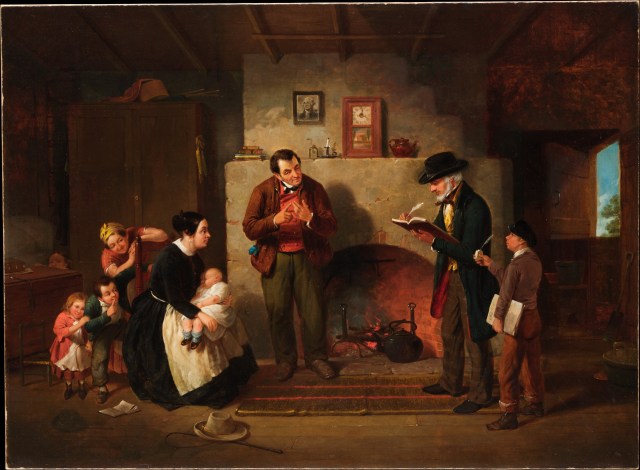
Taking the Census. oil on canvas, 1854. Francis William Edmonds. Gift of Diane, Daniel, and Mathew Wolf, in honor of John K. Howat and Lewis I. Sharp, 2006 2006.457 Metropolitan Museum of Art.










 Kirsten Hammerstrom
You must be logged in to post a comment.