Frivolous Friday: Flip your Lid

Print. Drypoint by John Theodore Heins, Jr. 1747-1771. British Museum 1858,0417.362
Drypoint by John Theodore Heins, Jr. British Museum 1858,0417.362

Bonnets. Who doesn’t like them? They’re the cupcake of costuming, just enough sugar to be delicious, not enough trouble to count. I know I have far too many, they fall from the hall shelf nearly every time I get my coat.

But I started asking myself questions about bonnets when a friend asked me questions about bonnets: shape, color, and how they’re worn (rakish angle? pulled down low?).

We’re planning on going to an event in March, and I’ve been thinking about head wear, especially bonnets. Now that the question’s been asked, I don’t want to randomly cram black silk taffeta on my head and call it a day: I’m back to “don’t know mind.” Time to start looking. So far, I’ve searched the Tate, the British Museum, the National Portrait Gallery UK, the Lewis Walpole Library, the Yale Center for British Art, the Met,  the V&A, and the BBC’s Your Paintings site.

I started at the British Museum. Here are the results for a collections search using the term bonnet and the production dates 1765-1772.  Hmm. No classic black bonnet. Dammit, actually, because I really like mine.

Print made by James Caldwall, A Ladies Maid Purchasing a Leek, 1772, Line engraving and etching Yale Center for British Art, Paul Mellon Collection. B1977.14.11105
James Caldwall, A Ladies Maid Purchasing a Leek, 1772, YCBA, B1977.14.11105

Yale Center for British Art, same search parameters. I know you know this print.

Man, this is a pain, right? Where are the bonnets? 1772 is actually too late for my purposes in this instance.

The Lewis Walpole Library Digital Collections lack a feature for limiting or sorting by date, but they tag bonnets in their prints. Still: no big black bonnets in early prints.

I’m starting to think it’s lampshade or saucer for the 1765-1770 period. You remember lampshade, don’t you? One of my post-operative slightly narcotized creations based in part on the Marquis of Granby (Relieving a Sick Soldier).

The Marquis of Granby (Relieving A Sick Soldier) Oil on canvas by Edward Penny after 1765 (c) Royal Academy of Arts
The Marquis of Granby (Relieving A Sick Soldier) Oil on canvas by Edward Penny after 1765 (c) Royal Academy of Arts

Lampshade seems pretty fashionable in 1760. There are more portraits at the National Portrait Gallery (UK), but bonnets are scarce in them, primarily, I suppose, because they are not indoor wear.

Lady Fenoulhet is wearing a lampshade. Nelly O’Brien is wearing an interesting, more hat-like device. Her imprint is ca. 1765-1780, but other impressions are dated ca. 1760. The 1762-1764 seems plausible. But that’s still early for my purposes. The lampshade really is, too; Mrs Mary Smith of Portsmouth may be wearing one, but considering that the artist who drew this plate died in 1766, I think we can place this form in the 1750s to early 1760s. Lampshade is too early. The”Lady’s Maid buying a Leek” is too late.

Next, please.
Transparent Visions

With armloads of cash, the NPYL has, as I’m sure you know, digitized thousands of items which are now available on a ridiculously procrastination-worthy (it’s research, I tell you) site.

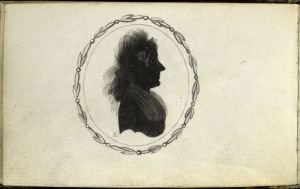
Carl H. Pforzheimer Collection of Shelley and His Circle, The New York Public Library. (1795 - 1834). Portrait silhouette.
Carl H. Pforzheimer Collection of Shelley and His Circle, The New York Public Library. (1795 – 1834). Portrait silhouette.

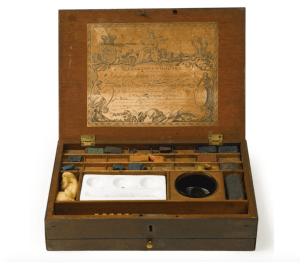
In my current quest for watercolor boxes and miniature inspiration, I found the Anne Wagner album particularly interesting. The pages in the book compile verses, mottoes, collages, locks of hair, and a portrait silhouette. In all likelihood, Anne Wagner had a watercolor box not unlike this one coming up at Sotheby’s on Thursday.

Lot 738, Sotheby's Sale N09466 REGENCY MAHOGANY PAINT BOX BY W. REEVES & WOODYER, FIRST QUARTER 19TH CENTURY
Lot 738, Sotheby’s Sale N09466
REGENCY MAHOGANY PAINT BOX BY W. REEVES & WOODYER, FIRST QUARTER 19TH CENTURY

Every young lady of some means would have had a watercolor box suited to her station (they came in a variety of sizes), and young ladies with leisure time occupied themselves with diaries, commonplace books, amateur silhouettes, and paintings. Diana Sperling is one of the better-known examples of amateur artists, with drawings occasionally appearing at auction. The best of these watercolors give us a literally transparent look at the long 18th century from inside.

 May 25th. Henry Van electrifying - Mrs Van, Diana, Harry, Isabella, Mum and HGS. Dynes Hall.
May 25th. Henry Van electrifying – Mrs Van, Diana, Harry, Isabella, Mum and HGS. Dynes Hall.

Museums try to connect the people of the past to the people of the present, and sometimes in focusing on similarities critical differences are missed.

It’s not just that the people of the past accepted racism, slavery, and sexism. They literally saw the world differently. I’ve watched contemporary amateur artists try to recreate the imagery of the past, and it’s hard. I wonder, as I try my own had at the task, if we can manage it. Color sensibilities were different; taste was different (checks from hell, remember?). My own style is more graphic and bold than an 18th or 19th century artists’– more Fairfield Porter than Edward Malbone.

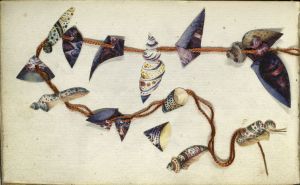
Carl H. Pforzheimer Collection of Shelley and His Circle, The New York Public Library. (1795 - 1834). Threaded shells.
Carl H. Pforzheimer Collection of Shelley and His Circle, The New York Public Library. (1795 – 1834). Threaded shells.

We are, each of us, products of our environment and our time. Can we really recreate the past? We can dress correctly, carry the right stuff (or almost no stuff at all), but how can we overcome our own thought barriers, our own vision? I think it’s by attempting that effort that we can do better at replicating the past whether we try in four dimensions, or in two– and acknowledge the unbridgeable gap to the past.

Back to Basics

Landscape with Rising Sun, December 1, 1828, 8:30 a.m. Artist: Joseph Michael Gandy (British, London 1771–1843 London) Date: 1828 Medium: Watercolor over graphite on white wove paper Dimensions: sheet: 4 3/16 x 6 3/4 in. (10.6 x 17.1 cm) Classification: Drawings Credit Line: Harry G. Sperling Fund, 2005 Accession Number: 2006.46
Landscape with Rising Sun, December 1, 1828, 8:30 a.m. Watercolor by Joseph Michael Gandy. Metropolitan Museum of Art, 2006.46

Despite the assertions of Mr Eliot, I find December to be the cruelest month. In each of the past five years, December has brought me drama if not disaster, usually on a grand scale. After the immediate crises passed, I tried to figure out what I could learn, really, from the things that happened.

Scandinavian tradition puts the start of Jul at the solstice, and here we are: at the moment when it’s traditional to stop the spinning world to consider where we are, where we want to be, and what we really want. (Hint: It’s not a toaster.)

I write a lot about authenticity, and after The Noble Train, I thought about how authenticity isn’t just in what we wear, or carry, or eat, or how a day is run: it’s also in who we are. The way some of us are made, we cannot be other than who we are. It’s akin to the real thing: you know when it’s right, and it matters.

Finding the real and the true isn’t easy– brass ladles, shawls, love, yourself– it takes time to develop a good eye, and honesty often hurts.

IMG_5534

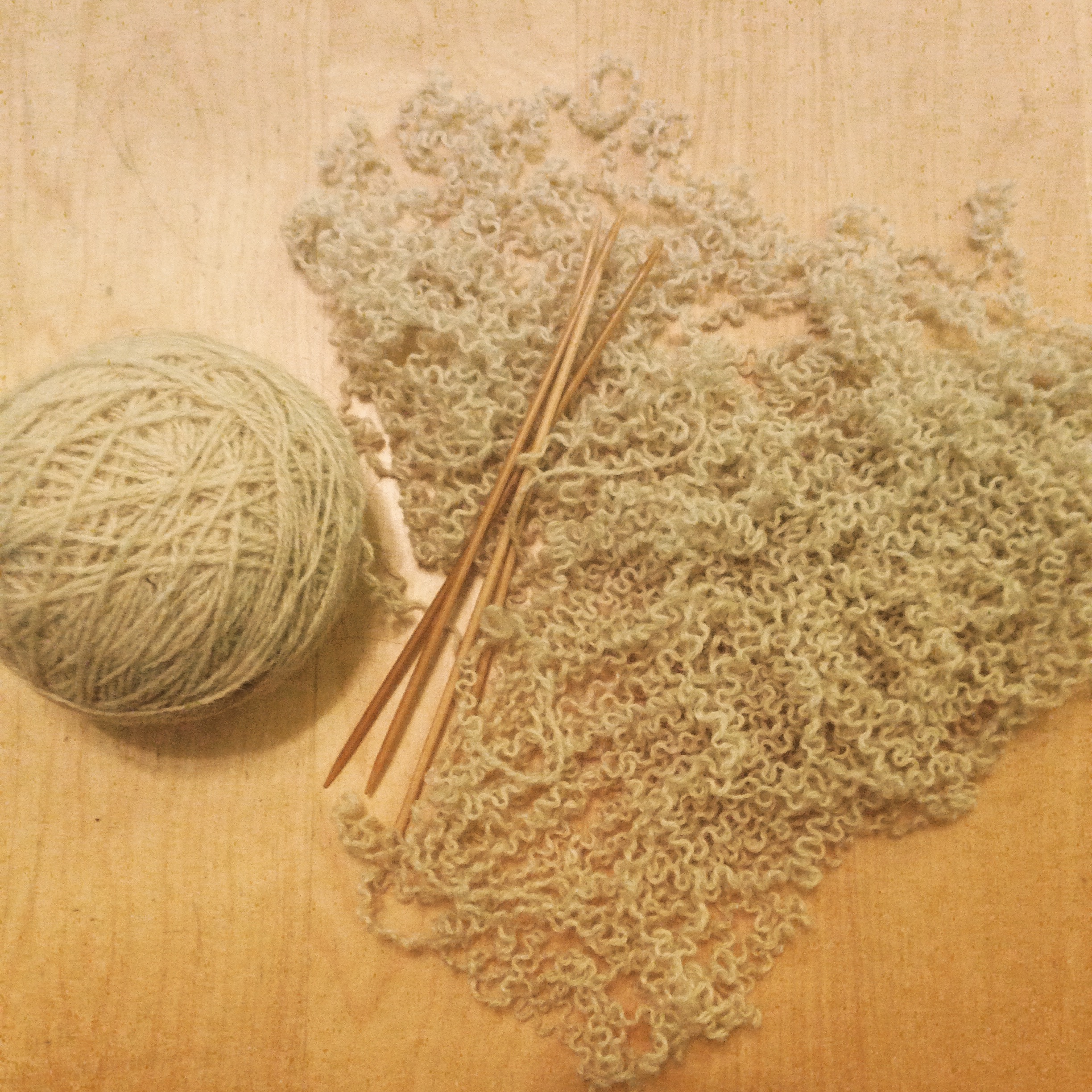
Taking apart the things you’ve made isn’t easy, but sometimes that’s the only way to get them right. Mr Hiwell learned that setting linings and making mittens. Sometimes the things you must take apart aren’t tangible, but are concepts, organizations, or beliefs. That work is much harder than undoing and redoing a sleeve seam or taking apart and recutting a box lid, or frogging a stocking.

If you’re a consistent reader, you know I won’t tell you what to wear, or carry, or eat. I’m much more interested in helping people figure out what questions to ask than I am in giving answers. It’s what we don’t know, and the assumptions we overturn as we learn more, that makes living history– and living– worthwhile to me.

IMG_5557

So while I don’t encourage you to reduce your actual house to stone walls alone, I do encourage you to question your house of assumptions, and the why of the things you do.

Lysistrata on the Lake (and elsewhere)

Let me be clear: Fort Ti was amazing. It was everything I’d hoped for. Far away, made of stone, populated with people I like, with an event cleared of all the crap that makes me crazy.

File_000 copy

The issues that enrage me are both societal and hobby-specific.

While boys were boys and women were women this past weekend, I found myself tired out by biologically deterministic behaviour. For the love of Christ, you can listen to a woman, not talk over her or interrupt her even if:

a) she is not your boss or mother
and/or
b) you do not want or expect to sleep with her.

Gentlemen: we are human beings as smart as- if not smarter– than you. If we are smarter, society has taught us to manage that for you, so you won’t feel <ahem> small. I know that what men fear most is humiliation (the bravest ones will admit it) and what women fear most is violence (it’s true).

But a woman’s interest in history, or even military history, should be as joyous to you as your male friend’s interest.

So why the shouty?
Why the taking over of the conversation?
Why the relegation of women to a separate bench?
Why am I pointing this out?

Well… because even some of the best progressive reenactors have trouble getting past uber-traditional gender roles.

I get it, really, I do. I am accustomed to being a woman in a (hyper manly) man’s world.

I studied sculpture in college in the Dark Ages and I know from male-dominated fields. I ran a foundry in grad school, and a bunch of mostly-male work study students. I’m an owner’s rep for construction projects, and work with a lot of different contractors and construction workers.

But that doesn’t mean I have to like it or tolerate it, as any of my history, art, or construction associates will tell you. My younger counterparts have even less tolerance than I do, so I advise you to listen up, think about gender roles, gun shows, assault/predation and interpretation or consider Lysistrata the future you have earned.

It’s really simple.

You like living history?
We like living history.

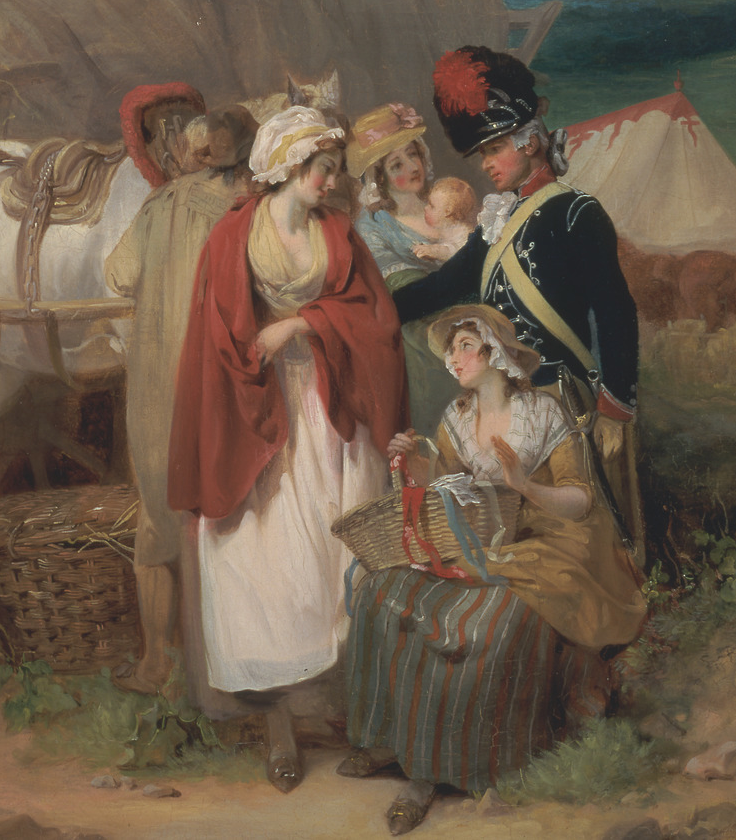
Francis Wheatley, 1747-1801, British, Soldier with Country Women Selling Ribbons, near a Military Camp, 1788, Oil on canvas, Yale Center for British Art, Paul Mellon Collection

Let’s play together better to more accurately represent the past without replicating crappy gender relations. If you start listening and stop interrupting, we’ll stop laughing at you.