Auction Season: The Holiday Sales

Screen Shot 2018-12-05 at 6.34.13 AM
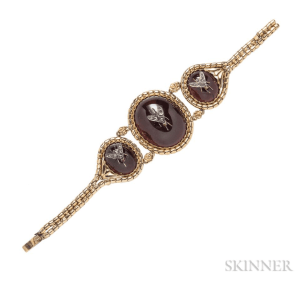
Lot 1159 Antique Gold, Carbuncle Garnet, and Diamond Bracelet. Yes, those are rose-cut diamond flies.

First come the jewelry sales, the big guns like Sotheby’s leading the way with sales as crazy as Marie Antoinette’s jewelry (Royal Jewels from the Bourbon Family of Parma, technically, though it sounds more like a delicious lunch than a sale), but the smaller houses play, too. Skinner’s sale closed December 5, Freeman’s earlier, but later than Sotheby’s. These are not sales I bid in, but they are places to see things you’d might not otherwise see. Garnet bracelets with rose-cut diamond flies? Not something I see gracing the wrists of my fellow Metro riders or grocery shoppers.

Screen Shot 2018-12-05 at 6.41.39 AM
Lot 7, Contemporary painted tin hat trade sign, 20th Century. 7″ x 13.25″

Once the serious stuff has sold, the fun begins: the toys! Pook and Pook’s two-day toy sale begins December 7th, and you might call it whimsies and toys, since it begins with shop signs. Who doesn’t want an enormous tin hat? What’s the point, you ask? Why look, if you don’t collect? Because you can collect– information, screen caps of reference images, ideas for things to make, and a visual reference library to fill in the blanks of what you read. The steam engine that breaks in The Railway Children seemed crazy to me as a child, and I assumed it was just a model of a steam locomotive. But no: there were steam toys and accessories, from lighthouses in moats with Indians in sailboats to working looms to….steam locomotives.
Screen Shot 2018-12-05 at 6.52.23 AM
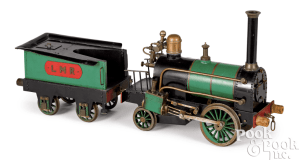
Day Two, Lot 521, Large Bassett Lowke live steam train locomotive and tender, 3 1/2″ gauge, engine – 13 1/2″ l.

The darling thing even looks like Percy, filling in the gaps of the origins of Thomas the Tank Engine, Edwardian children’s stories, and the wonders of the steam age (which you can replicate, if you choose). Hard to believe, in our age of safety, that steam engines might be de rigueur in the parlors of well-to-do Victorian and Edwardian families. (Perhaps your childhood was not as full of E. Nesbitt, Kenneth Grahame, and Arthur Ransome as mine, but if your mother’s primary caregiver was born in late 19th-century Great Britain, you might grow up with an attachment disorder and a taste for fabulist literature of the early 20th century.)

Day One, Lot 230,
German dressmaker and milliners shop room box.

And then there are the dioramas or room boxes, many, if not most, German. These early 20th-century displays give us a sense of the kinds of craft or hobby activities people enjoyed, front-facing dioramas. I think you either “get” them, or you don’t; not everyone wants a miniature world to control or fantasize about, but from the perspective of someone trying to understand what the past looked like, these can provide a three-dimensional view of what are usually only black and white images. Are they perfectly correct? No. But they do give us a sense of the kind of visual stimulation people encountered and enjoyed shopping and playing.
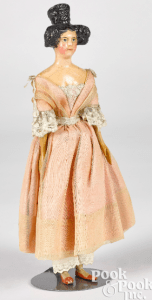
Day One, Lot 220, Papier-mâché milliner’s model doll.

There are dolls, always divisive (they’re creepy or cute, few folks fall in between) and they have they own usefulness. None in this Pook sale tell us much about early toys, but there are a couple of early 19th century examples to remind us of what children played with in the past, and how new fashions were disseminated. In the case of the milliner’s model doll at left, we get a good sense of the Apollo’s knot hairstyle, and a pair of red slippers I would love to have. The back view is equally useful, for it is only with three-dimensional objects (dolls or sculpture) that we can get a complete sense of a hairstyle or costume. With enough looking, you can extrapolate, but there’s nothing like being able to see the past in the round. That’s even better than the telephone-book-thick catalogs from Sears and J.C. Penney that arrived before the holidays in decades past.
High Style/Low Brow

It’s auction season again, the best one of all: the major Americana sales and the Winter Antiques Show in New York. I won’t be at any of the exhibitions or sales, which is just as well for me; my friends know the twitchy “must-touch” finger motion that means I need to leave my wallet and checkbook in wiser, saner hands.

Still, even if we can’t buy, we can learn. This time around, I was delighted by the juxtaposition of two pre-1750 paintings in the Sotheby’s sales.

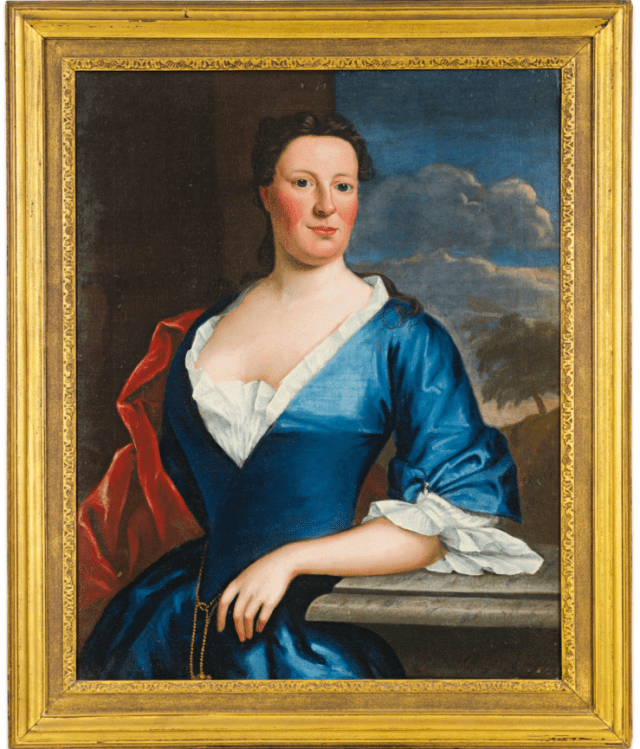
First, the ever-delightful Robert Feke’s portrait of Mrs Tench Francis.

Robert Feke (1707 - 1752) PORTRAIT OF MRS. TENCH FRANCIS In what appears to be the original frame; Bears a label on the back of the frame: Mr. Willing, Bryn Mawr. Painted circa 1746. Label on the back of the stretcher: Philadelphia Museum of Art, Robert Feke, Portrait of Mrs. Tench Francis, 11-1969-2. Lender: Mr. E. Shippen Willing, Jr. Oil on canvas 36 by 28 1/2 in. Sotheby's Sale N09456 Lot 1595
Robert Feke (1707 – 1752)
PORTRAIT OF MRS. TENCH FRANCIS
In what appears to be the original frame; Bears a label on the back of the frame: Mr. Willing, Bryn Mawr.
Painted circa 1746.
Label on the back of the stretcher: Philadelphia Museum of Art, Robert Feke, Portrait of Mrs. Tench Francis, 11-1969-2. Lender: Mr. E. Shippen Willing, Jr.
Oil on canvas
36 by 28 1/2 in.
Sotheby’s Sale N09456 Lot 1595

Francis. Shippen. Willing. This thing is DEEP in the history of Philadelphia, and by my fave 18th century RI painter.

But does she Remind you of anyone? Like a Smibert, maybe? Or perhaps it’s a Copley?

It was a THING, that blue silk gown business with a red silk wrapper. Better yet? This one:

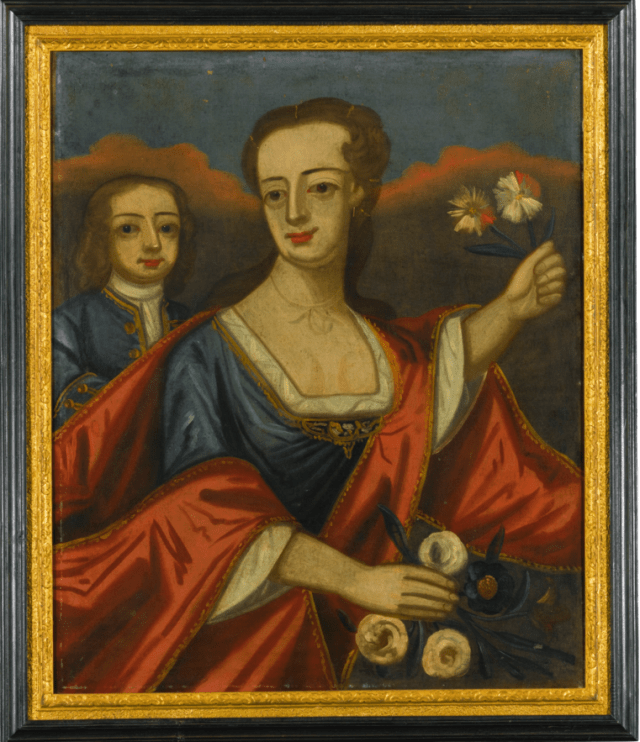
Attributed to J. Cooper 1685 - 1754 WOMAN WITH YOUNG BOY Appears to retains its original frame attributed to J. Cooper. oil on canvas 30 in. by 25 in. CIRCA 1715. Sotheby's Sale N09466, Lot 398
Attributed to J. Cooper 1685 – 1754
WOMAN WITH YOUNG BOY
Appears to retains its original frame attributed to J. Cooper.
oil on canvas
30 in. by 25 in.
CIRCA 1715. Sotheby’s Sale N09466, Lot 398

What I love about the J. Cooper is how crude it is: that painting looks more like a woolwork picture than a painting. But that vernacular adaptation tells us how prevalent this portrait style was, and how desirable.

Smells Like Money: Must be Auction Season

There’s nothing like a little frivolity to lighten your day when you’ve been pondering some really serious and stomach-churning topics. Hail, then, the arrival of the Sotheby’s catalog and the momentary dropping of all material culture pretenses.

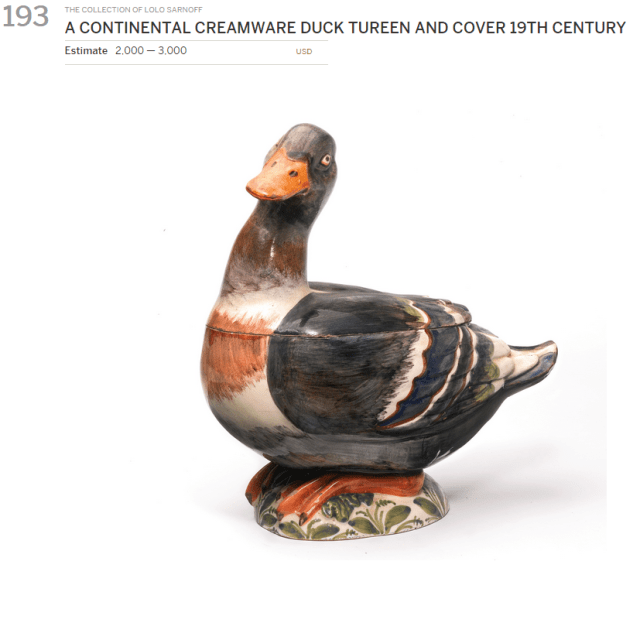
This time, it’s Private Collections.  You say Private Collections, I say Disturbing and Hyper-Overpriced Gift Shop. But what does Snarky Duck say?

A Continental creamware duck tureen and cover.  Duck ways, no more hot soup, please.
A Continental creamware duck tureen and cover. Duck says, No soup for you.

Poor Strangled Parrot: I don’t think he can say much.

A Holitsch parrot-form jug and cover ca. 1760.

And these guys, described as playful dogs, look more like dyspeptic pugs to me.

A pair of Hochst fayence figures of seated pugs ca 1770.

It is amazing what people will make and buy (which delights me), and I’m certain that things I own would astonish and appall someone with different taste. But animal effigies always intrigue me, and (aside from Snarky Duck, our 19th century friend) figures like these could have graced the mantels and tables of the finest homes of the 19th century. It would have been a crowded and raucous world.

Here’s the whole catalog, should you care for some ormolu chairs or Aubusson drapes (which I did not know existed until today).

Frivolous Friday: Whitaker Auction Waistcoat

It’s so nice to have enabling friends. If it’s not one tipping me off to a sale on fabric at Williamsburg (over now, keep calm) it’s another tipping me off to costume auctions.

My most recent tip-off came from Mr Cooke, about the Whitaker auction coming up April 25 and 26 in New Hope, PA. There are some very nice things from the collections of the Met and LACMA coming up in that sale. It’s hard to understand deaccessions from the outside, so I won’t comment on that part of the sales.

Unmade waistcoat ca. 1790. RIHS 1990.36.15

I was particularly taken with this waistcoat.

The lapel embroidery and button details remind me very much of an uncut dimity waistcoat in the collection of the Rhode Island Historical Society.

Whitaker’s got copyright notices on their images, so I won’t post them here, but I can assure you, the visit will be worth your while. But my tip to you is this: forget those estimates– from what I’ve seen lately, they’re all too low by a factor of 10.