Jonkheer Gijsbert Carel Rutger Reinier van Brienen van Ramerus (1771-1821), met zijn vrouw en vier van hun kinderen, Adriaan de Lelie, 1804
Perhaps because I just finished Longbournand have just startedYear of Wonders, servants are on my mind.
In the family portrait at left, the servants are visible (just) to the right of the tree.
The man and woman almost literally mirror the main subjects, Carel Rutger Reinier van B can Ramerus and his wife, positioned as they are in opposite relationship to each other. The servants, too, are surrounded with life, carrying a child and dogs and game.
The woman is holding the infant of the van Ramerus couple, and even without Google Translate (that’s “four of their children”) we can figure this out. How? Because the child is held away from her body, and faces forward. It is a slightly odd arrangement, with the infant so peripheral to the main image, but we’re fortunate, because this composition allows us to see the servants.
Class distinctions are clear in the dress: the female servant wears a cap, kerchief and short gown, the male servant-gamekeeper, perhaps–wears breeches and a jacket from the pervious century, as well as a cocked, and not a tall, hat.
It does remind me strongly of the imperative to continue a family line, and the lot of women to breed and produce male heirs. For all that I love the past, I know I could not live there easily.
I’ve been following the Times’ “Arts Crush” series, and one of the best, and best-written, in the series has been Holland Cotter’s piece on poetry and the MFA. Cotter’s writing is always elegant and accessible, with an amazing ability to render high concepts simply. (I wish he’d taught my graduate seminars in art theory…) The series inspired me to think about my first visual arts crush, and how it still resonates today.
I grew up on the North Side of Chicago, in the actual city, not Ferris-Bueller-land. By the time I was in high school, I had a pretty free-range existence thanks to the Chicago Transit Authority, and rode the bus anywhere and everywhere, even up to the southern edge of Bueller-land, also known as Evanston.
Mrs. James Ward Thorne American, 1882-1966 A17: Pennsylvania Kitchen, 1752, c. 1940. Art Institute of Chicago
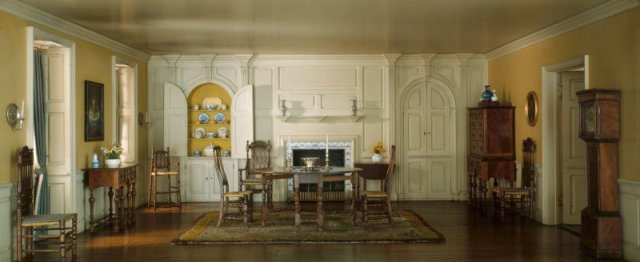
Mrs. James Ward Thorne American, 1882-1966 A3: Massachusetts Dining Room, 1720, c. 1940. Art Institute of Chicago.
There’s a lot to love in the AIC, from classic Impressionists to post-war Abstract Expressionists, but when I was in grade school, what really made an impression on me were the Thorne Rooms. The Thorne miniature rooms are meant to be the most accurate 1/12 scale representations of historical interiors. It will not surprise you that I pressed my 10-year-old nose against the glass of the early Pennsylvania rooms, or the high-style Rhode Island rooms, wishing desperately that I could shrink and slip through that solid membrane and inhabit the world the rooms depicted.
Mrs. James Ward Thorne American, 1882-1966 A11: Rhode Island Parlor, c. 1820, c. 1940. Art Institute of Chicago
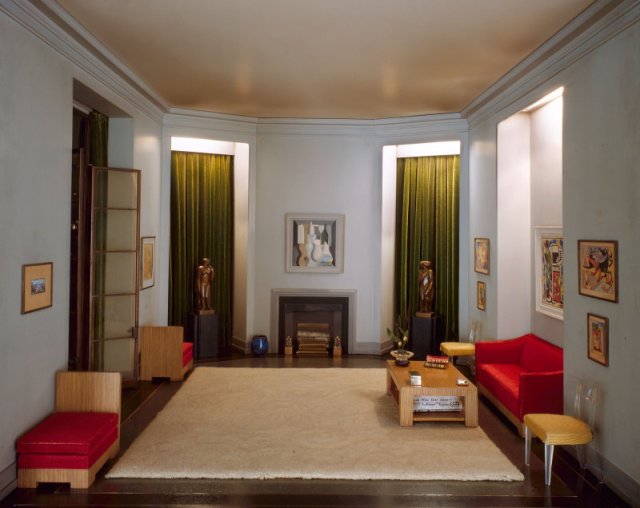
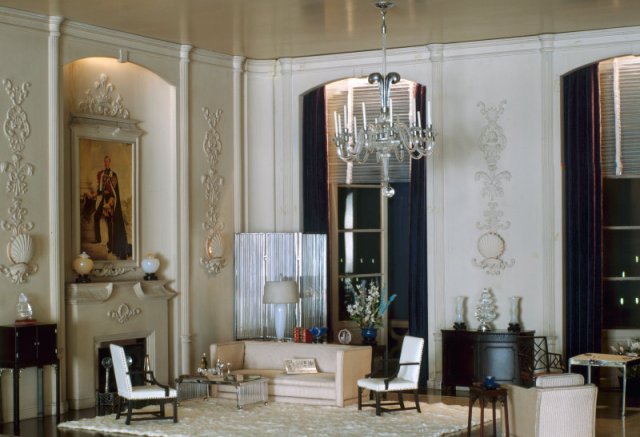
My mother and I would play a game: Which is your favorite room? Which one would you like to live in? And even if the rooms filled with tiny ball-and-claw feet were my favorite, or the chestnut-panelled keeping rooms, the one I wanted to live in (because somewhere there would be a telephone and a radio, and behind the tiny door, a well-appointed bathroom) was the Art Deco apartment. We were fairly certain this was a room you never saw in “Bringing Up Baby,” maybe the room on the other side of the bathroom where the leopard was kept.
Mrs. James Ward Thorne American, 1882-1966 A37: California Hallway, c. 1940, c. 1940. Art Institute of Chicago.
Accuracy and anarchy: those contradictory impulses have guided most of my life, from the work I made as an artist, to the work I do now. Getting details right, from citations to what’s on a table for a 1799 tea, matters; but once that’s set in motion, life takes over, the metaphorical leopard is loose, and we’re off to see what life was really like in all its emotive glory in 1799.
Mrs. James Ward Thorne American, 1882-1966 E-15: English Drawing Room of the Modern Period, 1930s, c. 1937. Art Institute of Chicago.
And it all started in the basement of the Art Institute of Chicago, imagining what it would be like to live in each of the tiny worlds that ring the walls of the Thorne Rooms gallery.
Admiral Peter Rainer, MFA 04.1757Captain of HM 54th Reg’t of Foot.
Meet Admiral Peter Rainier, painted sometime between 1778 and 1787. The curious thing about Admiral Rainier is that I know someone who looks uncannily like his portrait.
We found portraits in our collection that look like people we know, and there are people on the street who look like they stepped out of Sandby or Hogarth drawings, even if they’re not in period dress. Take a look: you’ll see it too.
Video art has often left me bored. It can be too schlocky, too stupid. Not that I don’t appreciate simple, silly work. The first piece of video art that made an impression on me was at the Museum of Contemporary Art in Chicago. It was William Wegman’sHeads With Tails, featuring the ultra-patient Man Ray. This simple video was an excellent introduction to conceptual for a 10-year-old. (I could not have been more than 10 or 12 to tolerate going to a museum with my mother…by 13 and 14 I was going on the bus by myself.)
Flipping a coin and turning a dog around, while hilarious, is not necessarily what everyone thinks of as art; for others, Nam June Paik is a more valid artist.
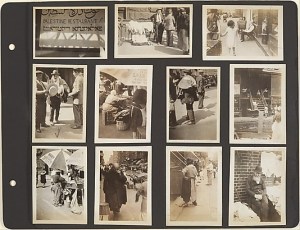
Album page, New York City. Bernice Abbott, 1929-30. MMA 1982.1180.106–.116
I give you James Nares, and his Street project at the Met (which closed 5/27/2013, sorry). There’s a short clip (2:17 out of 60 minutes) if you scroll down the page. This isn’t the section I stumbled upon, but it captures much of the essence of the piece. I think it was the best thing I saw all day, and even better, the video is bracketed by galleries of photos and objects selected by Nares from the Met’s permanent collection.
These are can be found online, though they are not divided or arranged the way they appear in the galleries. Still, you can see connections between the pieces.
For other interesting and rather less famous street still photographers, check out Vivian Maier, orJoe Sterling (who lived around the corner from us when I was growing up).






 Kirsten Hammerstrom
You must be logged in to post a comment.