Getting Cultured

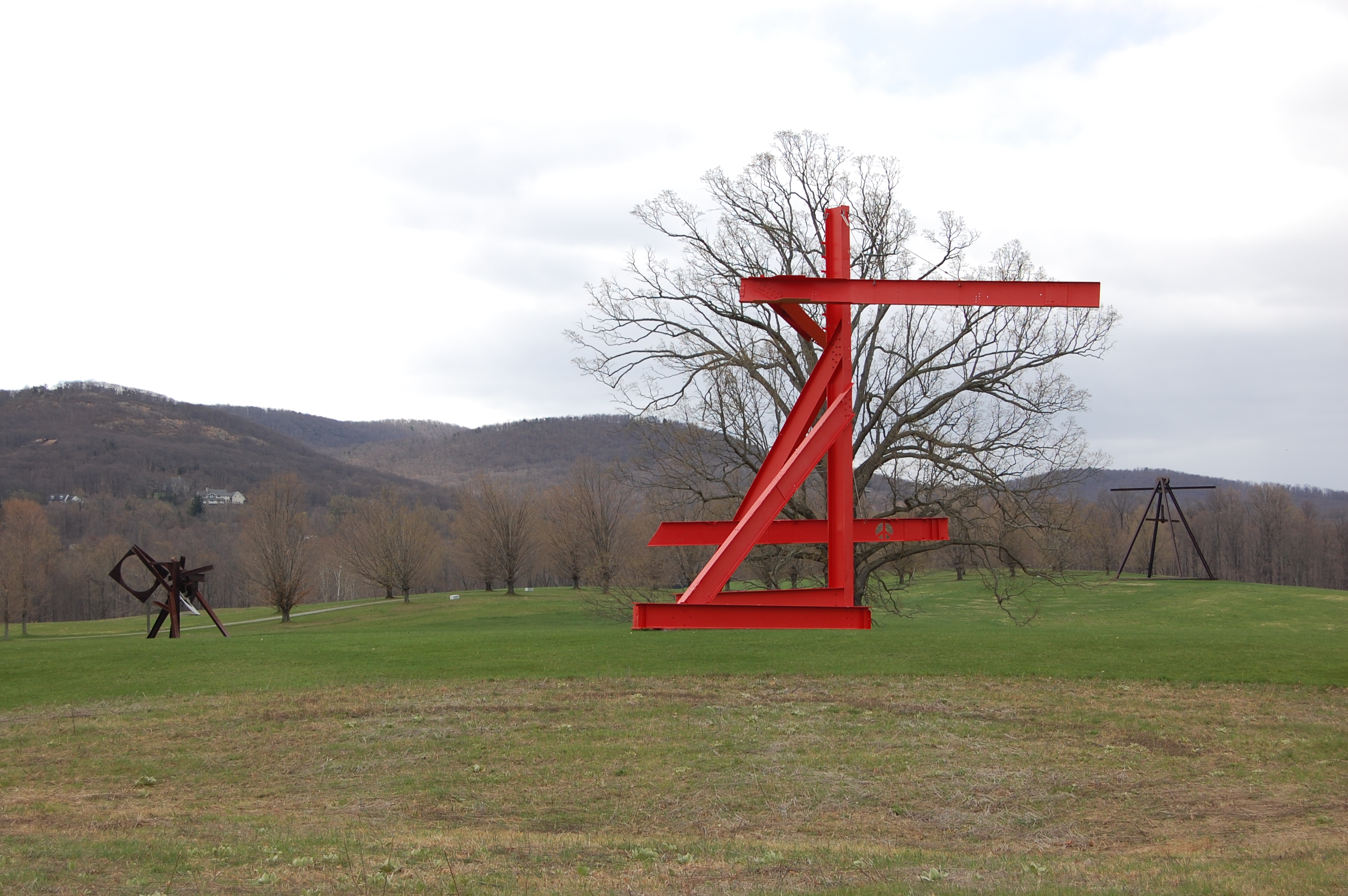
Mark di Suvero at Storm King

Cats don’t like travel. You might, therefore, expect that Kitty Calash would prefer to stay home, but I’ve had a few travel adventures, and the hardest part is usually finding decent and strong coffee early in the morning, though sometimes dinner is a challenge: like my cats, I like my own bowl.

Happily, we’ll be cooking our meals for real tomorrow, boiling roots and meat and slabbing cheese on bread. Thank goodness for the 10th Massachusetts’s own John Buss and his love of cheese, but why did I forget the Massachusetts man who carried a pound of chocolate in his militia knapsack? We could have had drinking chocolate!

We’ll be at the New Windsor Cantonment tomorrow, but today, the last blustery snow-squally day of April School Vacation, we spent at Storm King.* The Young Mr enjoyed our visit last year, so we went back again.


Fun with framing
Fun with framing

This year, we did another quarter or so of the park, mostly di Suveros but also Magdalena Abakanowicz and Andy Goldsworthy. It was an interesting exercise in scale, and specificity. I used to joke that the worst part about making sculpture was that once it was done, you’d have to dust it forever, but Storm King presents another issue: the sculpture that must be weeded.

In St. Louis, we experienced Mark di Suvero pieces at Laumeier Sculpture Park , but not on this scale. They’re more interesting together; as with so many things, mass makes a difference—though with di Suvero, acres of ‘gallery’ are required for mass.

Goldsworthy at Storm King

Goldsworthy has long been a favorite, the site-specific and temporal nature of the work appealing and similar to the kind of immersive, living history performance I prefer. Here, the wall wraps the trees and runs through the lake like a low, grey and solid version of Running Fence .

It’s a funny thing, walking the acres of art, and thinking about the kind of parkland gentlemen used to maintain—Pemberley and Stately Homes—and how yesterday’s folly is today’s site-specific sculpture.

Mozart's Birthday: another di Suvero, with snow. Snow!
Mozart’s Birthday: another di Suvero, with snow. Snow!

*Not for nothin’ is it called Storm King, as they would say in No’t Providence.
Smells Like Money: Must be Auction Season

There’s nothing like a little frivolity to lighten your day when you’ve been pondering some really serious and stomach-churning topics. Hail, then, the arrival of the Sotheby’s catalog and the momentary dropping of all material culture pretenses.

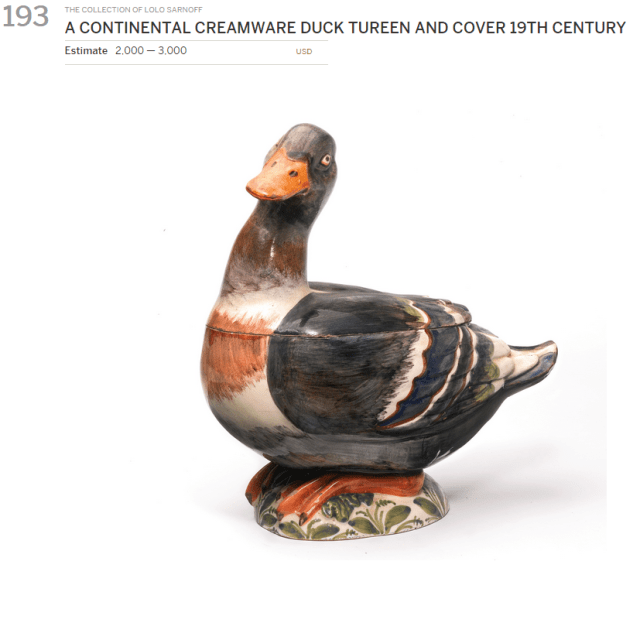
This time, it’s Private Collections.  You say Private Collections, I say Disturbing and Hyper-Overpriced Gift Shop. But what does Snarky Duck say?

A Continental creamware duck tureen and cover.  Duck ways, no more hot soup, please.
A Continental creamware duck tureen and cover. Duck says, No soup for you.

Poor Strangled Parrot: I don’t think he can say much.

A Holitsch parrot-form jug and cover ca. 1760.

And these guys, described as playful dogs, look more like dyspeptic pugs to me.

A pair of Hochst fayence figures of seated pugs ca 1770.

It is amazing what people will make and buy (which delights me), and I’m certain that things I own would astonish and appall someone with different taste. But animal effigies always intrigue me, and (aside from Snarky Duck, our 19th century friend) figures like these could have graced the mantels and tables of the finest homes of the 19th century. It would have been a crowded and raucous world.

Here’s the whole catalog, should you care for some ormolu chairs or Aubusson drapes (which I did not know existed until today).

Frivolous Friday: Puppy in a Poke (bonnet)

Plate 11, Twenty-four Subjects Illustrating the Costume of Paris

Like most humans, I have whimsical tastes and occasional outbreaks of covetousness. Today, while looking for images of milliners, I found this book for sale online, and while I cannot dream of owning it, I am delighted by this image, and by the others shown on the bookseller’s site. The British Museum has a copy, but only a few images online; Yale has a copy at the Center for British Art, but no images online.

John James Chalon, (more images here) who made this engraving, also made the classic image of the milliner’s shop, and that was where my search began.

La Marchande des Modes

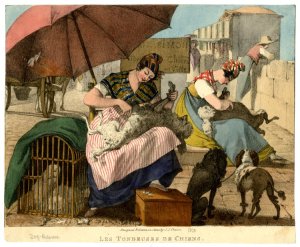
Searching a little more only improved the results… Dog groomers! I have got to get hold of this book.

AN01035992_001_l
Les Tondeuse de Chiens

While these engravings satisfy my delight with the absurd, more seriously, they provide some insights into daily life in the 1820s. It’s not the United States, but it’s a helpful place to start, because despite the humour in these, there isn’t a layer of satire that has to be peeled off before we can begin to understand the image.

Full-on satires, like those of Hogarth, Rowlandson and Gilray, can be hard for us to interpret: we’re so far away, we no longer get the joke, so the joke is now on us if we take what is shown for exact truth. The prints in “Twenty-four subjects exhibiting the costume of Paris” have a gentler humour.  

I don’t think I’m ready to portray a 19th century dog groomer, but I am stunned that I never considered how long they’ve been around. How many other everyday occupations do we overlook when we think of the past?


Visual Illiteracy

Banastre Tarlteon by Joshua Reynolds
Portrait of Sir Banastre Tarleton (1754-1833) by Joshua Reynolds, 1782. National Gallery (UK)

See update below!

By 9:00 on Sunday, I was asleep and missed “Turn,” which Mr S wasn’t even watching because, as he declared, “It’s just a bad show.” On Monday evening, I made it through the opening of the show and gave up for good. But those minutes made me think of the Banastre Tarleton portrait by Sir Joshua Reynolds, and the suggestion on Twitter that “Turn” had no historical consultant.

It occurred to me, as I stared at the rather curious headgear worn by Captain Tallmadge (I think it’s stretch lycra over a “Roman” gladiator costume helmet glued to a baseball cap visor and edge-taped with gold foil) that perhaps the people doing the costumes simply lacked visual literacy. This could explain the refugees from Fort Lee who looked like they stepped out of an Emma Lazarus poem, and it could explain the very unfortunate helmet.

Tarleton_notes

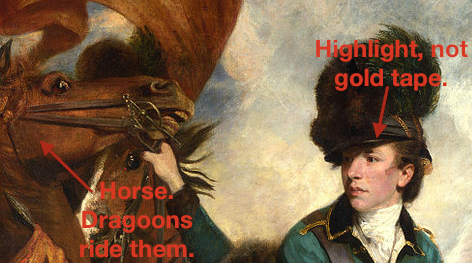
Let us look at Banastre Tarleton, hunky bad boy of the British dragoons: he came to mind on Monday night, and what visual relief he is.

Note the light edge of the visor: this is a highlight. The leading edge of a polished surface will shine, and helmets, even of leather, will be reflective. Over time, the edges will polished by wear if not on purpose. I cannot speak to the helmet habits of the horse-mounted, but I know from paintings, and that edge is a highlight.

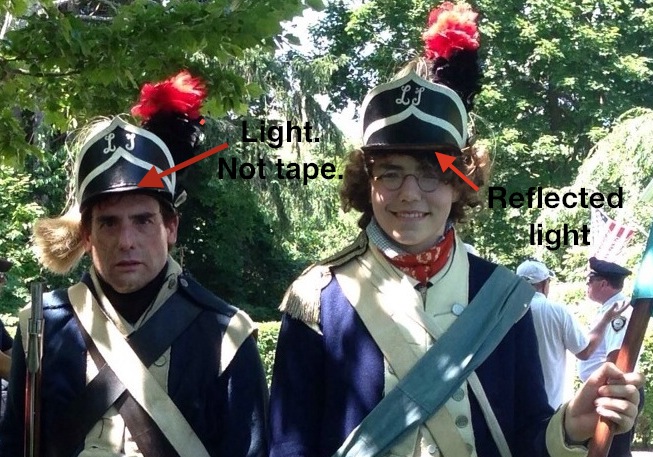
The Boys last July. Look, shiny, not-taped visor edges.

Reynolds painted what he saw, and just as the Young Mr’s cheekbones are reflecting light off the underside of his visor and Mr S’s helmet edge is shining in the direct light, so too is Colonel Tarleton’s helmet edge shining.

(Yes, there are both mounted and unmounted dragoons within a unit; but I just can’t help feeling that an officer would be mounted more often than he has appeared to be thus far.)

ETA: Heather has graciously pointed out a very nice blog on Turn, which is doing a far more even-handed and informed job of watching and commenting on the show. Thank you, Heather!