Fine Art Friday

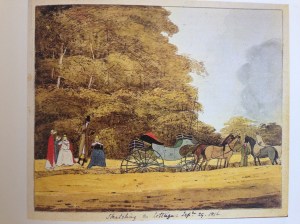
Sketching a Cottage, Sept 29, 1816. Watercolor by Diana Sperling

In a mere four weeks, I will pack the Subaru and head west into New York State as so many Rhode Islanders have before me. And while I will have clothes suitable for the time of the RI Quaker Migration, I will be leaving not to found a more utopian society nor to seek my fortune on a farm. Instead, I’ll be joining some dear friends for a weekend sketching party (minus the horse and carriage).

This new enterprise has required some additional research, and while I look forward to painting miniatures at some point this summer, I suspect this venture will be a simpler proposition. A new dress and apron are the least of my worries: brushes, watercolor boxes, sketchbooks, pencils and pens all require research just when I should be thinking more seriously about the way the Revolution played out as a civil war in New Jersey.

Anne Rushout, ca. 1768–1849, British, 3 sketchbooks of 82 drawings by Anne Rushout (B1977.14.9506-9587), 1824 to 1832, Watercolor on moderately thick, slightly textured, cream wove paper, Yale Center for British Art, Paul Mellon Collection
Anne Rushout, ca. 1768–1849, British, 3 sketchbooks of 82 drawings by Anne Rushout (B1977.14.9506-9587), 1824 to 1832, Yale Center for British Art, Paul Mellon Collection

Still, the Yale Center for British Art has rarely failed me: a simple search for sketchbook turned up a catalog record for three sketchbooks of 82 drawings by Anne Rushout. These are lovely, well-executed landscapes in a fine British tradition, far more sophisticated than Diana Sperling or Sophie DuPont– I fear I will closer to Sperling and DuPont when I take up sketching again, and can at least console myself that my wonky drawings will be part of a fine tradition of ladies’ accomplishments.
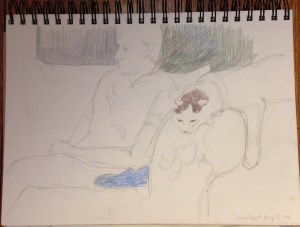
Man and cat, 2004
Man and cat, 2004

The Yale Center for British Art also has a nice Romney sketchbook for Paradise Lost, which demonstrates the cartoon-like nature of preliminary drawings (and I mean cartoon in the old sense, not the Animaniacs sense, though the uses are related). And as I sew my dress of unmatched checks, I have art programming to entertain me: Fake or Fortune, thanks to a tip from Ms B, has provided happy, envious hours of conservation labs, artists’ colourmen, and auction rooms. Vicarious delight, indeed.

Small Obsessions

IMG_5625Some of you may recall that I am a recovering artist with a fairly constant need to keep my hands busy. To encourage industry and the domestic arts, and to keep me out of trouble generally, a thoughtful friend provided me with a start to furnishing an early nineteenth century-style paint box. They’re hard to come by, these paint boxes, and extant examples fetch far more than we can afford chez Calash, being in somewhat reduced circumstances of late.

Thomas Reeves & Son Artists watercolor paint box c. 1784 to 1794. Whimsie Virtual Museum of Watercolor Materials
Thomas Reeves & Son
Artists watercolor paint box c. 1784 to 1794. Whimsie Virtual Museum of Watercolor Materials

Researching paint boxes and miniature painting in the early Federal era has been a happy fall down a deep rabbit hole. It’s clear that Reeves watercolors were being sold in Providence in the early 19th century; Peter Grinnell & Sons include “Reeves watercolor boxes” among the extensive list of items for sale in an 1809 newspaper ad. Frames and cases were also to be had; John Jenckes, gold and silver-smith and jeweler, advertised gold miniature cases in 1800.

Distraction is always easy to come by, tunnels leading from main entrance to the warren. Painting manuals, scholarly articles, and extant examples, which prove most distracting of all. SO shiny.

George Catlin Artist: John Wood Dodge (1807–1893) Date: 1835 Medium: Watercolor on ivory Dimensions: 2 3/16 x 1 13/16 in. (5.6 x 4.6 cm) Classification: Paintings Credit Line: Rogers Fund, 1926 Accession Number: 26.47
George Catlin byJohn Wood Dodge, 1835, MMA 26.47

Searching the Met’s collection, I found a portrait of George Catlin, remarkably similar in pose to an image of a friend I considered copying, but had thought too modern. My assumption has been proved wrong, and I am delighted. And then I found the HIDEOUS checked neck wear, always distracting. Historic New England provided super-tiny-bowtie man, and then I really had to focus, since I’m only enabling, not making, neck wear.

My real focus, of course, is on female miniaturists, especially in Rhode Island (gallery of RI miniatures can be found here.) From the scant number of women I’ve found advertising in the local papers, (okay, two: Miss Mary R. Smith, in 1820, and Mrs Partridge in 1829) I’ll have to expand my search geographically. Nantucket Historical Association had an image attributed to Anna Swain, and ten attributed to Sally Gardner.

Eye

The Met, repository of so many wonders, has works by six women miniaturists, including Sarah “Wowza” Goodridge and Anna Claypoole Peale. For all we know, some of the works by unidentified makers might be the work of female painters. The extant miniatures in all collections, range in quality from excellent to amateur, giving hope to those of us unpracticed in portraiture, and regaining our hand.

The Real Thing

Talking with a friend about authenticity and realness, I remembered the moment when I really understood the power of the real thing

Meret Oppenheim Object Paris, 1936 Museum of Modern Art, NY. 130.1946.a-c
Meret Oppenheim
Object
Paris, 1936
Museum of Modern Art, NY. 130.1946.a-c

Longer ago than I care to admit, I went to MoMA with my dad, and saw, up as close as you could get to a glass case, Meret Oppenheim’s fur lined tea cup, Object, or Luncheon in Fur

I’d seen slides, and illustrations in books, but only when I saw the object did I really understand what it was about. Unfortunately, even having seen Duchamp’s “Bride Stripped Bare” in person, I still don’t get that piece. Such is life.

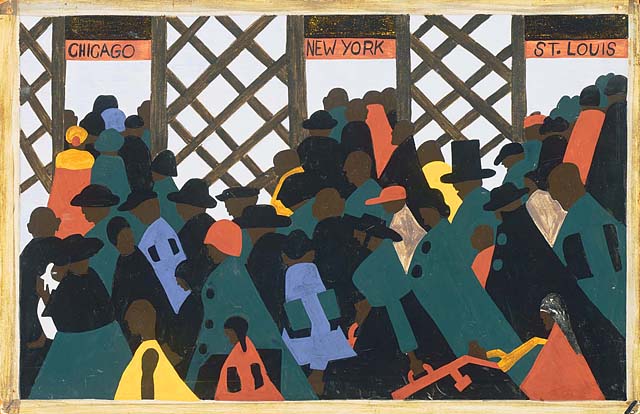
So what is it about the fur-lined tea cup in person that makes it so different? What is it about Jacob Lawrence’s Migration series that makes it different? Or Pollock, for that matter? Why is the real thing so ineluctable?

 JACOB LAWRENCE (1917–2000) The Migration of the Negro, Panel no. 1, 1940-1941. The Phillips Collection, Acquired 1942 © The Estate of Gwendolyn Knight Lawrence / Artists Rights Society (ARS), New York.

JACOB LAWRENCE (1917–2000)
The Migration of the Negro, Panel no. 1, 1940-1941. The Phillips Collection, Acquired 1942 © The Estate of Gwendolyn Knight Lawrence / Artists Rights Society (ARS), New York.

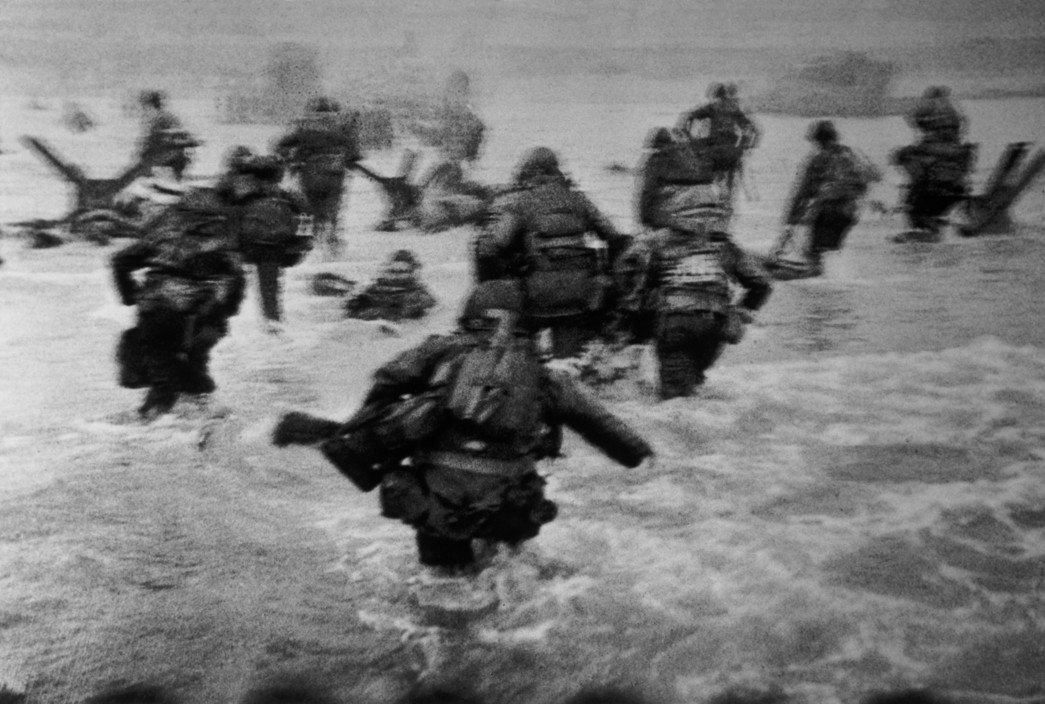
I don’t know, really; what I do know is that it matters. I’ve held a transparency of The Migration of the Negro, Panel no. 1, in my hand before, and it’s not as good as seeing the marks Lawrence put down in gouache. I’ve held a Robert Capa print in my hand, marked on the back with publication notes from the 1940s and it still gives me goosebumps to think of it, to think of him in the water off Normandy on D-Day. Existential ambiguity of the wrecked emulsion be damned: those images, held in your hand, are more moving than you can imagine from seeing them published in Life or any monograph.

FRANCE. Normandy. June 6th, 1944. US troops assault Omaha Beach during the D-Day landings.
FRANCE. Normandy. June 6th, 1944. US troops assault Omaha Beach during the D-Day landings.BOB194404CW00003/ICP586(PAR121451)© Robert Capa © International Center of Photography/Magnum Photos

I’ve had people say to me recently that “it doesn’t matter,” that no body will know if they’re wearing 1774-1783 clothes at a 1790 event, and I disagree strongly and thoroughly. It does matter. The mattering is the whole reason museums exist. It’s why we go to see our favorite music performed instead of sitting home with Victrola or iPod listening to the crackle of Bessie Smith² or album-produced Billy Bragg. Listening at home puts us at a remove, polishes the roughness and steps back from immediacy.

To say that the image in the book or the not-really-right clothes are the same at the real thing does a disservice to ourselves and to the public. Are we really suggesting that audiences for art or history are that stupid? Or that we are so unmoved ourselves that it just doesn’t matter?

I’m too old for nihilism. Bring on the real. Let’s get it right, because it does matter. I know when it’s real, and so do you.


______________

¹Sadly, this goes through my head with the phrase “the real thing.” Curse you, Douglas Coupland, for capturing my generation’s fixation on pop references.
²Yes, I know she’s dead, go with me here.

Frivolous Friday: A-Spalling Behaviour

Mr. Turner, out now on iTunes and elsewhere, won’t be for everyone: M’damsel isn’t treated very well– artists are, you know, often narcissistic, driven users– but the landscapes thrill.

We talk sometimes about going to the antique store in historical clothing and asking why our chattel is for sale. I toy with similar naughty thoughts about visiting historic house and other museums, but Mr Turner inspires a dream of a simpler pleasure: dressing in period clothes to visit a period gallery.

Classic Mr Turner in the salon

Possibly my companion would grunt as Turner does, but we might also unnerve guards by pointing walking sticks at salon-hung still lifes or reacting with disgust at the sight of an Impressionist work. (Might as well take it all the way.)

Everybody’s a critic

No takers yet for this diversion, which is just as well. I expect it would be a quick way to meet security and police staff if you didn’t coordinate with the museum/gallery in advance. Still: what a stunt. Someday I’ll pull it off.