‘Visual Arts Crush’

I’ve been following the Times’ Arts Crush” series, and one of the best, and best-written, in the series has been Holland Cotter’s piece on poetry and the MFA. Cotter’s writing is always elegant and accessible, with an amazing ability to render high concepts simply. (I wish he’d taught my graduate seminars in art theory…) The series inspired me to think about my first visual arts crush, and how it still resonates today.

I grew up on the North Side of Chicago, in the actual city, not Ferris-Bueller-land. By the time I was in high school, I had a pretty free-range existence thanks to the Chicago Transit Authority, and rode the bus anywhere and everywhere, even up to the southern edge of Bueller-land, also known as Evanston.

Mrs. James Ward Thorne American, 1882-1966 A17: Pennsylvania Kitchen, 1752, c. 1940. Art Institute of Chicago
Mrs. James Ward Thorne
American, 1882-1966
A17: Pennsylvania Kitchen, 1752, c. 1940. Art Institute of Chicago

Thanks to the CTA, and to the car my family drove only on weekends, and plenty of field trips in school, we visited most of the museums in the city: the Museum of Science and Industry, the Shedd Aquarium, the Chicago Historical Society, the Field Museum and the Art Institute of Chicago. That’s where I found my very first crush.
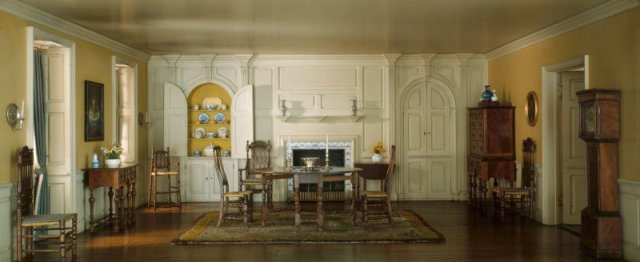
Mrs. James Ward Thorne American, 1882-1966 A3: Massachusetts Dining Room, 1720, c. 1940. Art Institute of Chicago.
Mrs. James Ward Thorne
American, 1882-1966
A3: Massachusetts Dining Room, 1720, c. 1940. Art Institute of Chicago.

There’s a lot to love in the AIC, from classic Impressionists to post-war Abstract Expressionists, but when I was in grade school, what really made an impression on me were the Thorne Rooms. The Thorne miniature rooms are meant to be the most accurate 1/12 scale representations of historical interiors. It will not surprise you that I pressed my 10-year-old nose against the glass of the early Pennsylvania rooms, or the high-style Rhode Island rooms, wishing desperately that I could shrink and slip through that solid membrane and inhabit the world the rooms depicted.

Mrs. James Ward Thorne American, 1882-1966 A11: Rhode Island Parlor, c. 1820, c. 1940. Art Institute of Chicago
Mrs. James Ward Thorne
American, 1882-1966
A11: Rhode Island Parlor, c. 1820, c. 1940. Art Institute of Chicago

My mother and I would play a game: Which is your favorite room? Which one would you like to live in? And even if the rooms filled with tiny ball-and-claw feet were my favorite, or the chestnut-panelled keeping rooms, the one I wanted to live in (because somewhere there would be a telephone and a radio, and behind the tiny door, a well-appointed bathroom) was the Art Deco apartment. We were fairly certain this was a room you never saw in “Bringing Up Baby,” maybe the room on the other side of the bathroom where the leopard was kept.
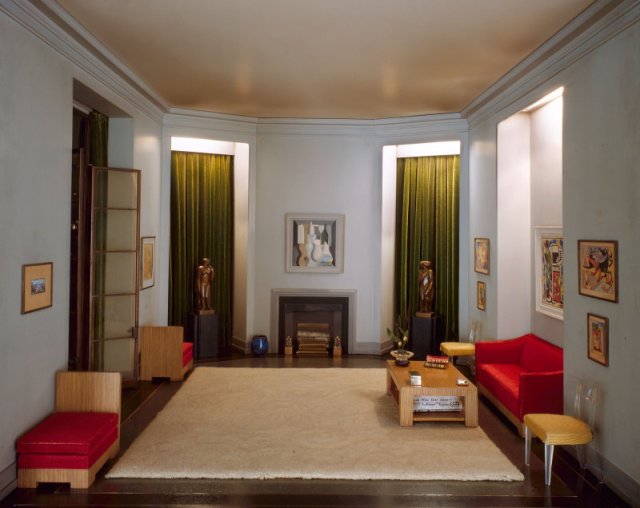
Mrs. James Ward Thorne American, 1882-1966 A37: California Hallway, c. 1940, c. 1940. Art Institute of Chicago.
Mrs. James Ward Thorne
American, 1882-1966
A37: California Hallway, c. 1940, c. 1940. Art Institute of Chicago.

Accuracy and anarchy: those contradictory impulses have guided most of my life, from the work I made as an artist, to the work I do now. Getting details right, from citations to what’s on a table for a 1799 tea, matters; but once that’s set in motion, life takes over, the metaphorical leopard is loose, and we’re off to see what life was really like in all its emotive glory in 1799.
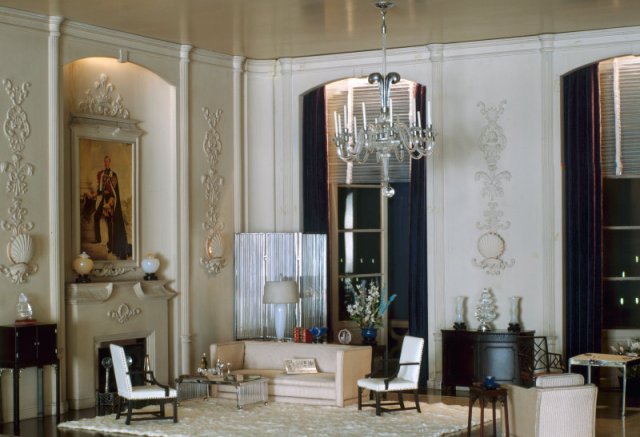
Mrs. James Ward Thorne American, 1882-1966 E-15: English Drawing Room of the Modern Period, 1930s, c. 1937. Art Institute of Chicago.
Mrs. James Ward Thorne
American, 1882-1966
E-15: English Drawing Room of the Modern Period, 1930s, c. 1937. Art Institute of Chicago.

And it all started in the basement of the Art Institute of Chicago, imagining what it would be like to live in each of the tiny worlds that ring the walls of the Thorne Rooms gallery.

Faces from History

Admiral Peter Rainer, MFA  04.1757
Admiral Peter Rainer, MFA 04.1757
Captain of HM 54th Reg't of Foot.
Captain of HM 54th Reg’t of Foot.

Meet Admiral Peter Rainier, painted sometime between 1778 and 1787. The curious thing about Admiral Rainier is that I know someone who looks uncannily like his portrait.

We found portraits in our collection that look like people we know, and there are people on the street who look like they stepped out of Sandby or Hogarth drawings, even if they’re not in period dress. Take a look: you’ll see it too.

D-Day: Robert Capa

Robert Capa, American, b. Budapest 1913 - d. Indochina 1954
Robert Capa, American, b. Budapest 1913 – d. Indochina 1954 © International Center of Photography

Once upon a time in the Midwest, I worked in a Department of Photographs and Prints. (That’s where I met Mr S, when he was hired as the first museum Photographer, though he was initially known as the Badger in the Basement for the tenacity with which he defended his studio.)

I am fortunate to have a visual memory, and that’s part of how I got my job, and part of how I got to be an Assistant, and then a full, Photo Editor of the museum’s magazine. I love images, and I love photography, and I suppose I must love photographers, too, since there’s one around here somewhere in this place that I call home.

FRANCE. Normandy. June 6th, 1944. Landing of the American troops on Omaha Beach. Robert Capa, International Center of Photography
FRANCE. Normandy. June 6th, 1944. Landing of the American troops on Omaha Beach. © Robert Capa © International Center of Photography

One of the best assignments was photo editing an article based on the World War II diary and service of a local doctor who served in the Army infantry. He wasn’t the most enlightened or unbiased man, but in the 1940s, I suppose that was sadly normal. I read the piece for placement and image ideas, not for tone or subtlety. North Africa, Monty, Casserine, Messina, Easy Red and Omaha: that’s what I underlined.

My go-to for WWII photography was Robert Capa first and last. There’s Blood and Champagne, but the book I read first was Slightly Out of Focus. It was written by Capa, just as he wrote Images of War. (I discovered these killing time on summer weekends in the air-conditioned fine art reading room of the downtown public library.) Capa did not love war, even as he thrived in the combat photography environment, and said, “If your photographs aren’t good enough, you’re not close enough.” But he also noted, like Cartier-Bresson, that you had to like people to take good photographs of them.

His images are dark: not just the imagery, but the prints themselves. A well-printed Capa has deep, rich, dark tones (D-Day images excepted, thanks to a horrendous processing error), and even decades later, a vintage Capa print has magic.

I called Magnum, back in the days when one called, described what I had seen, cited the books I’d read, listed what I wanted prints of to use in the magazine. I think I knew enough to get a little more: vintage prints of images I hadn’t seen. They arrived, sandwiched in cardboard, in a FedEx envelope.

TALY. Near Troina. August 4-5, 1943. Sicilian peasant telling an American officer which way the Germans had gone. Robert Capa, International Center of Photography
TALY. Near Troina. August 4-5, 1943. Sicilian peasant telling an American officer which way the Germans had gone. R © Robert Capa © International Center of Photography

There were photos like this one, and one of a soldier shaving, using his helmet as a basin. There were images I’d seen, and some I had not. They were dark, and sympathetic, and captured the war and humanity as no other images I’ve seen have ever done.

His portfolio was huge, and includes not just war photography, but fashion and film and humorous photos, too. Holding one of his prints–or at least a print made close to the time when he had shot the negative, and might have been alive–was as close as I was ever going to get to meeting Robert Capa. For all he lived through–escaping Fascism, documenting the Spanish Civil War, the Rape of Nanking, the Blitz, all of World War II– Robert Capa died after stepping on a land mine on the road to Thai Binh in what was then French Indochina.

INDOCHINA. May 25, 1954. Vietnamese troops advancing between Namdinh and Thaibinh. This is one of the last pictures taken by Robert Capa with his Nikon camera before he stepped on a landmine and died at 14.55. © Robert Capa © International Center of Photography

It seems so sad, and yet one has to remember that he died working, doing not just what he loved–taking photographs–but what he had to do. He didn’t love war, but he loved people. The beauty of the images he made almost undoes their purpose, in recording war’s horrors, but the real affection for people that comes through in those contrasty prints redeems the violence, I think, giving us sympathy for the people uprooted, displaced, used and abused by war, whether soldier or civilian. Through that love,Capa found courage and we can find truth. Keep looking: there is more to see.

Punk is Dead and Buried at the Met

So, I went to New York yesterday and spent the day at the Met. It was a good, if epically long, trip. I saw everything my feet could bear. One show I even went through twice, Punk: Chaos to Couture. I was trying to “get” it.

The [In]famous Bathroom

Punk got a lot of hype in the NYer and the NYT but it was the least imaginative installation in the Museum. Oh, so what about the CBGB bathroom! If we had to walk through it to get to the gallery, now that would be something. Instead, the bathroom and the “store” are offset, afterthoughts to the main drag, which is a drag.

Hall of Classics. Worship these Gods of Fashion.

The galleries main attractions are mannequins lined up as if on a catwalk, above us, so couture, so not punk. Rainbow colored spike wigs do not make Gianni Versace punk. Or, honestly, Vivienne Westwood at this late juncture, let alone Zandra Rhodes. I found the mannequins trite, and the clothing uninspired and only vaguely reminiscent of what I remember of punk.

Naked Raygun at the Metro

As for the store: I never shopped at Clothes for Heroes, or even Trash & Vaudeville (I had to send my Dad for my Johnson’s motorcycle boots) but I did buy Trash & Vaudeville label and band t shirts at Wax Trax, in the back. I wore the zip minis and fishnet stockings (real stockings) and vintage from the AmVets. I made my own tshirts, with spray paint, markers, and my dad’s castoffs. And even in 1980 Chicago, even at The Exit or Lucky Number or the Cubby Bear, I knew I was ersatz. I knew I was not really punk.

Graffiti & Agitpror
Graffiti & Agitpror

The Met show shines with the Alexander McQueen dresses. They are by far the most interesting and best made pieces. They’re clearly genius. Everything else, save for Rei Kawakubo, is merely derivative.

The sections of the show, Hardware, Graffiti & Agitprop, and Destroy, make sense. Yes, safety pins, chains, spikes and belts (hardware) were typical. Slogans and hand-made clothes, also typical, as well as shredded (purposeful or not, often not, but worn), are fitting descriptors or sub-genres of the punk aesthetic. But the clothes displayed disappointed and dismayed, a grand “So what?” And why?

Maybe it’s Andy Warhol, Mr. Anti-Punk in my mind. But I think it is the great postmodernist movement, where by at this point anything once ironic or referential is now merely self-referential. Punk could have a sense of humor. With few exceptions (Kawabuko, mostly) the clothes in this show lack the intelligence for humor, let alone politics.

Am I glad I went? Yes, absolutely. Because now I know there are bigger risks to take installing shows, and I’m ready to think about what they might be. I’d put a couple of those Kawabuko black-sleeve dresses, or McQueen’s black “bubble-wrap” gowns on display with over in Impressionism, Fashion and Modernity, and see what happens. That’s when chaos and couture would really meet.