
The Real Thing

Talking with a friend about authenticity and realness, I remembered the moment when I really understood the power of the real thing

Meret Oppenheim Object Paris, 1936 Museum of Modern Art, NY. 130.1946.a-c
Meret Oppenheim
Object
Paris, 1936
Museum of Modern Art, NY. 130.1946.a-c

Longer ago than I care to admit, I went to MoMA with my dad, and saw, up as close as you could get to a glass case, Meret Oppenheim’s fur lined tea cup, Object, or Luncheon in Fur

I’d seen slides, and illustrations in books, but only when I saw the object did I really understand what it was about. Unfortunately, even having seen Duchamp’s “Bride Stripped Bare” in person, I still don’t get that piece. Such is life.

So what is it about the fur-lined tea cup in person that makes it so different? What is it about Jacob Lawrence’s Migration series that makes it different? Or Pollock, for that matter? Why is the real thing so ineluctable?
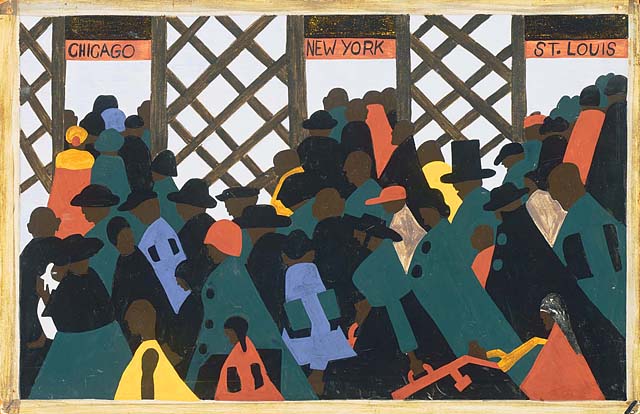
 JACOB LAWRENCE (1917–2000) The Migration of the Negro, Panel no. 1, 1940-1941. The Phillips Collection, Acquired 1942 © The Estate of Gwendolyn Knight Lawrence / Artists Rights Society (ARS), New York.

JACOB LAWRENCE (1917–2000)
The Migration of the Negro, Panel no. 1, 1940-1941. The Phillips Collection, Acquired 1942 © The Estate of Gwendolyn Knight Lawrence / Artists Rights Society (ARS), New York.

I don’t know, really; what I do know is that it matters. I’ve held a transparency of The Migration of the Negro, Panel no. 1, in my hand before, and it’s not as good as seeing the marks Lawrence put down in gouache. I’ve held a Robert Capa print in my hand, marked on the back with publication notes from the 1940s and it still gives me goosebumps to think of it, to think of him in the water off Normandy on D-Day. Existential ambiguity of the wrecked emulsion be damned: those images, held in your hand, are more moving than you can imagine from seeing them published in Life or any monograph.
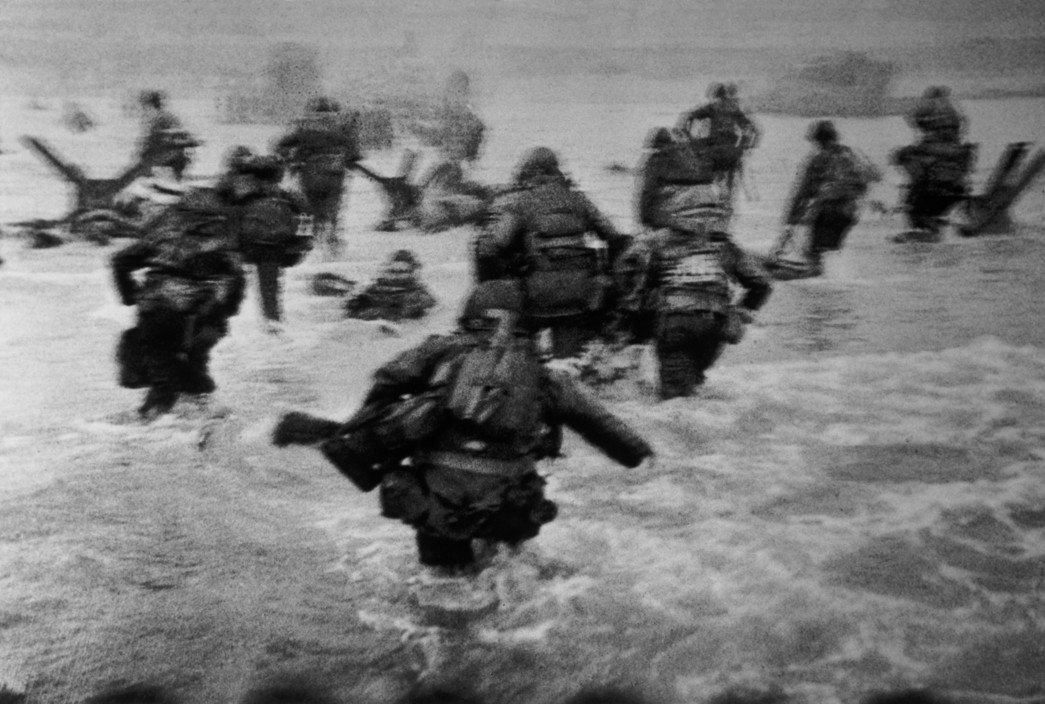
FRANCE. Normandy. June 6th, 1944. US troops assault Omaha Beach during the D-Day landings.
FRANCE. Normandy. June 6th, 1944. US troops assault Omaha Beach during the D-Day landings.BOB194404CW00003/ICP586(PAR121451)© Robert Capa © International Center of Photography/Magnum Photos

I’ve had people say to me recently that “it doesn’t matter,” that no body will know if they’re wearing 1774-1783 clothes at a 1790 event, and I disagree strongly and thoroughly. It does matter. The mattering is the whole reason museums exist. It’s why we go to see our favorite music performed instead of sitting home with Victrola or iPod listening to the crackle of Bessie Smith² or album-produced Billy Bragg. Listening at home puts us at a remove, polishes the roughness and steps back from immediacy.

To say that the image in the book or the not-really-right clothes are the same at the real thing does a disservice to ourselves and to the public. Are we really suggesting that audiences for art or history are that stupid? Or that we are so unmoved ourselves that it just doesn’t matter?

I’m too old for nihilism. Bring on the real. Let’s get it right, because it does matter. I know when it’s real, and so do you.


______________

¹Sadly, this goes through my head with the phrase “the real thing.” Curse you, Douglas Coupland, for capturing my generation’s fixation on pop references.
²Yes, I know she’s dead, go with me here.
Getting Cultured

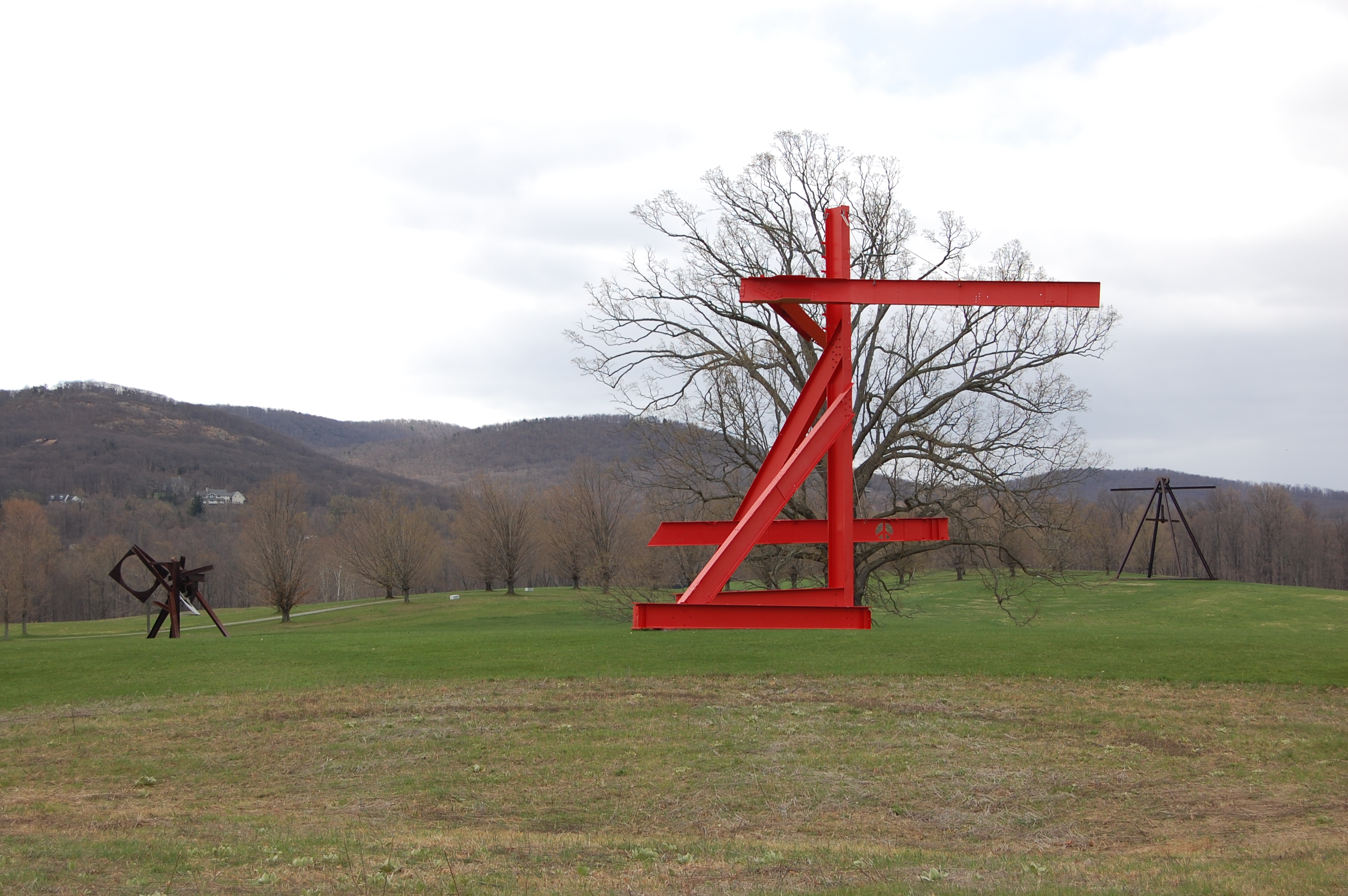
Mark di Suvero at Storm King

Cats don’t like travel. You might, therefore, expect that Kitty Calash would prefer to stay home, but I’ve had a few travel adventures, and the hardest part is usually finding decent and strong coffee early in the morning, though sometimes dinner is a challenge: like my cats, I like my own bowl.

Happily, we’ll be cooking our meals for real tomorrow, boiling roots and meat and slabbing cheese on bread. Thank goodness for the 10th Massachusetts’s own John Buss and his love of cheese, but why did I forget the Massachusetts man who carried a pound of chocolate in his militia knapsack? We could have had drinking chocolate!

We’ll be at the New Windsor Cantonment tomorrow, but today, the last blustery snow-squally day of April School Vacation, we spent at Storm King.* The Young Mr enjoyed our visit last year, so we went back again.


Fun with framing
Fun with framing

This year, we did another quarter or so of the park, mostly di Suveros but also Magdalena Abakanowicz and Andy Goldsworthy. It was an interesting exercise in scale, and specificity. I used to joke that the worst part about making sculpture was that once it was done, you’d have to dust it forever, but Storm King presents another issue: the sculpture that must be weeded.

In St. Louis, we experienced Mark di Suvero pieces at Laumeier Sculpture Park , but not on this scale. They’re more interesting together; as with so many things, mass makes a difference—though with di Suvero, acres of ‘gallery’ are required for mass.

Goldsworthy at Storm King

Goldsworthy has long been a favorite, the site-specific and temporal nature of the work appealing and similar to the kind of immersive, living history performance I prefer. Here, the wall wraps the trees and runs through the lake like a low, grey and solid version of Running Fence .

It’s a funny thing, walking the acres of art, and thinking about the kind of parkland gentlemen used to maintain—Pemberley and Stately Homes—and how yesterday’s folly is today’s site-specific sculpture.

Mozart's Birthday: another di Suvero, with snow. Snow!
Mozart’s Birthday: another di Suvero, with snow. Snow!

*Not for nothin’ is it called Storm King, as they would say in No’t Providence.

Wolf Whistle

Thomas Cromwell, Hans Holbein the Younger. The Frick Collection,1915.1.76

At last it has arrived: Wolf Hall. I waited, and did not use a proxy server to watch it early. Just as well that I watch PBS online as I have, thus far, watched the first episode three times.

At last I can understand people’s enthusiasm for historical programs some of us seethe at and cannot watch: my knowledge of the Tudors and their material world is limited enough that I am captivated and not annoyed (except by Anne Boleyn’s wrinkled silk satin bodice, which is striking in its puckers) and I read the books when they came out, and have thus forgotten enough of the details to be merely annoyed and not enraged at changes. (Other, real, critics have caught the language changes in the scene with Wolsey; Mantel is better, of course.)

The third Wolf-watching was with Mr S, who was suitably impressed by the low-light filming. As a former photographer who did a lot of night photography, improper and unbelievable lighting in film does cause an outbreak of caustic commentary. Not this time (he merely noted the fill light on Liz Cromwell’s face in one scene). With 20,000 pounds spent on candles, the BBC did this one right– and lucky for them the advance in camera technology.

But forgot the astronomical cost of all those tapers, that’s not the point: the point is what was believable and how the staging and lighting were used. I believed Wolf Hall all the more because of the low light, indoors and out, matching the time of day. I know how dim it is to light only with candles, and what a pain it is to make them, and how expensive. Light is money, whether you’re paying Ameren, National Grid, or the candlestick maker.

Aside from Hilary Mantel’s brilliant stories and all those candles, what makes this Wolf Hall good television? You know what I’m going to say: the authenticity. No, there are no Tudor accents, late or otherwise; these folks use our vernacular. And excellent arguments can be had about the historical accuracy of Mantel’s characters.

There are other arguments about the material details:

The dull palette used – presumably in conscious contrast to The Tudorscreated an ambience which, at worst, was lacklustre or, at best, homely. And it is that homeliness that concerns me most.

The homely is unthreatening. So, we are invited to view a ‘Tudor world’ as we know it or, rather, as we would like it to be. For instance, I was struck by how classless the society was – social gradation seemed to have disappeared both in the interactions and the interiors. There was little sense (as there is in the novels) of the heavy distaste for a man of such lowly birth as Cromwell’s; there was limited hauteur in a Norfolk or, indeed, the king. Meanwhile, the buildings which were home to Cromwell – still, at this point a lawyer in Wolsey’s service – seemed to lack none of the late-medieval conveniences afforded to the higher born and bettered housed. This is a world which has been domesticated for us so that it is tame, familiar and quintessentially English.

Anne Boleyn
by Unknown artist
oil on panel, late 16th century (circa 1533-1536)
21 3/8 in. x 16 3/8 in. (543 mm x 416 mm)
Purchased, 1882. NPG 668 [Britain}
I will say that I was struck not just by the cleanliness of everything in an age before detergents (the blacksmith’s yard is remarkably pristine) and the amount of stuff in Cromwell’s house, but also by the softness of class lines. An argument could be made that depicting that much background detail would distract from the larger story, that of Cromwell and Anne and Thomas More, and the dissolution of the Catholic church in England.*

I know Cromwell ended up with riches but on the BBC he seemed to start ahead of where I thought he was at the start of the novel, mercenary and mercantile background aside.

Still: the spirit of the story and of Mantel’s Cromwell seem well-drawn here, and that’s what makes the difference between a series of living Holbeins and a gripping tale. That’s also what makes the difference between museum mannequins and costumed interpreters: emotional authenticity.

No: you cannot get costume and material culture wrong and still claim emotional authenticity as your defense. But the factor that makes a good event or site great is the believability of the characters, and that means more than a lecture on fine details. It means understanding the past, and even admitting what we don’t understand, and seek still to learn.

* Here’s an interesting and tough take on Cromwell’s work destroying the church.

What Snow Day?

Benjamin West, 1738-1820, American, active in Britain (from 1763), Page Boy Asleep, undated, Brown wash with pen and brown ink on medium, slightly textured, cream laid paper, Yale Center for British Art, Paul Mellon Collection.B1975.4.786

Just because the Young Mr had a snow day and slept in didn’t mean the rest of us did.  So what did we do?

We went to work, just as they would have in the 18th century. We joke that the streets in our town are better after ice and snow, because the potholes are filled in and the ride is smoother.  You can see the principle at work here, in a watercolor by Benjamin Henry Latrobe.  Sleighs and sleds will run more smoothly on snow-packed roads, and sometimes I think a sled would be better than a Subaru in the city of Providence.

Still, I’m grateful for furry boots and buckets of salt, central heat and an electric tea kettle. Every winter, one or more of us falls on the ice, and when I went out to salt the paths this morning, I could see where Mr S had slipped on snow-covered ice.

In the Morland below, the scene revolves around the central figures, a man who has fallen on the ice despite his stick, the woman, black bonnet thrown back, who has witnessed his fall. We haven’t reached this point yet, and snow has become sleet that will freeze later, with more snow to come, so our vista is not nearly as attractive. But it’s clear that we, as humans, have never enjoyed snow and ice very much, and I think the donkeys are unimpressed as well.

George Morland, 1763-1804, British, Winter Landscape with Figures, ca. 1785, Oil on canvas, Yale Center for British Art, Paul Mellon Collection, B1993.30.23