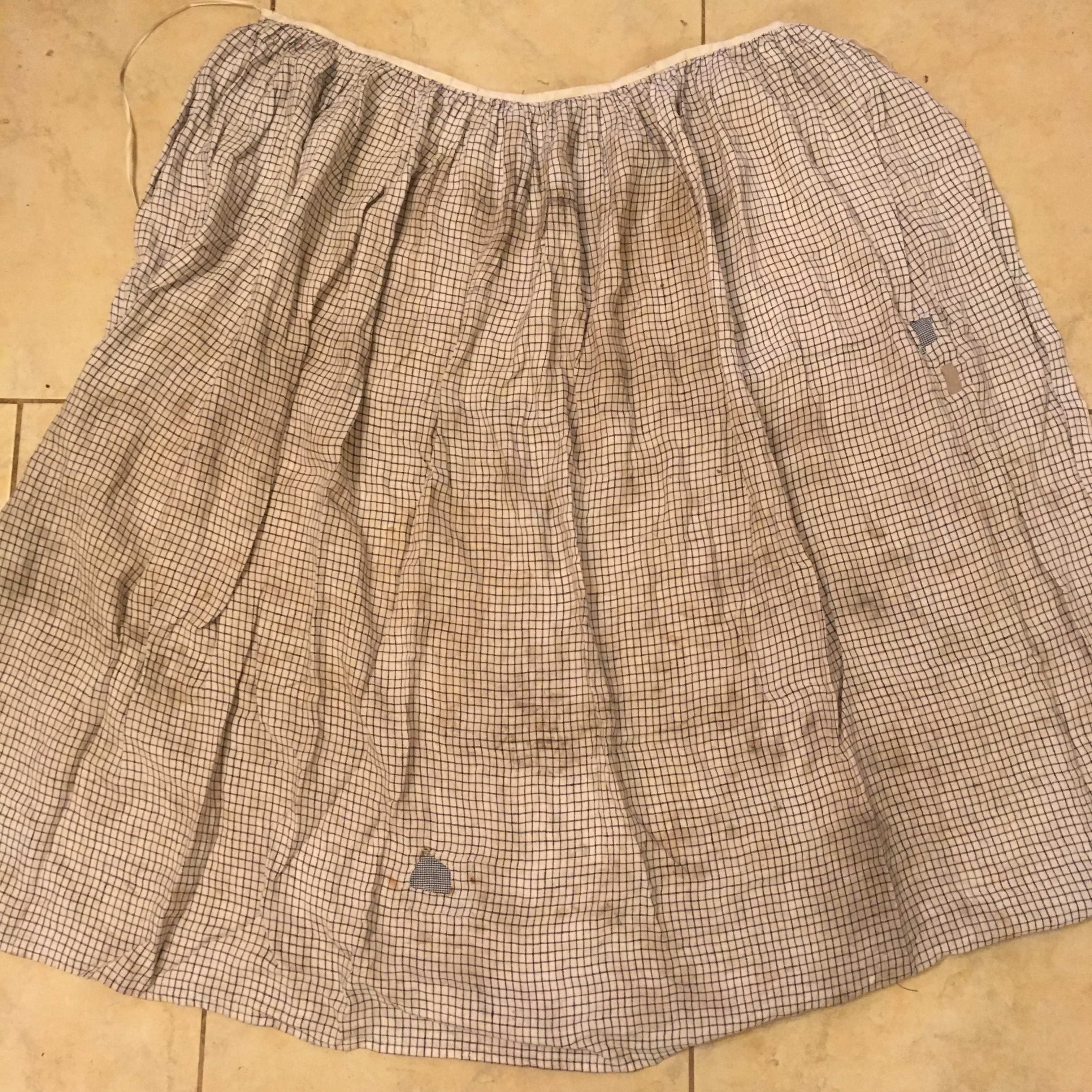
My poor old apron. It’s almost– but not quite– the firstarticle of historical clothing I made. (The first was a shift. Infrastructure and fundamentals, people.) It acquired some new wear (actual holes!) in New Jersey, and required mending.
First, it needed to be washed. I hadn’t taken a objective look at my apron in a while, but after we got home from Salem, I knew I had to mend it, which meant washing.
Reader, it smelled.
You get used to smells, and even enjoy them: wet wool, gunpowder, wood smoke. And then there’s tallow. I’ve never gotten used to the smell of tallow, and I don’t remember when this apron encountered hard fat, but the odor is unmistakable.
So is the water.
This past weekend, I had a chance to mend this favorite apron while I peddled luxury goods at Fort Dobbs’ War for Empire event.
Although I have a sturdy plain linen apron, I’m fond of checks, and of the hand this apron has achieved after much wearing and some washing.
It will never be really clean again, but for now, the apron is mended and back in rotation.
You only live once, as they say, so you might as well enjoy yourself, and have a nice apron while you’re at it.
At last I have finished the one I made to serve as a demonstration model for the apron class I taught for Crossroads of the American Revolution. Plain, unbleached linen (osnaburg), it will be a good, serviceable garment well suited to getting dirty through use. There’s a lot to be said for filth, and my first-ever apron has acquired a fine patina of stains and wear.
Paul Sandby RA, 1731–1809, British, London Cries: A Girl with a Basket on Her Head (“Lights for the Cats, Liver for the Dogs”), ca. 1759, Watercolor, pen and brown ink, and graphite on medium, cream, slightly textured laid paper, Yale Center for British Art, Paul Mellon Collection
Paul Sandby RA, 1731–1809, British, London Cries: “Do You Want any Spoons…”, ca. 1759, Watercolor, pen and brown ink and graphite on medium, cream, slightly textured laid paper, Yale Center for British Art, Paul Mellon Collection
So why make a new one, aside from needing a teaching aid? Especially when you already HAVE a checked apron that’s looking used, and you have others in your wardrobe: why? One reason was the sheer cussedness of making the plainest, dullest, least-pretty item as finely and carefully as I could. Another was that the more I looked for apron data and examples, the more I noticed plain linen aprons. Yes: the preponderance of aprons are check, but looking at Sandby again made me realize that plain was documented, and under-represented in living history.
Sandby shows working women in checked and in blue aprons, but he also seems to depict women in plain, unbleached linen aprons, particularly the women in the street scenes. All the more reason to make up a plain apron, when your preference is portraying the urban underclass.
It’s also a good chance to hone one’s skills and keep in practice when you’re avoiding sewing the things that need sewing, like new shifts. And a basic project is meditative in a way that a new pattern is not: making stitches small and even is to sewing what scales are to piano playing or singing.
The first supervised apron I ever made is described here, and I’m pleased that my skills have improved since.
Stroke gathers are worth practicing, since they’re used on shifts and shirts as well as aprons; I’ve even used them on early 19th century garments to evenly distribute fine cotton lawn across the back of a gown. Sharon Burnston explains them here. I don’t know that there’s any one “trick” to them aside from patience and even stitches, but that “trick” will take you far in assembling pretty much every hand-made garment.
Not that this is an exhaustive or final chronicle, but Jackie asked about the apron.
Spring Cleaning, 2012
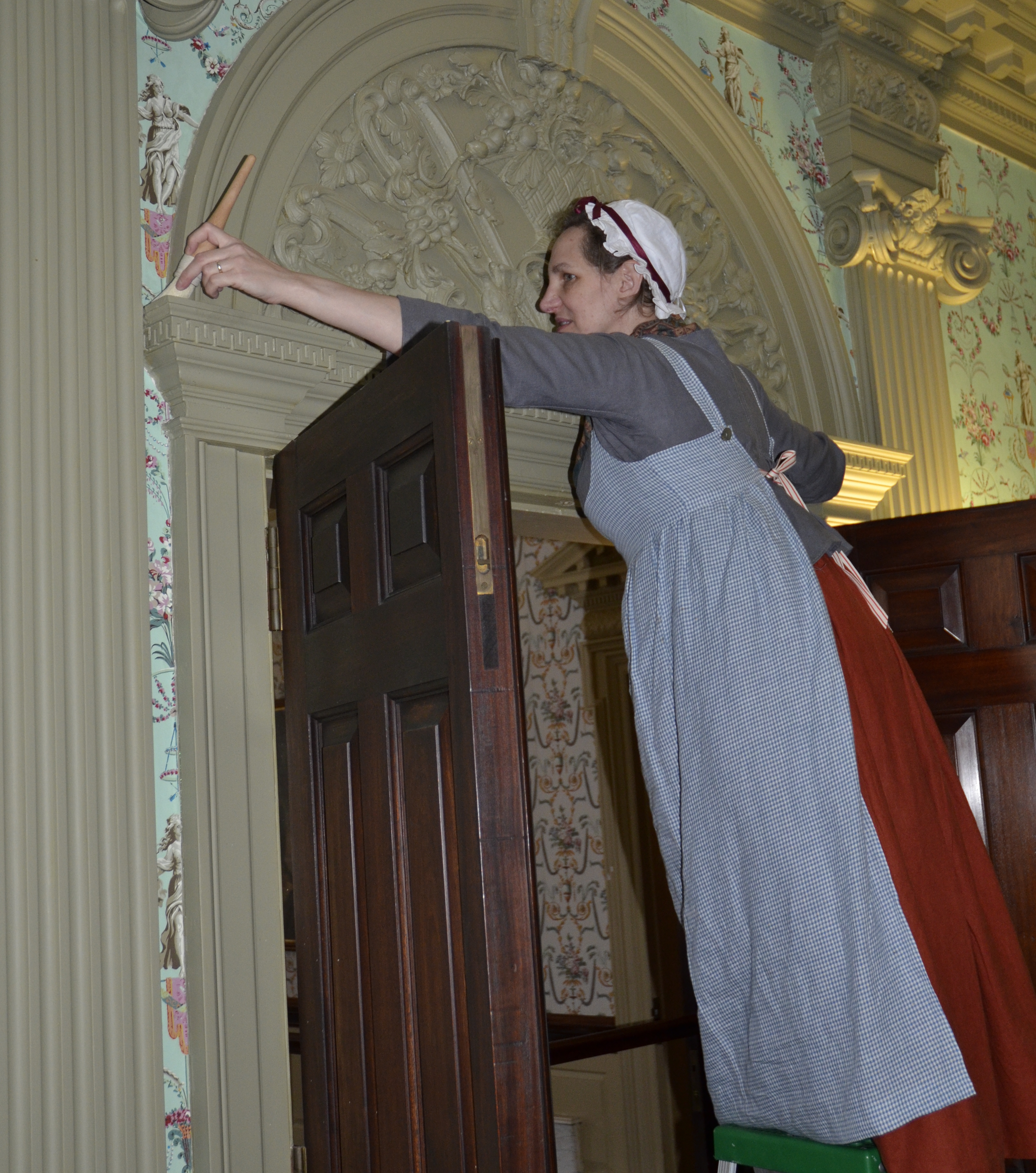
I first encountered this form of apron at Old Sturbridge Village, on display in the Firearms and Textiles exhibit space, which I think of as “Muskets and Muslins.” The accession number given on the exhibit label was 26.39.4, but the object does not appear in the OSV online collections database (they do warn that it contains just a selection of their total 60K-plus object holdings). The original at OSV, as sketched and described by me in April 2012 has a drawstring at the neck, straps that button, string at the back opening, and is slim, without gathers. That means the bodice is very similar to the gown bodices of the early part of the 19th century.
Smock, 2000.01.869 PVMA
There is another original checked bodiced apron in the Pocumtuck Valley Memorial Association collection in Deerfield, MA. This original appears in color in The Needle’s Eye by Marla Miller. As you can see in the images of my apron, I mashed the two styles together to suit the amount of material I had on hand, the skills I had three years ago, and the amount of time I had between seeing the apron and the day of the program, which was probably two days during which time I had pleurisy.*
This is also wrong, but funny.
To refocus: I chose to wear this apron at Whitehorse House in 1820 for a really wrong reason: it was what I had.
Papering the Saloon at Tickford Hall, watercolor by Diana Sperling, 1816.
Since we deal in confessions here, I will tell you that I did buy material for a black apron, and I planned to make a strapped or bibbed one, much like the one Sabine made. The appearance of the dark apron in Diana Sperliing’s watercolor of the ladies papering the saloon at Tickford Park put the dark strapped and sometimes bibbed apron the in English-speaking world. And still I did not manage to make one. If I were to do an 1820 program again, or even an 1813 or later millinery shop again, I like to think I would find the time to make a black strapped and possibly bibbed apron. I do think they were the height of fashion, and are likely to have been worn by women in shops, and by maids.
Do I think the checked apron is wrong? Given that I can rationalize anything, of course not! I think a checked apron is probably reasonably appropriate within the context of a kitchen, even in 1820, especially in New England. Since we did not cook on Saturday, the black apron would have been ideal, but I think the checked apron passes. To make it pass with a higher grade, I will freely admit it requires button and tape upgrades. Since the next dates on the horizon are 1775 and 1780, chances are good those upgrades won’t happen anytime soon. * Do not attend an all-day outdoor event in the cold when you are not well. Do not attend said event without your cloak, or in stays you have laced up a little too firmly. Do not deny that the cold you have might actually be the start of something bigger, when it includes a productive cough. Lo, the lessons of living history are many.
Mr & Mrs Thomas Sandby. Watercolor by Paul Sandby. RCIN 917875, Royal Collection Trust.
On Saturday, Sew 18th Century and I went out for lunch and fabric shopping. Along the way, I brought up pinner aprons, and that I’d seen them in British prints. She said, “You should blog about that!” and I went back to check my sources. Fail! There was an English print after a French original, and that doesn’t count!
So I shelved that idea, and went about looking for more Paul Sandby images of soldiers and maids and tents, and found instead Mr and Mrs Thomas Sandby. Ahem. Pinner apron alert.
Fluke, right? Well, no, not exactly.
Lady Chambers and child. Watercolor by Paul Sandby, RCIN 914409. Royal Collection Trust.
Because here is Lady Chambers and child, with Lady Chambers in a pinner apron.
The thing to note, though, is that “apron” here is a decorative, almost ceremonial garment made of black silk, while the maid engaged in Domestick Employment is wearing a working garment of [probably white] linen.
Domestick employment, washing. Mezzotint by Richard Houston after Phillipe Mercier, 1736-1775. British Museum 1876,0708.23
Well, can I wear a pinner apron as a Continental army laundress or not? Probably not, though I will be going back through all the images of laundering I can find. It would be so useful and protective a garment!
No, instead, it looks as if the black silk pinner apron was a fashion adopted by the British upper class probably in imitation of the aprons worn by young girls. These fleeting, black silk accessories were probably adapted to some other use when the fashion had fallen from favor. (You could make a lot of mitts out of one of those.) Sadly, I don’t care enough about the elite to go chasing inventories and more images, but someone else can. I think I have seen a few other examples of this style, but cannot immediately place them. My sense is that these are not common.
I’m much more interested in laundresses and maids. Doesn’t she look sassy? We could call her Bridget.
A country girl, full-length, facing front, leaning against a fence & a tree. Watercolor by Paul Sandby. RCIN 914438. Royal Collection Trust







 Kirsten Hammerstrom
You must be logged in to post a comment.