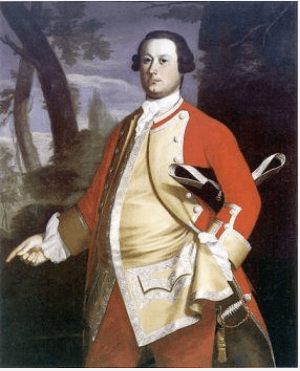
“Hanging in his quarters at Fort Lawrence, Winslow’s portrait in uniform would have served as a subtle reminder of his valuable connections. Copley’s three-quarter-length portrait lavishes attention on the young officer’s silver lace and pulsing red coat, a uniform more elaborate than the one he likely wore. The painter seemingly delights in the play of light upon shining surfaces, from the buff-colored sateen pulled taut across Winslow’s ample waist to the golden braid and tassel dangling from his silver-hilted sword.” (pp 56-57; emphasis added.)
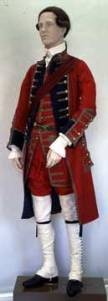
1760-65 Uniform of Captain Thomas Plumbe of the Royal Lancashire Militia.I missed that bit about sateen last night when I read this aloud to Drunk Tailor, so let’s roll back to the part that first set me off: the young officer’s silver lace and pulsing red coat, a uniform more elaborate than the one he likely wore.
Granted, Plumbe’s uniform is later than Winslow’s portrait, and Plumbe was a Captain and Winslow a Lieutenant, but the difference between them is rather less than, say, a private and a captain. Why does Kamensky assume that Winslow’s uniform is not the one he wore? Is it the lace? Winslow held a commission, and served as paymaster and commissary, roles Kamensky describes as “relatively modest.” Yes, Lieutenant isn’t Colonel; it’s the baby of officers, but it’s still commissioned officer and reasonably responsible (and, one might imagine, relatively remunerative if one was hooked into the Boston mercantile network). And uniforms were ornamented with tape, in gold, silver, or wool– see below, in Morier’s painting of two privates. (I further wonder whether it’s reasonable to describe a portrait of 50″ x 40″ as subtle, but perhaps it was placed in an enormous room.)
William Brattle, oil on canvas by John Singleton Copley, 1756. Harvard Art Museums/Fogg Museum, Partial Gift of Mrs. Thomas Brattle Gannett and Partial Purchase through the generosity of Robert T. Gannett, an Anonymous Donor and the Alpheus Hyatt Purchasing Fund 1978.606Fanciful? Fancy to our eyes, yes. Fanciful, no. Brattle was eventually a Major-General, so the uniform portrayed here, when he was likely a captain (same rank as Plumbe), seems pretty reasonable. If we were considering replicating a Massachusetts officer’s uniform ca 1755, we would consider Brattle and Winslow’s biographies and ranks, compare the two portraits of two men, probably both captains at this time, and, cross-referenced with Plumbe’s amazingly extant uniform and the 1751 warrant, begin to form an opinion that we would be making a coat in scarlet superfine broadcloth faced with buff, with buff small clothes, gold tape, and domed buttons. (Sateen is a weave structure, and wool sateen was not used in military uniforms.)
But that’s now how Kamensky is approaching this, of course, and why would she? She’s a historian, not a curator, material culture person, or a reenactor. Why does she assert that the uniforms worn by Winslow and Brattle are fanciful, and “more elaborate” than what they wore– without a footnote to back that assertion? And why does she then describe Major George Scott’s portrait “as the meticulously rendered uniform of his parent regiment, The Fortieth Foot” in contrast to “the fanciful, half-imagined costumes of Winslow and Brattle”? (p 58)
Major George Scott (detail), oil on canvas by John Singleton Copley, 1755-58. Private CollectionThe sitters’ biographies are footnoted, but nothing appears in the notes about the uniforms. Kamensky makes a great leap to the “fanciful,” which I find curious, considering that most male portraits are rendered carefully if flatteringly, and many female portraits are made for the male gaze, and are more likely to be “fanciful” or “fancy dress.”
I find myself wondering how it is that historians and art historians can write so confidently about images without understanding the material depicted. It’s as if they are all context and no content, while many reenactors/costumers favor content over context. In any case, having encountered these speed bumps in the book, I’ll certainly be reading it with a dose of skepticism when portraits are dissected.
Adam Stephen’s Waistcoat and Gorget
Date: ca. 1754
Catalog #: 12197; 12199 gorget Accession #: 52984
Credit: Division of Military History and Diplomacy, National Museum of American HistoryEdited to add:Drunk Tailor reminded me after I posted this that the NMAH possesses an actual officer’s waistcoat from the 1750s. Here’s the General History note in the online exhibit: “In 1755, the officers of the Virginia Regiment received orders from Washington to provide themselves with a “Suit of Regimentals” of good blue cloth. The coat was to be faced and cuffed in scarlet and trimmed with silver; they were to wear blue wool breeches and a scarlet wool waistcoat with silver lace.”
Scarlet wool waistcoat with silver lace. Sure does resonate with those portraits of Winslow and Brattle, and makes me all the more uncomfortable Kamensky’s assertions of “fanciful” depictions.
It’s auction season again, the best one of all: the major Americana sales and the Winter Antiques Show in New York. I won’t be at any of the exhibitions or sales, which is just as well for me; my friends know the twitchy “must-touch” finger motion that means I need to leave my wallet and checkbook in wiser, saner hands.
Still, even if we can’t buy, we can learn. This time around, I was delighted by the juxtaposition of two pre-1750 paintings in the Sotheby’s sales.
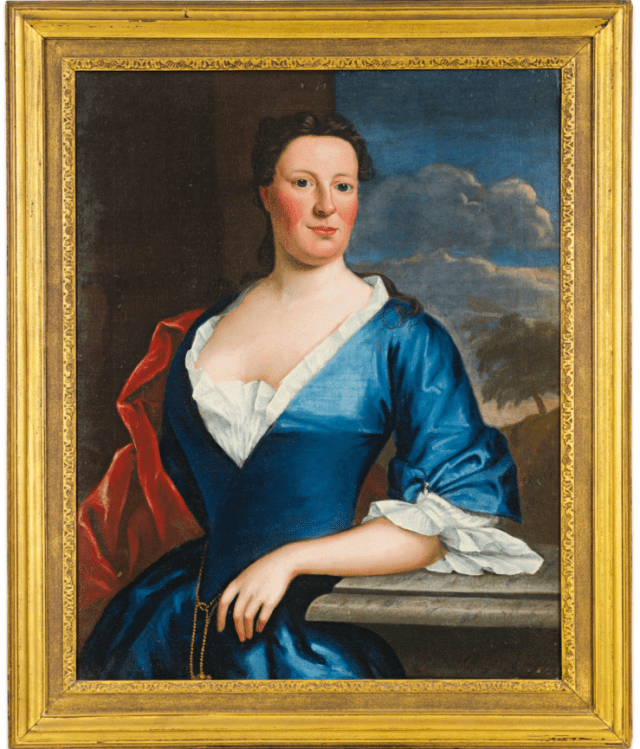
Robert Feke (1707 – 1752) PORTRAIT OF MRS. TENCH FRANCIS In what appears to be the original frame; Bears a label on the back of the frame: Mr. Willing, Bryn Mawr. Painted circa 1746. Label on the back of the stretcher: Philadelphia Museum of Art, Robert Feke, Portrait of Mrs. Tench Francis, 11-1969-2. Lender: Mr. E. Shippen Willing, Jr. Oil on canvas 36 by 28 1/2 in. Sotheby’s Sale N09456 Lot 1595
Francis. Shippen. Willing. This thing is DEEP in the history of Philadelphia, and by my fave 18th century RI painter.
It was a THING, that blue silk gown business with a red silk wrapper. Better yet? This one:
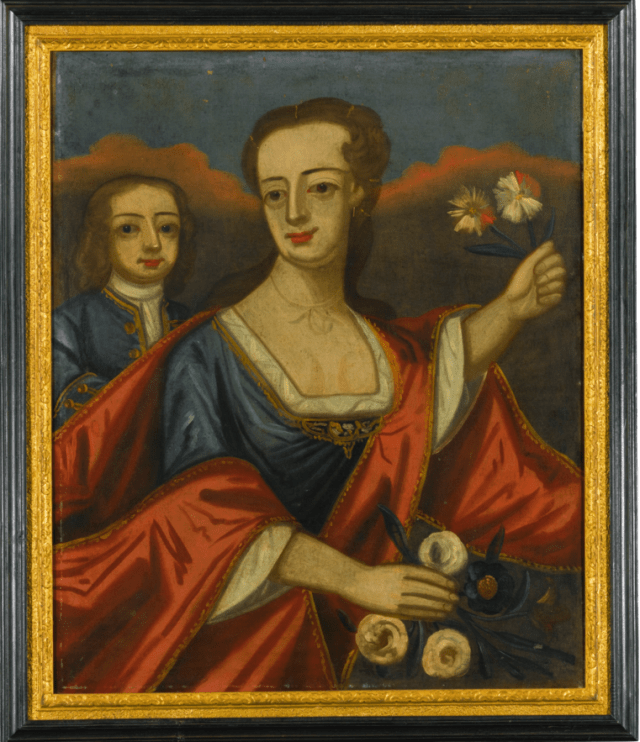
Attributed to J. Cooper 1685 – 1754 WOMAN WITH YOUNG BOY Appears to retains its original frame attributed to J. Cooper. oil on canvas 30 in. by 25 in. CIRCA 1715. Sotheby’s Sale N09466, Lot 398
What I love about the J. Cooper is how crude it is: that painting looks more like a woolwork picture than a painting. But that vernacular adaptation tells us how prevalent this portrait style was, and how desirable.
Another lot from the Sotheby’s American Folk Art sale is this pair of paintings by Jacob Maentel. (There’s an entire series of paintings by Maentel, all worth checking out.)
Particularly fun in this family portrait? The two little girls wearing dresses made of the same fabric. One of my former colleagues and co-conspirators always wanted to dress interpreters in clothes made of the same fabric, dresses, waistcoats and other items, as if we’d bought a sole bolt of fabric one year. Well, there it is, above: one length, two little gowns.
Lot 576, Sale N09106, “Nesmerian”
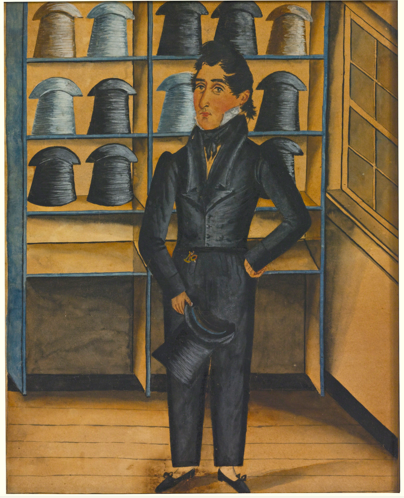
For my friend who makes hats, here is the portrait of Hatter John Mays of Schaeffertown, also painted by Jacob Maentel.
Top hats aplenty, bows on his shoes, and gold watch fobs. I’d say Mr Mays is doing quite well.
At the Brandywine River Museum, I saw an Asher B. Durand landscape and said, “I haven’t thought about Asher Durand in a long time.” My mother, ever the realist, muttered just-loud-enough, “Well, why would you?!” She studied art history for real, me, I only went to art school. It’s a wonder I can even feed myself.
Getting my stimulating-image fix last night on Pinterest: lo and behold, Asher B. Durand! Buddy! Good to see you! Even better, the side of Asher Durand you never get in those American Art History classes taught by a disheartened adjunct on a three-year contract trying to beat Manifest Destiny into you.
Thanks to Cassidy, Mrs. Winfield Scott gazed calmly from the screen last night, lovely in her golden silk gown with fine silk over sleeves not even as heavy as butterfly wings. Lovely Mrs. Scott, against a backdrop of a…finely painted river scene, highly detailed and with a looming cloud… That painter guy seems to know what he’s doing, why, Asher B. Durand, you scamp! You worked landscape magic into the background of that money-making, pay-the-bills portrait.
Grey Collection-Summer Afternoon
Cows won’t pay for portraits of themselves, so the history and landscape painters of the past generally had to shill the portraits (G.C. Bingham did it, but without Asher B’s grace). Lucky for us, they were good at people, too, though I think you can tell their first love is landscape.
So while Pinterest can be home to horrors (go see for yourself, I’m not looking), it can lead you to places you didn’t expect to go, or back to things you’d forgotten about, like Asher B. Durand. He was useful to know about when I worked in the Midwest, photo editing a history journal. I’m glad I’ve met him again.








 Kirsten Hammerstrom
You must be logged in to post a comment.