
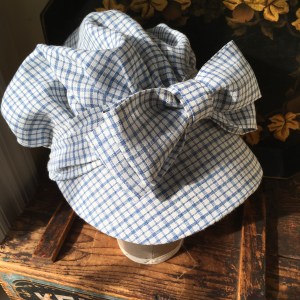
Check’d Bonnets

Here’s a question: what about those linen bonnets? Am I making that up?

As it happens, nope.

Linen bonnets appear in ads from the 1760s to the 1780s, sometimes described as white, and sometimes as check. There’s even a white diaper bonnet! The thing to remember is that so far I haven’t found these in New England, but that’s because I’m using runaway ads, and those are far less common in New England. There’s plenty of check linen fabric in New England– but if there were bonnets, those references may be in inventories I haven’t had a chance to dig into.

Maryland Gazette, (Annapolis)June 4, 1772

Another possibility in the regionalism of linen (checked or white) is climate. A friend and fellow blogger sees the linen bonnets in coastal North Carolina, which makes sense in terms of weather. It’s warmer and even more humid on the North Carolina coast than it is on the Rhode Island coast, and I’ve found linen to be much cooler than silk. This same regionalism may apply to what we see from Philadelphia to Frederick, Maryland.

Maryland Journal, August 21, 1776. I love this one because Rosannah is as tall as I am!

As I tabulate data, trends will emerge; as it happens, I’ve already seen that half the bonnets I’ve entered are linen and half are silk. Those references are from the Mid Atlantic and coastal South, with only one from Rhode lsland (and that a “blue cloth” bonnet), so there’s lots more data entry to come. For the moment, though, it’s safe to say that a checked, white, diaper, or dimity linen bonnet is documentable from 1758 to 1780 from Philadelphia south to Wilmington, North Carolina. The fiber persists, but shapes will change.

Vogue for the Lower Sorts

How does a reenactor know what to wear? There’s a wide range of choices for any decade, so how do you know what’s right?

Well, you don’t, not without documentation. This is where it can be nice to be a soldier. There’s griping in my house about “plain old white linen grumble frocks grumble waistcoat grumble” but really, the man and boy know who they are and what to put on. (Doesn’t stop them wanting regimentals, and I know they’re casting sidelong covetous glances at British coats.)

What about the women? The range is vast, from Mr. and Mrs. Ralph Izard

to the  Oyster Seller.

Both are ca. 1775, though the original Oyster Seller was probably earlier, but here’s the thing: how differently would she have dressed in 1775 than she would have in 1765?

It’s a point taken up, to a degree, in The Dress of the People, which I devoured in the orthopedist’s waiting room yesterday.

So if you know you’re not Alice Delancey Izard, but you’re not really an oyster seller, either, what do you do?

You check the ads.

I search runaway ads for Rhode Island to check my choices. That’s how I came to make a blue wool cloak, because I found Lucy, who ran away in December 1776 in a “blue Baize cloak.” There was Polly Young, who ran away in June, 1777, in a “black skirt petticoat and a short calico gown with long sleeves.” What did that short gown look like? I wish I knew. But it does place short gowns in Rhode Island (Lucy wore a short striped Dark Flannel gown when she ran away). Now, if only we knew what “short gown” meant in New England.