Spencers are not unlike bonnets, in my mind. They’re more work than a bonnet, sure, but compared to the layer cake that is an English gown, a Spencer is a batch of cupcakes.
I’ve fondled more silks than I may care to admit (oh, remnant table, how I love thee), and often picked up and put down a small length because it was patterned. Not enough for a gown, just enough for a Spencer. But Spencers are always solid.
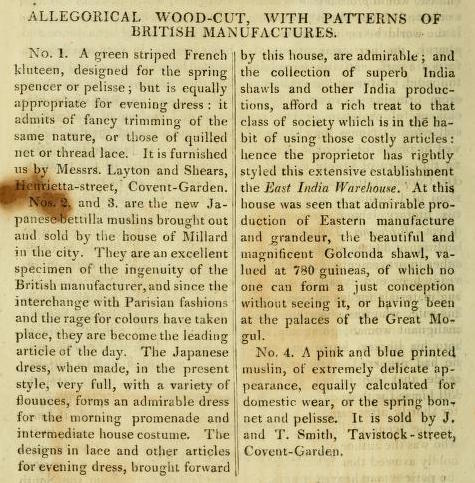
Allegorical Wood-Cut, with Patterns of British Manufactures. May, 1815. Ackermans’s Repository of Arts, etc. Volume 13.
It’s a Homer-quality forehead-slapping moment.
Caption, Allegorical Wood-Cut of British Manufactures. Ackermans’s Repository of Arts, etc. Volume 13, May, 1815. page 298
Not only are there extant cotton roller-print Spencers, and wild printed cotton Spencer ensembles in North American collections, there’s print evidence of patterned silks for Spencers. Somehow, until I came across this plate and the description in Ackermann’s, I could not make the leap from cotton to silk.
Ackermans’s Repository of Arts., etc. April, 1817.
Every now and then, someone argues with me that the historic house where I work would not have had window curtains or drapes. Sometimes they like to expand that argument to “there were no curtains at all” in early Federal America. The reasoning is usually that textiles were too expensive to “waste” on window dressing. If you know me, you know this kind of argument is a Bad Idea. The public fight (I was angrily accosted by a now-former docent during a public presentation) is known as The Great Curtain Kerfuffle, and resulted in my reply that the owner of the house could very well afford anything he pleased. Fabric is Money.*
There’s another iteration of my argument: Color is Money.
Ackermans’s Repository of Arts., etc. April, 1817. page 244
“Crimson is very rich, but blue is handsomer,” wrote Eliza Ward to her sister, Mrs John Innis Clark, in the 1790s. Curtains and covers were fringed (Mrs Hazard Gibbes was blue and yellow). Windows were dressed, and younger, less affluent relatives received hand-me-down curtains. In 1803, Elizabeth Watters in Wilmington, North Carolina was having a carpet “wove in true Scotch taste in imitation of Highland plaid.”
John Phillips (1719-1795) Oil on canvas by Joseph Steward,1794-1796. Sack Gallery, Hood Museum of Art, Dartmouth College.
Some carpets, no? Maybe the new mantra is Carpets are Money.
But quite aside from an obvious display of wealth, what we have to realize about these images and letters is that they are depicting a world that looks very different from our own. Color sensibilities, tolerance for pattern mixing, non-matchy-matchy sewing and dressing. We have to abandon our 21st century aesthetic sensibilities when we dress ourselves or our spaces for the past, and really embrace the vivacity of that world. Sensory overload, perhaps, but getting closer to what the world of the past looked like will help us see– in every sense– the way the people of the past did.
*I may or may not have made additional statements afterwards to the effect that of course wealthy Americans squatted naked in the corners of their well-appointed mansions gnawing raw meat until Benjamin Franklin invented fire and fabric. I should be sorry about that, but I don’t seem to be.




 Kirsten Hammerstrom
You must be logged in to post a comment.