Things Won’t Make You Happy…

DSC_0455except when they do.

I try hard not to be acquisitive, though our home is perhaps more crowded than it might be if I were better at the task or cleaned at work less and at home more. Around the time of What Cheer Day, I became rather obsessed with teapots.

At the local antique mall, I found an attractive Chinese export porcelain cylinder or barrel-form teapot with crossed strap handles, suitable in design and shape for use in 1800 Providence. I made a special mid-week trip fully intending to buy the teapot and free poor Mr S from ever hearing “teapot” again in endless conversation. When the item was out of the case, though, it turned out to have a mended crack right across the bottom, and as I told the woman, “It matters because I intend to use this.”

DSC_0450In the end, I did not have my fabulous teapot for What Cheer Day. In fact, my fabulous teapot arrived just this past Thursday, after patient stalking on eBay. It arrived with a bonus of five cups and a saucer, most with mends, but the pot itself has just a handle flaw or mend (typical, and seen, along with wear, in some museum pieces, too). The quantity of cups suggests that the previous owner had a relationship with them not unlike the one you might develop with a large litter of kittens you were fostering…adopt one, get another! Just to get them out from underfoot.

DSC_0470The cups and pot reminded me of the difficult meals and teas Elizabeth Bennett takes with Maria Lucas and Lady Catherine whilst visiting Mr Collins and his new bride Charlotte Lucas. There’s a tension in these cups, some combination of the dainty and the strong, some slightly misshapen (not all makers were equally skilled) that calls to mind the polite verbal combat of tea parties.

I washed the cups, and was reminded of the duties of maids to clean and care for these delicate items, the kind of thing they were unlikely ever to acquire, though there were grades of china then as now: what sat on John Brown’s table was not what sat on the Dexter’s table, or at least not in the same quantity.

DSC_0452The quantities of china coming into Providence and the rest of the Eastern seaboard after 1788 were enormous: in 1797, dinner sets of 172 pieces could be ordered at Canton for $22, and included 6 dozen large flat plates, 2 dozen large soup plates, 2 dozen small dessert plates, 8 pudding dishes, 2 large tureens, dishes and tops, 2 smaller ditto, 16 dishes of various sizes, 6 sauce boats and stands, and 4 salt cellars. Tea and coffee sets of 81 pieces were bought in Canton for $6 to $9! Just for dinner and tea, you could have 253 pieces of china, and we haven’t even begun to get into custard cups, cache pots, and garnitures!

DSC_0473The indifferent pieces I have acquired may have started out as kaolin, feldspar and quartz in Ching-te-Chen, 200 miles west-southwest of Shanghai. There were important porcelain manufactories there, and porcelain wares traveled by road and boat to Canton, where sets were customized to meet specific orders and then loaded onto ships bound back to America, six months or so after the order was placed in Providence, Salem, or Boston. It’s a lot of work for a fashionable sip of Hyson or oolong, and no wonder cups and pots were mended, saved, and reused.
Mad for Plaid and Patches

Yesterday, I went to visit another collection, this time at the University of Rhode Island. I don’t have thoughts about replicating coats- they didn’t ask me any hard questions about making coats, they just let me work– but I did see a lot of amazing garments.

I’m focused primarily on men’s clothing at the moment, largely because I’m stumbling towards an exhibit or a paper or maybe a better blog post, and because thus far I have not found any examples of women’s garments made from locallly-woven checks or stripes in local collections.*

What I concentrated on at URI were two very lovely examples of the kinds of clothing worn by everyday people in Rhode Island and Southeastern Connecticut, both collected by a woman who lived in the village of Lafayette on the Victory Highway. Mrs Muriel Buckley was born in Exeter, RI in 1884, and started collecting clothing of all kinds in 1900, when she married; by the mid-1950s, she was known as a “one woman historical society,” according to a Providence Journal article, and hosted parties where she and her guests dressed up in the clothes and cooked colonial recipes in early ironware. **

As my late landlady’s husband used to say, “Cut the cackle, let’s eat some grub.”***

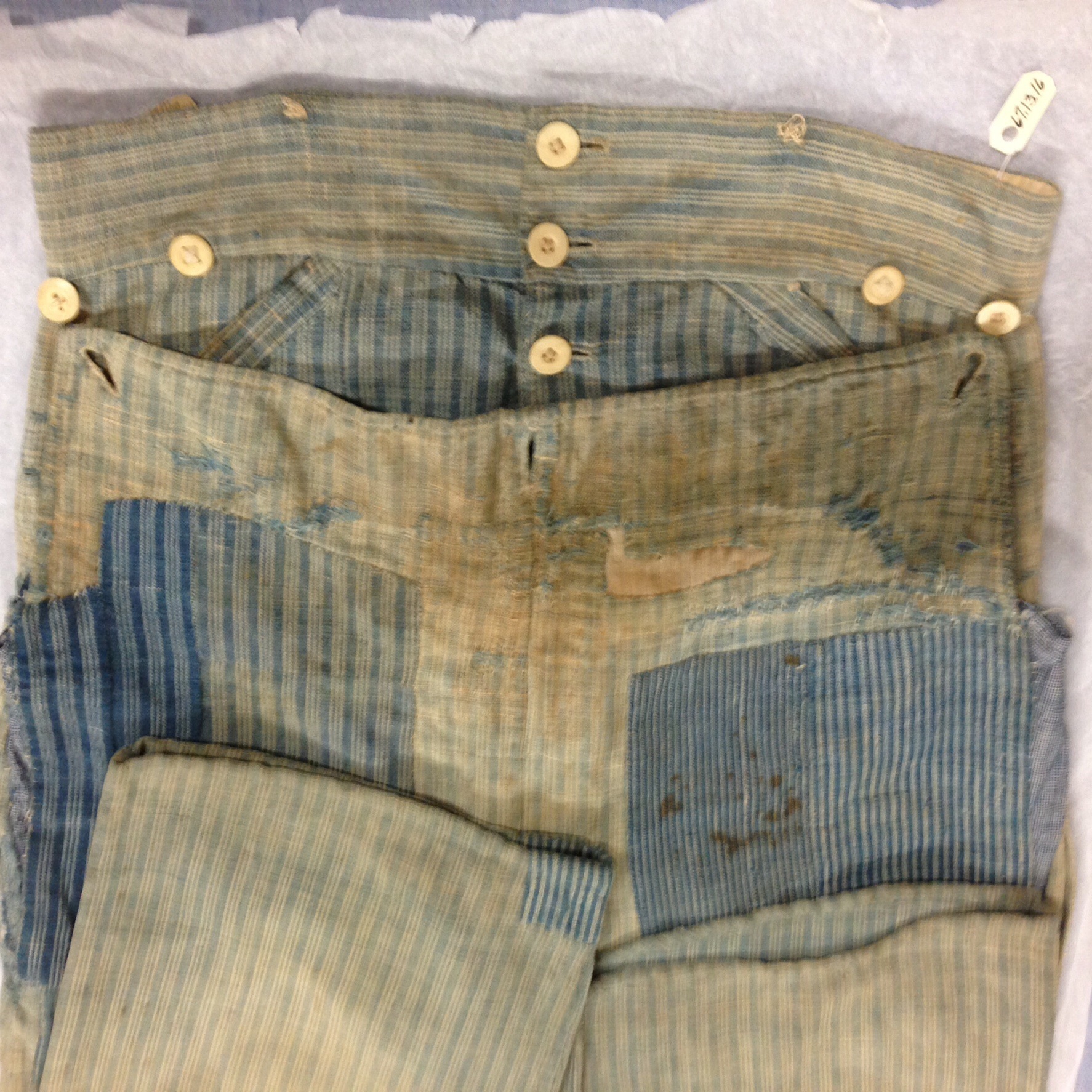
Blue and white striped linen fall-front trousers ca. 1830, URI 1967.13.16

11967.13.16, trousers ca 1830. Gift of Mrs Muriel Buckley, URI Textile Collection.
1967.13.16, trousers ca 1830. Gift of Mrs Muriel Buckley, URI Textile Collection.

These are pretty interesting, with about a dozen patches of various sizes and fabrics. The main fabric is a blue and white stripe linen of 42 threads per inch. The fall-fronts have pockets built into the bearers, with a welt cut on the grain but set on the bias for a snazzy little graphic moment. The button holes appear to be slightly rounded at the ends in a way that siuggests intent and helps confirm the date. The buttons are not all the same design, but are all four-holed bone buttons. The trousers have a 31″ waistband, a 19.5″ rise, and a 26″ inseam.

The other truly fabulous piece I saw was a coat in a blue, white and orange check “Stonington Plaid” ca. 1800, URI 1967.13.17.

This is a double-breasted, self-faced tail coat with self-covered buttons and notch collar lapels, false pocket flaps on coat body and pockets in the tails and left breast. The unlined, folded-back cuffs are tacked to the sleeve and may have been shortened. The overall length at CB is 36″, sleeve length is 25.5″ and the chest is about 34″.

1967.13.17, "Stonington Plaid" linen check coat, 1800-1810. Gift of Mrs Muriel Buckley, URI Textiles Collection.
1967.13.17, “Stonington Plaid” linen check coat, 1800-1810. Gift of Mrs Muriel Buckley, URI Textiles Collection.

When I opened this coat and looked at the seams, I was struck by the construction method, not because it was different, but because it was so typical. (I also peeked inside two wool broadcloth coats in the cupboard: same construction as the woolen coats I’d seen before.) It;’s nice to see conventions in action, and recognize what you’re seeing.

The collar on this coat has some little anomalies suggesting a less-experienced hand, or perhaps a foray into a new type of collar; judging by the pad stitching, I’m more inclined to guess less experienced hand, though not home manufacture. Someday I’ll track down the South County and eastern CT tailor’s books…

1967.13.17, back view of "Stonington Plaid" checked linen coat. Gift of Mrs Muriel Buckley, URI Textiles Collection.
1967.13.17, back view of “Stonington Plaid” checked linen coat. Gift of Mrs Muriel Buckley, URI Textiles Collection.

In the meantime, what amazing clothes and fabulous fabrics! The past looks nothing like what we imagine unless we can look past fashion plate elegance to the riot of stripes and checks and prints that must have existed in almost every village and town in Rhode Island.

*With the exception of a pocket at Mystic Seaport and a gown at the Smithsonian: accessory in the first case and very not local in the second case, making in hard to study in a day trip.

**Having palpitations yet? Your heart will really race if I can track down the photos to prove all this. In other news, I know a couple of gentlemen who are currently “one person historical societies.” The collecting instinct in wired into some folks.

***Jack and Harriet: she survived the 1938 Hurricane, and their overweight black-and-white polydactyl cat, Bonnie, followed them around the corner to church every Sunday.

Malaise or Ennui?

image Hard to say which, but I am ill at ease and dissatisfied with my costuming. You might even call it bratty. But I don’t wanna be like Bridget Connor!

It started the week of the Stamp Act protest, when I felt quite tired of being the shabby, unrefined woman of the regiment and street vendor, and wanted a nice cozy shop like the milliner had. I was also looking forward to being a housekeeper again, and several weeks of moving boxes and volumes with red rot at work had me feeling generally filthy and unappreciated. Bratty.

When in doubt, sew. A new dress can’t help but cheer you up, right?

Well… sort of…

Last Thursday, we did a reprise of the Williams family letters program at the Newport Historical Society. The Williams family were Quakers, and the letters were from the early part of the 19th century, so for the program in March, I made a green silk cross-front gown based on the Quaker gown in the back of Costume in Detail. (Check out the schematic on the 19thus.come page; I didn’t see this until I was mostly done with the dress, but thank goodness I got it right!)

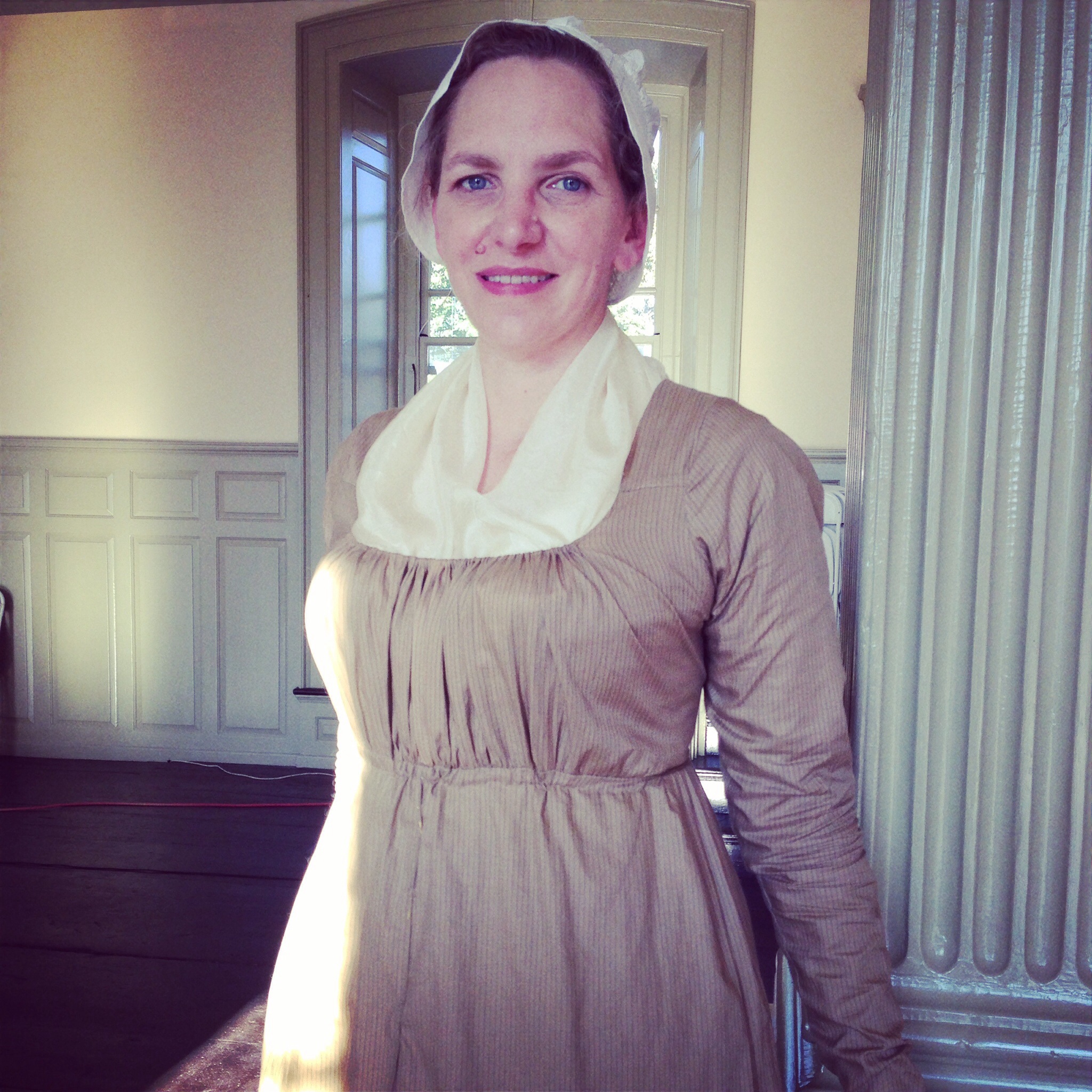
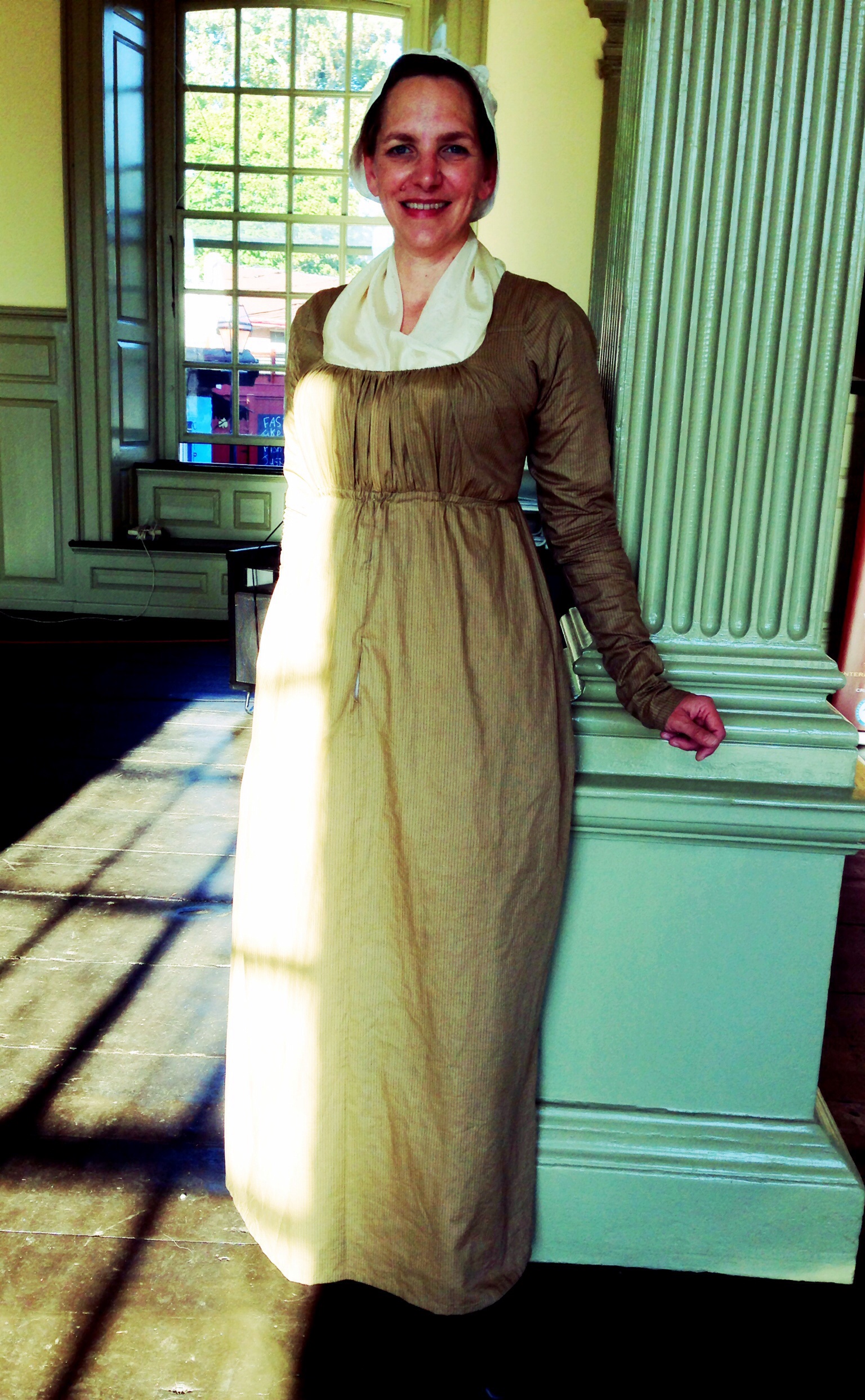
But it’s September, and Thursday was expected to be quite warm, so I salved my bureaucratic wounds in the $1.99 loft at the local mill store, and made a new Quaker gown, also suitable for a maid.

I ask you! Even though it’s my very own pattern based on sketches of original drawings, even though it fits, even though it cost $10, even though every seam is overcast and the whole thing is made with period correct stitches, it still fails to make me happy and cheerful and delighted.

image

This brattiness has resulted in a reappraisal of my approach– and a trip to Sewfisticated in Framingham. What did I buy there? Yards and yards of pink taffeta? Gold taffeta? Blue taffeta?

No.

Because they didn’t have the right colors in the right weave– too slubby– or in enough yardage. Brace yourselves: I bought brown.

Many thanks to Sew 18th Century for taking the photos!

It appears I do not learn from my mistakes. When I think, “Gee, I’d like a pretty dress,” I end up buying fabric based on the texture as much as the color, and I have to tell you, that brown taffeta has the most wonderful l hand and sheen, and I will look much more like a Copley portrait than I ever have before, so that’s something.

It seems I have created a set of mental rules for myself, a mission, if you will, for the historic clothing I sew and the roles I take on, and I only play within those rules.

Friends in Newport

Costumed interpreters as 19th century Quakers
Interpreters at Newport Historical Society, February 2014. Photo courtesy Newport Historical Society staff

I’m so glad I have friends in Newport. If I didn’t, I wouldn’t get over to the Island nearly as often as I do now.

Next Thursday, I’ll be joining friends in Newport next week for a program based on letters in the Newport Historical Society’s collection.  This program will be much like the one I was part of earlier this year, but open to the public.

The letters are really interesting and entertaining, providing a window into Newport history that I know you cannot hear anywhere else.