Frivolous Friday: Something Fishy

Fishing Tackle kit, Winterthur Museum, 1961.0492 A-Y
Fishing Tackle kit, 1820-1860 Winterthur Museum, 1961.0492 A-Y

The best things turn up when I’m looking for something else (in this case, the shell-printed pocket). These serendipitous finds always lead someplace interesting, in this case, to historical fishing (and my personal interest in historical hunting prints).

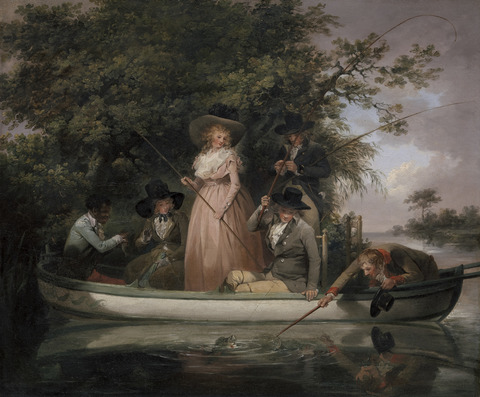
It’s a pleasantly refined sporting activity, suitable for ladies and gentlemen, with the pleasant result of dinner– presuming you manage both to catch a fish and not fall in. Standing up in boat seems unwise, and that hat surely casts an incredible and unmissable shadow on the water, but Morland’s party has caught a fish nonetheless.

Always something new to learn, and heaven knows I need yet another line of inquiry to pursue with all the others…though this might at least be a useful pursuit, if only in the meditative quality of an afternoon spent outdoors catching nothing.

George Morland, 1763–1804, British, A Party Angling, 1789, Oil on canvas, Yale Center for British Art, Paul Mellon Collection B2001.2.22

Spring Spencers

Spencers are not unlike bonnets, in my mind. They’re more work than a bonnet, sure, but compared to the layer cake that is an English gown, a Spencer is a batch of cupcakes.

I’ve fondled more silks than I may care to admit (oh, remnant table, how I love thee), and often picked up and put down a small length because it was patterned. Not enough for a gown, just enough for a Spencer. But Spencers are always solid.

No, they’re not.

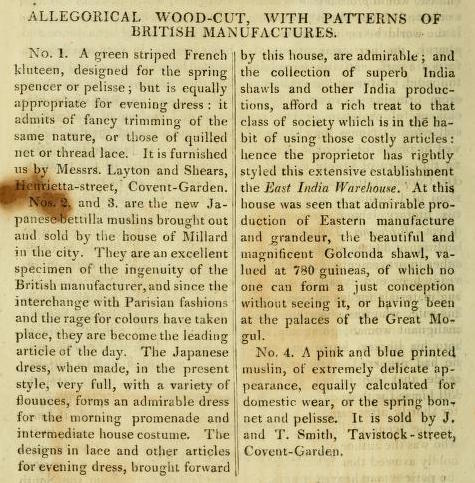
Allegorical Wood-Cut, with Patterns of British Manufactures. May, 1815. Ackermans's Repository of Arts, etc. Volume 13.
Allegorical Wood-Cut, with Patterns of British Manufactures. May, 1815. Ackermans’s Repository of Arts, etc. Volume 13.

It’s a Homer-quality forehead-slapping moment.

Caption, Allegorical Wood-Cut of British Manufactures. Ackermans's Repository of Arts, etc. Volume 13, May, 1815. page 298
Caption, Allegorical Wood-Cut of British Manufactures. Ackermans’s Repository of Arts, etc. Volume 13, May, 1815. page 298

Not only are there extant cotton roller-print Spencers, and wild printed cotton Spencer ensembles in North American collections, there’s print evidence of patterned silks for Spencers. Somehow, until I came across this plate and the description in Ackermann’s, I could not make the leap from cotton to silk.

Despite the existence of this.

My sole defense is that one patterned Spencer is still a zebra among horses.

But additional evidence, in the form of recommendations for spring in Ackermann’s? The zebra’s looking a little more like a horse.

Want more Ackermann’s? You know you do. The links are better sorted here.

Many, many thanks to Mr B for the tip!

Fashionable Furniture, or, The Glories of the Past

include window drapes.

Ackermans's Repository of Arts., etc. April, 1817.
Ackermans’s Repository of Arts., etc. April, 1817.

Every now and then, someone argues with me that the historic house where I work would not have had window curtains or drapes. Sometimes they like to expand that argument to “there were no curtains at all” in early Federal America. The reasoning is usually that textiles were too expensive to “waste” on window dressing. If you know me, you know this kind of argument is a Bad Idea. The public fight (I was angrily accosted by a now-former docent during a public presentation) is known as The Great Curtain Kerfuffle, and resulted in my reply that the owner of the house could very well afford anything he pleased. Fabric is Money.*

There’s another iteration of my argument: Color is Money.

Ackermans's Repository of Arts., etc. April, 1817. page 244
Ackermans’s Repository of Arts., etc. April, 1817. page 244

Those of us who shop at IKEA are not going to have “the most fashionable style of decoration” in our 1817 homes. The Willings and Binghams of Philadelphia were models for the  most fashionable families of Providence, and while well before this 1817 plate, the Binghams were recorded draping their chairs with orange and red silks. In early 19th century Providence, the John Innis Clark family had silk covers on their sofas and chairs in 1808, and plenty of carpets and curtains in their Benefit Street home from the 1790s on. 

“Crimson is very rich, but blue is handsomer,” wrote Eliza Ward to her sister, Mrs John Innis Clark, in the 1790s. Curtains and covers were fringed (Mrs Hazard Gibbes was blue and yellow). Windows were dressed, and younger, less affluent relatives received hand-me-down curtains. In 1803, Elizabeth Watters in Wilmington, North Carolina was having a carpet “wove in true Scotch taste in imitation of Highland plaid.”

John Phillips (1719-1795) Oil on canvas by Joseph Steward,1794-1796. Sack Gallery, Hood Museum of Art, Dartmouth College.

Some carpets, no? Maybe the new mantra is Carpets are Money.

But quite aside from an obvious display of wealth, what we have to realize about these images and letters is that they are depicting a world that looks very different from our own. Color sensibilities, tolerance for pattern mixing, non-matchy-matchy sewing and dressing. We have to abandon our 21st century aesthetic sensibilities when we dress ourselves or our spaces for the past, and really embrace the vivacity of that world. Sensory overload, perhaps, but getting closer to what the world of the past looked like will help us see– in every sense– the way the people of the past did.

*I may or may not have made additional statements afterwards to the effect that of course wealthy Americans squatted naked in the corners of their well-appointed mansions gnawing raw meat until Benjamin Franklin invented fire and fabric. I should be sorry about that, but I don’t seem to be.

On & Off the Grid

It’s been a very busy time chez Calash, with many changes underway and to come. It’s hard to keep up with all the writing I’m doing everywhere, but eventually I’ll be back on topics of authenticity, standards, and whimsical Wednesdays.

This week, though, is all about checks. (Most weeks are, in some way, aren’t they?) Not paychecks, silly: linen checks.

We are headed out to Eastfield Village Friday afternoon where Mr Hiwell and the Young Mr will join in the 1833 militia muster, and Mr JS and I will occupy a house as a shop/tailoring business/punch-making and cooking establishment of one kind or another.

Mr Hiwell has been warned to expect a diet unlike his norm, and since his roundabout is white, we will quickly know if he is smuggling Oreos and barbeque sauce.
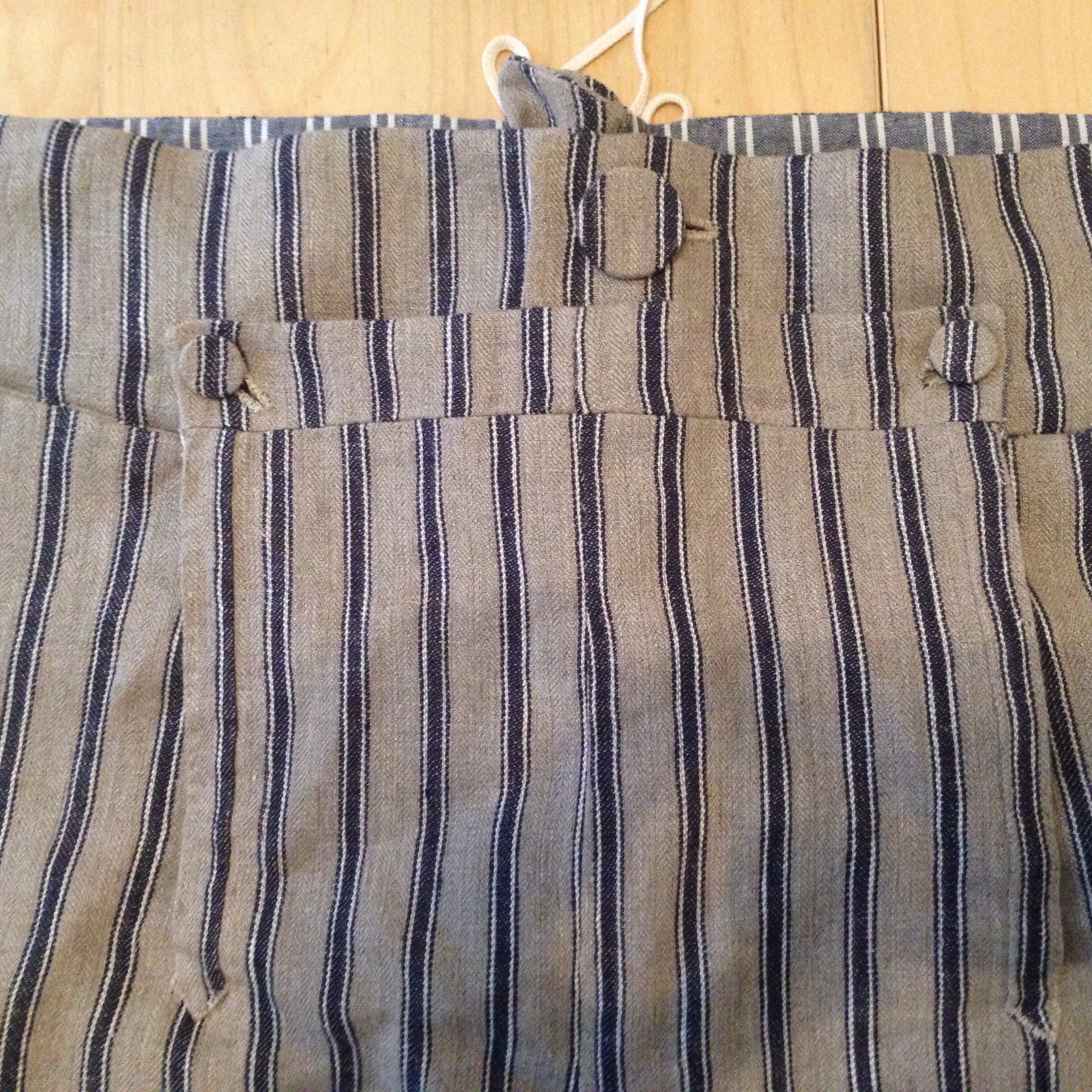
 For the Young Mr, I have been making trousers. Yes, I do like things to line up. I wasn’t even paying that much attention when I cut these, but apparently that was  was enough.

Yes, even the buttons.


Sigh. It’s a thing.

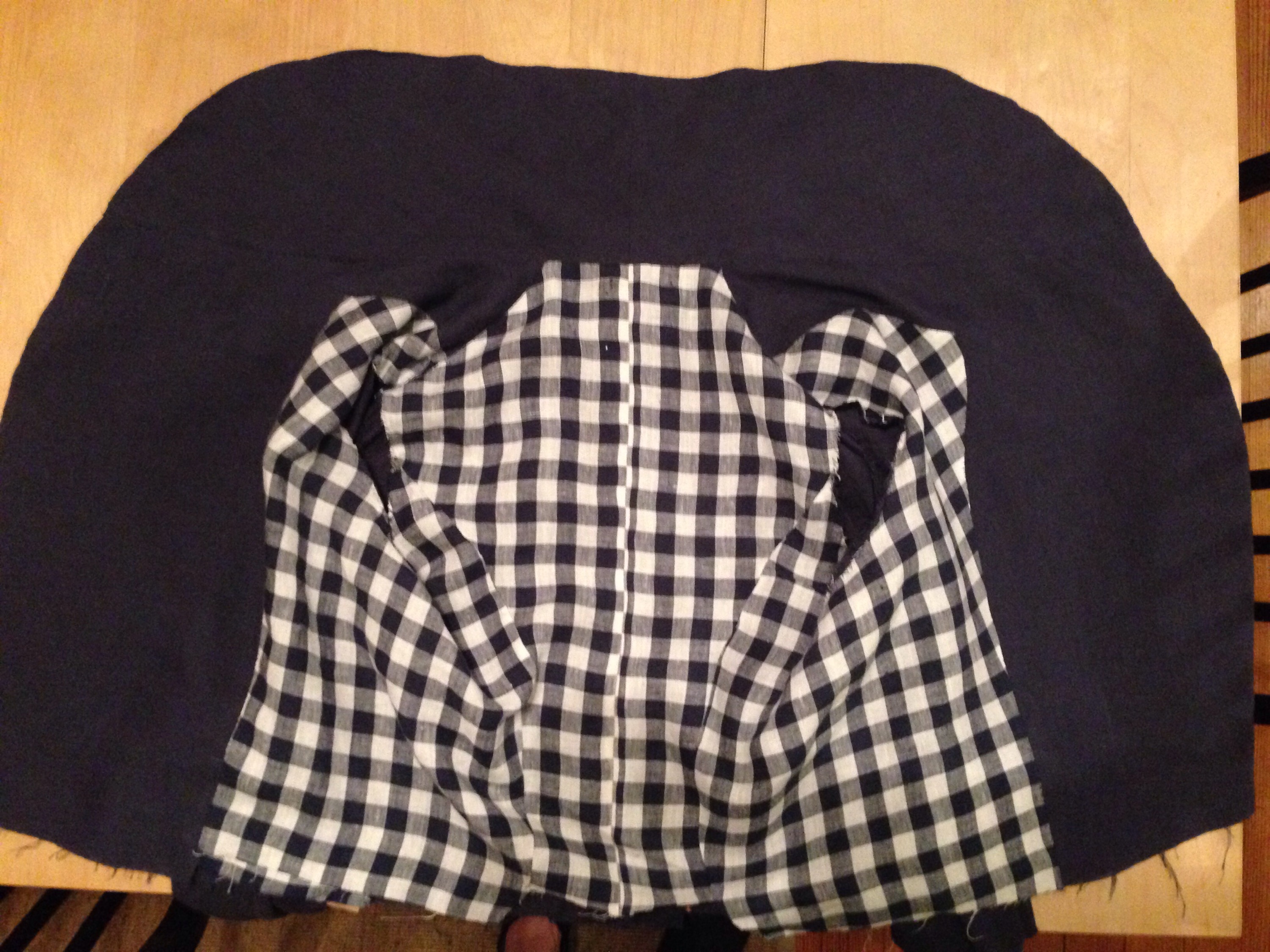
He’s also got a roundabout in the works, which I must focus on more closely to finish. This is patterned from an original in Henry Cooke’s collection, but… Mr. Cooke and I, on a very sticky Tuesday afternoon, did not have the Young Mr at hand to measure again. The original was too small: that we knew. What we did not know was that the boy had taken on a man’s shape– or, as a friend says, “he’s dude-shaped now!”–and the additions we made were not enough, except (barely) to the sleeves.


Oh, well. There was just enough to make it all work, and after some trials I realized it needed a lining. What kind of lining? A checked lining, of course!

It seems okay, but these collars are strange to  me.


Well, at least he will be clad.

Let you think  I’m sewing only for the lad, I am in fact working on a gown for myself. There’s a hopeful yard or so of another check’d  linen from the stickiest fabric store on 39th Street lurking, but I do not think that apron will happen this week. Perhaps John Brown’s housekeeper will finish it someday.

At least there are already gowns and aprons ready-made that can travel with me. Someday soon I’d like to finish my new stays… winter will come soon enough, and more sewing then.