Privacy and Proximity

DSC_0412
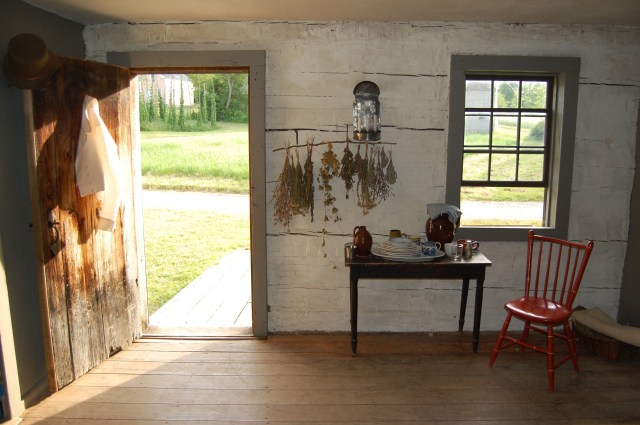
Feeling the Wyeth at Kiefer House

It has been a long time since I read Bowling Alone, and longer still since I read A Pattern Language or Jane Jacobs, but all of those came to mind this past weekend.

I don’t mythologize or romanticize the villages of the past: we all know how The Crucible turns out, but I thought about privacy and proximity, and I thought about scale. Let’s take privacy first.

In this century, it’s difficult to experience the past as anything more than a series of simulacra which we piece together in a crazy quilt of understanding, but past notions of privacy are far different from our own.

Bedroom

Early one morning, as I lay in a creaking rope bed, I considered how unfamiliar most of us are with the noises of other humans. The wall of our bedroom just barely fit against the exterior wall, and moonlight on whitewash showed the spaces between planking and the plaster, and we slept with the bedroom door open to take best advantage of the cool evening cross breeze.

As I lay awake, my companion happily asleep, I pondered the true extent of my laziness. How much clothing did I really need to wear to go up to the public facility? How loud would relieving myself in the chamber pot be? And what would the reaction be? (I have been on the side of someone else’s choice not to use a chamber pot, and said, “I wouldn’t care,” but one never knows.) And though I elected to put on more than my shift and walk to the public convenience, I began to wonder: what did the people in the past tolerate, ignore, or politely decline to mention?

What did living together feel like, when people shared smaller spaces? When the boundary between private and public, bedroom and parlor, was pierced with holes?
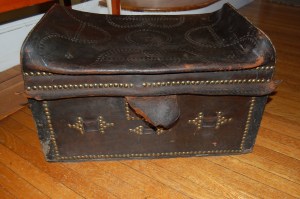
My Grandfather’s Trunk

Some objects you can't shake. And then you buy them.
Some objects you can’t shake. So you buy them.

When I was little, one of the games my mother and I played was “I packed my grandfather’s trunk.” You start with that line, and take turns adding an item in alphabetical order. The trick is, you have to repeat the whole string as you go along, so that by the time you’re packing a zebra, a zither, or zwieback, you’ve got to remember the other 25 things you and your companions have packed. It’s a good game for waiting rooms when you can’t run around, and fun for people who love words. How many nouns that start with “y” can you think of?

After lining the bottom with paper, I packed the linens.

In less than a week, I’ll be packing someone else’s greatx-grandfather’s trunk for a trip westward into the (relative) wilds of New York State to join a Sketching Party. Despite two intense weeks, I’ve persevered on the orange check gown and made significant progress on the Thriller Spencer and finished the second sheet. This is a trip to a different class altogether, one of my two annual forays into the mercantile class of the early Federal period.

It’s quite the thing, packing your alter ego’s equipage for another century, and as I’ve enjoyed a longer commute recently, I’ve pondered the ways in which we stereotype certain kinds of living history practitioners. Progressives don’t always travel light: they travel right, and in this case, it means a quantity of baggage to create the proper simulacrum of an 1814 excursion.

DSC_0401
It’s a quantity of stuff, isn’t it?

While I decry the use of film and television as sources for historical costuming, I do appreciate them for inspiration, and it is remarkably easy to get someone else hooked on a good adaptation like the BBC’s 2009 Emma. The depiction of the picnic on Box Hill is particularly good (i.e. excruciating) and the pile of materials required for appropriate comfort is overwhelming to anyone who prefers to travel lightly. Never before have I considered a turkey carpet a possible accessory to an excursion, but when one intends to ape one’s betters and bring culture to the frontier, anything is possible.

Stay Thy Hand

IMG_6784

Stays. They’re infrastructure: absolutely necessary, a major time commitment, and decidedly unsexy. I am in dire need to two new pairs, one for late 18th century use and one for early 19th century, and each with deadlines looming.

I can manage 19th century attire and Genesee with the chopped-and-dropped corded stays I already have, but New Jersey will not happen at all unless new stays are made. It was like a weekend of penance chez Calash, two straight days of stay mocking up and making.

Of course I bled on them. That’s how I know they’re mine.

IMG_6786

And let’s get this out of the way: I thought backstitching the back seam was a little more difficult on this side, but ascribed it to sore fingers. Wrong! I failed to notice that I was stitching through all the layers, and not leaving one free to fold over and finish.

IMG_0806

A glass of cider and an hour later, I’d rectified the error. These are now fully bound along the bottom edge, and ready for the top edge binding. Somewhere there’s coutil for the straps, and then numerous hand-sewn eyelets later, I will have a finished pair of hand-sewn stays.

New stays deserve a new gown, and since I found this lovely image, I know what that new gown should look like (as well as a portfolio).  Happily, there’s a dress in Cassidy’s book that will serve as a reasonable basis for recreating this image. I’m still pondering the portfolio, and what it might be made of: paper or leather covered pasteboard? As the clock ticks down to June, I suspect I will be using a portfolio I already have on hand.

And then there are the the 18th century stays, with their history of woe.

File_000

I’ve gotten this far with the new 18th century pair, and an interesting business it is. I altered the front side pieces and the stomacher, but cannot see the back well enough (even with a camera and a mirror) to adjust it by myself, so further changes will have to wait until I have some assistance.

The tabs aren’t right in the back, and while the advice is to shorten the stays when the tabs flare this way, I found the fronts were still too low, once again riding at nipple-cutting height. Finally it occurred to me that the problem– slippage–might actually be one of waist. I lengthened the fronts half an inch and nipped the waist in, and found the fit more pleasing.  I suspect the back pieces need to be trimmed a bit before they’ll fit (they’re stitched closed in this version, so you know they’re too big).

Another weekend of work awaits– with focus, those early 19th century stays may be done by then, if there are no more finger injuries.

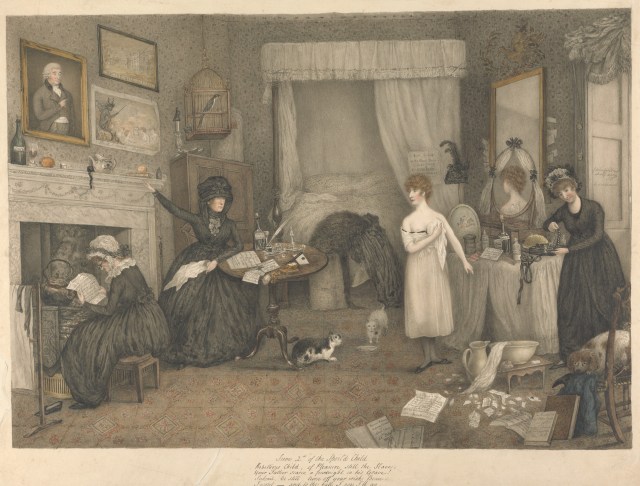
After Dark: Bedtime for Kitty

Lewis Vaslet, 1742–1808, The Spoiled Child, Scene II, ca. 1802, Watercolor with black ink and gray wash over graphite on moderately thick, slightly textured, cream wove paper, Yale Center for British Art, Paul Mellon Collection. B1977.14.4342

In just about a week, we’re running a pilot program in the historic house where I work (tickets available here). After Dark, or What Cheer Night, are programs we’ve wanted to do for a couple of years, but all good things take time.

Error
This video doesn’t exist

I’ve drawn the lot chosen to talk about getting ready for bed and sleeping: lighting devices, bedding, washing, chamber pots* and what people wore to bed. While already in possession of candles and candlesticks, and the proud new owner of exhibition and interpretation grant-funded LED candles, there are things I needed to make. Of course.

Print made by Guillaume Philippe Benoist, 1725–ca. 1770, French, Pamela Swooning, after having discovered Mr. B. in the closet, He (frighted) endeavouring to recover her, Mrs. Jervis wringing her hands, and screaming, 1745, Etching with stipple engraving on medium, slightly textured, cream laid paper, Yale Center for British Art, Yale Art Gallery Collection, Gift of the Library Associates.

A banyan, for one thing. And you know that will (one hopes) be followed in short order by a night cap. After all, you can’t talk about Pamela if you haven’t got a banyan and a cap in the house. That’s a simple and relatively fun project to tackle when brain capacity is somewhat limited: some piecing, straight seams, setting in facings and sleeve linings can all happen before I must assault the collar.

Collars are devilishly tricky for me sometimes– oddly, a pad-stitched collar set onto a tailored jacket seems easier to me than a bedgown collar– but I suspect the eventual recipient will manage to enjoy the garment no matter what minor construction errors a tipsy milliner or half-seas over housemaid might make (not, of course, that I am either of those things).

It’s been a fascinating exercise in having a staff-and-docent study group that has taken a decidedly feminist bent (calling Our Girl History!) as we explore what happened in Providence After Dark. Brothel riots in 1782. Warnings by the Baptist Church not to visit the “theatre, circus, or Green Cottage” on pain of punishment. No, I do not yet know what or where the Green Cottage is, but the best researchers I know are working on it. Is this the 18th century answer to the Green Door? We can but hope.

Reading The Coquette? Thomson’s The Seasons? Come experience an 18th century house on a night when people will know what you’re talking about! Or you can watch  that questionable housekeeper prepare a room for the night while she talks about sleep patterns and shares tips for 18th century pest control.


*Pro tip: put it on a chair. I fully expect to run an intimate workshop some evening called “Will Humiliate Self for History, or, Everything you ever wanted to know about the 18th century, but were too well brought up to ask.”