Portrait of a seated young lady, watercolor on paper by Anna Maria von Phul, 1818. Missouri History Museum, 1953 158 0013
Ladies’ Monthly Museum, v. 5, plate 71. July 1, 1816. Casey Fashion Plate Collection, Los Angeles Public Library
Anna Maria von Phul’s delicate watercolors of Saint Louis in 1818 (example at left) remind us that cities in the hinterland of America have never been as far behind the times as coastal dwellers might imagine. As a former resident of the Great Fly Over, I know how defensive people can be about their relative sophistication, and that could be why our Young Lady here appears slightly defensive in her posture.
The young lady is certainly fashionable in that white gown, and literate, too, though we cannot see what she is reading; perhaps Maria Edgeworth.
It took some doing to find a similarly posed and dated fashion plate with a book, for fashion has always been more fantasy than reality.
The Ladies Magazine, v/ 4, plate 53, Wednesday July 1, 1812. Casey Fashion Plate Collection, LA Public Library
I don’t know which I like best: the green and white bonnet, the green silk Spencer, or the suspicious and candid glance of the woman on the left. Perhaps its the date: mere weeks before the purported milliner’s store this coming August. Have I already purchased green silk and white cotton organza? Of course I have. Never let a fashion plate or an event keep you from a new and slightly mad project to make something new.
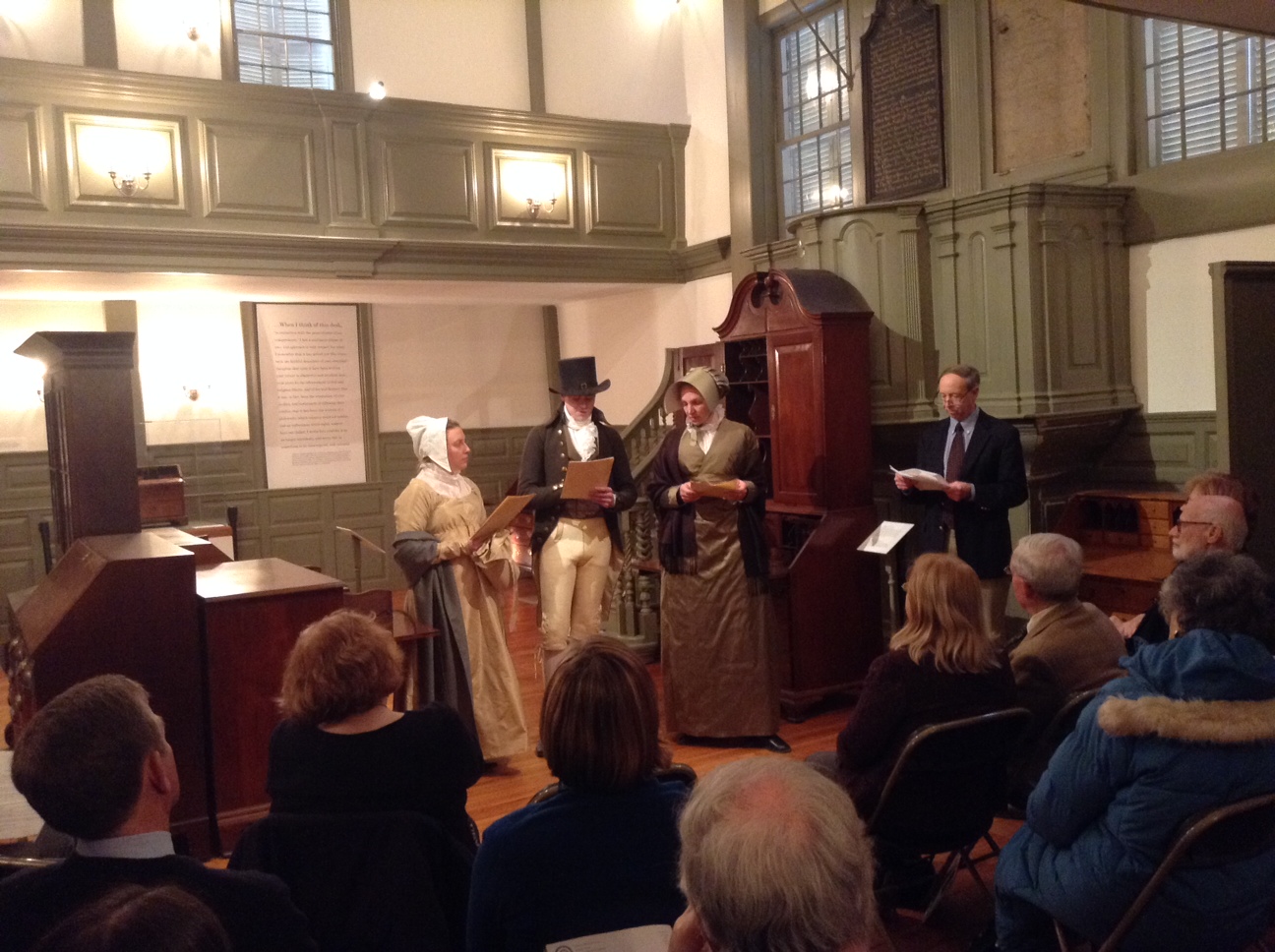
We stood in the Seventh Day Baptist Meeting House behind the NHS’s headquarters building and read excerpts of letters from the Williams Collection.
This is a simple, elegant concept for a program, and works incredibly well if the correspondence have the gift for expression that these people did. Even quotidian details–the price someone wants to get for their dining set, the likelihood of moving one’s mother, who must be carried ‘as carefully as a box of China’–take on humor when read aloud.
Courtesy Newport Historical Society
The best letter might well have been the last one, read by Sew 18th Century. The latest of the selection, the writer described a visit to Newport around 1844, arriving at the dock to the bustle of wagons, walking streets and finding a barber who knew the old fish hawker, the enormous jaw bone of a whale on a street corner, and even lifting the latch to walk inside the Seventh Day Baptist Meeting House where we were standing.
It was a lovely way to end the program, resonant with details the audience could connect with.
My dress turned out all right, and I managed to get it on and keep it on, which seemed a small miracle requiring only two pins.
When I tried it on at home, the front panel didn’t wrinkle, so I think I pulled it too tightly around me on Friday. I kept my bonnet on because I didn’t have time to make a new cap, so made do with the housekeeper’s cap from last fall. The chemisette was made by Cassidy, and saved me from the migratory ‘charms’ of a kerchief. The ‘shawl’ was a gift Christmas from my mother, who rightly saw it as a scarf, but those who wish to keep warm do not quibble when they cannot find exactly what they want. Before I wear the dress again, I have to attend to interior seams of the skirt and scoot the cuffs down to lengthen the sleeves. Four yards of 48-inch wide silk was just enough, but needs a little tweaking when you’re a tall as I am.
I’m still struggling with the Quaker Dress conundrum, both because I want a challenge and I want to be as accurate as I can be.
So, not unlike my stubborn cat, I got an idea, and I just can’t shake it. The kind-of-cross-over, apron-front, v-neck day dress.
I’ve tried and failed before, but I got a little farther Saturday. When I went looking for the original, I was pleased to find that it had ended up at Killerton House, as part of the National Trust Collection.
WOMAN IN GRAY DRESS John Brewster Jr. (1766–1854) New England 1814 Oil on canvas 29 1/2 x 24 5/8 in. (sight) American Folk Art Museum, promised gift of Eric D.W. Cohler, P3.1998.1
I think it may look something like the dress in this portrait, but without the collar.
Bradfield’s notes indicate that the front, sloping edge is a “fine, 1/10″ selvedge very narrow of rich dull orange saffron.” Based on this note, I have tried using the selvedge for that edge in the lining. (Better to fail on the lining than on the silk, right?)
We’ll see… the next trial will be a drawstring, just to see if I can get this business to fit.





 Kirsten Hammerstrom
You must be logged in to post a comment.