Like Sew 18th Century, I’ve been enjoying preparing for the August 2nd event in Salem.
I’ve not ventured too much into Regency bonnets, or into straw, but I did flirt with a 1794 bonnet. Now I’ve got hats on the brain, and the time to fully indulge my whimsy (though it runs out Sunday).
From the fashion plates, one would almost say, Anything Goes. Of course it doesn’t, really, but you can get a sense of the exuberance of bonnet trimmings in the illustrations, and the lavish use of ribbons, bows, feathers and flowers.
Not all straw bonnets were lined– in fact, they often weren’t– but the lining protects the straw and the wearer’s face, and finishes this off in a way I like. Pleating in my condition was, ah, challenging, but I figure it was good for my brain to have the exercise. The lining in the brim is white taffeta, but I used white linen in the main crown or tip portion of the bonnet. Instead of bagging the lining, or trying to fit it, I mimicked what Mr B does in the hats he’s made for us. The gathered linen closes with a drawstring and required slightly less effort to fit into the hat.
The velvet ribbons came from Lunarain Designs on Etsy, the ties are taffeta ribbon from Taylor’s Etsy shop, and the straw bonnet form came from Regency Austentation. While the finish work takes time and concentration, I do enjoy both making up and trimming bonnets, and look forward to several more.
While pretty hats were pretty important parts of the milliner’s trade, many more things were sold in a millinery shop.
Colonial Williamsburg’s Margaret Hunter shop is probably the best-known living history milliner’s shop, and they provide a nice definition and explanation of the trade. But that’s never enough: what’s the primary source information for New England milliners?
While there is documentation of a Rhode Island milliner in the 1830s, and even a thesis on her work, Sew 18th Century and I are working on an earlier shop. I started with Rhode Island newspaper advertisements, because I like the sound of “lately arrived from Providence,” and because I understand that context.
The Rhode-Island American, December 25, 1810. III(20), p. 1
Here is Mrs. Sands, just returned from New York to Newport and vicinity, with a long list of things for sale, “selected from the latest European importations, an elegant assortment of the most fashionable MILLINERY.. viz,:–” (you have the love the punctuation, which is like the Chicago Manual of Style on New Republic crack)
What is she selling? In addition to what we think of as traditional millinery, the “variety of ladies’ Caps and Turbans, Straw, silk and velvet Hats and Bonnets; Straw Trimmings of various kinds,” listed at the bottom of the ad, Mrs. Sands carries:
Lace Shawls
Caps, Handkerchiefs and Whisks;
Infants’ Lace Caps
Plain and figured mull mull and jaconet
–Muslins, of a superior quality;
Handkerchiefs and Habit Shirts,
India and British book Muslins,
Plain and figured Lenos,
Long black, white and coloured Beaver and Kid Gloves;
Silk and cotton lace Armlets,
A large assortment of Ribbons,
Artificial Flowers, Featehrs and silver Wreaths
Tortoise Shell Combs of Various sizes;
Merino long Shawls
Worsted Tippets
Gentlemen’s Neck Pads
Whew! That’s a lot of stuff, and many different kinds of things, though all broadly in the ‘accessories’ or supplies range. I am delighted to see Habit Shirt on the list, as I buy my chemisettes, and I am intrigued by the range of handkerchiefs and by the Tortoise Shell combs, in part because I did not buy an assortment of them at a shop in western Rhode Island a month ago (kicks self).
Newport Mercury, December 11, 1811. L(2593), p.1
In the December 21, 1811 Newport Mercury, Mrs Sands again advertised her goods lately arrived from New York. This is a less exhaustive, but no less interesting, list. “Ladies elegant green velvet mantles, with and without spencers” is particularly intriguing for a Spencer fan, and not particularly clear to me.
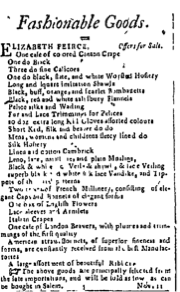
November 21, 1812. Essex Register
In Salem, which is where we will be in August, Elizabeth Pierce advertises her “Fashionable Goods” for sale. She, too, has a long list of things she will sell, from Canton crapes to imitation shawls, hosiery, lace sleeves and armlets, one box of English flowers, and American Straw bonnets.
I suspect that just as retailers do today, milliners of the late 18th and early 19h century probably had an assortment of things designed to bring buyers in to shop (new bonnet styles), and small items to tempt them into impulse purchases (English flowers). You can’t buy a new bonnet every week, but you can refresh an old one.
Plate 11, Twenty-four Subjects Illustrating the Costume of Paris
Like most humans, I have whimsical tastes and occasional outbreaks of covetousness. Today, while looking for images of milliners, I found this book for sale online, and while I cannot dream of owning it, I am delighted by this image, and by the others shown on the bookseller’s site. The British Museum has a copy, but only a few images online; Yale has a copy at the Center for British Art, but no images online.
John James Chalon, (more images here) who made this engraving, also made the classic image of the milliner’s shop, and that was where my search began.
La Marchande des Modes
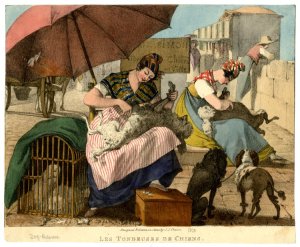
Searching a little more only improved the results… Dog groomers! I have got to get hold of this book.
Les Tondeuse de Chiens
While these engravings satisfy my delight with the absurd, more seriously, they provide some insights into daily life in the 1820s. It’s not the United States, but it’s a helpful place to start, because despite the humour in these, there isn’t a layer of satire that has to be peeled off before we can begin to understand the image.
Full-on satires, like those of Hogarth, Rowlandson and Gilray, can be hard for us to interpret: we’re so far away, we no longer get the joke, so the joke is now on us if we take what is shown for exact truth. The prints in “Twenty-four subjects exhibiting the costume of Paris” have a gentler humour.
I don’t think I’m ready to portray a 19th century dog groomer, but I am stunned that I never considered how long they’ve been around. How many other everyday occupations do we overlook when we think of the past?
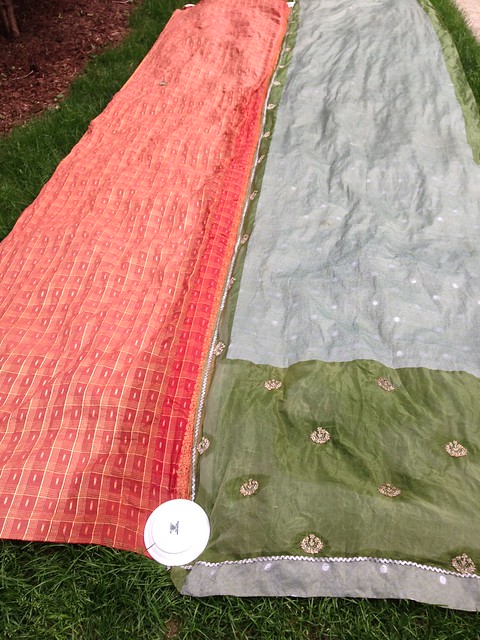
Like any good Rhode Island trader, I am pleased to announce the acquisition of some India silks. To be fair, I have not burn tested these, so while they were sold as pure and not ‘art’ silk, one never knows till one puts fabric to flame.
As reported elsewhere, these did have an odor (as most vintage and used textiles do) but a bath in vodka and cold water solved that. They seemed color fast, and brighter after washed. It’s really nice when what you read on the interwebs is true, isn’t it? Thanks to the Laced Angel blog entry, Mr S and I found ourselves at the liquor store asking for the cheapest vodka they had. It came in a plastic bottle, and we were compelled to explain we were going to be cleaning with it. The manager seemed pleased to get the tip, since his wife has a collection of her aunt’s doilies and things in their garage… I think Mr S was glad to drag me away, but he does get more human contact than I do, these days.
Samuel Ames, May 19, 1796
Besides just loving the fabrics and the potential for gowns and waistcoats, trading on Etsy with women in India pleases me logistically and historically. I retain a Huckle Cat fascination and delight with mail services, and am just astonished that a woman in New Delhi can wrap these up and put them into the India mail service and a week later they’ve made it to Rhode Island. How many trucks and airplanes does that take? And in the 18th and early 19th centuries, how many carts and ships and wagons?
By May 1796, the partnership of Brown & Francis was probably faltering (they dissolved that August, probably due to John Francis’ ill health), but Samuel James might well have boughtthe goods he advertised at wholesale from Brown & Francis. There were other importers, of course, in other Rhode Island ports, as Lopez & Dexter in Newport, advertising goods in 1809. Five cases of India silks! Four cases of fancy Prints!
It’s astonishing, the quantity of goods brought from the East, as astonishing in its way as the quantity of goods we bring from the East today. The range of colors, prints, and textures must have been incredible! For all the white muslin gowns of the Early Federal/Regency period that remain in collections, there must also have been numerous patterned gowns, shawls, and Spencers, and fancy ribbon trims, not to mention fancy silk waistcoats made up from the silks. I think we underestimate the rich texture of the past at multiple class levels– these ranges of goods hint at how colorful and acquisitive our ancestors were.



 While pretty hats were pretty important parts of the milliner’s trade, many more things were sold in a millinery shop.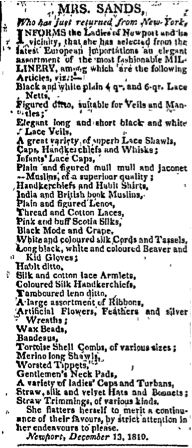





 Kirsten Hammerstrom
You must be logged in to post a comment.