Malaise or Ennui?

image Hard to say which, but I am ill at ease and dissatisfied with my costuming. You might even call it bratty. But I don’t wanna be like Bridget Connor!

It started the week of the Stamp Act protest, when I felt quite tired of being the shabby, unrefined woman of the regiment and street vendor, and wanted a nice cozy shop like the milliner had. I was also looking forward to being a housekeeper again, and several weeks of moving boxes and volumes with red rot at work had me feeling generally filthy and unappreciated. Bratty.

When in doubt, sew. A new dress can’t help but cheer you up, right?

Well… sort of…

Last Thursday, we did a reprise of the Williams family letters program at the Newport Historical Society. The Williams family were Quakers, and the letters were from the early part of the 19th century, so for the program in March, I made a green silk cross-front gown based on the Quaker gown in the back of Costume in Detail. (Check out the schematic on the 19thus.come page; I didn’t see this until I was mostly done with the dress, but thank goodness I got it right!)

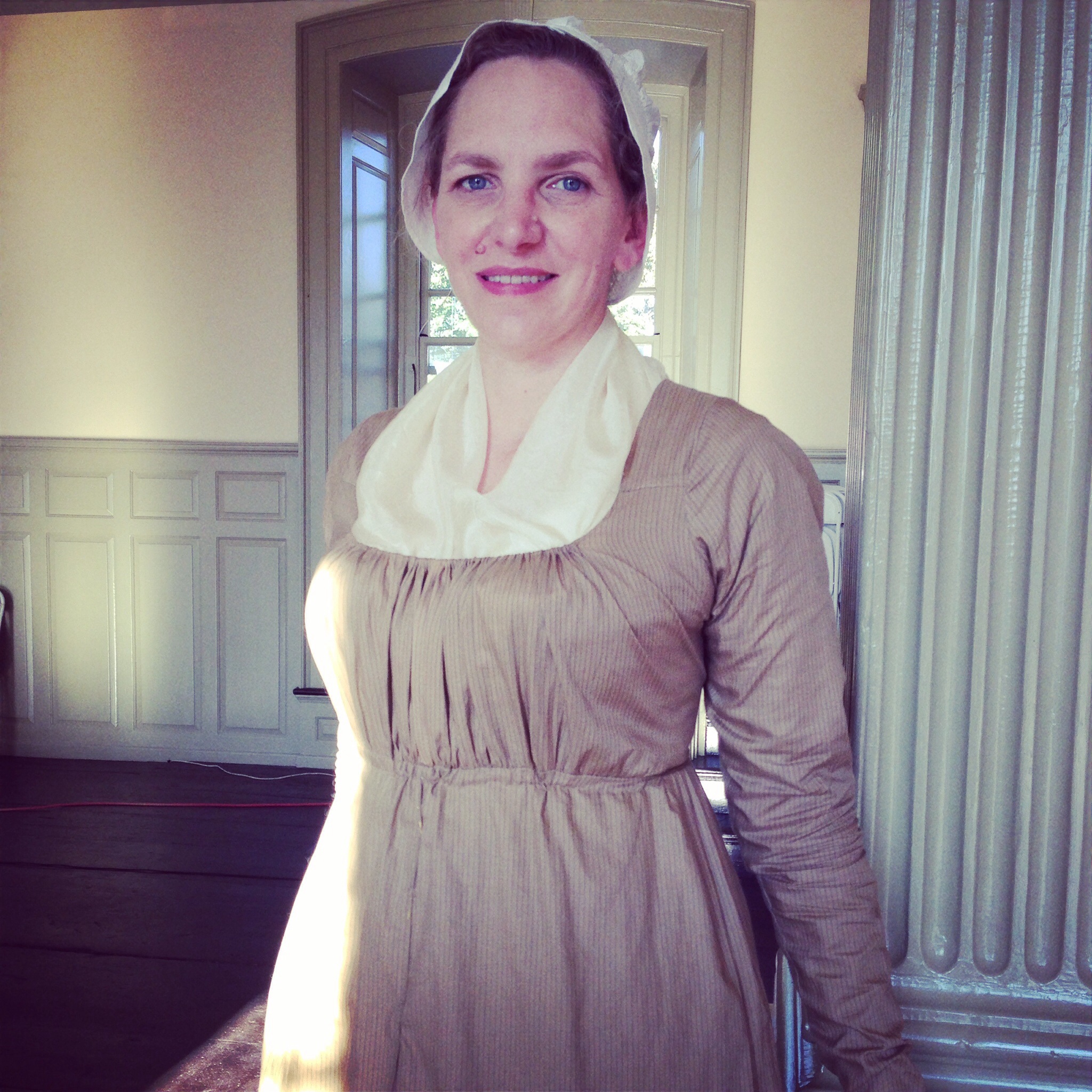
But it’s September, and Thursday was expected to be quite warm, so I salved my bureaucratic wounds in the $1.99 loft at the local mill store, and made a new Quaker gown, also suitable for a maid.

I ask you! Even though it’s my very own pattern based on sketches of original drawings, even though it fits, even though it cost $10, even though every seam is overcast and the whole thing is made with period correct stitches, it still fails to make me happy and cheerful and delighted.

image

This brattiness has resulted in a reappraisal of my approach– and a trip to Sewfisticated in Framingham. What did I buy there? Yards and yards of pink taffeta? Gold taffeta? Blue taffeta?

No.

Because they didn’t have the right colors in the right weave– too slubby– or in enough yardage. Brace yourselves: I bought brown.
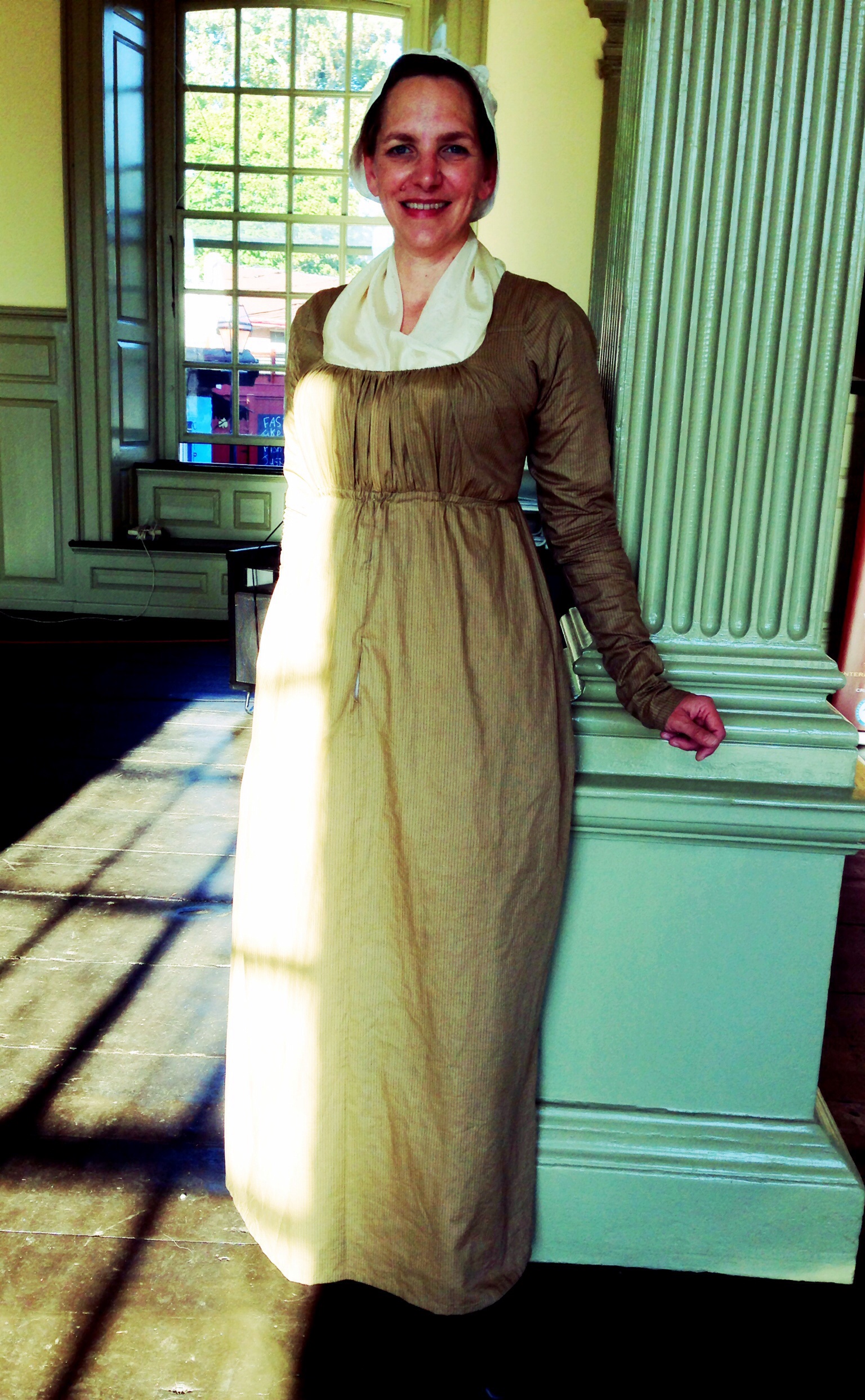
Many thanks to Sew 18th Century for taking the photos!

It appears I do not learn from my mistakes. When I think, “Gee, I’d like a pretty dress,” I end up buying fabric based on the texture as much as the color, and I have to tell you, that brown taffeta has the most wonderful l hand and sheen, and I will look much more like a Copley portrait than I ever have before, so that’s something.

It seems I have created a set of mental rules for myself, a mission, if you will, for the historic clothing I sew and the roles I take on, and I only play within those rules.

Friends in Newport

Costumed interpreters as 19th century Quakers
Interpreters at Newport Historical Society, February 2014. Photo courtesy Newport Historical Society staff

I’m so glad I have friends in Newport. If I didn’t, I wouldn’t get over to the Island nearly as often as I do now.

Next Thursday, I’ll be joining friends in Newport next week for a program based on letters in the Newport Historical Society’s collection.  This program will be much like the one I was part of earlier this year, but open to the public.

The letters are really interesting and entertaining, providing a window into Newport history that I know you cannot hear anywhere else.

Can’t Type: Sewing!

What has kept me so busy I can’t blog? Mostly preparing for the millinery shop in Salem, which I am really looking forward to!

Cassandra attempts a Regency Wedgie

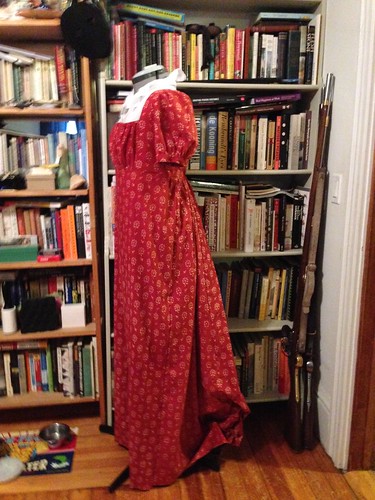
In just about a week, I managed a gown, now needing only a hem.  This based on the roller-printed serpentine stripe gown at Genessee Country Village and Museum, documented nicely at the 19th US site.

This was an easy gown to build up from a shoulder and back piece, once I did the math to scale it up to my size, and with the generous help of Sew 18th Century, who gave me the sleeve pattern I started from. This isn’t a drawstring sleeve, so the gown is not an exact copy of the GCV&M gown. I’m OK with that, since–as far as I can tell– it fits. It may be a little large, but that’s what an apron or sash is for. No, I don’t know when I’ll get the apron made.

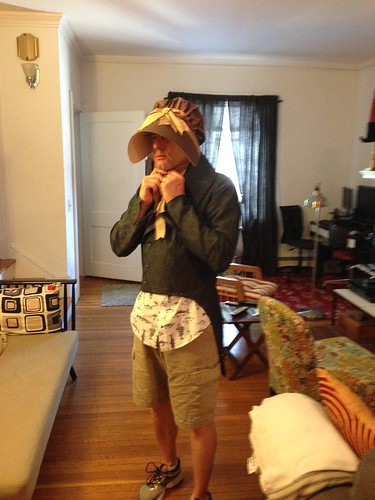
Mr S saves time by modeling *both* coat and new bonnet

There should also be a coat, and many bonnets.

Mr S’s coat seems to be working, and is now faced on the right side, leaving the left, the sleeves, and just a few buttons. He was excited about helping with button manufactory until he realized that the largest tool required was patience. But what are facings and buttons and buttons holes, among friends?

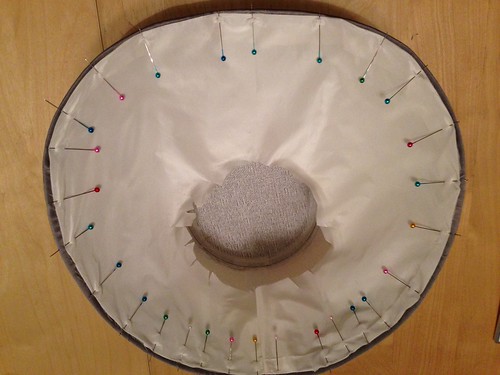
Bonnet Number I Forget

Another bonnet is in the works- can you ever have too many? I think not. It is in the prickly phase, while I work this evening on taking apart a waistcoat that must be altered for the Young Mister for this weekend at Stony Point. Bouncing between 1779 New York and 1812 Salem, when one is also considering 1765 and preparing for 1800 can make telling time a little challenging!

Six Toiles, a Coat and a Bonnet

14557116394_73c2d5ea9f_zYes, six toiles.
That’s how many it took to get a coat pattern to fit Mr S the way I thought it should. I finally built the pattern around a sleeve and arm scye that I knew worked and suited the period. From there, I built out the back, altering the center back seam curve to suit Mr S’s figure. Arm scyes are still hard for me to figure out, although sleeves are often my favorite part of a garment. I like how flat pieces become three dimensional in a sleeve, and I enjoy setting sleeves– go figure.

Thanks to the three-day holiday weekend and sitting out a parade to pad stitch, I have a coat body.

I’m not thrilled about the size of the lapels, though I have found extant examples and fashion plates showing lapels this size, and sleeves, too. While I’ve pinned up the sleeves in the back, thinking there’s too much fabric there, I can also see from the images that the subject’s posture was not the best– and that was the moment when I realized that I really did want a mannequin for menswear as the subjects are hard to catch at any age, and variable in posture and wiggliness. They also object to being pinned accidentally.

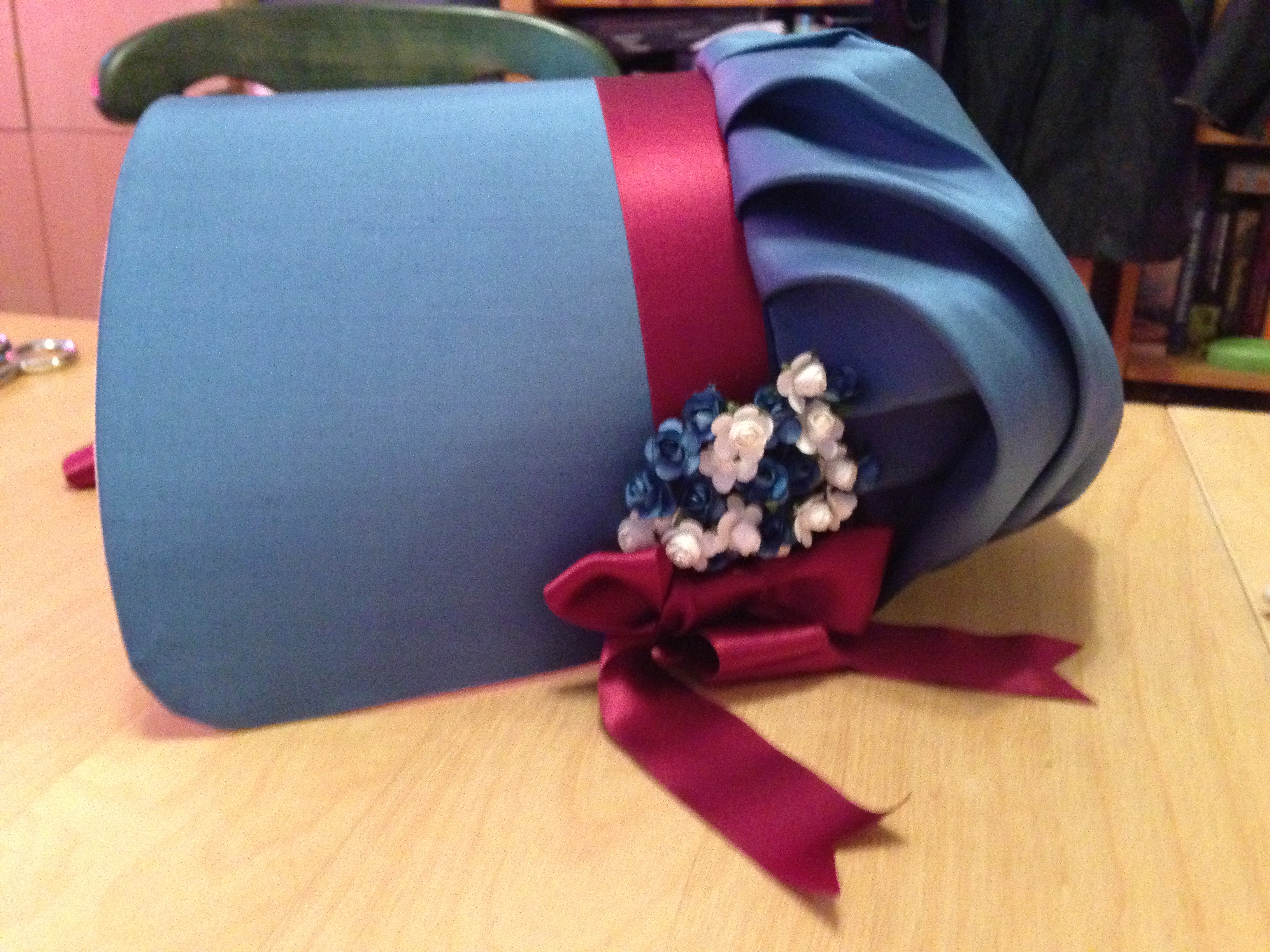
But there is at least a coat body on the way to being done, so I took a break and made a bonnet, which is really the point here <ahem> milliner’s, not tailor’s, shop, after all.

IMG_1738

Pasteboard brim, blue silk taffeta lined with white silk taffeta (they had new things at the fabric store, very exciting!), trimmed with silk ribbon from Wm Booth and paper flowers from the V&A.

Now, more bonnets, two waistcoats, a gown, an exhibition, a lecture, and Stony Point are all that stand between me and the milliners’ shop in Salem…