Woolen Woes

imageOn Saturday, I got a very nice piece of wool from Mr C’s Strategic Fabric Reserve, just the color and weight I’d been looking for to make a Very Specific Spencer. The VSS is not a replica, but rather specific to a gown: I want it to go with a 1797 V&A print.

Did women wear Spencers in 1797-1800 Providence? At least one tailor, Joseph Taber, advertised that he made Habits and Spencers, but as far as I know, there are no extant Rhode Island Spencers. Given how few collections are fully online here, and how few Spencers survive anywhere, I’m not too surprised. Julia Bowen’s diary covers Spring and Summer, when she’s quilting (mighty lazy work, she says), but she doesn’t say much about outerwear.

Providence Journal, 11-13-1799

I’ve been on the fence about how common Spencers were– after all, the drawings in Mrs Hurst Dancing show women clearly wearing red cloaks– but might a Spencer and cloak combination have been just the thing to keep warm on a raw October day? With a wool petticoat and long wool stockings, you could be fashionable and warm.

There’s no firm documentation of any of that– which does not mean, as I once muttered in the general direction of some recalcitrant docents, that rich people in Providence hunkered naked in cold corners of curtain-less rooms gnawing on raw meat.** What it does mean is that much of what we make and wear is conjecture, based on examples from the same time period in other geographic areas.

Can I have a Spencer in New England? I’m not sure, but I’ve made another one anyway, and here it is, still underway. (The thing about Cassandra is that while she is a very patient model, she has terrible posture. I can verify the back fits me a great deal better than it fits her.)

Cassandra's posture is very different from mine. She will not pull her shoulders back!
Cassandra’s posture is very different from mine. She will not pull her shoulders back!

This wool is buttery and soft, and takes the needle well. Waxed thread glides through it and grips. It does have a tendency to fray a bit at the cut edges, but has a good pinked edge, and there are examples of pinked-edge facings in extant men’s wear. Sweet, right?

I’m not showing you this to boast about my skills, but to show off an dandy mistake. In working the folded edge of the collar, I trimmed a bit too much at the neck edge, and found the collar a bit small when I basted it in. Of course I removed it, and started again, easing a bit more as I went: Huzzay! It fit!

Really, I'm not sure how this happened. But there it is: upside down.
Really, I’m not sure how this happened. But there it is: upside down.

Oh, reader: rejoice not. I backstitched that bad boy on upside down. Expletive deleted! Mad Skillz: I even managed that bit of genius before my pre-work panic attack.

I took the garment in to work to seek council from my tailoring-class-educated friend who possesses native common sense and Yankee practicality. It came down to this: is it worse to have the collar upside down, or to have it not fit as well right side up? Decide with the knowledge that working the fabric more will affect the cut edge badly. My friend suggested stitching in the ditch with contrasting thread to make this flaw an Intentional Design Element.

Black trim on a Spencer?

That is a good idea, but I thought the flaw will still be too noticeable. Then it came to me: trim. Just as the construction guys are spreading drywall mud in the chinks around the window frames, I can spread some wool braid love around this collar. There’s certainly evidence for trim use on Spencers in fashion plates, and trim would push the men’s wear aspect of this garment even farther. As soon as I got home, I double-checked extant garments and fashion plates, Roy Najecki’s lace page, and measured my edges.

Four yards of quarter-inch black mohair braid should do the job, stitched around the edge of the collar and lapels, the cuffs and possibly the hem edge.

Do I run the chance of looking like a black-outlined cartoon drawing? Yes.

Did I just buy endless hours of tiny stitching? Yes.

This is a crazy, work-making solution that may leave me with a garment not suited to my class in early Federal Providence. But I think it’s going to look amazing when it’s finished.

**(The docents argued that textiles were SO RARE and SO PRICY in late 18th century RI that NO ONE in Providence had curtains. NO ONE. The lack of fire was my own bitterness coming out at this Great Curtain Kerfluffle which took place at a public lecture I gave explaining what we knew about the use of textiles to furnish Providence homes of people who would be as rich as Bill Gates today.)
Cold Scoops

What Cheer Day preparations must begin in earnest now, no matter how distracting I might find orderly books or silk shoes (not in my size, alas: no last can be found). I already have clothes enough for a housekeeper, though I still crave a broadcloth Spencer and am working on a petticoat. I’ll hardly go outside that day, so why am I thinking bonnets– especially when I have a known bonnet problem?

One of my favorite resources for Federal era Providence is Julia Bowen’s diary. Born December 1, 1779, Julia’s diary records her life in Providence in 1799, when she was 19. She records the daily activities of the second set of Providence women– daughters not of the most elite merchants, like John Brown and John Innes Clark, but the Bowens, Powers, Howells, and Whipples. Distinguished, but not super-elite. Many of the entries are as prosaic and superficial as you’d expect from a young woman in late adolescence, and thank goodness they are, or we’d never be able to imagine life in such fine detail.

Julia got me thinking about bonnets with her entry of April 12:

found the Major & Citizen Sarah & C. Angell altering their cold scoops into Rosina hats, so busily were they employed that the Major could not go a visiting, which deprived me at once of the greatest pleasure I anticipated in my visit.

(She used code names for her friends; some we can decode, and some we cannot.)

I haven’t been able to decipher what “Rosina hats” were, but cold scoops I could handle: coal scoops.
That colloquialism fits not just fashion plates but extant coal scoops and buckets.

You just have to imagine them turned over.

The Gallery of Fashion, 1797, Bathing Place, Morning Dresses.

I went for cold scoop, with a pasteboard brim and olive green taffeta brim and caul. The mannequin is a 3-D sketch, if you will, of what the housekeeper plans to wear this autumn. At least until she can figure out what a Rosina hat is.

A Trip to Stonington

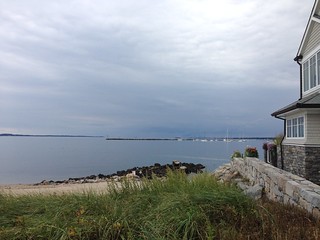
The view from Stonington Point

On Tuesday, I drove down to Stonington, CT to visit the Stonington Historical Society’s Lighthouse Museum and look at a coat. Stonington was beautiful as ever, smelling of the ocean and money, and the little Lighthouse Museum was nicely done.

The coat did not disappoint.

It is a truly amazing artifact, having survived despite pretty incredible events. The donor wrote a letter about the coat when he gave it to the SHS in 1914:
“I have heard my father say due to the haste and excitement of the volunteers they failed to properly cool their gun before pouring into its muzzle the powder, which due to the excessive heat of the gun caused the powder to explode prematurely, as you may see by reference to the coat—burned and torn upon the neck and shoulder.” (Coat and letter, Stonington Historical Society, 2009.120.001).

Stonington, CT

As beautiful as the town of Stonington may be, and as much money as there may be on the Connecticut coast, the SHS has a small budget and must use its funds wisely. We had an interesting conversation about the reenactors and museum collections, and what responsibility historical costumers have to the collections that hold clothes they replicate.

Half Robe or Jacket: How Do You Wear One?

Half robe, 1790-1800. National Trust Inventory Number 1348749,
Half robe, 1790-1800.
National Trust Inventory Number 1348749,

What Cheer Day is coming, and I hate to miss an opportunity to make a new gown (despite having just made one, and despite needing to make some waistcoats and trousers for the event). While I lay awake last night, I pondered my options, and whether a half gown would be suitable.

Although I have concluded it probably is not, I was curious about how these should be worn. Where can you wear such a garment? Is it only suitable for at-home use?

This is the robe from Nancy Bradfield’s Costume in Detail, replicated by Koshka the Cat here, and approximately by me, here.

Since I will be a housekeeper again, I think a gown is more correct for me, but that doesn’t stop me thinking about half robes, and whilst scrolling images by year at the Yale Center for British Art, I found this by Cruikshank:

ladies in a lending library
Isaac Cruikshank, 1756–1810, British, The Lending Library, between 1800 and 1811, Watercolor, black ink and brown ink on medium, lightly textured, beige wove paper, Yale Center for British Art, Paul Mellon Collection

There’s a lot to love in this image, even with its fuzzy “between 1800 and 1811” date. Not only do we get an array of reading material (Novels, Romance, Sermons, Tales, Voyages & Travels, Plays), we get costume tips and– special bonus– a dog gnawing its leg.

(If you are curious about some of the books in the Library at the John Brown House, check out this tumblr bibliography. I’ve been using it of late, and the representative genres are quite similar to what we see in the Cruikshank.)

We also get a chemisette on the lady at the counter, along with a very dashing hat, a fancy tiered necklace on the lady in pink, who also carries a green…umbrella? Parasol? With just a veil, that seems likelier than the longest reticule ever.

I like our Lady in a Half-Robe and her deep-brimmed bonnet showing curls at her brow. She and her companions show the range of white and not-white clothing seen in early 19th century fashion plates, and the range of head wear, too.

Undress for August, 1799. Museum of London

The last question I’m asking myself, though, is whether the yellow garment is a half-robe or a short pelisse or a jacket. And can you wear a half robe out of doors? And what did the ladies of the period call that garment?

In this fashion plate (featured by Bradfield on page 84, found by me at the Museum of London), the lady on the right is certainly wearing a short upper body garment, and I’d wager that she’s out of doors or headed that way, since she’s carrying a (green) parasol. Bradfield calls her garment a “jacket,” and until I can find the text of the Ladies’ Monthly Museum for August 1799, perhaps that is the term we should use instead.

While two images aren’t a lot of evidence, it does appear possible to wear a half-robe or jacket out of doors for informal visits in clement weather, and finding two is as good a reason as any to look for more.