Mr Herreshoff and Miss Brown hope soon to be married
Mrs Brown will be in, and receiving guests, and we hear that Mr Herreshoff will come to call as well. While he may decry the state of the roads, we expect him to have news of business conditions in New York, and his prospects for the future.
Miss Alice– Mrs Mason, now– will be at home with her sister, Miss Brown, and Mr Mason is living here now as well. I do not know how I shall keep their room in order, since he is hardly outside of it!
There are other visitors I expect as well; there is a man (I cannot call him a gentleman) who has been doing jobs for us, though he does not live here at the house. He seems extraordinarily interested in the house, and will not stay away. Whatever can be his interest? There may also be a tailor and his apprentice– though the apprentice tends to daydreaming, and looks above his station, studying Latin at all hours. I think he will not be long in his apprenticeship if he will not pay attention.
Yesterday, I went to visit another collection, this time at the University of Rhode Island. I don’t have thoughts about replicating coats- they didn’t ask me any hard questions about making coats, they just let me work– but I did see a lot of amazing garments.
I’m focused primarily on men’s clothing at the moment, largely because I’m stumbling towards an exhibit or a paper or maybe a better blog post, and because thus far I have not found any examples of women’s garments made from locallly-woven checks or stripes in local collections.*
What I concentrated on at URI were two very lovely examples of the kinds of clothing worn by everyday people in Rhode Island and Southeastern Connecticut, both collected by a woman who lived in the village of Lafayette on the Victory Highway. Mrs Muriel Buckley was born in Exeter, RI in 1884, and started collecting clothing of all kinds in 1900, when she married; by the mid-1950s, she was known as a “one woman historical society,” according to a Providence Journal article, and hosted parties where she and her guests dressed up in the clothes and cooked colonial recipes in early ironware. **
As my late landlady’s husband used to say, “Cut the cackle, let’s eat some grub.”***
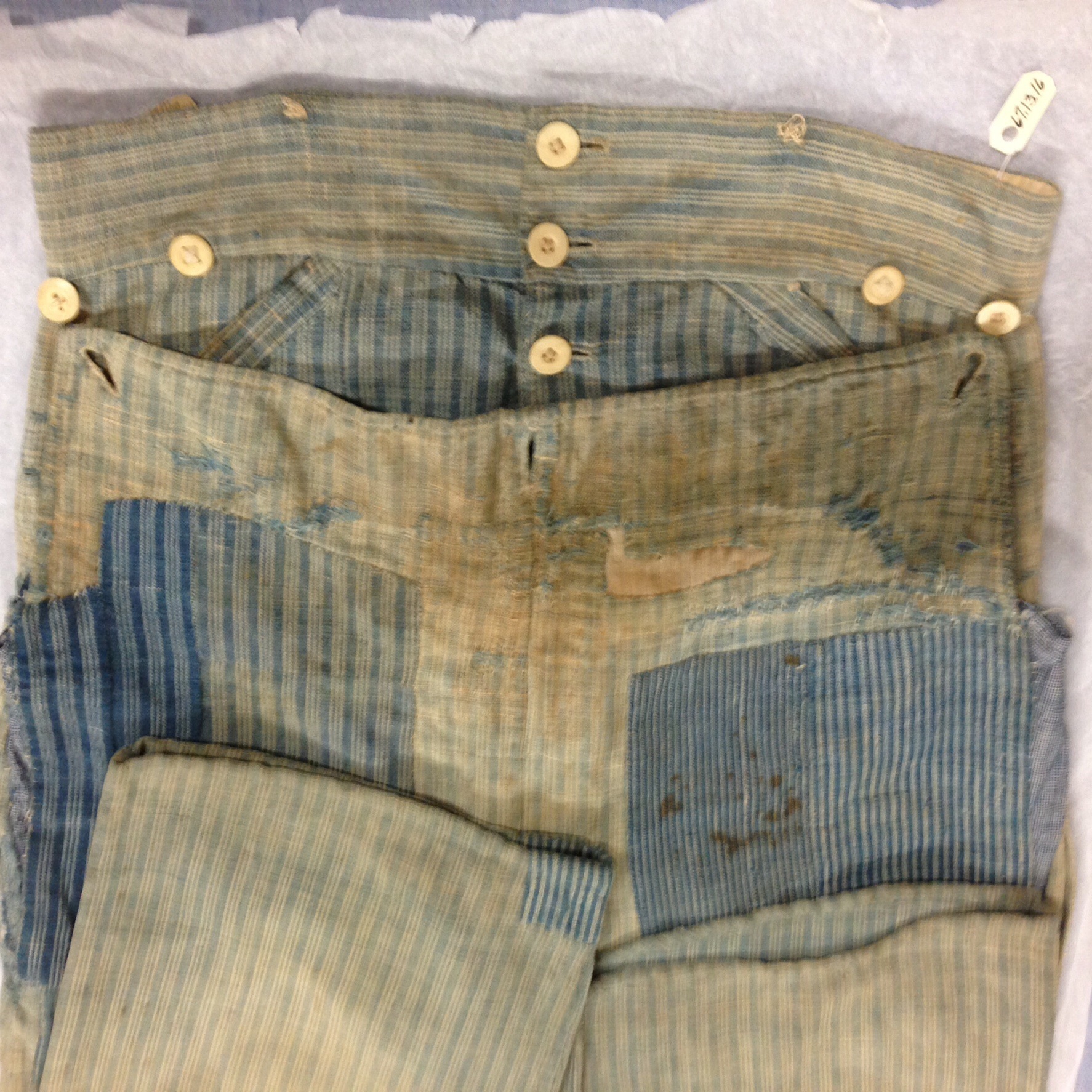
Blue and white striped linen fall-front trousers ca. 1830, URI 1967.13.16
1967.13.16, trousers ca 1830. Gift of Mrs Muriel Buckley, URI Textile Collection.
These are pretty interesting, with about a dozen patches of various sizes and fabrics. The main fabric is a blue and white stripe linen of 42 threads per inch. The fall-fronts have pockets built into the bearers, with a welt cut on the grain but set on the bias for a snazzy little graphic moment. The button holes appear to be slightly rounded at the ends in a way that siuggests intent and helps confirm the date. The buttons are not all the same design, but are all four-holed bone buttons. The trousers have a 31″ waistband, a 19.5″ rise, and a 26″ inseam.
The other truly fabulous piece I saw was a coat in a blue, white and orange check “Stonington Plaid” ca. 1800, URI 1967.13.17.
This is a double-breasted, self-faced tail coat with self-covered buttons and notch collar lapels, false pocket flaps on coat body and pockets in the tails and left breast. The unlined, folded-back cuffs are tacked to the sleeve and may have been shortened. The overall length at CB is 36″, sleeve length is 25.5″ and the chest is about 34″.
1967.13.17, “Stonington Plaid” linen check coat, 1800-1810. Gift of Mrs Muriel Buckley, URI Textiles Collection.
When I opened this coat and looked at the seams, I was struck by the construction method, not because it was different, but because it was so typical. (I also peeked inside two wool broadcloth coats in the cupboard: same construction as the woolen coats I’d seen before.) It;’s nice to see conventions in action, and recognize what you’re seeing.
The collar on this coat has some little anomalies suggesting a less-experienced hand, or perhaps a foray into a new type of collar; judging by the pad stitching, I’m more inclined to guess less experienced hand, though not home manufacture. Someday I’ll track down the South County and eastern CT tailor’s books…
1967.13.17, back view of “Stonington Plaid” checked linen coat. Gift of Mrs Muriel Buckley, URI Textiles Collection.
In the meantime, what amazing clothes and fabulous fabrics! The past looks nothing like what we imagine unless we can look past fashion plate elegance to the riot of stripes and checks and prints that must have existed in almost every village and town in Rhode Island.
*With the exception of a pocket at Mystic Seaport and a gown at the Smithsonian: accessory in the first case and very not local in the second case, making in hard to study in a day trip.
**Having palpitations yet? Your heart will really race if I can track down the photos to prove all this. In other news, I know a couple of gentlemen who are currently “one person historical societies.” The collecting instinct in wired into some folks.
***Jack and Harriet: she survived the 1938 Hurricane, and their overweight black-and-white polydactyl cat, Bonnie, followed them around the corner to church every Sunday.





 Kirsten Hammerstrom
You must be logged in to post a comment.