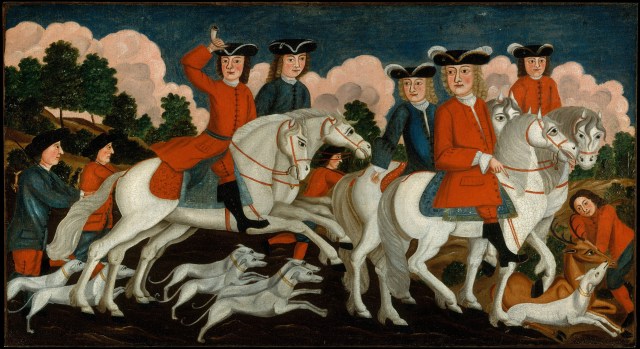
The Hunting Party- New Jersey. oil on canvas ca 1750. MMA 1979.299
Slightly turbulent and busy days chez Calash have resulted in a lack of postings, but work proceeds: Genesee and then New Jersey lie ahead, with some extra-interesting interpretation at Monmouth in late June. For a time, I despaired of figuring out what to do to occupy the time and interpret what was essentially a civil war in Monmouth County. The Craig House, while interesting, is no longer a working farm, so we couldn’t farm a not-farm. Then there’s the tedious issue of the not-home not-farming Craigs: on the day of the battle, John Craig is with the Continental Army and Ann Craig has taken off with wagons of chattel, two slaves, and her child. This began to seem a lot like interpreting the John Brown House without John Brown: they are more present by their absence.
Full Sail off Sandy Hook- Entrance to New York Harbor. watercolor and gouache by Pavel Petrovich Svinin, MMA 42.95.2
What to do? Read more, of course, and talk and talk and talk with Drunk Tailor, who discovered the Association for Retaliation (yes, exactly what it sounds like: vigilanteism) and the Pine Robbers. Much satisfaction there, and finally I listened when he said, “Why can’t we all be refugees?”
Sometimes, you just have to give in to reality. The “London trade” flourished between New York and New Jersey, Sandy Hook providing ready access to the city and Staten Island, where so many Loyalists fled the radical Whigs of New Jersey. Male slaves ran away to join the British army, and the most fearsome and feared in New Jersey was Colonel Tye. The Retaliators promised “a man for a man” for every depredation Whigs suffered, while a similarly-chartered Loyalist association promised the same in return. Chaos reigned and people of all kinds fled the civil war and the uncivilized war. It promises to be an interesting weekend.
This past weekend, I had a conversation with a friend about requests to borrow “costumes” we’ve made, sometimes for school children to wear, sometimes for movies, and sometimes for parties. We generally say no: these are hand-sewn clothes, and the replacement cost would be ridiculous– plus, we like them and wear them.
I hand sew because I get better control, but also because there were no sewing machines in the 18th and early 19th centuries. To get a garment right, you have to hand sew it, and that’s expensive. I took the time once to figure out what a set of clothes for the Young Giant cost– much to my dismay, and eventually, to his, as I became even more insistent that the garments be treated with respect.
Last year, I sent the Young Mr off to Battle Road in a new suit, and the whole business of what he was wearing was quite expensive. Using $25/hour as a base for labor, here’s how the kid’s Battle Road suit breaks down:
Grand total, with labor: $2532.25 Grand total without labor: $732.25
This wasn’t cheap either.
So think about this the next time you attend an event with a lot of well-made garments: you are standing amid a lot of labor and love.
Sewing is a fairly simple enterprise (you’re pushing thread in and out of fabric, after all), but it takes practice to develop fine skills and speed. A well-made garment will never be cheap. The best investment you can make in your wardrobe is to invest in your skill set, and learn to sew.
There are some interesting topics in the list– brewing? I certainly enjoy the results of brewing. Dairying? I like cows and love the local dairy farm. Language and speech patterns? I could certainly do better. Professions? Hmmm….I’ve considered several. Much to love in this list, and I’m looking forward to learning more.
Sometimes you’re a jerk without meaning to be, usually because you can’t see past your own limited self. I was that jerk on Friday, when my obsession with a missing package led to unfortunate words with both a supplier and worse, my sweetheart, about an unexpected length of fabric lately arrived from India. Would that my brain would work faster, for by the time I’d figured out what to make of it, the conversation had turned, and an additional 300 miles lay between me and the recipient of my confusion and dismay.
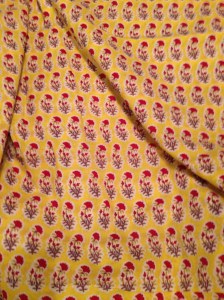
Despite my best intentions and resolve, I am a sentimentalist. This instinct sometimes conflicts with a devotion to honesty, for kindness often lies in elision. Confused? Short story: I don’t wear yellow, but a package arrived Friday with a dress length of printed Indian cotton, red and green flowers on a yellow ground.
“But Kitty,” you say, “Don’t you crave the hideous, the clashing, and the correct? You applaud Our Girl History’s choice of 1770s fashionable pink, though she prefers blue. Yellow is the haute couleur of the 18th century, fashionable everywhere, even in North America. You should leap at the chance to wear it.” (I was not thinking fast at all on Friday evening.) What made me bend my resolve– what will always makes me bend my resolve?
Petticoat fragment. Note the bright yellow, with crudely printed lining. Wintherthur Museum 1959.0118.004
Sentiment, of course, backed by research.
April, that cruel month, brought obsessive searches for Indian cotton print appropriate for the 18th century, as I looked at sample books and extant garments, searching for material to create frankly annoying clothing. Orange and green check with clashing Spencer and bonnet lining isn’t enough: I want to push my representation of the fashion sense of the past closer to truth. People in the past weren’t as matchy-matchy as we are, and their ideas of stylish, attractive, and fashionable were very different from ours. Loud was ladylike, and that’s a style statement I can get behind. Along the way, I ordered fabric in a pink and green (a departure itself) floral print on white ground, yardage now long overdue.
Textile Sample Book, British, 1780. MMA156.41 P34
A friend has been dabbling in these same waters, and made up a new gown for Mount Vernon, satisfyingly loud and clashing with our modern sensibilities about the past. Our mutual friend, also at Mount Vernon, assisted her in choosing a dress length for me, and reader, I was confused and lacking when it arrived. But like any good curator in a social history museum, it was the story that got me. How can I resist a gift from a fellow enthusiast in a pattern chosen by my sweetheart, on the grounds that I don’t wear the color? Reader, I cannot.
Think of Cranford, of lengths of dress muslin requested and never received, and the sentiment embodied in that fabric. Think of women in Providence craving an India print gown, of lovers, husbands, sons, ordering dress lengths at trading ports thousands of miles and long months from home. Think of the affection and thoughtfulness embodied in textiles brought back months after they were requested. Complex meaning is woven into that cotton, giving this dress length interpretive meaning before it is even a garment.
Now what? Now I have to decide which century/event this gets made up for: 1812-1817, 1778, 1804, 1768. There are many choices, but with the meaning embedded in the fabric, I’m most inclined to make something I’d wear often– not that this is particularly housekeeper-appropriate.
And about the research you ask? Yes, small floral print on colored ground is documentable to the 18th century. While early and European, here’s an example of an Indian motif translated by Dutch makers for printing in Sweden. Rhode Island merchants traded in the Baltic, so given the early date of this fabric sample, its arrival in North America could predate 1788 and John Brown’s first ship to China and the far east trade. Possible? Yes. Probable? We can have a lively discussion, in which I will point out the Brown’s love of all things French and French translations of bright, small motif print patterns. The printing factories in Sweden ran until 1771 and produced at least two relevant prints. Would my successful Presbyterian farmer have bought something like this for me in New York or Philadelphia? Would I have worn something so bright and loud? Am I overthinking this? Perhaps, but yellow is a new thought for me.
With especially fond thanks to Miss N and Drunk Tailor, to whom I also owe an apology.





 Kirsten Hammerstrom
You must be logged in to post a comment.