It has been quite busy chez Calash, with What Cheer Day a little over a week away, the Warren Commission happening tomorrow, and various and sundry other things to do, like get a Young Giant into college. But results were promised and results you shall have.
Despite my lack of chemistry knowledge, I made and used the pewter-cleaning liquor with some success.
The pewter plate spent some time sitting on its edge in a basin of the liquor, and the line is pretty clearly visible in the first image. The second shows the plate after being cleaned with the liquor and a wool rag. It’s better than it was, but there are still more experiments to do. I’d apply rottenstone, but the container hasn’t made it back to New England yet, the posts being poor and the roads infernal.
different class levels
As the silver bowl demonstrates, rottenstone on its own is remarkably effective at removing polish. It is certainly a fairly readily-available, non-toxic, period method of cleaning metals (andirons and fenders to plates and punch bowls) that can be easil;y employed.
Some people will tell you I overextend myself, and while those people may be correct, my enthusiasms compel me to do more, try more, travel more, and to that end I found myself preparing for an event by turning my 1962 Ossining kitchen into an experimental laboratory.
I was taken by Hannah Glasse’s receipt for cleaning pewter, copper, and tin in her section for The Scullion, so of course I had to try it. It’s simple enough: boil wood ash with unslaked lime for half an hour, let cool, and pour off the clear liquid. Easy-peasy, until you realize you have forgotten your high school chemistry, the Young Giant is not at home, and google searches for lime turn up too wholesome uses and unsavory quantities.
Happily, a more scientific brain than my own pointed out potash/pearl ash/potassium carbonate, which Amazon can provide in small quantities. Wood ash proved a little more challenging. Happily for me, I am one of those East Coast foodie fools with a backyard grill and a fondness for hardwood charcoal, so an overdue chore later, I had an enamel kettle of ash.
I did do a little sifting
to end up with finer ash
The receipt calls for “a pail” of wood ash to a “half- pail” unslak’d lime, boiled in four pails of soft water. Since “pails” is a general sort of term, I decided to use the quantity of wood ash I scavenged as the approximate measure of a pail, figuring that proportions mattered more than actual grams or liters. I have resigned myself to the fact that this is more art than science. Four pails of soft water included the remains of a few gallons of water stockpiled for hurricane preparedness years ago, bolstered with water from the tap.
Pail, schmail.
Fortunately, art did not turn into science gone wrong. The boiling was rather placid, considering, and dissolved the fine ash and the potash. I filtered the liquid mixture through a screen (ok, the spatter screen for my frying pan) to ensure that when I poured off the clear, it would be as clear as possible.
Boiling. Not to stinky
sacrificed to a good cause
By the time it had cooled, I had fished out appropriate containers into which I could “pour off the clear.” This recipe, seat-of-the-pants as it is, makes a fair quantity, a mason jar of which I have left with the Drunk Tailor so that he might better clean his officer’s pewter and copper, because, yes! This does work to brighten silver and copper. Tune in next time for details on getting shiny.
Front and a center: A liquor for cleaning pewter, etc.
But here’s the thing: they didn’t carry the shopping, because they didn’t do the shopping– not the big shopping, anyway.
La Pourvoyeuse, oil on canvas by Jean-Simeon Chardin, 1739. Louvre Museum.
La Pourvoyeuse by Chardin shows a woman returning from market in 1739. No basket. A bundle or bag with a fowl in it, head down. Unwrapped loaves of bread. But clearly a servant.
From waste books, it’s pretty clear that people are sending their “boys” and “girls” (servants or slaves) to fetch liquor. That will come home in bottles, like the ones at the feet of La Pourvoyeuse. And I think it comes home just in their hands, but perhaps- and more likely not– in a basket. A floppy basket, usually for floppy birds.
Balthazar Nebot, active 1730–1762, Spanish, active in Britain (from 1729), Fishmonger’s stall, 1737, Oil on copper, Yale Center for British Art, Paul Mellon Collection
After the meteoric rise of consumerism, after department stores, yes: shopping is more like what we do. But in the pre-ice box and pre-packaged era, meat cannot be bought and frozen, and milk will not last all that long. Things were brought home one at a time, or a few at a time, many times a week. And middle class ladies bought small things– ribbons, almanacks, shoes– and bring them home in their pockets, just in their hands, or, I would guess, wrapped in a bundle of paper (a pair of shoes) or in a band box (a bonnet) if the things are not delivered.
A long winded way to say, I don’t know: but I’m pretty sure middle class ladies sent their servants out frequently so the ladies didn’t carry baskets and the servants used bags, aprons, and their hands.
John Singleton Copley.
Portrait of Mrs. Daniel Rogers (Elizabeth Gorham Rogers), 1762
50 X 40, oil on canvas.
Middleton Collection, Wake Forest University
HC1991.1.1
Hmm…. 1762. Does that dress look like 1762 to you? Or does it resemble a 17th century garment? Check out those sleeves: scallops. The shift sleeves: super full. The line of the gown at the neck: a shallow scoop. The front of the bodice: closed.
Are those the hallmarks of a typical 1762 gown in New England, England, or France? You are correct, sir: They are not.
What’s happening here? What is Copley doing, and why?
He’s making his subject look good, reflecting her wealth and status. He’s flattering her by painting her in a faux-17th century gown, a “Vandyke costume, a popular artistic convention in England related to the vogue for fancy dress and masquerade.”* 1762 seems a trifle late for this convention, but in 1757, James McArdell produces a mezzotint of Thomas Hudson’s portrait of the Duchess of Ancaster. Henry Pelham wrote to Copley in 1776 that he had purchased one of those mezzotints, suggesting their use as references for Colonial American painters. Reynolda House has a nice explication of this style of dress in the Thëus portrait they own of Mrs. Thomas Lynch, shown below.
Mrs. Thomas Lynch, oil on canvas by Jeremiah Thëus, 1755. Reynolda House, 1972.2.1
There was also a convention of portraying women in “timeless draperies,” following the school of Peter Lely and Godfrey Kneller, both late 17th-century English painters who produced portraits with generalized costumes.
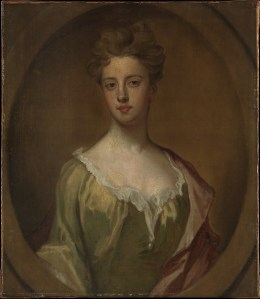
Lady Mary Berkely, wife of Thomas Chambers. oil on canvas by Sir Godfrey Kneller, ca. 1700. Metropolitan Museum of Art, 96.30.6
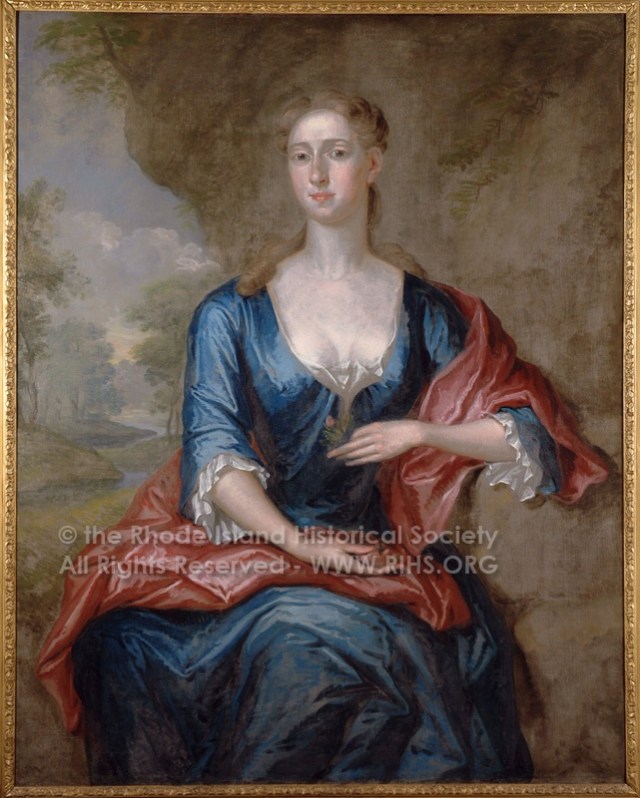
This portrait by Kneller (born in Germany, he worked in England) explains a lot, doesn’t it? And this timeless convention persists for some time, and the stylization of the facial features and hair is copied by English and colonial American painters. John Smibert, long familiar to many of you, was a leading practitioner of this style of portrait, and his work would have been well known to Copley and his sitters.
Mrs Samuel Browne by Smibert, RIHS 1891.2.2
Blackburn’s portrait of Mary Sylvester adopts two conventions at once, in a way: she’s in timeless-style drapery and fancy dress as a shepherdess. Let’s remember, too, that there’s symbolism in the shepherdess imagery, referencing pastoral innocence and Mary Sylvester’s unmarried, presumably virginal, status. Don’t believe me? Read the catalog entry, written (at the very least) under the supervision of actual, degree-toting art historians.
Mary Sylvester, oil on canvas by Joseph Blackburn, 1754. Metropolitan Museum of Art, 16.68.2
Where does that leave us with Mrs. Rogers? She’s portrayed in what is essentially fancy dress, holding her straw hat in her left hand (much as Mary Sylvester is) with a basket over her right forearm. You will note the open work of the basket, the delicate arches and the fineness of the base. What’s in it? Something gauzy, as light as the drape around her shoulders, with a square of dark blue silk and a fine white silk ribbon. Honestly I am not entirely certain — the resolution of the image is dreadful.
But what’s NOT in the basket? A redware or pewter mug, sewing, keys, bottle, food, candy, toys, or, really, anything of a very concrete or practical nature.
Is this image a justification for carrying a [nearly empty ] basket on the streets of Boston? Of course it is–as long as you justify walking the streets of Boston in imaginary or fancy dress.



_-_WGA04759.jpg)




 Kirsten Hammerstrom
You must be logged in to post a comment.