
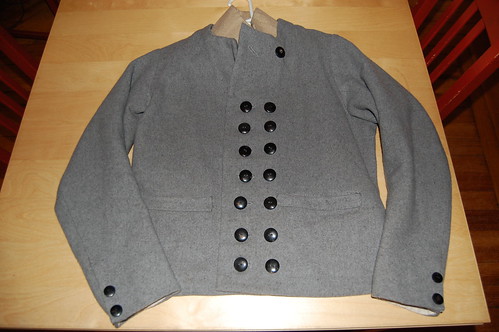
HSF #0: Waistcoat, Bloody Waistcoat

Challenge garment peers from jacket. Calm thyselves, fellow authenticity hounds. New buttons for jacket are on order.

(Actually, the jacket was bloody where I jabbed myself with the needle inserting the sleeve, but that’s fun for another day. And how you know your historical sewing project is complete. I bled for this, man.)

The Challenge: #0, Starting Simple

Fabric: Body: ¾ yard remnant from Wm Booth Draper WWB816 Broadcloth, light brown. Lining: Left over heavy-weight linen. Might also have come from Booth, I forget.

Pattern: Kannik’s Korner Man’s Waistcoats, 1790-1815

Year: Call it 1799. That’s the year where it will be worn.

Notions: 9 brass buttons from Wm Booth Draper
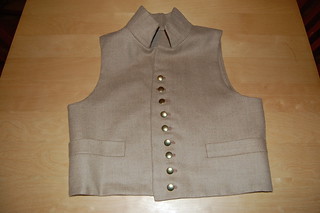
What monkey did those buttonholes?

How historically accurate is it? Well…the pattern has good documentation and the fabric is within reason for the period. The waistcoat is entirely hand-sewn, but the button holes were apparently accomplished by drunken crack-headed monkeys, which is what you get for trying to finish a garment on New Year’s Eve. I was neither drunk, nor on crack, and have no helper monkeys, but all the same…thank god for jackets to hide the sins of my buttonholes.
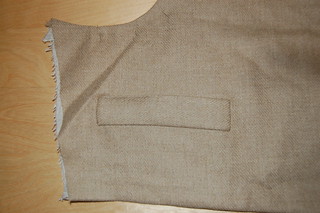
Best welt I ever made–aside from butting heads with a colleague once.

Hours to complete: Don’t ask. It’s a soul-robbing number. The buttons and buttonholes alone took 1 full and two half Abbot & Costello movies, and two “Monarchy” episodes. Probably 25 hours total (I started in November, but stopped sewing after December 2). Total time may include naps taken when I fell asleep while sewing.

First worn: To be worn by the new owner (Mr S) January 19, at the Winter Frolic.

Total cost: Blood, sweat, tears… sorry, wrong war. Buttonholes bring that out in me.

  • Fabric:  $13.50
  • Lining: Leftover, hence not factored in.
  • Buttons: Used 9, but bought 10 because I’m not as simple as I look, so $12.50
  • Pattern: Also from Wm Booth, $16.

That puts the cash outlay at $26 for materials, and $16 for pattern, which I will use again starting yesterday. Yes, sports fans, another bloody waistcoat to sew. Lucky for me, it’s red, so the blood won’t show. Checking the HSF schedule, I can see that the only 1813 garment I can make is another waistcoat (1790-1815, remember?) for the Young Mr, who needs a full set of clothes made by January 19. Waistcoat underway, pattern pieces assembled and two more pieces of broadcloth remnant order for a jacket, leaving trousers to wrestle with. At least I have fabric. 

Winter Holidays

NGA-The Skater
NGA-The Skater

Family’s here (OK, my mother; we’re a small family) and it’s time to pay attention to the people in the room instead of writing. So to celebrate winter, and the shorter days (tell that to a child waiting for Christmas), here’s one of my favorite paintings by Rhode Island native Gilbert Stuart.

NGS- The Skating Minister

It has a cousin here, by Sir Henry Raeburn. The selection of Raeburn’s portraits online (there are 25 in the National Galleries of Scotland) is stunning. What a treat for wintery days in these dark but luminous works.

Those English Gowns…

GMFS2At the V&A, a fun interactive exhibit on 18th century costume allows you to turn the costumes around and zoom in for a better view.

V&A Screenshot
V&A Screenshot

My favorite, because I need to start making something like this, is the Gown made from a Shawl, about 1797.
There’s a good description of the gown, and you can always search the collections for the catalogue record and more non-turnable images. This is a good thing because the 3-D image player requires Flash, so it doesn’t work on an iPad.

I found the viewer helpful in understanding the sleeve-collar relationship, which was confusing to me with the contrasting colors. The description in the catalog record helps, too:

“An open robe with a medium high waist, the material stitch is pleated down the back, and then flowing into the skirt. The sleeves are of white satin, trumpet shaped, with a short green silk oversleeve. The oversleeve is bound with cream ribbon, and the undersleeve at the wrist where it fastens with three pearl buttons, with metal shanks, has a narrow green ribbon turn back cuff. There is a shaped falling collar of green silk bound with white, and a green ribbon binds the front of the gown. The bodice is lined with linen, and extends in front to cover the bust. The sleeves are lined with white linen.”

Fairfax House
Fairfax House

The oversleeve makes me think of this Fairfax House dress. I’ve not been able to find a larger image so I can’t get “close enough” to determine how it all goes together. Time to collect images of extant examples and fashion plates in a Pinterest board, and start comparing them. And time to think about whether or not this is a style seen in New England…and time to get ready for work.