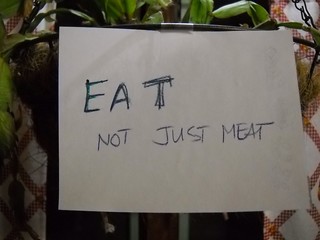
The Young Mr has been unsupervised some of this week (he’s old enough but not always as mature as one might prefer) and I have left him notes to help him with some basics, as he does prefer to rise long after I’ve left for work. In the bathroom, BRUSH YOUR TEETH is affixed to the mirror (should’ve added + HAIR). In the kitchen, another note is taped to the Christmas Cactus above the sink.
My coworkers, many of whom have known the Young Mr since he was in a stroller and had nicknames like Possum Baby and Seal Monkey (he just shivered a small death when you read those names), found this note hilarious. The kid has a reputation as a one-human plague of locusts: he once ate a third of a pound of ham in a 20-minute span while his father and I went to the grocery store. He will eat a large head of lettuce in the hours between when he gets home from school and I get home from work. Entire tins of Altoids vanish suddenly, and all I get is a sulky, guilty look.
So I found this blog post, What’s For Supper? very interesting, as I had been thinking of late, How would I feed the kid in the 18th century winter?
Fantastic Hairdress with Fruit & Vegetable Motif, 65.692.8, MMA
Fortunately, there would have been vegetables. And whether the beds were hot with manure or straw, there would have been some greens. At the farm we had salad in January; would it make it to February, or March? Don’t know, but I love the idea of spinach. Parsnips store well (scrub hard) and are delicious, and apples, too.
I think we forget we did not invent the larger world: it was big before we got here, with ships circumnavigating the globe and caravans crossing mountains long before container ships began losing sneakers on the ocean.
Soldiers Cooking, 1798 National Army Museum (UK), 1983-11-63-1
Here’s some visual evidence for why we travel with three sticks, two kettles, and no matches. (We bring the sticks as we suspect the sites where we camp & cook don’t want amateur logging on their grounds.) I stumbled upon this at the National Army Museum in the UK. Here’s what they say about the image:
Soldiers from an unknown unit attend to their cooking pot on a break from their duties during the Wars of the French Revolution (1793-1802). They are accompanied by their womenfolk. Although only a few men from each unit were officially allowed to marry and have their wives and families accompany them, women would have been found in almost every British military camp. Some worked as cooks, laundry women and sutlers (camp followers who sold provisions), while others were prostitutes.
One of the things one learns when reading about women who followed the armies of the Revolutionary War is that prostitution–at least for those following the American army– was not high on the list of occupations for women.
Why not? Lack of ready cash, folks.
Working for the Army would get you rations, and that literal meal ticket was desirable in a time of shortages and want. If you’d been burned out of your home or farm (I’m looking at you, 54th Reg’t of Foot, Aquidneck Island torchers) what would you eat? What would you do? It depended, of course, but one thing to do would be to follow your husband if he had enlisted.
I know less about the women who followed the British Army, but for a Continental Army start, I recommend the following books:
The last title is about children in the time of the Revolution, not women, but considering who was left home with the children, and in trying to understand what the time might have been like for the Young Mr, I’ve given it a read as well.
As for the camp gear? We keep it at a minimum based on period images. We don’t all sleep in one tent, but we pack as light as we can. It’s nice when authenticity and ease are the same.
An Old Woman Cooking Eggs, Diego Velazquez, 1618. National Gallery of Scotland, NG 2180
…could be pewter. Or do I mean tin? Carolina had excellent points about pewter being, yes, that shiny, though we think it is not. Our perception is probably based in large part upon the extant items in museum collections. And museums don’t polish their pewter–at least we don’t, and I don’t know anyone who does. Is it because we’re so unaccustomed to using pewter daily that we no longer know how to care for it?
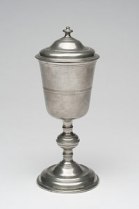
Covered chalice, pewter, c. 1756-1780. Philadelphia Museum of Art, 2008-110-1a,b
I thought it could be interesting to experiment with polishing pewter (not in the collection) so I turned for advice to that touchstone of housework past, Hannah Glasse. In The Servants Directory, Part V: The Scullion Mrs Glasse lays out To clean Pewter, Tin, and Copper.
Take a pail of wood-ashes (either from the baker’s dyer’s, or hot-pressers; the latter is the best) half a pail of unslack’d lime, and four pails of soft water; boil them all in a copper together, stirring them; when they have boiled about half an hour, take it all together out of the copper into a tub, and let it stand until cold, then pour off the clear, and bottle for use.
When you clean your pewter, lay a flannel on the dresser; set your dishes one on another by themselves, the plates to likewise; then heat liquor according to the quantity you have to clean, pour some on the uppermost plate and dish, and as you use them pour it on the other. Take a piece of tow to rub them with, then having two little basons of red sand, pour some of the liquor on each; with the first scour your plates well, and rince them in cold water; with the second clean them, rince them into two waters, set them to dry, and they will look like new. Thus you may clean them at any time with very little trouble.
Very little trouble for you, Hannah Glasse! The red sand is definitely something museums won’t do: we have this prejudice about not abrading the collections, or applying chemicals, so the lime/ash/soft water mix probably won’t appear in our workroom either.
Willem Claesz.Heda, Still life with gilt goblet, 1635. Rijksmuseum, Amsterdam
I also took a look in my books for paintings that showed pewter with sheen, and for objects. I suspect that pewter’s softness will not allow it to achieve the high-gloss shine of tin, but that it can be brought to brightness. I do think the best way to find out is to start polishing, so I’m in the market for some wood-ashes from the hot-pressers, and a good place to lay a fire and boil some chemicals. Who wouldn’t volunteer for open-fire chemical boiling?
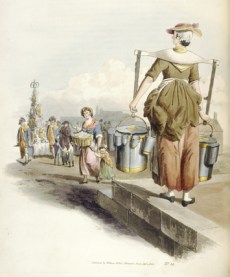
Sandby: A Milkmaid. ca. 1759, YCBAPyne: Milk Woman, 1805, MoL
What do pewter and tin have to do with costuming? Well, aside from the many expensive buttons Mr S and the Young Mr wish to sport, I got interested in the milk maids’ pails because of their similarity to the tinned kettles used by RevWar reenactors. The uses converged in December in a conversation I had with a colleague about Carl Giordano’s beautiful kettles. (He made my wash basin, but my kettles came from Missouri because I needed them very quickly; the fur trade & rendezvous reenactors have similar material culture interests and needs, because of time period & culture overlap.)
Milk Below Maids, 1793, V&A
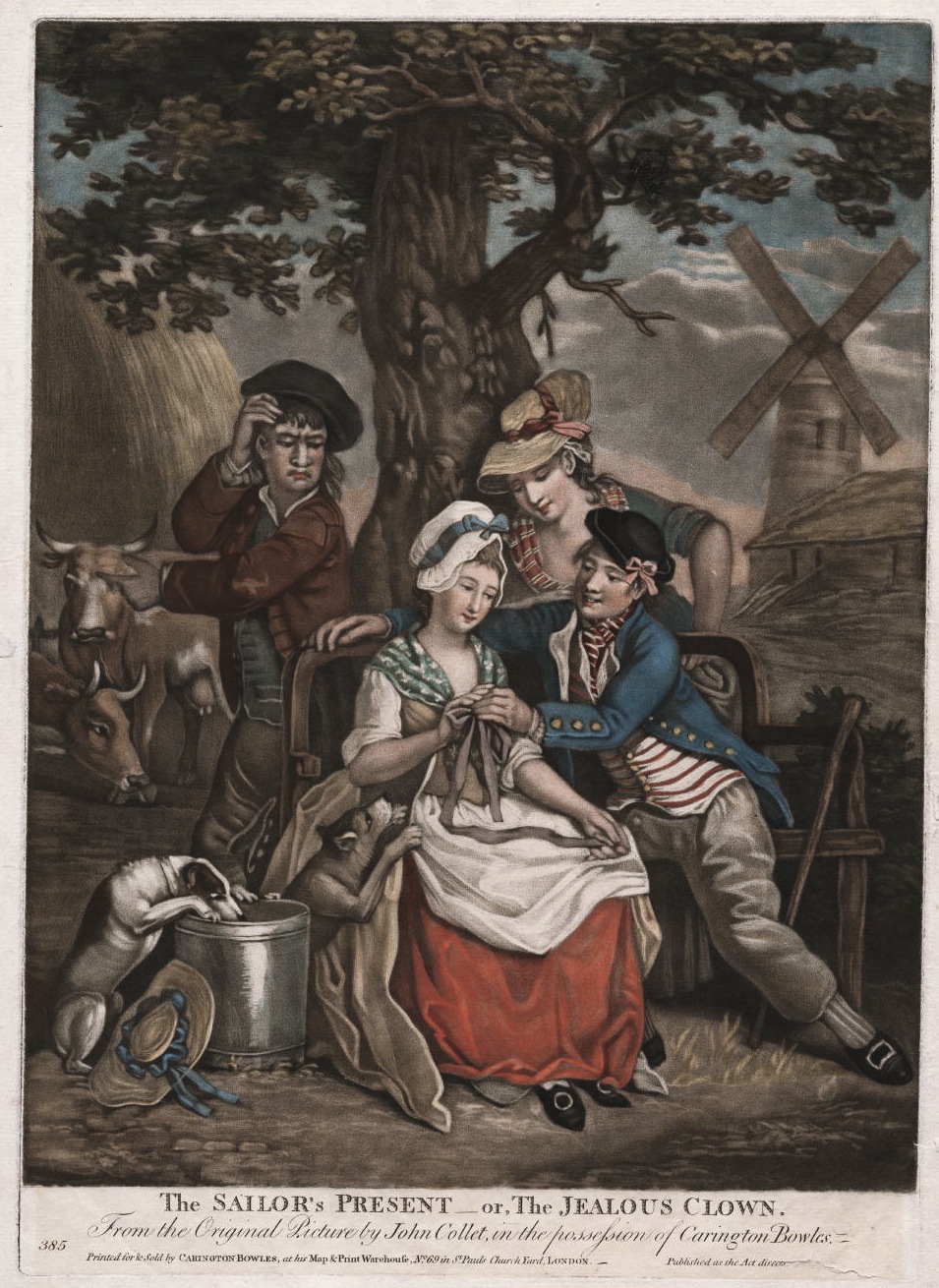
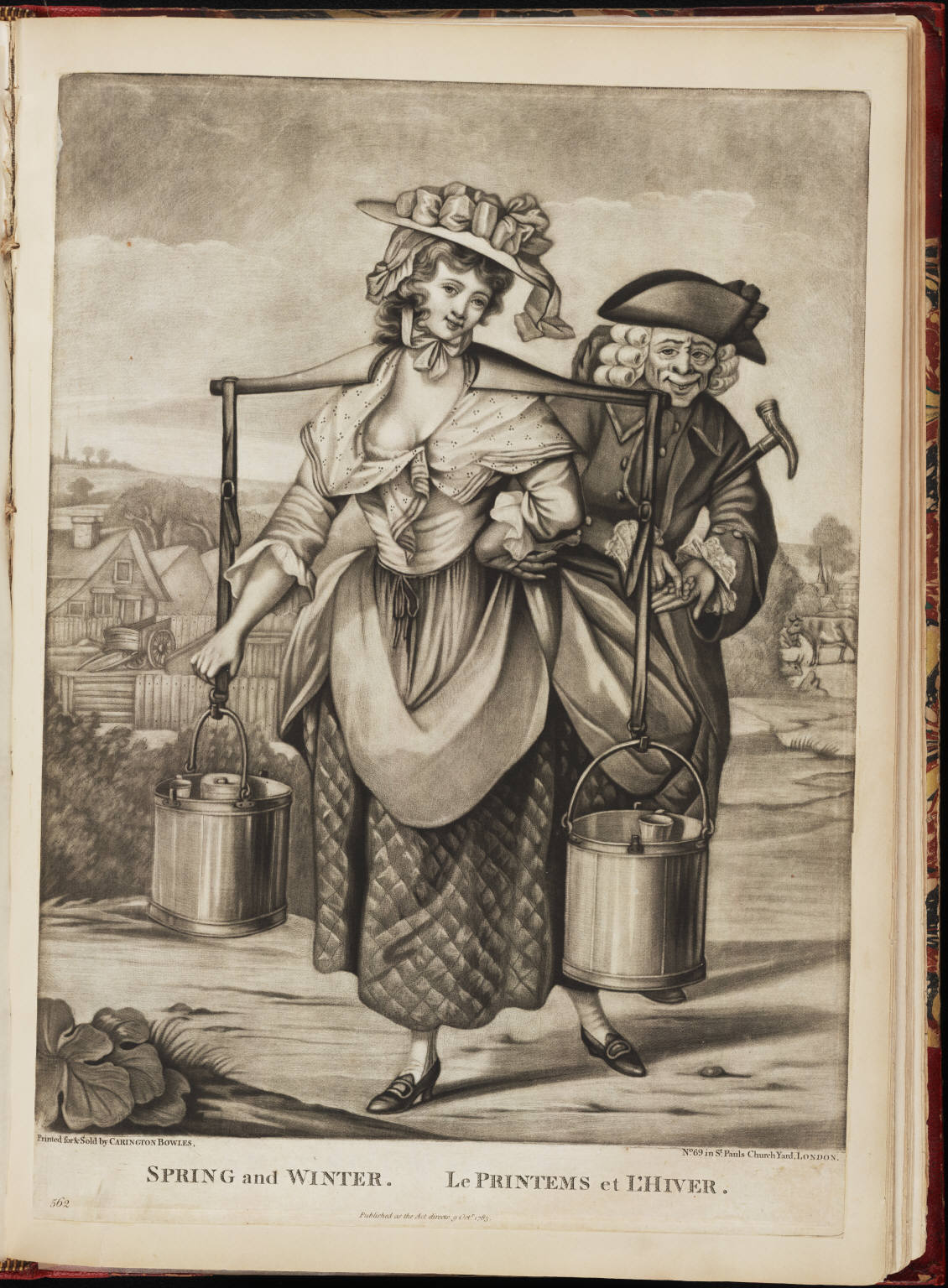
The milk pails look like tin, don’t they? One from ca. 1759, the other from 1805, and both appear to be carrying shiny, seamed metal buckets with brass details at the base and rim. The captions call them pewter, though. So I went to the V&A and the Museum of London looking for pails, but only found more milk maids.
I began to wonder: if the pails were really made of pewter, wouldn’t they be awfully heavy? And wouldn’t there be extant examples? Pewter is highly collectible. There’s a George II pewter milk pail on Worthpoint, but it looks nothing like the pails in the images. Is pewter ever so…shiny? And I’ve never seen seams in pewter the way they appear in the Pyne illustration.
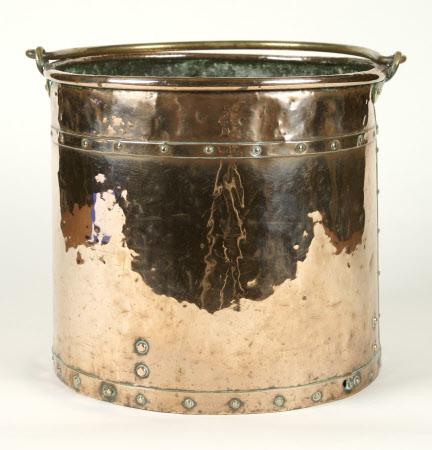
Here’s something that reminds me of that George II milk pail. I think I trust the Met more than I trust an online seller. On the right is a “bucket carrier” from the National Trust (UK) Collections.
Mid-18th century dinner pail with cover, MMAMid-19th century bucket carrier, NTC (UK)
Google defines pewter thus:
pew·ter
/ˈpyo͞otər/
Noun
A gray alloy of tin with copper and antimony (formerly, tin and lead).
Utensils made of this.
Synonyms
tin
178, Collet: The Sailor’s Present, LWL1785: Spring & Winter, LWL
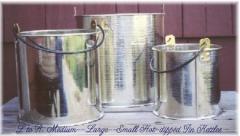
Synonym: tin? That’s pretty interesting, even though I don’t trust Google with etymology. But don’t these tin kettles look a great deal like the milk maids’ buckets?
Carl Giordano Tinsmith: Kettles
The Giordano tin kettles can be made with brass ears (that’s the part the bail, or handle, goes through). Look at the ears in the photo, and at this detail from “Spring and Winter:”
Detail, Spring & Winter, 1785, LWL
The ears may be the best lead to follow. There are plenty of ears (handle attachments) if you search the Met for bucket or pail and limit the search the metalwork… but they’re bronze, and Roman. The National Trust (UK) doesn’t turn up much, or the Museum of London (yet).
ca. 1750: Silver cream pail, MFA
There’s a silver cream pail at the MFA, and it sort of looks like its handle attaches with ears, but not in the riveted-on kind of way, but in a purposeful and elegant way. This is just about where I start to ask myself why I care, but then a number of other questions present themselves, like:
Where are the milk pails? Are there really no milk pails in museum collections? (Yes, this could be true)
Was this pewter milk pail with attached measures specific to London, as my colleague thinks?
How does milk taste when it spends quality time in pewter (or tin)?
How heavy would a pewter milk bucket be?
Things to ponder as we prepare for heavy snow… In this state, that means dashing out for “French toast supplies.” I’m not originally from here, and I solemnly swear we are legitimately out of bread, eggs, and milk.








 Kirsten Hammerstrom
You must be logged in to post a comment.