Eating in the Field

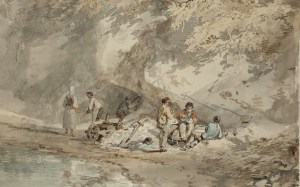
Workmen Lunching in a Gravel Pit circa 1797 Joseph Mallord William Turner 1775-1851
Workmen Lunching in a Gravel Pit, circa 1797. Joseph Mallord William Turner 1775-1851

A compatriot asked how we handle food and cooking in the field. What do we do about “yucky stuff?” by which she meant meat.

She was doing just about the same stuff we were doing, and with Battle Road around the corner, I thought I’d write about food in the field, and ways we handle it. Other people will have other ideas, but the main things I think about are:

  • Maintaining authenticity and food safety (Nobody wants flux.)
  • Historical eating is seasonal, local eating
  • Gear: less is not only more, but easier

Food safety is one of those things where you really don’t want to compromise too much, though from eating at the farm, I think there is more leeway than we admit. I will confess that when I was poor and in school, I stored dairy products on the windowsill of my studio when there was no fridge, so eating at the farm is like eating… when I was a whole lot younger.

Here are my principles. I’m not an expert, your mileage may vary, but this is where I begin.

Universal Truths

Start with who you are.
Objects you bring, and food you eat, should be true to your impression.
Authenticity goes beyond the date of accouterments: a porcelain tea set may be quite correct for a 1778 Newport or 1763 Boston parlor, but it makes very little sense if you are with a Continental private. One chipped plate is different for a woman to carry, or a piece of pewter. How long either would last you is another story, but at least you’d have a story. If you are the Colonel’s wife, it’s a different matter, even more so if it’s a British Colonel.

Food safety trumps purest authenticity.
Cloth covered, hidden ice packs will hurt no one and may save you misery later.

Stay Hydrated.
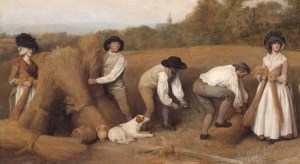
Reapers 1785 George Stubbs 1724-1806
Reapers, 1785. George Stubbs 1724-1806

Soldiers drank water.

In a hot summer camp, we keep a large pitcher full of water (see the Stubbs painting at left). Covered with a white linen or cotton cloth, it will keep coolish and free of dust & insects (or dog fur & fleas, if you’re in the Stubbs painting). We sliced limes into our enormous pitcher, and refilled it all day from the pump at OSV.

Limes are in period; justifying a source can be tricky, but at a certain level, safety trumps authenticity. 98 degrees and 90% humidity means drinking a lot of water.

Chances are you’re a caffeine addict like me, so what do you do? Boil water in a kettle, and bring tea in a screw of clean white paper is one answer. What’s your justification? I’m a personal fan of ‘stole it from my master,’ but in small quantities, perhaps you got it from home, or did a farm woman  a favor. Or stole it from her. John Smith (I kid you not), Sergeant in Colonel Lippitt’s Rhode Island State Regiment, in Continental Service, writes in his diary* of apprehending geese and chickens who failed to respond with the correct password when challenged.

*Published as “Sergeant John Smith’s Diary of 1776”, edited by Louise Rau, in Mississippi Valley Historical Review, No. 20, 1933, pages 247 – 270. NB: Kitty Calash recommends reading, not stealing.

Tomorrow: Food-related recommendations by event type.

Choosing a Gown

Here’s a good question (I love questions): how do you choose which [historic example] to make?

The answer, as almost always: Research.

I start with a date. For Battle Road, the dress must be typical of New England in April, 1775 and appropriate for my impression or persona.  As I imagine my character from the past, she’s in her 40s, from the upstart town of Providence, married to a tradesman or craftsman. She has one child, and I haven’t thought about whether or not it’s one only or one surviving—too busy chasing the One Child Who Eats Like Ten.

Providence, 1790. John Fitch, RIHS Map #30
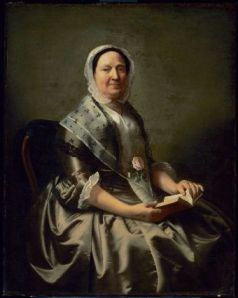
Mrs Nathaniel Ellery, J S Copley, 1765, MFA Boston
Mrs Nathaniel Ellery, 1765, MFA Boston

Living in a port city means my character—we’ll call her Kitty—has access to new goods and ideas, a town where you can buy almost anything, but where staymakers are less common than in Newport.  It’s less refined than Newport, brassier, but competitive and striving and with plenty of money in some hands. Providence is where the Gaspee affair was plotted; in 1790, residents from around the world are recorded here—men from Java, living in Providence—it’s polyglot, mercantile, striving.

Given that Kitty is of the middling sort in a town, she can wear linen and wool and camblet and even some silk. Her clothes will be fashionable but not high style, “a thought behind the current moment,” as Lord Peter says of someone’s hat. What’s the purpose of this brown gown? Everyday wear, that, with accessories, can be dressed up, or dressed down. Eventually, who knows, I might manage a crewel work stomacher and nice linen cuff-ruffles for my shift, though a filthy apron, burned skirt, and a striped rough linen petticoat are more likely…

Mrs. James Otis (Mary Allyne Otis). JS Copley, ca. 1760. Wichita Art Museum
Mrs. James Otis ca. 1760. Wichita Art Museum

Making an everyday dress means not copying the silk dress from Williamsburg, and honestly, I couldn’t wear that wedding cake frosting on my chest, nor what Mrs. Otis has on her stomacher. How about that lovely Norwich wool gown? Well…almost. But I can’t sew that well, and haven’t got fabric that lovely, couldn’t afford it now, wouldn’t have had it then. I have brown wool. Have I seen Mrs. John Brown dressed like one of Copley’s women? Perhaps (if you take Copley as evidence, which you must do carefully.) Have I looked at the lovely brown silk satin and thought, I could do that. Possibly.

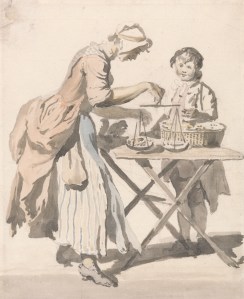
Black Heart Cherries, Paul Sandby, ca. 1759. YCBA B1975.3.206

What we do know is that in New England, gowns are found more often than any other kind of garment (i.e. short gowns or jackets or riding habits). We know that wool is common, but that linen is found in towns and cities, wool more often in the country, and that the pretty, but expensive, cotton prints are popular. Open robes are more common earlier, and “hatchet” cuffs (pleated tubes) predominate. The style is worn by Copley’s women and Sandby’s girls, and it’s seen in images from 1760 on. That means it’s a good choice for a base style for any class level.

Here’s my process, more or less:

Determine the date, that sets the style.
1775 means stomacher front gown.

Determine the character, that sets the fabric and trims.
Kitty’s New England middling, so she’ll have a wool gown with robings but not trims, a plain stomacher, cuffs and not ruffles, and a matching petticoat.

Determine the event, that sets the accessories.
Battle Road is a hard one for me: as a woman, I shouldn’t be there, and as a Rhode Islander, I really shouldn’t be there. (RI militia were stopped at the border by the governor to prevent them joining Massachusetts men after news of the events at Lexington and Concord reached Rhode Island. They did get there eventually and participated in the siege of Boston, but you see what I mean…) So I have to construct a story for how to dress, and the best I can manage is going out, either to a shop or to pay a casual call on family. So what I plan is a matching petticoat, white neck handkerchief, clean check apron, and bonnet over a clean white cap. (This emphasis on clean should remind me to wash and iron a thing or two.)

That’s my story, and I’m stickin’ to it. For now, anyway, till I get a better idea.

More on Pockets

If you think you don’t like military history, think again. A friend of mine is working on a French and Indian War 250th Anniversary project in Boston, and in the course of his research he got interested in a red velvet grenadier’s cap that I happen to be adjacent to from time to time.

UBM 2006-08-53
UBM 2006-08-53

One thing led to another, fortunately for him and not me, and he ended up calling on the National Army Museum in London. There a curator after my own heart distracted him with one of the coolest things I have ever seen: A Lady’s Pocket made from the decorative panel of a mitre cap, or as they call it, Mitre Pocket.

Here’s their description:

“Front section of a mitre cap made into a ladies pocket, 1760 (c); wool and cotton; on front the emblems for the 70th Regiment of Foot, all sewn as for the period, 1760 (c); back is made of brown cloth; front is bound with red cloth binding.

Note: Hanoverian white horse and ‘Nec Aspera Terrent’ used by 8th (The King’s) Regiment of Foot, later King’s (Liverpool Regiment), which might make the L an initial not a numeral and the XX a company number rather than part of the regimental numeral.”

Grenadier’s cap, 1833.1.1, RIHS

One of the most charming things about the email is that the woman at the NAM sent my friend an image of a gown and pocket, just so he’d be clear about how it would have been worn. He knew anyway, but I thought that was a very nice thing to do.

The cap we’re looking into is this one, said to have been picked up at Bunker Hill. Not for nothin’ (as the locals say), but this cap would make a lovely pocket.

What’s in your pocket?

A typical rough linen lining

My son’s pockets used to be full of acorns: he collected them at the bus stop, but I don’t know if it was because he planned to feed the squirrels, or if he thought he was a squirrel. Later, he moved on to rocks. Now, rocks, fish hooks, a pocket knife, change and a hankie fill the pockets of his 18th century breeches.

We’ve had some moments of unhappiness when things have gone missing from the pockets, though we’ve usually found them again. When you look at the contents list, you wonder how the linen stands up as well as it does.

There’s a clever way to upgrade pocket bags in menswear, and it’s authentic: leather bags, instead of linen. Original garments have leather bags, probably deerskin, and they’re deliciously soft and very durable. Stuff all the heavy, sharp things you want to in that pocket, and it will probably take it.

1895.4.3A-C
1895.4.3A-C

Based on a suit in the RIHS Collection, I decided to modify the pocket bags on the Young Mr’s new workman’s jacket-in-progress, which I plan to have finished by March 11 for HSF #5, Peasants and Pioneers.

Made of a heavy, rough-finished brown broadcloth (possibly manufactured in New England), both jacket and breeches pocket bags are made of deerskin.

Pocket bag in progress.

To recreate this, I took a trip to the auto parts store, and purchased a large chamois.  Instead of cutting the bags from linen, I cut them from the chamois and trimmed the seam allowances: chamois won’t ravel, so the seam won’t need to be folded over at the top.

A little fuzzy, but you get the idea

I backstitched the bag seam, and in general, I’m pleased with the way it has turned out. I think I’ll look into additional leather options, but otherwise, it seems like a fairly successful experiment.

The real test, of course, will be user testing. How many sharp, heavy things can the kid load in a pocket before it gives out?