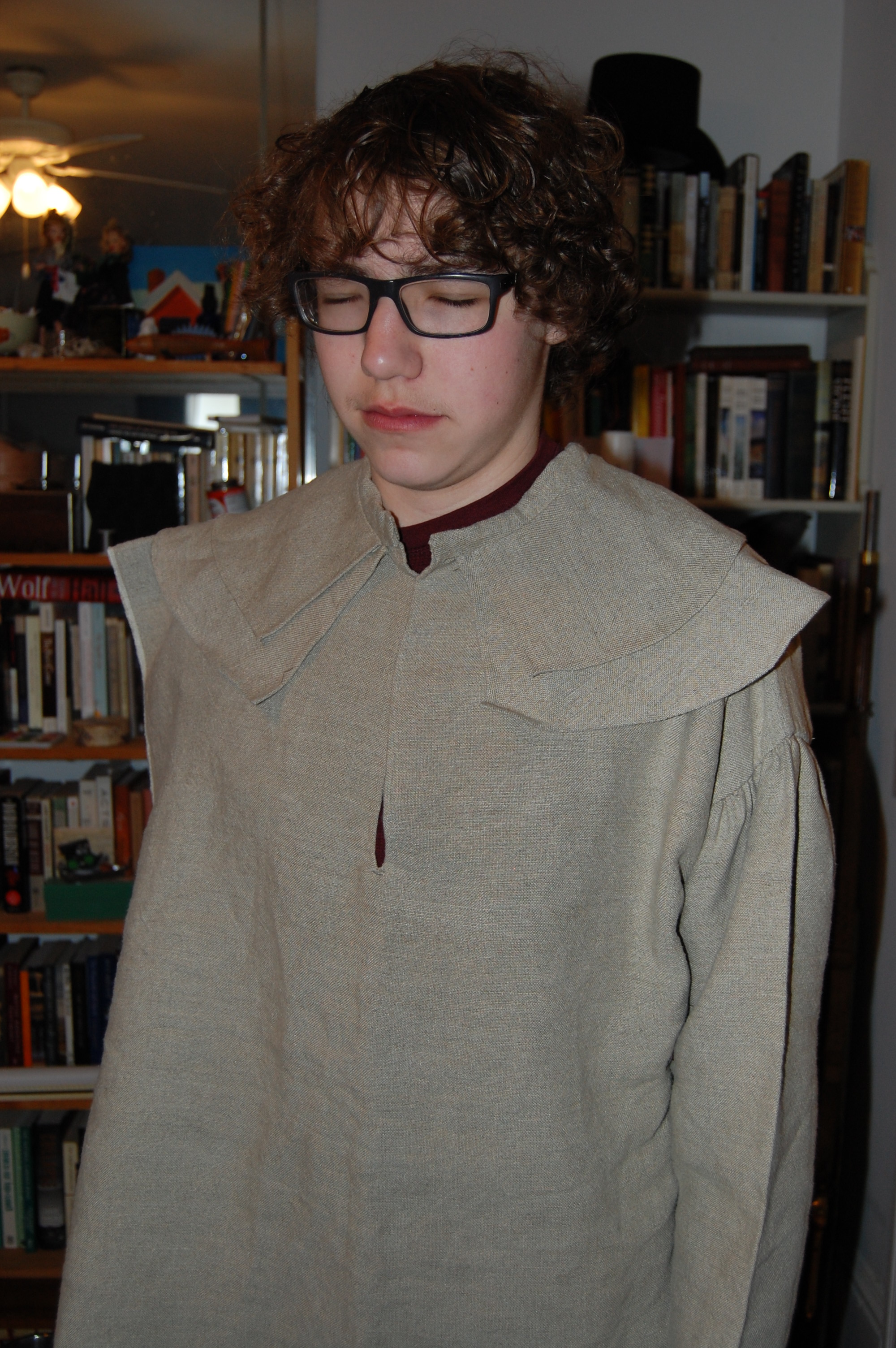
Twenty-four hours on, this is where we are: Poofy, shoulder-popping sleeve of doom. How can that be a uniform sleeve?
Well, Pilgrim, this is how:
Oh. They’re all Infernal Sleeves of Doom.
So glad I have that near-feral hunting shirt, because without it I would have ripped this out completely. Could the Poof of Doom be there to allow movement?
Subject was detained for photography.
Before school, even.
Arm out, doubts remain. Arm down, less terrifying.
I do feel sorry for him, but at the same time, I have to fit it to him.
It’s possible that the poof at the apogee of the shoulder is due to the intense pressing I gave this to retain the center line, and the fact that, despite washing, the linen is still pretty stiff. When I compare the two– the completed shirt and the in-progress shirt, I can see that while both display a tendency to drift up, the gathers on the adjutant’s shirt are more evenly distributed. You know what that means…and that’s why the sleeve is only basted in. Might as well change it now as on Sunday, because it must be done. So in the end, I am ripping it out completely, but with the knowledge that 1) the upward angle seems to be correct as shown in the finished garment, and 2) evening out gathers may reduce the Poof of Doom.
We were invited to join a Massachusetts regiment after the event at Old Sturbridge Village last summer, and we did. This has been a good thing, though it’s sometimes a little tricky to figure out which unit to “be” with. It is also a challenge because even though the Rhode Island unit has careful (if unwritten and slightly out-of-date) standards, the Massachusetts unit is another thing altogether.
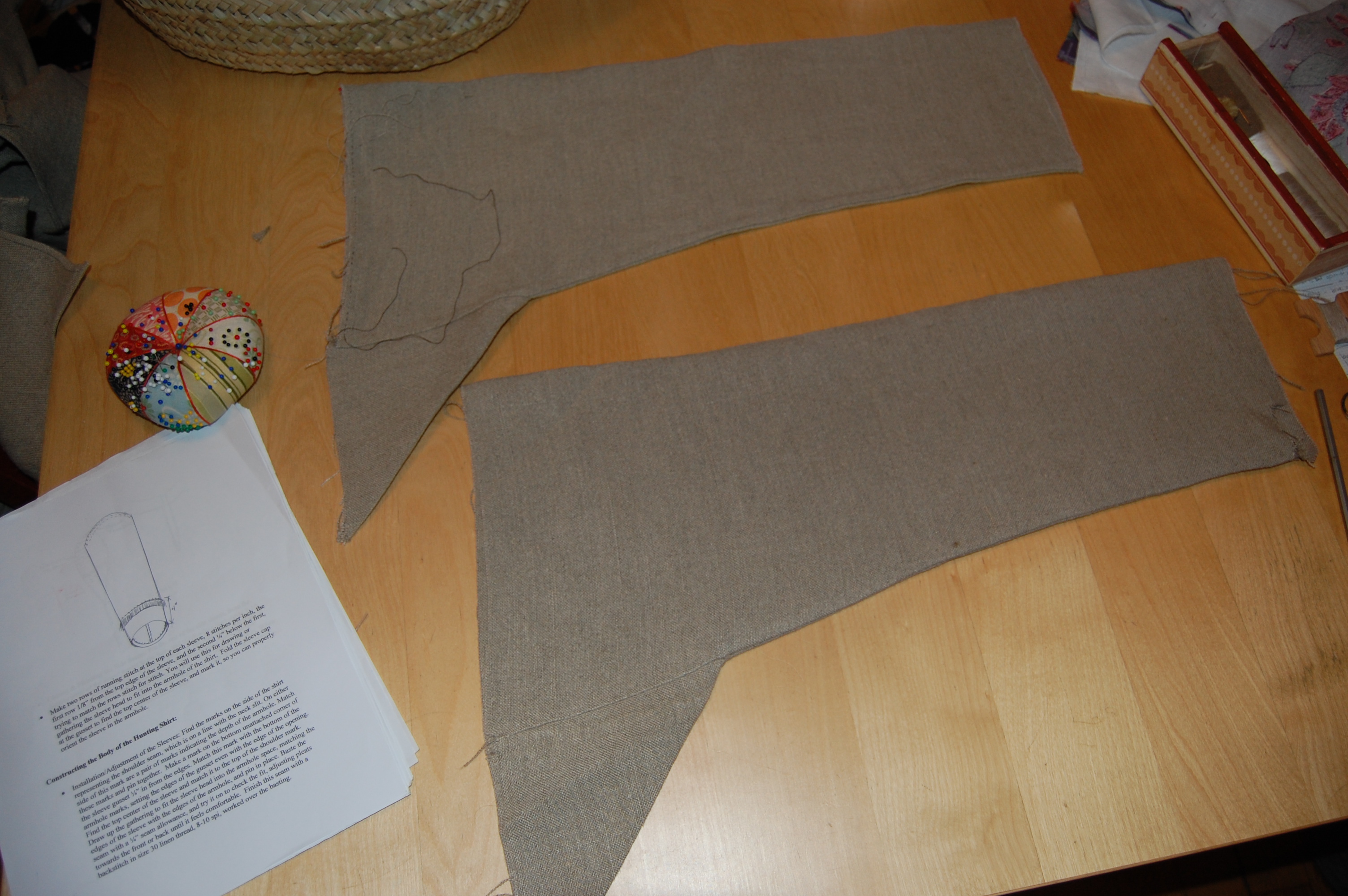
Gathering the sleeve heads. Saturday is soon!
The women last weekend kept asking what I was working on so assiduously. It was the hunting shirt (to become a frock) for the Young Mr for the new unit. Cut by the master, entirely hand-sewn by me. This is not something they would do.
“Sewing for The Adjutant, ” I said, “is another thing altogether.”
“Don’t even try. Who can sew like that? He’s a professional,” I was told.
What we’re aiming for.
Well, yes.
So wouldn’t that be the very thing to reach for? It’s not like he’s not helpful. I have his shirt to copy, he answers my questions patiently, and I haven’t yet felt like an idiot.
The skill I have I owe in part to my mother and grandmother, and to the Dress U workshop with Sharon Burnston. Stroke gathers, two-by-two stitching, using the tiniest needle possible are all things I learned or honed in Sharon’s workshop. And thanks to that workshop, this hunting shirt-(perhaps)-soon-to-be-frock is a great deal easier to tackle.
The other part of skill is practice. It’s as true for piano or soccer as it is for sewing. Just keep stitching, and it will come.
After fitting comes fringing. That’s for someone else to do.
What I find hardest is fit: not only is it hard for me to judge how much to take in a garment to achieve 18th century fit while maintaining enough ease for the wearer to swing an ax (or to accommodate teenage wriggling), alterations annoy me. I suspect that the key may well be not to fit at the end of a day, but at a beginning, or at least a middle. Fitting after a long day of sewing could make you think you were tossing away a whole day of work. It also feels, still, like taking a car to the mechanic or the cat to the vet. There’s something wrong, and I don’t quite understand it. Yet. But with Shoulders Roll Forward and Monkey Arms, I bet I’ll understand more soon.
I have this friend, DC: I can call him a friend now, but when we worked together, he was more of a nemesis, mostly because of his OCD tendencies, intense perfectionism, and complete inability to meet deadlines. It was a classic example of Mr Failure-to-Plan working poorly with Miss Contingency-Plan-Required. We literally knocked heads installing an exhibition, and I can still feel the hollow ringing pain. But it’s been six years, and with that distance, friendship is possible.
I’m only in this for the artillery.
But he’s got this idea. In August 1763, Boston celebrated the Treaty of Peace ending the Seven Years War (known here as the French and Indian War). There are fantastic descriptions of the celebrations and Thanksgiving Proclamations issued by the colonies, and you can read more about it in the Boston Gazette 8-15-1763.
My friend’s idea is to re-create this celebration, complete with cannons and volleys, and to that end he has enlisted local re-enactors, including a unit he didn’t realize I was part of when he asked me if I had a 1763 impression. True to form, we are asking questions he’s not yet prepared to answer… including, what sort of people do you want these townspeople to be? With the calendar as packed as it is, stitching up militia and my own clothes needs to start now, what with the regular regimental requirements due in June and again in August, and oh yes, actually maintaining life and a tolerable standard of cleanliness in the home. (DC is moving to Europe in the Fall. After this event, when he leaves North America, I expect we’ll be better friends.)
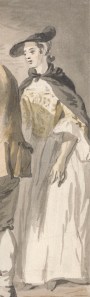
Jean-Etienne Liotard (1702-1789) Portrait of a Woman called Lady Fawkener circa 1760
The reason I want an answer now is simple: I want a hat. After steaming and cramming The Hat onto Mr S’s head, I deeply desire my own Hat. I don’t covet much, really, and a hand-made piece of headwear made by someone you know and respect seems a very innocent thing to covet, even if coveting is wrong. But to give the Favorite Hatmaker time to create a hat like the one at left, and me time to trim same, I need to know rather soon if I should be a lady or a cherry-seller.
I started a Pinterest board (when all else fails, collect images) of 1763 ideas. It’s a pretty simple thing, really, gown with robings, cap, blah blah petticoats blah blah, but: isn’t it all about the fabric? And the trims? And, lest we forget, the coveted hat!
Paul Sandby, London Cries: Black Heart cherries… ca. 1759. YCBA, B1975.3.206
The Sandby cherry seller can probably be replicated with an open gown with robings made from B&T’s Virginia cloth; the question is merely of color, drape, and patience waiting for swatches. (Wish Wm Booth still had that yellow and blue striped linen, but my blue and white linsey-substitute would have to do.) This is simple enough, really; I have a cap like the cherry-seller’s cut out, somewhere, or linen to make one, anyway.
Paul Sandby, London Cries: The Fishmonger (detail), ca. 1759. YCBA B1975.3.210
Maybe the compromise is this, yellow, with a black hat. I suspect this hat is straw, but perhaps I could combine the hat above with this idea. The black hat and black cape are very appealing. The answer, of course, is all in research: find out about the men in Thomas Marshall’s Boston Militia, and from there I can find out about, or make intelligent surmises, about the women. But that’s irritating, as military/militia-based history often is–to be dependent on the men. Perhaps the less annoying route lies through JSTOR…. and following up on the memory of a Boston widow-businesswoman.
In the end, I’m realistic enough to know that I shall be lucky to get a new hat trimmed at all, given all the menswear there is to complete between now and August. Even my plans for chitzy sewing this week turned late yesterday into, “Oh, but I thought you liked the Adjutant. We’re going up Saturday for fitting.” I suppose that means they think I’ll finish something enough for fitting.
I’m not an expert, and your results may vary, but here’s what I’ve learned.
Single Day Events without Fires
(e.g. Battle Road, parades, Fort Lee)
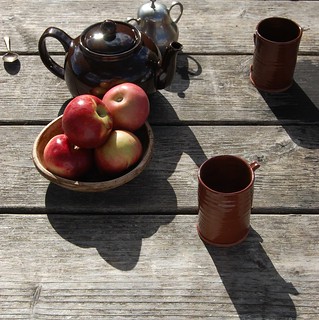
For single-day, warm-weather events, ice packs covered in cloths at the bottom of a basket or slipped into a market wallet can keep food cold.
Pasties are self-contained, period appropriate, and require no “hardware” to eat. I wrap them in parchment or plain white paper and tie them with string, or wrap them individually in plain white cloths. Because the filling is cooked and then baked in the pastry, they keep and travel very well. I have a basic receipt here for pork pies; they’re good with chicken, too. Keep the filling a little on the dry side, and you won’t need a plate. I’ve never made an all-vegetable pasty, because I live with T-Rex in a hoodie, but I imagine it would be delicious with parsnips, squash, and maybe even kale.
Another single-day-event solution is bread and cheese. John Buss of the 10th Massachusetts was all about cheese. He writes home longing for cheese, and writes, too, that he can eat cheese again because he’s recovered from the small pox. (That’s one of those historic statements that I try not to imagine too much about.) I’ve never had the time to bake bread from the Amelia Simmons’ cookbook, but I’ve had bread made from it, and it’s great. Pressed for time? Worked later than you thought you’d have to? Whole Foods Take-and-Bake baguettes have played the role of home-made bread, as have various loaves from other grocery stores.
The Hive blog has some good recommendations to fill your basket, so with some repackaging and artful packing, you can assemble an 18th century pick-a-nick basket, or stuff a market wallet with suitable foods. Just please, please: peel stickers off the fruit, and don’t pack bananas, which aren’t seen in the U.S. much before 1880.






 Kirsten Hammerstrom
You must be logged in to post a comment.