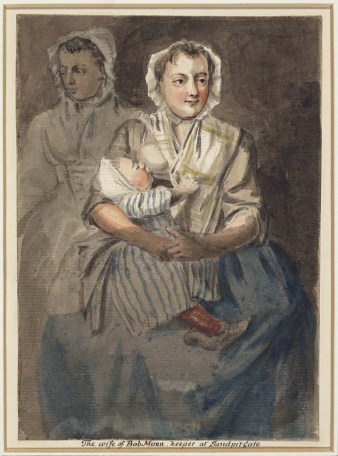
The wife of Bob Munn, Keeper at Sandpit Gate. Paul Sandby, Royal Collection Trust RCN 914337
On Sunday, Mr FC mentioned that they knew the names of at least two of the women of the 10th Massachusetts, including one notorious woman, Bridget Mahoney. I mentioned this in an email to Mr HC, and got back four solid paragraphs of information. I sincerely and earnestly wish I had those retention skills, but embedded in one paragraph was that they knew of a woman in Wallcott’s company, because the brigade chaplain, Enos Hitchcock, had baptized the child of a soldier in Wallcott’s company.
April 25, 1779
Baptized child of Richard Northover, Soldier of the Train, by the name of Mary.
May 5, 1779
Married Sgt Bates and Mrs Lucy Gun
May 9, 1779
Baptized Lydda, daughter of George Wilson and Letty, his wife, of Capt. Buckland’s Train—Baptiized Adaulph, son of John Degrove of the above company
May 31, 1779
Sent for to go aboard the Lady Washington galley to marry John Thompson and Abia Chase
June 21, 1779
Married Henry Smith and Phebe Cockswain, late Brewer’s Regt.
Three baptisms and three marriages in just over 8 weeks: that’s a busy regiment.
Of course, they did their share of fighting, and not just on the field. I did not witness the fight instigated on Sunday morning by Mr FC, against the New York troops in which there was shoving, the beating of Mr S with a hat, and the deflection of Mr McC, who upon arriving with a shovel, was put to work digging.
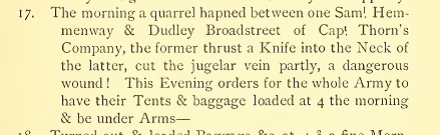
September 17, 1777. Enos Hitchcock diary.
In Hitchcock’s diary, I found an account of a quarrel near Stillwater, NY on September 17, 1777. This was intramural knife-thrusting, but clearly, the 10th Massachusetts were very busy men.
Wow. Yet another learning experience up on the Hudson River this past weekend. It was as up-and-down a weekend as the rutted field in which we were camped, where walking felt more like swimming over the ground, and social calls were well nigh impossible. Also, we had considerable wind. By Sunday, Mrs P said we should feel grateful we never camp with a dining fly, because we knew it was wrong to feel smug that we hadn’t had to chase a fly down. Yes, every possible pun of “fly” got an outing.
The Coats, Grouped Around their Colors, Prepare for Action.
The coats turned out quite well, and there would have been one for the Young Mr if only I had not spent the past two weeks on a petticoat and patterning a gown for What Cheer Day at work. I have some regrets about that, just because they looked so very well in those unusual coats. They weren’t just a fashion statement, either: I know Mr Cooke answered a lot of questions about them, and I did, too (women ask women about the guys…). They’re a really good interpretive hook to talk about supplying the troops, and the differences in uniforms over time, and the kinds of documents historians and costume historians use in their work. Also, those coats are just plain handsome.
Down in the corner, in a lovely white gown, holding her hat on head, is Cassidy. The wind was hard on headwear.
The Battle, well, there was chaos on the public side of the battlefield, and it was difficult to see. The wrenching ground made visiting difficult (and we don’t have much of a parlor in our camp) so I did get to meet Cassidy in person but not much more.
Mr S, the Young Mr and I were grateful for Mr H’s excellent assistance with the fire.
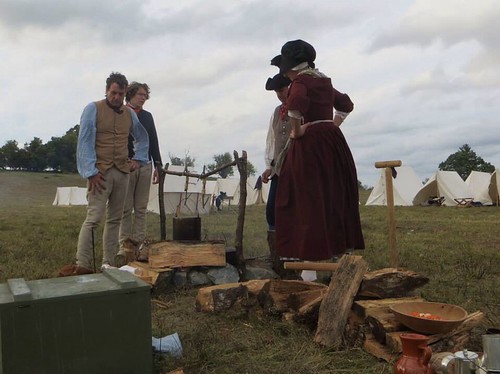
My friend Mrs H and her husband, Mr H, and I walked back from the battlefield to work on dinner. I’m not sure what we’re contemplating here, but the kettle is on and we’re thinking about something (probably what to add next).
As you can see in the photo, we had no iron “s” hooks. I don’t know what box they’re in, but they weren’t in the kitchen box. Mr FC made us hooks from branches he discovered on the way back from his car. They held up well, and were even better and more authentic than the “s” hooks would have been. With this, we were all delighted and not at all smug.
After dinner and washing up, we participated in the hospital vignette for the public tours. (By ‘participate,’ I do sort of mean ‘first person bombed’ the scenario.) In working this out, the Adjutant wondered which of the men was the smallest and lightest. His first thought was the Young Mr, but Mr S and I soon disabused him of that notion, and after I said, “It’s you, Mr C,” and we determined that even skinny Mr S was 5 pounds heavier than Mr C, we had our victim: Mr C. He became the wounded captain carried up by Mr S, the Young Mr, Mr FC and Mr McC on a litter made from a tent and poles. I carried the lantern.
At the hospital tent, we demanded attention for our wounded captain, who had taken shot in the groin, ‘near the back.’ (We covered the wound with a coat.) The men and I were insistent upon the Captain receiving attention, despite the enlisted men requiring attention to their head wounds and amputations. Although he was given laudanum, and the ball removed (ba-thump, yes, we’re here all weekend, tip your waitress), the captain developed a fever. We demanded rum and water, but he vomited upon the very noisy private with a head wound, while down the line another private cried out, “Why, captain? Why did you do this to us?”
After he vomited, the captain’s delirium increased, and the doctor bled him. He called for his wife, and reached for me, though I am but the lowly woman with the army. I held his hand and stroked his head to ease his passing while he talked of his wife and his son, “with the angels now.” After he died, the men were summoned again to remove him from the hospital and they carried him away.
Ready to leave with the entire kitchen on my back and in my hands.
The captain’s story may have been too quiet and subtle for the public to see in the dark, but around us nurses and doctors were busy and patients were yelling, and the scene presented was one of chaos and misery (and some humor). I’ll have to analyze it more later, because there’s a strand for the reenactors and another for the public and it’s hard, sometimes, to know if they combine satisfactorily for all. I know we were pleased with our dying captain, and the boundaries it pushed for those of us newer to the first person world.
On Sunday–well, less said the better, perhaps–some of us failed to eat or drink enough and felt quite ill until mid-morning and a second cup of coffee. It’s a lesson in having protein bars stashed in pockets and haversacks, and in how wretched the soldiers and women must have felt, and how limited their decision-making capacities. That’s the argument for officers getting better food and accommodations: they make the decisions, so they need fuel and rest for their brains. The rest of us just go where we’re told.
Ruth’s seat is for a side chair. But there’s value in them thar seats. MMA 50.228.3
Sarah Brown had a sister, Ruth Smith. Ruth was good with a needle, and there is an extant chair seat made by Ruth. I’d always thought, in a fuzzy, not-thinking-too-hard kind of way, that Ruth had made the chair seat for her sister and brother-in-law because they were family, and how else would a lady spend her time but with her needle?
My thinking sharpened radically late last week when a colleague said, “Didn’t Ruth make shirts for John and James [Brown]?”
Yes, she did. In Ruth Smith’s 1785 daybook there are two entries, though the pages are lined for more.
The first records 5 shirts made for John Brown February; against this, in March, Ruth received a pair of shoes, and a pound of Hyson tea.
In April, she made 4 shirts for John Brown’s son, James; in May, she received 9 yards of lutestring from James.
The values didn’t seem to quite line up, so I’ll have to pull the day book again, but what seemed most important was Ruth’s trading shirts for shoes, silk, and tea. In “Dress of the People,” John Styles writes about servants drawing goods from merchants on their masters’ credit; did this transactional relationship allow Ruth wider access to the world of goods than her means might otherwise allow?
Shirt, ca. 1780. MMA 2009.300.62
And if Ruth makes shirts for John and James, are there other, less-well-off relations doing other work for the Browns? There are records of servants or slaves of African descent working in the house on Power Street, but we can only find evidence of three, one dedicated to the horses. That’s not nearly enough people to run a house with a dozen fireplaces and a kitchen, and six or seven occupants. It seems unfathomable that the Browns tended their fireplaces, hauled their water and cooked all their food themselves. John Brown writes to a daughter of “your Marr baking pies,” but it seems radically unlikely that Mrs John Brown, wife of the wealthiest man in Providence, would handle the heavy round of chores required to keep a household and its visitors fed, clothed, cleaned, and entertained.
Direct it, yes. Do it all herself, no.
Could we be missing the maids? Could we be overlooking evidence of work being done by extended family members “visiting” or “come to stay?” Could the poor and widowed and never married women of the Brown and Smith families be the people we should be looking for along with the servants or slaves of African descent? (By 1790 and later, it is not clear if the Browns’ slaves are working in the Power Street house, or if they are at the farm at Spring Green or Bristol, Rhode Island. Many records remain in private hands and others remain badly processed and arranged. I have referred herein to collections publicly held and well-processed.)
What this means, as always, is more research and more looking. It also means that the relationships between Mrs Brown and her ‘maids’ might be more complicated and more interesting. She knows these women, and their families, and how they fit into her world and her family. Could one be a distant cousin, a daughter of a mother no longer living, whose father is abroad, perhaps on a boat owned by John Brown or his companies? Might a young, unmarried woman in her twenties exchange work for room and board and credit with Brown & Francis? Perhaps.
Mourning Embroidery by Ann Barton, 1800. RIHS 1840.1.14
That takes care of one or two of us–I’m looking for a widowed niece, with a son gone to sea on a Brown ship to India. Mr S will have to tell me which battle he wants to widow me in, as he has rejected “lost at sea” and “frozen to death on the Oswego expedition” as possibilities. Actually, at my advanced age, I might have been widowed twice already. You’d think I would have done better with it.
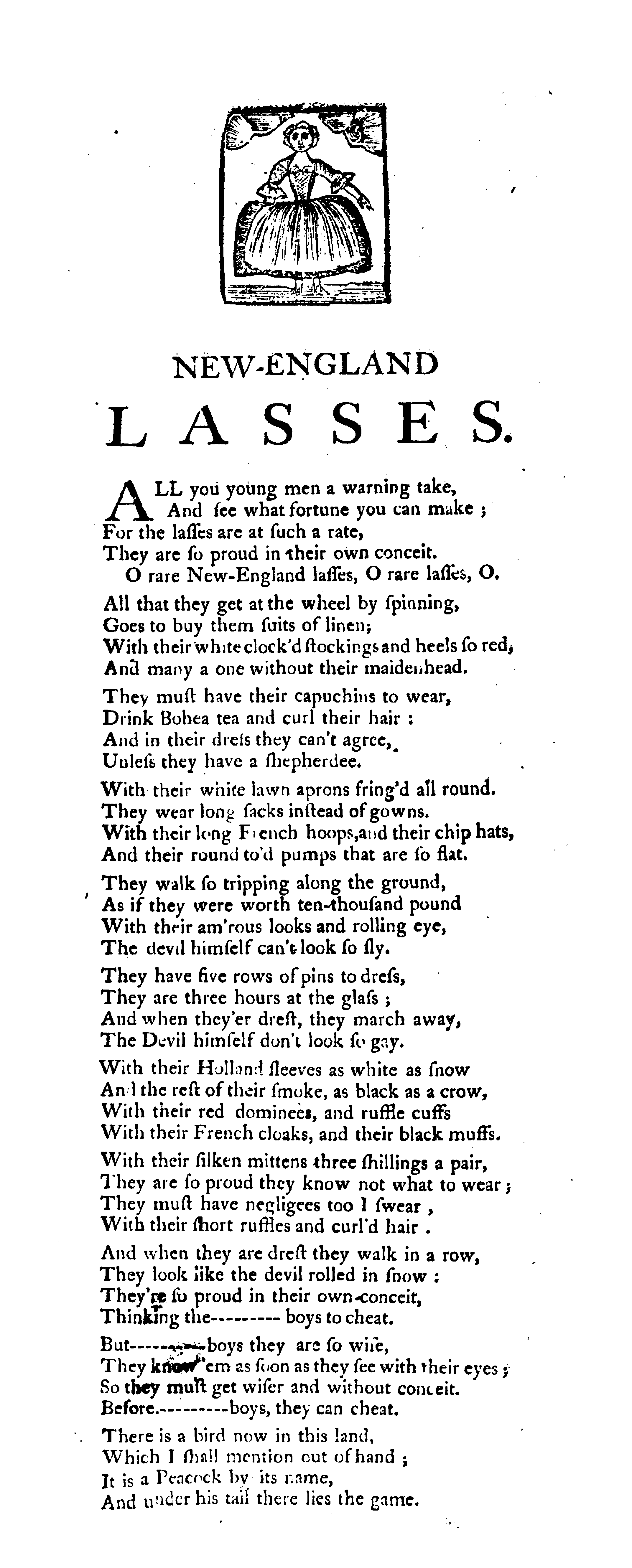
Slightly naughty, no?
The original is at the American Antiquarian Society, where the date given is 1790-1810, based on the typography (the internal fashion references seem earlier).





 Kirsten Hammerstrom
You must be logged in to post a comment.