
Tactical Strategies

One of the things I liked best about this year’s School of Instruction was the Petite Guerre demonstration that followed a discussion of those tactics by Dr Stoltz of the 5th NY.
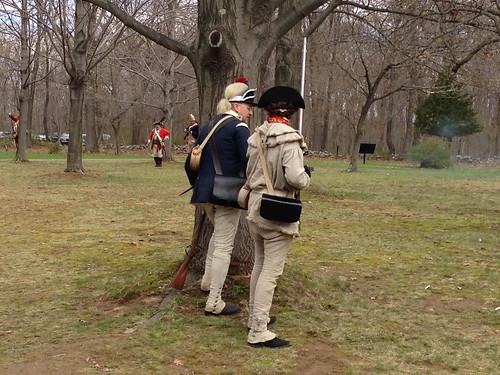
Mr McC & the Young Mr share a tree; note British officer and Hessian

Demonstrating skirmishes instead of linear warfare makes sense, given the numbers of men who take the field at events, and the smaller engagements will reflect exchanges common between the sides during the war.

What I like in particular is that using ‘petite guerre’ tactics requires the commanders and soldiers to tailor their actions to a site (site specific immersive experience: you cannot go wrong) and as the action unfolds, soldiers at all ranks are forced not only to move but also to think. Any action where the interpreters have to think is likely to create a better experience for visitors—and no great surprise, that usually makes a better experience for interpreters. It also flatters the site managers and visitors, who will appreciate that you’ve taken the time to explore and understand their place, and its place in history.

While you don’t necessarily want to fight the Battle of the Comfort Station, skirmishing around a site with buildings provides an objective, while multiple buildings and some woods or undergrowth provide cover for the Light Infantry troops and opportunities for deceit.

Of course, depending on troop size, it may be that each man needs his own tree. On Sunday, the Young Mr kept close to Mr McC, demonstrating troop [leg] length.
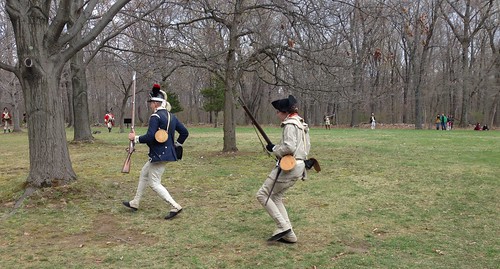
It’s hard to be invisible when you’re tall.

But I do mean this seriously: scaling events to available resources allows for a better interpretation.

That’s common sense, and sound museum practice, and that’s pretty much the business living history practioners (aka reenactors), are in: interpreting the past to visitors. Best practices for professionals and hobbyists are grounded in the same principles:

  • Primary source research
  • Material culture research
  • Site, resource, and audience- appropriate delivery
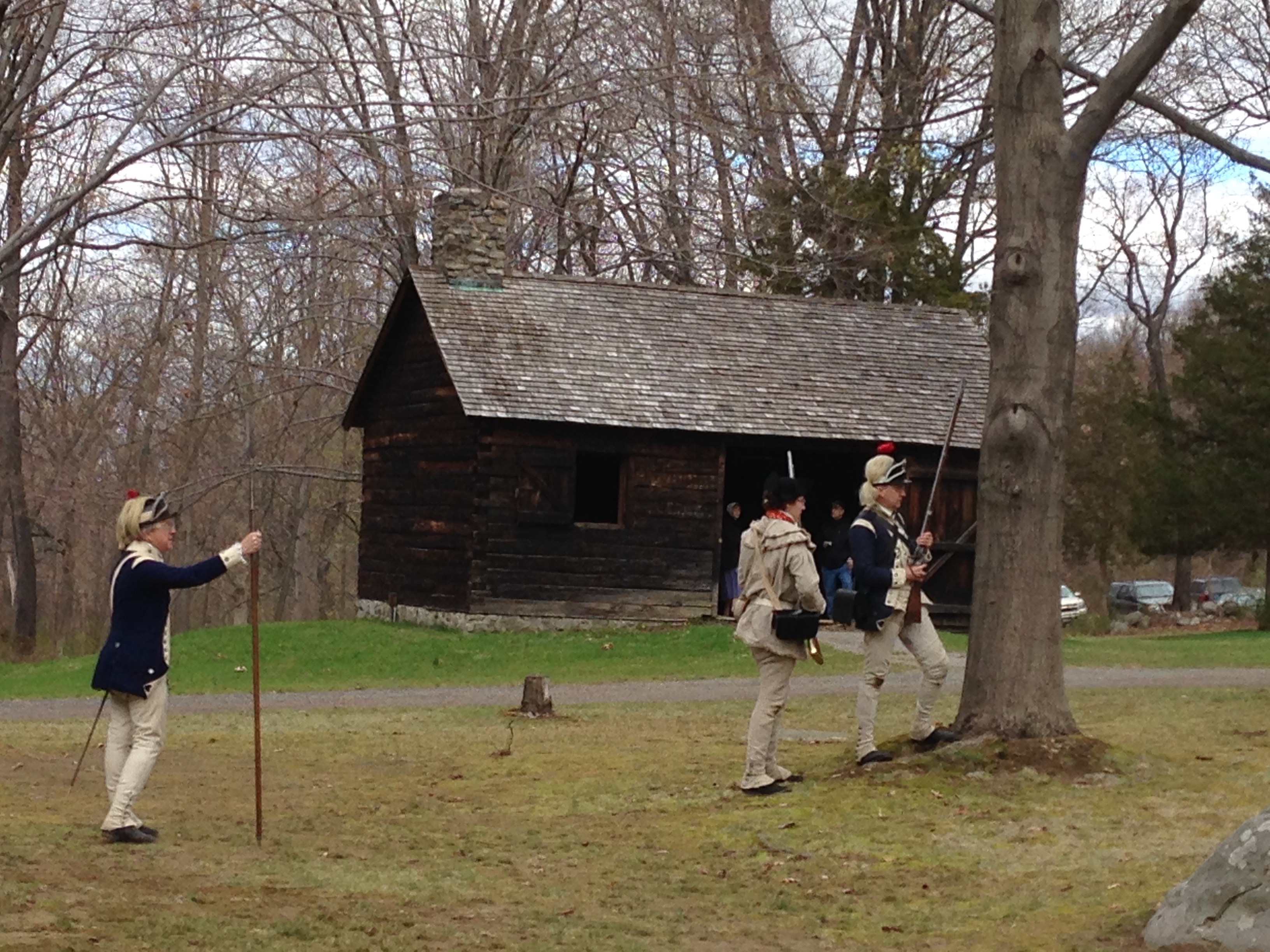
IMG_1386
Direction provided by Mr C with spontoon.

Building an encampment and tactical demonstration on the first two principles grounds the event in in historical authenticity. Adding the third principle, and increasing the use of smaller group tactics, tailored to the participants and site, would be a subtle but strategic shift to build a more engaging experience that better educates visitors and might even attract new recruits.
tite Dressed

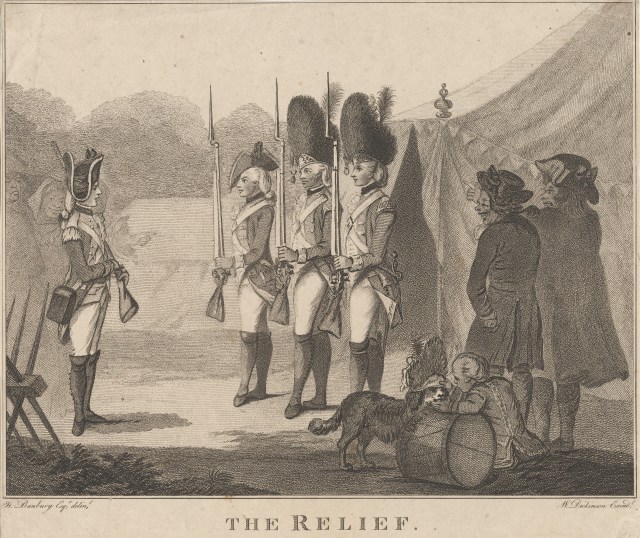
William Dickinson, 1746-1823, The Relief, 1781, Stipple engraving and etching on moderately thick, slightly textured, beige laid paper, Yale Center for British Art, Paul Mellon Collection

Reading the Abbott orderly books takes some patience, even though they have been transcribed. As with so many 18th century texts, punctuation is unreliable and open to interpretation. Here’s an entry from July, 1782, on the subject of uniforms, guard duty and fatigue duty.

July 22 1782
The Greatest Care and aten
tion is to Be pade to the preservation of the Mens
Clothing and to keep the Cloth Clean.. As
the Guards are always to Be fill Dressed in
uniform they are not while on that Duty to be
put on Ferteeg or any kind of Meaniel service
but to appear Clean, tite Dressed and In a
Soldierly manner when any parties for
Ferteeg are Necesery they are not to be applied for
and Sent in there undress or Ferteeg Clothes
this order to be Strictly observed

Which seems in more sentence-like form to be:

The greatest care and attention is to be paid to the preservation of the men’s clothing and to keep the clothes clean. As the guards are always to be full dressed in uniform, they are not, while on this duty, to be put on fatigue or an kind of menial service, but to appear clean, tight dressed, and in a soldierly manner. When any parties for fatigue are necessary, they are not to be applied for, and sent in their undress or fatigue clothes. This order to be strictly observed.

Here’s what I think it means:

Pay attention to the men’s clothing and keep it clean.
Men assigned to guard duty are always to appear in full uniform. When on guard duty, these men are not to be assigned to fatigues or menial duties. They should instead always appear clean, neatly dressed, and solider-like. When fatigue parties are called, the guards are not to be assigned to that duty, so that they do not appear on guard in their fatigue or undress uniforms. This order is to be strictly obeyed.

Who was Bridget Connor?

Detail, James Malton, 1761-1803, A Military Encampment in Hyde Park, 1785, Watercolor with pen in black ink, with traces of graphite on moderately thick, moderately textured, beige, laid paper, Yale Center for British Art, Paul Mellon Collection. B2001.2.999
Detail, James Malton, A Military Encampment in Hyde Park, 1785. YCBA Paul Mellon Collection. B2001.2.999

Who knows? She’s hard to find, though I am told and have real hope that the microfilm of the Abbott orderly books that chronicle her misdeeds in wending its way to me down the dirty, salt-and-sand covered highways of southeastern New England.

Where have I looked for her and Francis Connor, whom I presume is her husband?

Francis appears in Soldiers and Sailors of Massachusetts, for seven months’ service. That’s all I can find.

Well, crap, right? This genealogy stuff in Massachusetts is hard work—there are so many more people and towns than we have here in Li’l Rhody—but diligence and method pay off, and when you figure you’ve about exhausted the primary sources you can access for now,[1] you turn to secondary sources.

Lest you think I dislike Deborah Samson, note that I found her life a useful source in thinking about Bridget, as well as Book of Ages and Jane Franklin Mecom’s life. I’ve also been re-reading Holly Mayer’s Belonging to the Army.

Crippled soldier with family. Etching, London (?) ca. 1760. Lewis Walpole Library, 760.00.00.16

The common denominator: poverty, and the resulting lack of choices. This is useful for Bridget, because her story is probably one of necessity. Most women who followed the Continental Army, and worked for it, were from the lowest ranks. [2] These are women who would do what was necessary to survive, and as Mayer notes, “would rather steal than starve.” [3]

I’m not suggesting that Bridget, who would likely have received rations, needed to steal shirts to survive: I rather think she was attempting to leverage her position and profit by ill-gotten gains. But how did she end up in the Army to begin with? Massachusetts in 1782 is not New York in 1780, or Rhode Island in 1778.  What drove her to (presumably) follow Francis Connor?

Late in the war, maintaining troop strength is more difficult. The fervor of patriotism has cooled, and recruiting sergeants find it harder to fill the ranks.[4] There are bounties to be had, and the economy has suffered. Could Francis have been a property-less laborer who enlisted for the bounty? Nothing talks like cash. And, if the couple were tenants somewhere, without Francis’ income, Bridget might not have been able to maintain a home. Laundry doesn’t pay that much.

Why didn’t she stay with family? Could they have been indentured servants? Could they have been immigrants? My guess is that Bridget had no family, and if Francis had family, Bridget got on with them as well as she did with the officers of the 10th. I think she had nowhere to go, no way to survive without Francis.

Did they love each other? Did they like each other? Were they grifting together? I don’t know—but Francis Connor deserts the same day Bridget Connor is expelled from camp, so they’re bound together in some way. No matter what, Bridget was assuredly dependent on Francis.

Knowing so little about them opens up a world of possibilities, and the “opportunity” to do a great deal more research on the context of 18th century Massachusetts populations and enlistments. My best guess is that they’re an unpropertied laboring class couple from Boston, source of many of the relatively unstable and non-homogenous companies that made up the 10th Massachusetts. I also think they don’t have family, and might be former indentured servants. I have guesses about their religion and country of origin, which could be why the records are so hard to find. [5]

Looking for Bridget, and not finding her, leaves me with more and more questions, and I’m happy about that.


[1] She’s in the Abbott Orderly books, at least. Other Orderly Books to follow, as time and funds permit.

[2] Mayer, Belonging to the Army, page 122.

[3] Mayer, page 127

[4] How do you think Deborah Samson got in, passing as a boy? That’s 1782 for you.

[5] The Catholic Diocese of Rhode Island maintains separate historical vital records, and when we cannot find someone in the usual town records, we ask the genealogist if their family is perhaps Catholic or Quaker. Lack of evidence can be a suggestion of faith in my home state. But could these two be Irish Catholic in Massachusetts in 1782? I have no idea, but it seems a great stretch and a great question all at once.