Winter Amusement

Winter Amusement: A View in Hyde Park from the Sluice at the East End.Aquatint, printed in color and colored by hand, 1787.Print made by James Tookey. YCBA  B1985.36.609
Winter Amusement: A View in Hyde Park from the Sluice at the East End.Aquatint, printed in color and colored by hand, 1787.Print made by James Tookey. YCBA B1985.36.609

I count myself among the people sick of winter in New England, but the piles of snow and wretched driving have prompted some comments from the Young Mr, including “Well, it would be worse in the 18th century, right?”

16314413949_fca9e1de44_zHaving recently walked on a combination of cleared, partially cleared, and uncleared walks, I’m not so sure…but I was in modern boots, and not my leather-soled repro shoes, which I prefer not to expose to the variety of modern snow-melting chemicals, though they can be cleaned.

Still: the partially cleared and unsalted walk was easier to walk on than you might imagine, and I suspect that the 18th century tasks of clearing steps and paths to make room to walk or drive carts, wagons and carriages was probably reasonably effective– though the melting must have been more annoying and messy when mud season arrived.

In all this cold and snow, how did people keep warm and stay fashionable? For gents, of course, greatcoats were an option, and cloaks or mantles for women, both in the last quarter of the 18th century and into the 19th. I found documentation for women’s Spencers and greatcoats in the first decade of the 19th century, but what about earlier?

detail,  Winter Amusement, 1787
detail, Winter Amusement, 1787

While I cannot (yet) place the coat at right in New England, you know I covet one.

Tail pleats with back buttons, a possible shoulder cape? I love the menswear styling of this coat, and the drab-and-black color combination of coat, gown and accessories. I don’t have much call for 1787 clothing in my life (actually none whatsoever) but by the time I’ve patterned and made this coat (after many other things to finish), perhaps I will also have created a reason.

Winter frolics, New Year’s Eve party, 1788? Anything is possible, and time is better spent imagining fun than complaining about snow.

Peale’s Progress, or, High on History

No, we didn’t go, and I have regrets. Six weeks before the event, I thought I was working on January 3rd, and by the time the schedule changed, it was too late. Instead, you can read about Drunktailor’s experience.

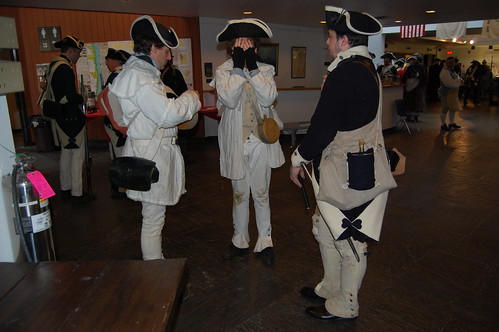
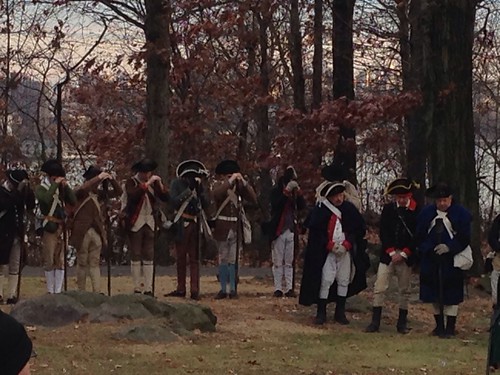
Reenactors portraying Philadelphia Associators take part in the real time tour of the Battle of Princeton, Princeton, NJ, January 3, 2015. Beverly Schaefer, Times of Trenton
Reenactors portraying Philadelphia Associators. Beverly Schaefer, Times of Trenton

The background is interesting, similar to the kind of events and projects we’ve been talking about here in RI: site- and time-specific events that combine commemoration, history, and experimental archaeology, or an emotional and social archaeology, if you will.

From event co-organizer Dave Niescior, quoted in the Rutgers-Camden News Now: “The goal is to gain a better understanding of the hardships endured by individuals who lived and made a critical moment in history.It is one thing to write ‘the troops marched overnight to Princeton,’ it is yet another to understand what that physically and mentally meant to the men who had to put one foot in front of the other all night long.” Co-organizer Matt White told NJ.com, “We’re trying to stage a number of vignettes to give people a sense of what was going on in the Continental Army in this period between late December and early January of 1776 and 1777.”

that’s cold. From Daily Reenactor

These and other collected images help convey a sense of the event,  which–as far as I can tell– did provide participants with the kind of transcendent experience I know I enjoy and hope to find at events.

This is the kind of event that I think proves a belabored (and elsewhere belittled) point: accuracy matters. It is just about ALL that matters.

On a now-defunct phone, I had an old video of the Young Mr with a now-deceased reenactor of whom I was quite fond, despite our wildly divergent politics. In it, Mr D shows his Charleville to the Young Mr on the front porch of an 18th century home and asks, “Do you know what this is?” The Young Mr shakes his head, and Mr D answers, “It’s a time machine.”

Although I remain committed to reducing the degree to which living history is musket-centric, there’s truth in that statement: Mr D had an original, period Charleville and a fairly well-cut uniform, considering his generous figure. Using, showing, and interpreting actual period pieces and well-made, correct replicas is the single best way to connect the present, and the public, to the past. Accuracy matters because it’s the literal key to the past: you have to cut the pattern right.

Accurate impressions rendered in a place of shared value will transport you to the past, and give you insights you did not expect. That is the point of these exercises: insight and understanding. It’s how to get high on history.

In Tents Tuesday*

You know The Tent Article, don’t know? You do, if you’re camping 18th century private soldier style in your hand-sewn coat.

Scene of the Camp on Hampton Green, 1781

The Tent Article (hereafter The Document) pulls together documentation and research assembled by a team of living history enthusiasts dedicated to replicating the 18th century enlisted army experience in an accurate manner. Though the PowerPoint format affects the overall length, be warned: we are talking 300+ pages here.

No strangers to the pursuit of the accurate and never ones to shy away from an arduous task involving pointy objects and string, the 10th Mass assembled on Saturday afternoon for a round of tent sewing.

I first read The Tent Article in 2012, and was promptly ashamed of our hand-me-down tent which had everything to recommend it in terms of price, but wanted in terms of accuracy. In response, I began making 1/8″ scale models of tents to figure out how much linen I would need to buy in order to make a truly correct tent. Finally, all that edumacation in art and architecture had utility! Alas: distractions arose, cost overwhelmed, our then-primary regiment scoffed, and I abandoned hand-sewn tent plans.

Fast forward to Tyler Putnam’s blogging on The First Oval Office project, and I was once again intrigued. I began calculating how much vacation time I might need to complete a tent by hand in our living room. Well, thank goodness for finding fellow travelers, because lo and behold! The 10th Mass had tents in want of sewing, so I could learn a great deal without filling our home with excessive yardage.

“Sails.”

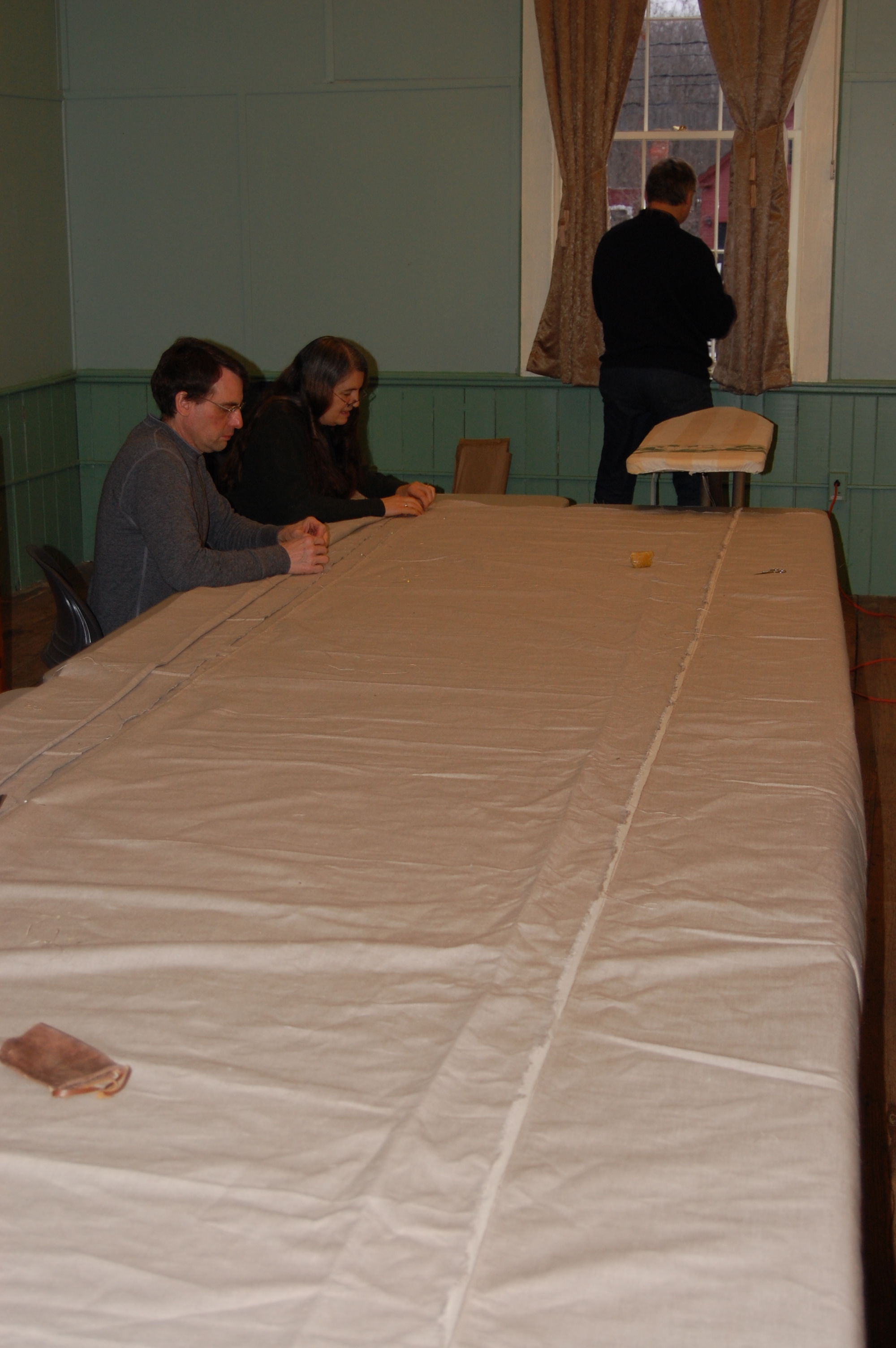
Progress was made last August in Newport, where the tents masqueraded as sails, but the canvas languished unsewn until last Saturday, when we duly assembled in Hopkinton and unfurled the vast expanse of linen. It was suggested that I might know some people with access to sail lofts (!), but in about 4 hours, a number of us managed to finish the final foot of backstitching and to flat-fell a little more than 60 feet of tent seams.

It's a vast expanse of linen.
It’s a vast expanse of linen.

The Document was consulted to make sure we were proceeding correctly, though the iPad misbehaved and forwarded us many pages to grommets. (I’m looking forward to those, as I enjoy sewing eyelets– and have just earned myself the dubious honor of sewing at least half of them, I’m sure.) We checked the images, threaded our needles, and off we went.

A few inches (feet) of felling had to be unstitched and resewn, but heavy linen is wily and some stitchers were newer to the process than others. But by the close of day, all seams were felled, needles packed, and tentage folded.

Next up, per The Document, are mud flaps. This should get interesting, as math in front of an audience usually is.


IMG_2728

I promised a pun, so here’s the worst. Somehow we got on to unfortunate reenactorisms, which collided with Star Wars, and brought us to the realization that what we needed were light sabres… ’cause it’s the 10th Massachusetts Regiment Light Infantry Company. We were punished for this hilarity by having to drive home on untreated roads into snow that looked like we were trying to take the Millenium Falcon to hyperspeed.


*It really happened on Saturday.

A Matter of Interpretation

On the way to Southbridge, Mr S and I were discussing the last “big” event for the year, and whether or not we wanted to go. It’s an annual event grounded in ceremony, and somewhat repetitive.

The landing of the British forces in the Jerseys on the 20th of November 1776 under the command of the Rt. Honl. Lieut. Genl. Earl Cornwallis. Watercolor, attributed to Thomas Davies. NYPL

Mr S would like to go if he had the proper wool coat– it will be easy enough to make, once he gets a kit– but which he does not now have. I find it’s usually a day alone wishing I was across the river in a museum or fabric shop. In the end, it’s a long drive to a day spent in the cold and wind followed by a dash home in the dark, with Sunday spent catching up on chores and cleaning muskets, and now with an added measure of homework stress.

I have painted this as a grimmer day than it usually is, but considering that it’s been 7 months since we had any non-medical time off from work, squeezing this into a busy and stressful schedule is not as appealing as it once was. In part, I think it is because there is a lost opportunity in the interpretation, which is surely limited by the size and nature of the site, and by the loss of the historic fabric of the area.

Nestled in a densely settled and very urban area, the park site has a block house, hut, and fortification as well as a museum. Sutlers and others set up in the museum for the day, including some demonstrations of women’s work…like spinning. Spending the day inside spinning is not for me: not only can I not spin, I cannot imagine fleeing the British with a spinning wheel, which is an annoying contraption to move even with assistance, plenty of time, and a Subaru.

The Young Mr hides

But more than my impatience with Ye Olde Colonial Spinning Wheel at too many military camps this past year, I think what stops me from wanting to go is the repetitive formality of the interpretation, with the the march to the monument and the post-prandial “battle” for the blockhouse, with the Americans sometimes winning, despite the fact that the fall of this site marked the beginning of Washington’s retreat to Pennsylvania, and despite the fact that three days earlier, when the companion fort across the river fell to the British and Hessian troops, nearly 3,000 Americans were taken prisoner in 1776, and of those, only 800 survived. In what way is this ritualistic commemorative event remotely authentic? And if the only way people get the actual history and importance of the event is through the event narration or museum exhibit, hasn’t the reenactment or living history portion then failed?

Ritualistic, commemorative.

The more I think about interpretation and presentation, the more Ye Olde Colonial things annoy me and the more important I think it is to be accurate and correct.

Forcing a passage of the Hudson River, 9 October 1776. oil on canvas by Thomas Mitchell from an original by Dominic Serres the Elder. Royal Museums Greenwich

That does not mean that I expect a naval engagement (though a girl can dream) or a cross-Hudson rowing affair, but I do think it could be interesting to see troops at a fort packing up and evacuating the site, with the confusion that could result. But it’s not my circus, and not my monkeys, and in any event, I shall probably stay home to make sure that homework and housework alike are done in this current century.