Hot Topic

I’m of an age (none of your beeswax, thanks for asking) where most of the clothes in the shops are simply not for me. Not only am I picky about labor standards, fabric and construction quality, the styles aren’t for me. I’m too old. I create enough havoc walking (falling) down the street as it is that I do not need to look like the mid-life crisis I’m having involves a desperate search to recapture my youth through H & M or Hot Topic or whatever-the-kids-are-wearing clothing. I’ve achieved “a certain age,” and as with my everyday closet, my living history wardrobe has to reflect my age as well. Pity, really.
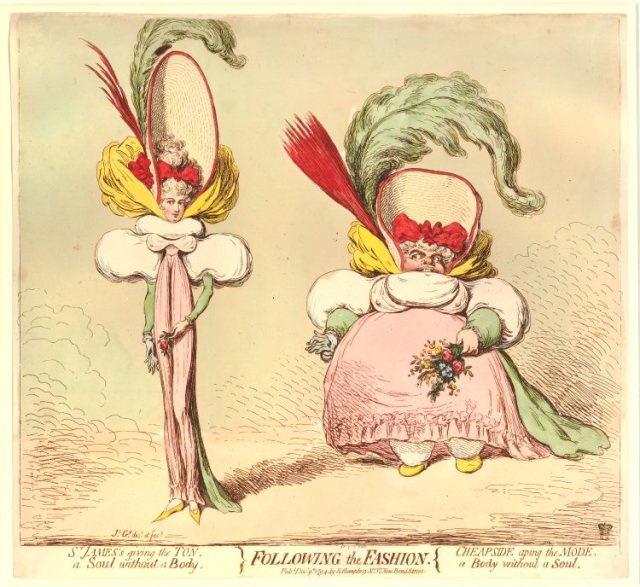
Following the Fashion. Hand colored etching by James Gillray, published by Hannah Humphrey, 1794. British Museum 1851,0901.706

But more’s the pity here: I don’t have a clear idea, really, how age was perceived in the various decades I interpret. I have a clearer idea of how different body shapes and class levels were perceived and taunted, though sometimes body shape is an analogue for age.

Is this my daughter Ann? Pen and ink print study by Samuel Hieronymus Grimm, 1774. British Museum 2011,7084.56

There’s a classic image that juxtaposes age and youth.  Here’s how the British Museum describes this image:

‘Is this my Daughter Ann?’; satire on fashion. A street where, before a house [on the right], over the door of which the name ‘Love Joy’ is written, a sedan chair has been brought, in order to carry away a young lady, who, in a towering toupée, and other articles of fashionable attire of this period, is leaving the house in company with a young soldier, who caresses her as they go; she looks fondly at him. An old woman, in what was then an ‘old-fashioned’ costume is interposing to prevent the departure of the damsel. 1774

Okay… “An old woman, in what was then an ‘old-fashioned’ costume.” You will note that the old woman is wearing what we typically wear here in New England to represent everyday clothing for middling and lower sort American colonists for most of the 1770s. I don’t want to put too much stock in the cataloger’s description, because I’m not sure that print curators or curatorial assistants always know as much about material culture as they think they do. And we know that six weeks is not six years when it comes to transmitting fashion changes and updates across an ocean. I think “old fashioned” might not be exactly or entirely right as a descriptive phrase.

What does the old woman’s clothing really signify? That she’s rural and not urban? That’s she’s poor? That she’s old? How ‘old fashioned’ is that costume by 1774… in a context other than London courtesan couture? And how do we translate the clues we have trouble deciphering into a dress code for living history?

Is this my Daughter Ann, mezzotint by James Watson after S. H. Grimm, published by Sarah Sledge, 1774. British Museum J,5.104

Well, happily, there’s a verse under the image in this print.

Is this my Daughter Ann

The Matron thus Surprised exclaims,
And the deluded Fair One Blames
But had the Mother been as Charming

She had Thought the Mutual sport no harm.
This Moral’s an undoubted Truth
Age envies Still the Joys of Youth

So this print is not about fashion. It’s about sex. (Well, duh. You were wondering when I’d bring that up.) It’s also, in a way, about hypocrisy, isn’t it? But the verse gives us the clue that the mother’s clothes are meant to be matronly.  “Conservative because of her age” might be a better descriptive phrase than “old fashioned” in that catalog record.

But does that mean that those of us who have achieved “a certain age” might also consider whether we, too, should be dressing in a more “conservative because of her age” style? I don’t really know.

But look here: Zoffany, ca. 1762.

David Garrick and Mary Bradshaw in David Garrick's "The Farmer's Return". Johann Zoffany, ca.1762. YCBA B1981.25.731
David Garrick and Mary Bradshaw in David Garrick’s “The Farmer’s Return”. Johann Zoffany, ca.1762. YCBA B1981.25.731

Here we’re looking at a rural woman ten to twelve years before “My daughter Ann.” The costumes are very similar; maybe the mother in Ann really is just old fashioned.

Here’s another version of “My daughter Ann,” this time more clearly fashion focused, without the sexual overtones.
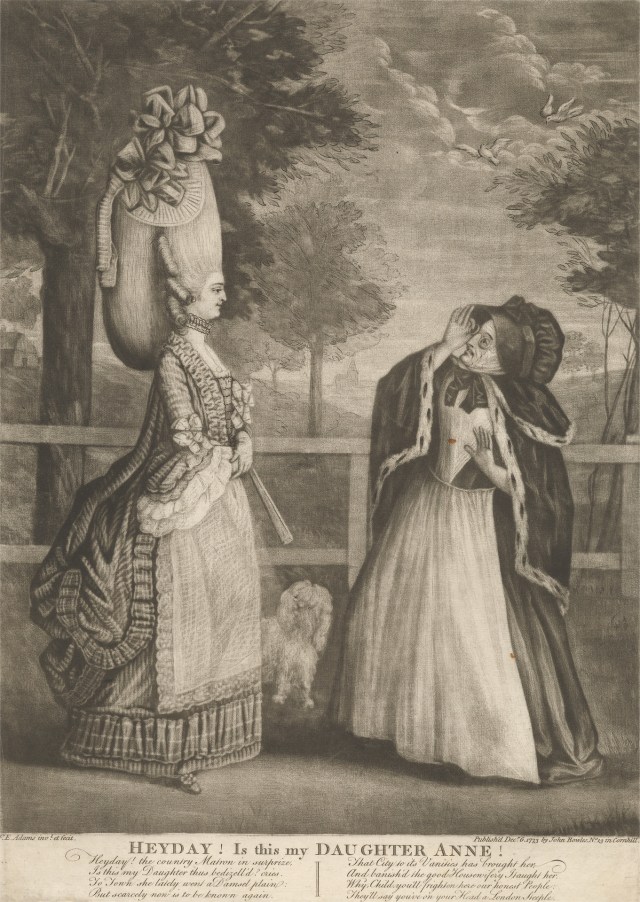
Print made by Francis E. Adams, active ca.1760–1775, British, Heyday! Is This My Daughter Anne!, 1773, Mezzotint and etching on medium, moderately textured, cream laid paper, YCBA, B1970.3.820

Yale helpfully provides a transcription of the verse at the bottom:

HEYDAY! Is this my DAUGHTER ANNE! | Heyday! the country Matron in surprize, | Is this my Daughter thus bedizell’d? cries. | To Town she lately went a Damsel plain: | But scarcely now is to be known again. | That City to its Vanities has brought her, | And banish’d the good Housewifery I taught her. | Why, Child you’ll frighten here our honest People: | They’ll say you’ve on your Head a London Steeple.

My best guess is that this print is skewering both Anne and her mother: Anne, for being so outlandishly fashion-forward, and her mother, for being so far behind. But again, that’s only a guess.
Sometimes a Great Notion

Finished! Cozy, too.

(Think Lead Belly, not Ken Kesey.)

No, I did not take a notion to jump in the river, but I did take a notion to sew slightly more than the quilted waistcoat.

I couldn't resist.
I couldn’t resist.

I got this unshakable great notion, you see, about some wool from the remnant table in Framingham. It was a lovely olive color, and paired up with some plain weave I already had, it reminded me strongly of World War II-era Army uniforms from the ETO, which I had been packing recently in Rhode Island’s alpine north. And yes, if I find a pinker tan for a petticoat, I will procure it.

Since I already have an olive wool petticoat that will also work for this notion, I started on the gown last week, cutting it out on Wednesday night so the table would be clear for Thanksgiving dinner.

The wool was a little slippery to pleat, and the twill slightly dazzling with its sheen. Let’s pretend it’s shalloon, shall we?

A week into the project (after a brief annoying detour attempting to correct my mitt pattern), I have only half the hem and the bottom of the robings to finish. Not too shabby, thanks to a holiday weekend and hours of The Pacific, Band of Brothers, and The Purple Plain. Homage to the color, I suppose.

I'm never not smirking, so thanks for not smacking me.
I’m never not smirking, so thanks for not smacking me.

It fits– which always seems like a miracle, even with a tested pattern– and better yet, it fits over that plush waistcoat.

The rustle of the silk and the swish of the wool are unlike anything I’ve ever worn. I think I shall feel quite fancy– let us hope I shall also feel quite warm.

Cold Comfort Compromises

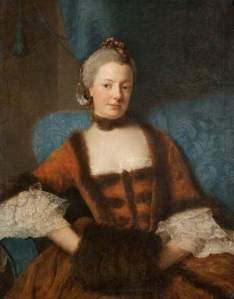
"Henrietta Diana, Dowager Countess of Stafford", Allan Ramsay, 1759; Glasgow Museums 3026 (c) Glasgow Museums; Supplied by The Public Catalogue Foundation
Henrietta Diana, Dowager Countess of Stafford, Allan Ramsay, 1759(c) Glasgow Museums. Fur: cozy, but not for me. Also too early.

Winter is bearing down upon us, and while I was not in Connecticut last weekend, nor will I be in New Jersey two weekends hence, I do have winter history plans, barring the proverbial 50 feet of snow, which even a Subaru cannot handle. The Noble Train: I could not resist, for, as regular readers know, I prefer my history to hurt.

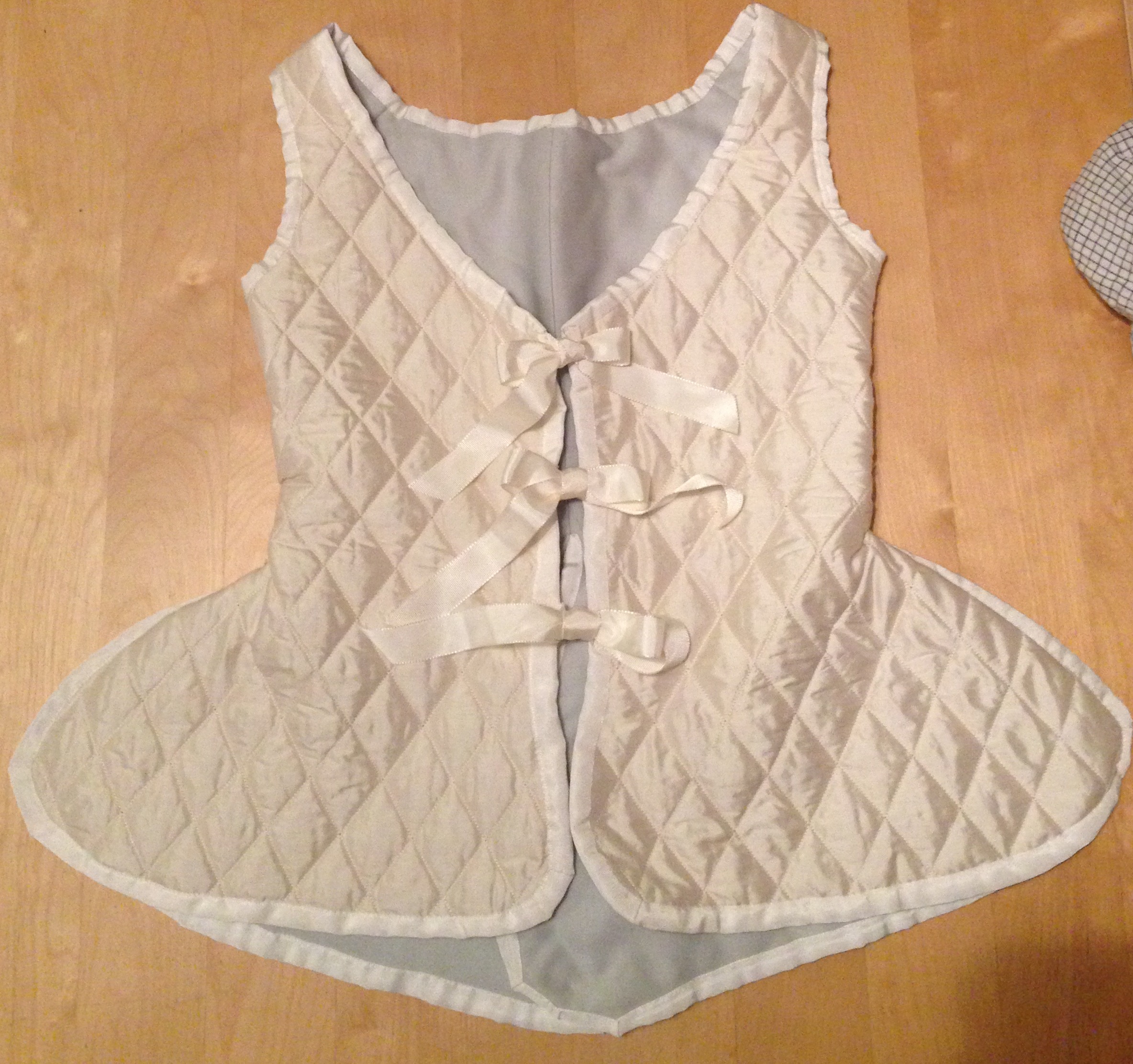
Still, I try to avoid cold-related illness and extreme discomfort, so I’m making sensible preparations. Of course, I have not finished my quilted petticoat, and lack the time to make a proper hand-quilted silk under-waistcoat. Reader, I have done a terrible thing: I have compromised.

The saddest part of all of this is that the waistcoat I’m making is the most feminine and luxurious item, and the only item even close to lingerie (aside from shifts) that I have ever made myself, or even own, no matter its inaccuracies. There is a kind of irony built into this project, hence a post while the irony is hot.

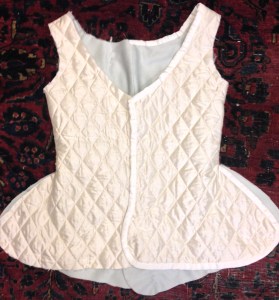
Waistcoat. Silk quilted and bound with silk grosgrain ribbon. ca. 1745. V&A Museum, T.87-1978

The waistcoat: an item of occasional debate, these are not the most common beast in museum collections. Fortunately, Sharon Burnston has a handy article and pattern posted on her website. To be clear, I am not recreating the Atwater-Kent waistcoat. I am cobbling together my own inappropriate but satisfying item. I am also using the absolutely inexcusable excuse that no one will see this garment, as well as previous bouts of pleurisy after long, cold events in stays when I had the merest hint of a cold. (My boss kindly offered to cup me for a cure when I had to take time off work, but I declined. The look on her face suggested a lack of appreciation for my historic ailment.)

But here we are, “confessions of a known bonnet-wearer” and all that, so onward to the project. I started with Sharon Burnston’s scaled diagram of the Atwater-Kent woman’s waistcoat. The shapes are very similar to a basic woman’s jacket of the period, bonus: loose fitting, no sleeves. It was easy enough to pattern up in an afternoon, with limited fitting (I did test it over stays, just in case.)

overview

The compromises I made are in the materials: pre-quilted silk (with a cotton backing), lined with wool-cashmere, and bound in silk grosgrain ribbon. The size of the diamonds and the machine quilting, plus the wool lining, make this an inauthentic, inaccurate garment. The shape, construction, and binding are at least correct, as far as they go. But the lusciousness of that remnant table cashmere and the soft colors please me immensely, and I do expect to be warm.

corner

This has been a quick project, with the majority of time spent on the binding. As in the Atwater-Kent waistcoat, I’m top stitching with a running stitch on the inside, folding the ribbon over, and hem stitching on the outside.

Will this feel like a hair shirt of shame under my gown, compromise as it is? Maybe, but at least it’s cashmere.

The Myth of Perfection

Ain’t nothin’ perfect.

Jackie’s got good points, and although I think they are slightly tangential to where I thought I was going on Monday, let’s pick them up.

Completely 1819 to represent 1819? My standard reply to pretty much every question is: It depends. Who are you, where are you, what are you doing? Middle class or higher bride? You are so 1819 it’s scary, from your skin out, head to toe. Lower class? You’ve altered your best dress, if not made a new one, and refreshed your accessories.

Look, folks: part of our problem is that we forget that the people in the past had the same covetous, jealous hearts that we have. They had wants and yearnings, for each other, for new bonnets, for velocipedes and overcoats. They were just as interested in impressing each other as we are, even if they sublimated desire into poetic images of greater obscurity than James Brown ever used.

I thought about this notion of mixed up times for clothing as I stood on a landing at work yesterday. Skin out, here’s what I wore on 1 September 2015:

  • Black Natori sports bra, purchased in Boston on January 10, 2014 (I saw my surgeon so I remember.)
  • White cotton tank top, label gone, acquired ca. 2013, possibly from Target
  • Blue and white striped cotton 3/4 sleeve J. Crew blouse, 2006
  • Black Nike undershorts, 2010
  • Lucky brand jeans, August, 2015
  • Red suede belt with brass buckle, ca. 2004
  • Red suede Naya oxfords, late winter, 2014

The oldest thing was the belt, followed by the blouse. The most stylistically determinate item is probably the jeans, since waistline height and cut of the legs fix trouser/jeans style. So, what could this mean for us, when we dress for the past?

Let’s start with dressing for the American Revolutionary War period, 1775-1783. What you wear depends of course on who and where you are; here I am in New England, wishing I was middling sorts.

Detail, Mrs Richard Skinner, oil on canvas by John Singleton Copley, 1772. MFA Boston, 06.2428
Detail, Mrs Richard Skinner, oil on canvas by John Singleton Copley, 1772. MFA Boston, 06.242

If I wear an open-front stomacher gown in 1775, will I still feel comfortable in that in 1783, when the ladies of means around me have switched to closed-front gowns? Or will I feel like I’m wearing bell bottoms and a macrame vest to high school, while the cool girls are wearing pegged Guess jeans and Fair Isle sweaters? (Not what happened to me, but you follow my point). Think how much American fashion changed between 1975 and 1983, and while you will surely see pieces carried over– watches, headbands, socks, Tretorn sneakers– they will be primarily small pieces, accessories, and not main garments.

Lady Williams and Child, oil on canvas by Ralph Earl, 1783. Metropolitan Museum of Art, 06.179
Lady Williams and Child, oil on canvas by Ralph Earl, 1783. Metropolitan Museum of Art, 06.17

That’s really want I think we want to get at: Yes, people mixed up clothes, wore favorite things, wore things out. But then as now, they wanted to be stylish. The more care you put into imagining yourself in the past, really being that person, the more convincing you’ll be. You won’t be perfect, and authenticity is as unachievable as objective truth, but you will be closer to real, and yes, even the public will know.