Frugal Friday: Make Do and Mend

In a world of fast fashion, mending is quite out of date (unless you’re a hipster, and I am one of the trilobites of hipsterism), so it is all the more appropriate that I have a gown in need of mending.

I am still making new things, like the “Bad Squishy” jellyfish cap. It didn’t look so tentacular until I held it up to show it off. As with any cap, the main goal is merely to keep it upon my head–always in doubt.
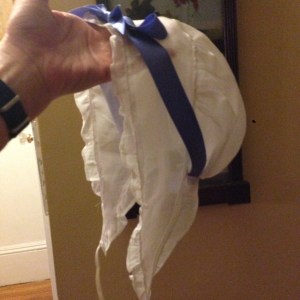
Tenactularly good. And now I can whip gather.

In just a week I’ll be headed up to Fort Ticonderoga to clean the officers’ quarters and generally represent the women who accompanied the 26th Regiment of Foot— and yes, I know I’m old enough to be the mother of any number of those folks, but there’s no need to point it out all the time. The main thing is the cleaning. And the weather, which looks like it could once again be unseasonably warm. That won’t stop me making another wool gown, which I am making up in a drab wool specifically for dirt and distracting my unsettled mind.

Washing, wearing, and airing

All the same, I pulled out the mother of all wrecked and wreckable gowns, the cotton gingham made for Bridget Connor. This has achieved a pretty nice patina, though I will confess to having washed it last fall after repeated wearings over the course of the summer. I know– not so necessary, but I did. Fear not: the stains remain.

But I wore it vigorously and made it up quickly– to the point of needing to take it off and mend it at Stony Point (was that really two years ago?). Mending is required once again, so that small seam ruptures do not become actual sleeve separations as I dust, sweep, and mop. Yes, of course I’ll be making experimental mops this weekend, why not? There just isn’t enough distraction in the world.

I worried about those eyelets I installed way back when, but was relieved to discover that I had seen a precedent, and that the date was within tolerances for someone of my age to retain in her clothes. The lacings also make dressing significantly easier for me; some days, putting on an open robe takes me back to the button-up and lace-up toys of pre-school, when tying shoelaces was a major accomplishment.

Mountebanks, Watchmen, and Questionable Women

Mountebanks at night. watercolor by Paul Sandby, 1758 Royal Collection Trust/© Her Majesty Queen Elizabeth II 2014

Sometimes I think I’ll forgo the dressing up and going out in public, and just do the research; the world that exists in my mind is pretty satisfactory, and within it, Boston doesn’t have the GPS-killing skyscrapers of the financial district or the motor-powered vehicles that seem bent on killing pedestrians. Instead, it has horse-drawn vehicles, equally ready to run you down.

But: in thinking about the people on the margins, the people in the backgrounds of images, the people casually mentioned– “so hard to find a cook when you need one”–in letters, I’ve been looking at even more images. Here, a mountebank, illuminated by a torch, performs on a washtub outside a tavern (Good eating every Day) for a crowd of men, women, and children. Much texture here, and many people one could aspire to be.*

Mountebanks at night. watercolor by Paul Sandby, 1758 Royal Collection Trust/© Her Majesty Queen Elizabeth II 2014

Let’s get the watchman out of the way.

Is that a snarl or he is just happy to see the mountebank he can bash over the head with his prodigious stick? He’s carrying the obligatory lantern, here apparently made of tin with horn, glass, or mica windows. It looks like he’s slung it over the stick, where it is caught by by the knob to keep it from sliding.

It’s a Great Coat, really: the button-embellished flap (pocket slit?), the deep sleeve cuffs, the taped buttonholes all serve to make this coat impressive and intimidating.

On his head, a rakishly angled black wool hat worn over…a cap? Help me out here, gents. It looks like a linen cap that covers the very crest of his ear. Is that possible? Or he is tonsured? If so, you’d think he’d want a cap for the cold…

Mountebanks at night. watercolor by Paul Sandby, 1758 Royal Collection Trust/© Her Majesty Queen Elizabeth II 2014

Next up: the girl with a basket. She raises a lot of questions for me when I zoom in close. Yes, Virginia, she really is wearing a cast-off regimental under a short red cloak. I’ve never understood how women came to possess these coats, but look closely and you’ll see the blue cuffs and plackets on the sleeves, the pocket flap sticking up just below her basket, and the long skirt of the red coat. (That’s a dog, not a killer shrew, between her feet.)

Her hair is a mess, too; we can speculate on reasons for that, but let’s go with a long, busy  day as a servant, and not freelance corner-based activities.

What’s in the basket? A bottle? A decanter? A funnel? Hard to tell. Is she someone’s serving girl, sent out to the liquor dealer? If she is, why that coat? Is the man in red next to her grasping her elbow? Possibly…(and doesn’t he have a nice red double-breasted coat?)…and if that’s a uniform he’s wearing, is that her connection to the coat she is wearing? So many questions.

In the center background, there’s a young woman escorting a male child; she may be an older sister, but I think it’s also likely she’s a nursemaid. In the background at the left, two ladies are seen from the back, clearly wearing neat caps and jaunty hats. They’re moving away from the mountebank and the crowd, probably on their way home, respectability leaving the dangerous streets.

It’s as much a mix of people as you might find outside the Pret a Manger on State Street today. Somewhere in that crowd, there is someone to be.

*In a nod to riots recent, let us note there are 5 or 6 women shown here, 14 men, 5 children, 2 dogs and 1 monkey. That’s a 40:60 ratio of women to men. Children are, in general, grossly underrepresented in living history. Let’s talk about that someday.

Illuminating Lampshades

The more you look, the harder things get. That’s usually cause for celebration, but I’m starting to feel the pressure of more ideas and commitments than time. Here’s a question: in these undated Sandby watercolors, are the women wearing the bonnet colloquially called lampshade? What does lampshade look like from the side? My guess is that it looks a great deal like the headwear of the woman sitting on the wall. (Click the images to go to the Royal Collection site where you can enlarge them.)

Somerset House Gardens. Watercolor by Paul Sandby, 1750-1760. Royal Collection Trust/© Her Majesty Queen Elizabeth II 2014

So much good stuff in this image: the woman sitting on the wall, swinging her foot (take that, decorum); the black silk mantles; sleeve ruffles; gloves; pointy shoes; big skirts.

About those pointy shoes and big skirts….much as I would love for this image to be really relevant to my quest, we are looking at the 1750s. At least lampshade comes in to greater focus, both in date and in construction. Ooh, look! More lampshade.

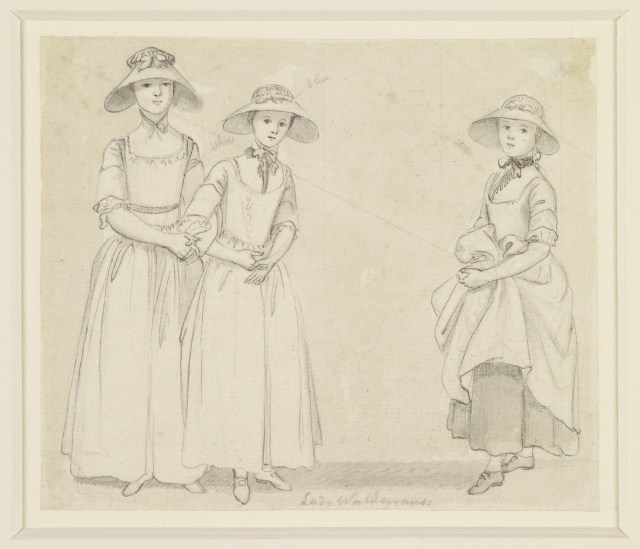
The Ladies Waldegrave, 1760-1770. Watercolor by Paul Sandby Royal Collection Trust/© Her Majesty Queen Elizabeth II 2014

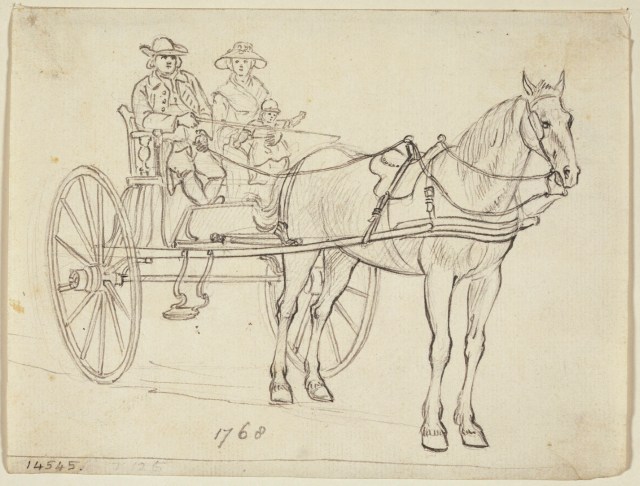
The eldest of these young ladies was born in 1760 and the youngest in 1762, so we’re really close to 1770 here. They’re not only incredibly adorable (I know a quite darling and very young lady for whom I want to make one of these pretty much immediately), but they’re in the right time period. Most of the bonnet images in the Royal Collection seemed to be of young women or girls, until I happened upon this image, from 1768.

A carriage, with man and lady 1768. Watercolor by Paul Sandby. Royal Collection Trust/© Her Majesty Queen Elizabeth II 2014

Well, “lady” might be pushing it where I’m concerned, but that image feels like the best solid evidence of bonnetness close to 1770.

Here’s another ca. 1770 image. Way in the back, there’s a bonnet.

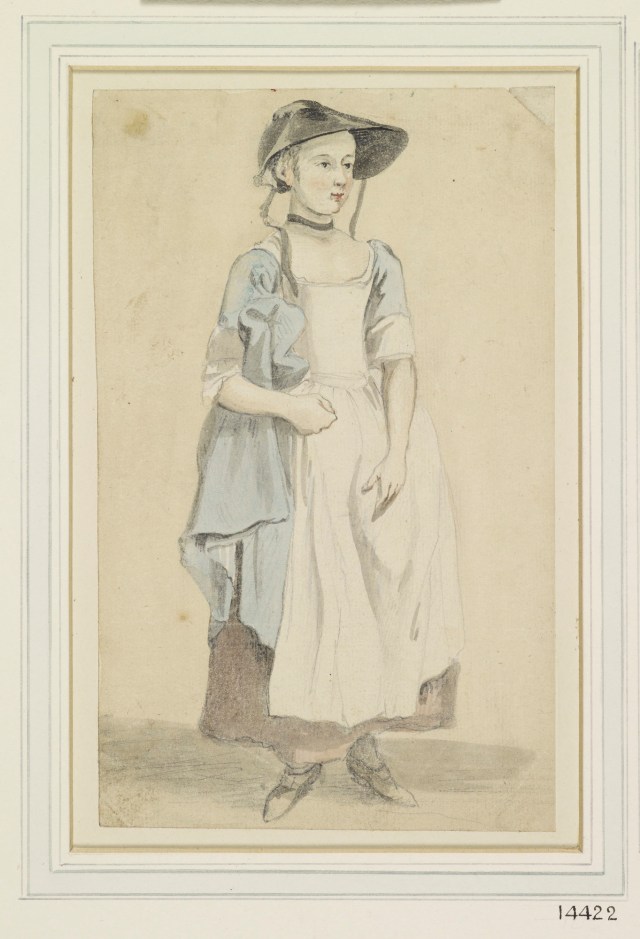
Can’t get enough of that black taffety? Have another.

A young girl, standing 1760-1780. Paul Sandby, Royal Collection Trust/© Her Majesty Queen Elizabeth II 2014

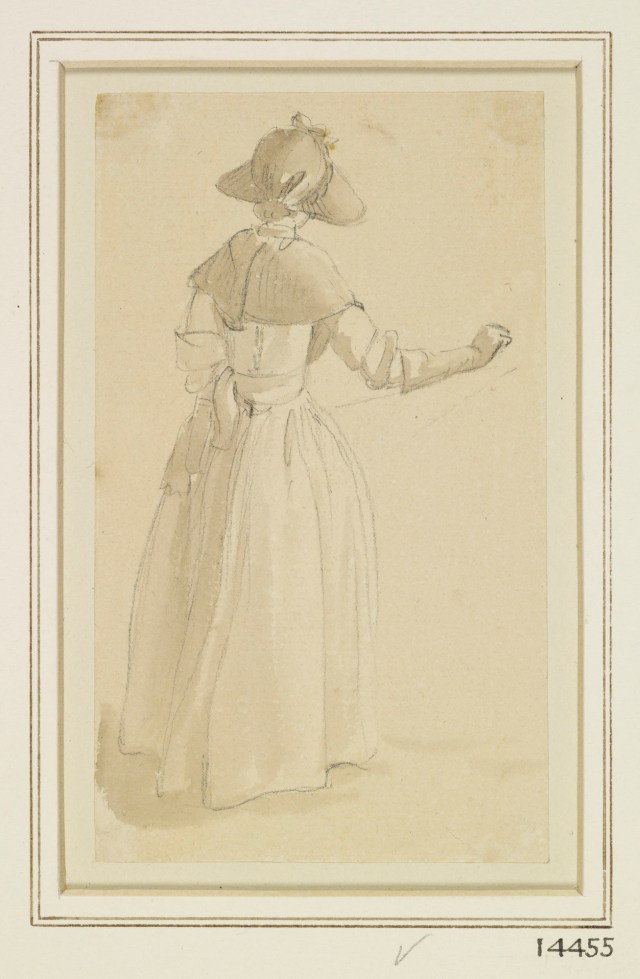
Wonder what that might look like from the back? Voila.

A girl in a sunhat, seen from behind, 1760-1770. Paul Sandby, Royal Collection Trust/© Her Majesty Queen Elizabeth II 2014

This is by no means an exhaustive search, but thanks to a Facebook commenter, I’ve rediscovered the Royal Collection, and found later images of the peculiarly lamp-shade like headwear, and one image with a firm date of 1768.

In Book of Ages, Jill Lepore quotes a February 27, 1766 letter from Jane Franklin Mecom in Boston to Deborah Read Franklin in Philadelphia, regarding the clothing her brother Benjamin had shipped to her. “For ‘Each of us a Printed coten Gownd a quilted coat a bonnet.’ She continues about her bonnet, “is very suteable for me to were now being black and a Purple coten.” (Lepore, Book of Ages, p. 144)

What do you suppose that 1766 bonnet looks like? Do you think it looks more like lampshade, or these transitional forms? Probably lampshade, but the materials are intriguing: Purple cotton. Is that the brim lining? Jane Mecom is in mourning, so I’d expect the main body (brim and caul) of the bonnet to be black, and most likely taffeta, which turns up as a descriptor in the runaway ads.

Wide-brimmed, black taffeta bonnet, possibly lined in cotton, 1766-1768. But how long did bonnets last?*  What went into them– Buckram? Pasteboard? Coated pasteboard? Baleen? A combination of pasteboard and baleen?

I’ve got some ideas, and if the next winter storm doesn’t delay the mail too long, I might have experiments to conduct this weekend.

*Or any clothing? But that’s a post for another day.

Frivolous Friday: Flip your Lid

Print. Drypoint by John Theodore Heins, Jr. 1747-1771. British Museum 1858,0417.362
Drypoint by John Theodore Heins, Jr. British Museum 1858,0417.362

Bonnets. Who doesn’t like them? They’re the cupcake of costuming, just enough sugar to be delicious, not enough trouble to count. I know I have far too many, they fall from the hall shelf nearly every time I get my coat.

But I started asking myself questions about bonnets when a friend asked me questions about bonnets: shape, color, and how they’re worn (rakish angle? pulled down low?).

We’re planning on going to an event in March, and I’ve been thinking about head wear, especially bonnets. Now that the question’s been asked, I don’t want to randomly cram black silk taffeta on my head and call it a day: I’m back to “don’t know mind.” Time to start looking. So far, I’ve searched the Tate, the British Museum, the National Portrait Gallery UK, the Lewis Walpole Library, the Yale Center for British Art, the Met,  the V&A, and the BBC’s Your Paintings site.

I started at the British Museum. Here are the results for a collections search using the term bonnet and the production dates 1765-1772.  Hmm. No classic black bonnet. Dammit, actually, because I really like mine.

Print made by James Caldwall, A Ladies Maid Purchasing a Leek, 1772, Line engraving and etching Yale Center for British Art, Paul Mellon Collection. B1977.14.11105
James Caldwall, A Ladies Maid Purchasing a Leek, 1772, YCBA, B1977.14.11105

Yale Center for British Art, same search parameters. I know you know this print.

Man, this is a pain, right? Where are the bonnets? 1772 is actually too late for my purposes in this instance.

The Lewis Walpole Library Digital Collections lack a feature for limiting or sorting by date, but they tag bonnets in their prints. Still: no big black bonnets in early prints.

I’m starting to think it’s lampshade or saucer for the 1765-1770 period. You remember lampshade, don’t you? One of my post-operative slightly narcotized creations based in part on the Marquis of Granby (Relieving a Sick Soldier).

The Marquis of Granby (Relieving A Sick Soldier) Oil on canvas by Edward Penny after 1765 (c) Royal Academy of Arts
The Marquis of Granby (Relieving A Sick Soldier) Oil on canvas by Edward Penny after 1765 (c) Royal Academy of Arts

Lampshade seems pretty fashionable in 1760. There are more portraits at the National Portrait Gallery (UK), but bonnets are scarce in them, primarily, I suppose, because they are not indoor wear.

Lady Fenoulhet is wearing a lampshade. Nelly O’Brien is wearing an interesting, more hat-like device. Her imprint is ca. 1765-1780, but other impressions are dated ca. 1760. The 1762-1764 seems plausible. But that’s still early for my purposes. The lampshade really is, too; Mrs Mary Smith of Portsmouth may be wearing one, but considering that the artist who drew this plate died in 1766, I think we can place this form in the 1750s to early 1760s. Lampshade is too early. The”Lady’s Maid buying a Leek” is too late.

Next, please.