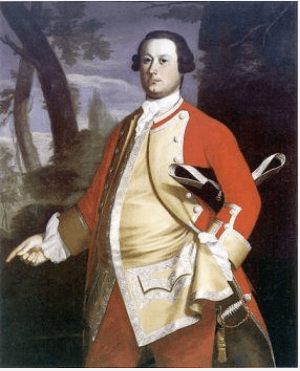
“Hanging in his quarters at Fort Lawrence, Winslow’s portrait in uniform would have served as a subtle reminder of his valuable connections. Copley’s three-quarter-length portrait lavishes attention on the young officer’s silver lace and pulsing red coat, a uniform more elaborate than the one he likely wore. The painter seemingly delights in the play of light upon shining surfaces, from the buff-colored sateen pulled taut across Winslow’s ample waist to the golden braid and tassel dangling from his silver-hilted sword.” (pp 56-57; emphasis added.)
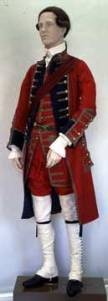
1760-65 Uniform of Captain Thomas Plumbe of the Royal Lancashire Militia.I missed that bit about sateen last night when I read this aloud to Drunk Tailor, so let’s roll back to the part that first set me off: the young officer’s silver lace and pulsing red coat, a uniform more elaborate than the one he likely wore.
Granted, Plumbe’s uniform is later than Winslow’s portrait, and Plumbe was a Captain and Winslow a Lieutenant, but the difference between them is rather less than, say, a private and a captain. Why does Kamensky assume that Winslow’s uniform is not the one he wore? Is it the lace? Winslow held a commission, and served as paymaster and commissary, roles Kamensky describes as “relatively modest.” Yes, Lieutenant isn’t Colonel; it’s the baby of officers, but it’s still commissioned officer and reasonably responsible (and, one might imagine, relatively remunerative if one was hooked into the Boston mercantile network). And uniforms were ornamented with tape, in gold, silver, or wool– see below, in Morier’s painting of two privates. (I further wonder whether it’s reasonable to describe a portrait of 50″ x 40″ as subtle, but perhaps it was placed in an enormous room.)
William Brattle, oil on canvas by John Singleton Copley, 1756. Harvard Art Museums/Fogg Museum, Partial Gift of Mrs. Thomas Brattle Gannett and Partial Purchase through the generosity of Robert T. Gannett, an Anonymous Donor and the Alpheus Hyatt Purchasing Fund 1978.606Fanciful? Fancy to our eyes, yes. Fanciful, no. Brattle was eventually a Major-General, so the uniform portrayed here, when he was likely a captain (same rank as Plumbe), seems pretty reasonable. If we were considering replicating a Massachusetts officer’s uniform ca 1755, we would consider Brattle and Winslow’s biographies and ranks, compare the two portraits of two men, probably both captains at this time, and, cross-referenced with Plumbe’s amazingly extant uniform and the 1751 warrant, begin to form an opinion that we would be making a coat in scarlet superfine broadcloth faced with buff, with buff small clothes, gold tape, and domed buttons. (Sateen is a weave structure, and wool sateen was not used in military uniforms.)
But that’s now how Kamensky is approaching this, of course, and why would she? She’s a historian, not a curator, material culture person, or a reenactor. Why does she assert that the uniforms worn by Winslow and Brattle are fanciful, and “more elaborate” than what they wore– without a footnote to back that assertion? And why does she then describe Major George Scott’s portrait “as the meticulously rendered uniform of his parent regiment, The Fortieth Foot” in contrast to “the fanciful, half-imagined costumes of Winslow and Brattle”? (p 58)
Major George Scott (detail), oil on canvas by John Singleton Copley, 1755-58. Private CollectionThe sitters’ biographies are footnoted, but nothing appears in the notes about the uniforms. Kamensky makes a great leap to the “fanciful,” which I find curious, considering that most male portraits are rendered carefully if flatteringly, and many female portraits are made for the male gaze, and are more likely to be “fanciful” or “fancy dress.”
I find myself wondering how it is that historians and art historians can write so confidently about images without understanding the material depicted. It’s as if they are all context and no content, while many reenactors/costumers favor content over context. In any case, having encountered these speed bumps in the book, I’ll certainly be reading it with a dose of skepticism when portraits are dissected.
Adam Stephen’s Waistcoat and Gorget
Date: ca. 1754
Catalog #: 12197; 12199 gorget Accession #: 52984
Credit: Division of Military History and Diplomacy, National Museum of American HistoryEdited to add:Drunk Tailor reminded me after I posted this that the NMAH possesses an actual officer’s waistcoat from the 1750s. Here’s the General History note in the online exhibit: “In 1755, the officers of the Virginia Regiment received orders from Washington to provide themselves with a “Suit of Regimentals” of good blue cloth. The coat was to be faced and cuffed in scarlet and trimmed with silver; they were to wear blue wool breeches and a scarlet wool waistcoat with silver lace.”
Scarlet wool waistcoat with silver lace. Sure does resonate with those portraits of Winslow and Brattle, and makes me all the more uncomfortable Kamensky’s assertions of “fanciful” depictions.
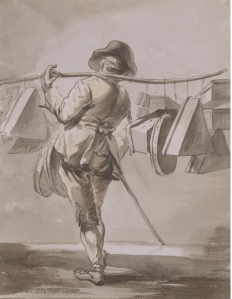
Band Box Seller, pen and watercolor by Paul Sandby, n.d. The Huntington Library, Art Collections, and Botanical Gardens, 67.18
It has been a long time since I participated in a traditional “reenacting” event, the kind with tents and pew and kettles and a TWD but here we go, borne back into the past to where it all began, more or less. I remain as uncomfortable as ever in the camp follower role, constantly questioning the likelihood of my being a follower, and the activities I would participate in. It’s a historical personality disorder, trying to figure out who one was, complicated by all the modern politics of gender roles, relationships, and unit rules.
So what to do? Petty sutlery is much on my mind, for I have need of the money and a habit of making things. Lately, i’ve been band-boxing, so I was delighted to find the Huntington had digitized this Sandby drawing of a band-box seller, placing the trade firmly in the middle of the 18th century. Triangular boxes for cocked hats, circular boxes for bergeres, rectangular boxes for gloves and (neck)handkerchiefs, I presume.
Glass coral and garnet necklaces
Red wool pincushions
I’ll have band boxes and a bonnet or two in addition to a custom order delivery, coral, glass, and garnet necklaces for girls and women, pincushions, handkerchiefs, possibly garters, and, if my hands hold up, boxes for hats and bergeres, all on a stick. Look for me between the 17th and the 7th, hindering or helping laundresses.
Why have just one dream project when you can have more than you can possibly achieve? Here, in no particular order, are things I’d like to make or achieve but probably never will:
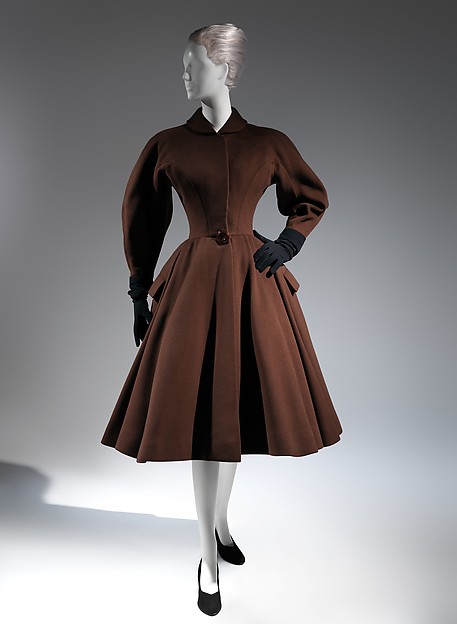
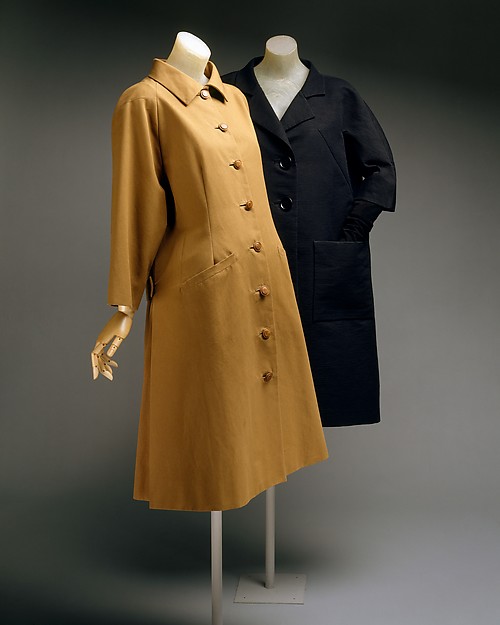
Charles James (American, born Great Britain, 1906–1978) “Cossack”, 1952 American, wool; Length at CB: 46 in. (116.8 cm) The Metropolitan Museum of Art, New York, Brooklyn Museum Costume Collection at The Metropolitan Museum of Art, Gift of the Brooklyn Museum, 2009; Gift of Muriel Bultman Francis, 1966 (2009.300.402)
Charles James: American master of draping fabric. I have nowhere and no reason to make or wear this coat, but the lines and fabric appeal to me. This skill level is currently beyond me, but I recognize that I have enough historical clothing that I could get out of the 18th and 19th centuries to concentrate on learning the couture techniques of the 20th century. Many muslins went into making this, and a deep understanding of fabric. One of the best things about the Met’s Charles James collection is the large number of muslins. Costume and clothing designers’ sketches, muslins give us a good sense of how a designer thought, and what steps went into a garment.
Balenciaga is another favorite. Evening gowns, suits, and coats, all deliciously draped.
House of Balenciaga (French, founded 1937) Rain ensemble, fall/winter 1965–66 French, cotton ; Length (a): 42 1/2 in. (108 cm) Length (b): 24 in. (61 cm) The Metropolitan Museum of Art, New York, Gift of Rachel L. Mellon, 1987 (1987.134.23a, b)
Lest you think I only like coats, the “Tulip” dress is equally interesting.
House of Balenciaga (French, founded 1937) Evening Dress, 1964 French, silk ; The Metropolitan Museum of Art, New York, Gift of Baroness Philippe de Rothschild, 1973 (1973.21.8)
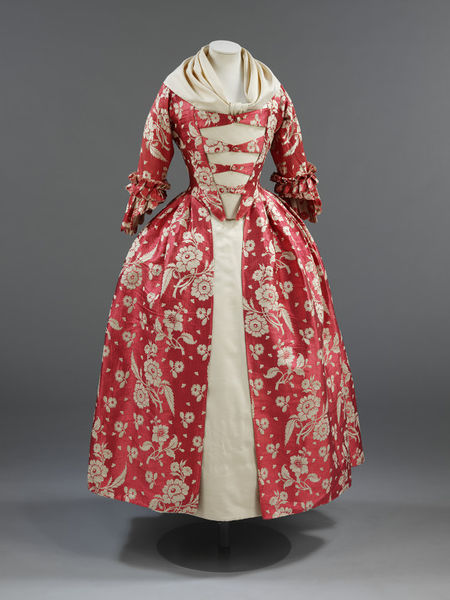
Equally out of reach is this: a remodeled silk lampas gown. The idea is to make the first gown– that is, the gown suitable for the fabric’s earliest date (which is probably not 1790, but closer to 1740-1750) and then alter that gown to the late 18th century style.
Gown, 1790s. Silk, French, Purchase. C.I.64.32.2
Metropolitan Museum of Art, C.I.64.32.2
Unknown maker. Gown, 1790. French, silk, The Metropolitan Museum of Art, New York, Purchase, Irene Lewisohn Bequest, 1964, (C.I.64.32.2)
Gown, Spitalfields silk, , 1740 – 1749 (weaving) 1740 – 1749 (sewing) 1760 – 1769 (altered) 1950 – 1959 (altered) Given by Mrs H. H. Fraser Victoria and Albert Museum, T.433-1967
There’s silk taffeta, and the occasional silk satin, for bonnets.
And linen for shifts and linings.
But my all-time favorite fabrics are Indian block print cottons. I have multiple yards in storage, and multiple yards in the accessible Strategic Fabric Reserve. I try not to look at them in the online shops, for I cannot afford to be tempted.
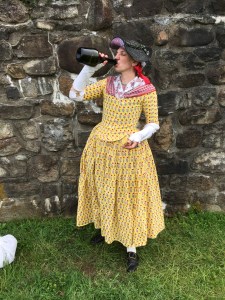
My favorite three gowns are made of Indian block print cotton:
There’s an early red, white, and black calico based on a Philadelphia runaway ad, too, and though I’ve not had it on in a while, it may be due for a renaissance.
Once upon a time in Connecticut…
Oh, and while it requires some shoulder strap adjustments, there’s the brown Indian print I wear as a unsatisfactory Philadelphia servant and Boston sight-seer…and the red print I wore for a 1790 Providence housekeeper.












 Kirsten Hammerstrom
You must be logged in to post a comment.