The Material World of Widow Weed: an interpretation

Pomade, powder, a pad, and a liberal dose of hairspray got me closer to Big Hair than I’ve ever been.

Part four of a series

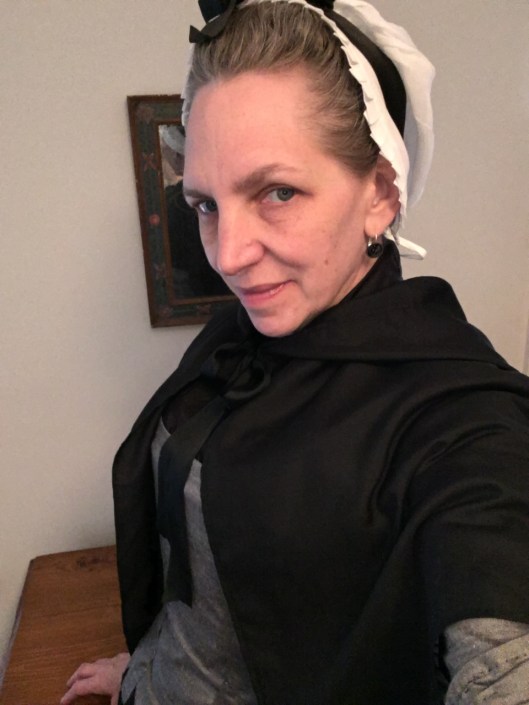
Widow Elizabeth Weed: what would she wear? What would she own? My first inclination had been to wear the grey tabby wool gown I already had, until I realized how much of George Weed’s estate Elizabeth had received. As detailed in the first post, the strategic fabric reserve (SFR) provided a “just enough” remnant of shiny silk to make a gown. Second mourning seemed right, for six months past the death of her second husband; with Mrs. Mifflin’s 1773 gown style in mind, I decided to make an English gown with robings and stomacher. (To be honest, I’m pretty pleased with how close my cuff came to Mrs. Mifflin’s, considering how badly I can mess up a cuff, and that this was my first finished silk gown in an 18th century style.)

A gown is one thing, but what about the rest of the ensemble? The Widow Costard print provided some guidance, despite being some years later than 1777. The black hood and cloak or mantelet over a white cap appears in other widows’ portraits, although the black silk cloak is not an uncommon accessory. I had been toying with making one already, and had patterned one from the original in Costume Close Up; extant examples aren’t thick on the ground, but there are enough to demonstrate some consistencies.
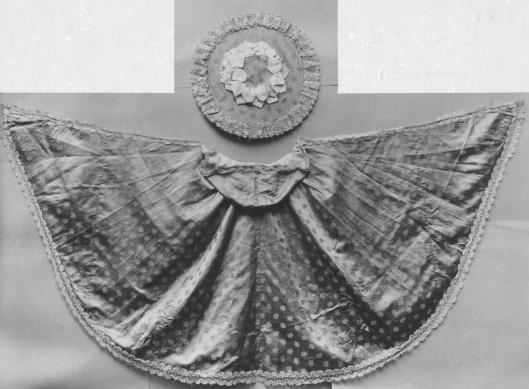
Cloak, figured cerise silk satin with a lace trim, 1760-1770. Victoria and Albert Museum, T.61-1934

1760s example at the Victoria and Albert has a shape similar to that in the Williamsburg Collection, while another at the Met (dated, without a reason cited, to 1820-1829; perhaps the reason is in the selvage or the lace), provides some clues to construction and materials. So, with another remnant from the SFR in hand, I worked from my muslin to a paper pattern, using the neck cutout from my red wool short cloak as an additional guide. It went together in fairly short order, since it is mostly hemming, with just two seams and some pleating. While I wore it untrimmed due to time constraints, self trim or lace or would be ideal additions.

Portrait of a Woman called Lady Fawkener ca. 1760. Jean-Etienne Liotard.

Additional clues to Elizabeth Weed’s status as a six-months widow are found in the black silk ribbon of her cap; black and white hats are common enough that the hat alone does not signal “widow.” I chose to make mine from a black figured silk taffeta lined with white, based on an ad in a Philadelphia paper. On October 15, 1776, John Brown advertised in the Pennsylvania Evening Post for a runaway Irish servant girl, Judith Kennedy, wearing, among other items, a “black spotted silk bonnet lined with white.” Obviously, this might well mean “bonnet” in the form we are most familiar with, and I have taken liberties by extrapolating the spotted silk to my hat cover. Nonetheless, black and white hats are a thing, and I was looking to upgrade from my tatty and faded black chip hat.

Gathering white linen evenly is a challenge: literal thread counting.

Gown, hat, cloak, updated caps: so far, so good. I had a black wool petticoat already, suitable for mid-Atlantic autumn (there was no way a black silk quilted petticoat was happening in the time allotted), and black worsted (woven) mitts. What else would Mrs. Weed need? Upgraded shoes are tempting but beyond my budget, so the last article of clothing was an apron.

The majority of my aprons are check linen, with one clean unbleached linen apron and one stained white linen apron (coffee is my weakness). Fortunately, I found 30 yards of vintage white linen on a trip to New England, and thus had apron fabric handy. After making five aprons, this one went together in less than a day.

The final piece was jewelry. A few years ago I found a “Georgian” cut steel and glass locket suitable for hair that I wore as a widowed housekeeper; on a fresh black silk ribbon, that would be a cornerstone. I added a three-strand necklace of black glass beads to contrast with the locket (thanks to the local hobby store and a stash of findings). Earrings also came from the stash, made up quickly from modified buttons and black faceted drops.
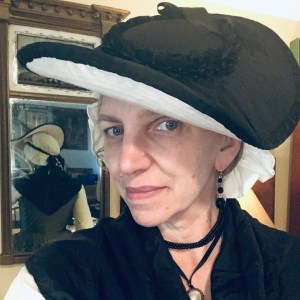
Accessories. I finally have them.

I added a white silk neck-handkerchief for warmth, and bought a black one just in case. Based on images, I thought white most appropriate, but somehow, with the grey gown, the image of “Pilgrim” was hard for some visitors to overcome, so on Sunday, I switched to black. Sometimes you have to choose accessories to lower the hurdles for your audience. Explaining that I was not a Pilgrim, but in mourning–while providing an opportunity for interpretation–was not my primary objective, so the easy color switch seemed well worth making.

The remedies (as promised) were another, slightly strickier matter. While making them according to the receipts I found was relatively simple– this is long before big pharma– carrying them was another challenge. I opted to make a box, and fill some bottles, as will become plain in the next installment.

I Want [peppermint] Candy

A friend regularly sends me bonnet descriptions from the inventories she’s researching; one description was of a white silk bonnet with a red cherry silk lining from Rowan County, N.C. in the 1770s. Hot stuff, right? Less hot if you made it in white linen, but even North Carolina has winter sometimes. I made two, of course, in sightly different shapes.

Bonnet Number One

Strawberry shortcake? Whipped cream and cherries? You tell me, but I always maintain that bonnets are the cupcakes of costuming: pretty, fluffy, low-calorie and quick to make. 

Once she’d sent me the description, I got hung up on finally finishing my wrapping gown. 

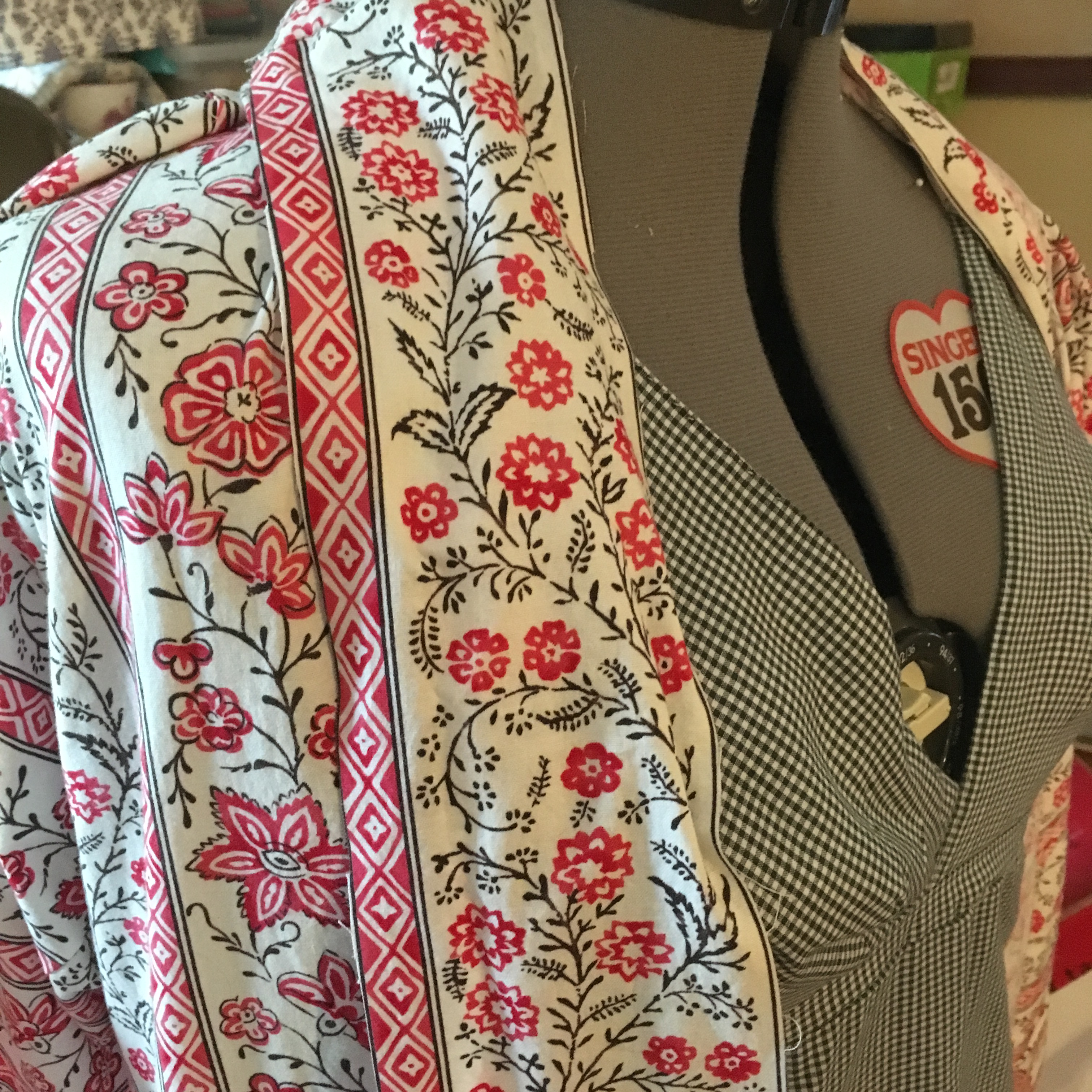
There are enough events where I sleep over that a wrapper for the morning is a useful thing. My characters don’t rate the silk of the one I made for Potts Grove Manor, but I used the same pattern with a reproduction cotton print from Burnley & Trowbridge. I love it– but I do feel a bit like a candy cane. 

Bonnet Number Two, Lampshade Style

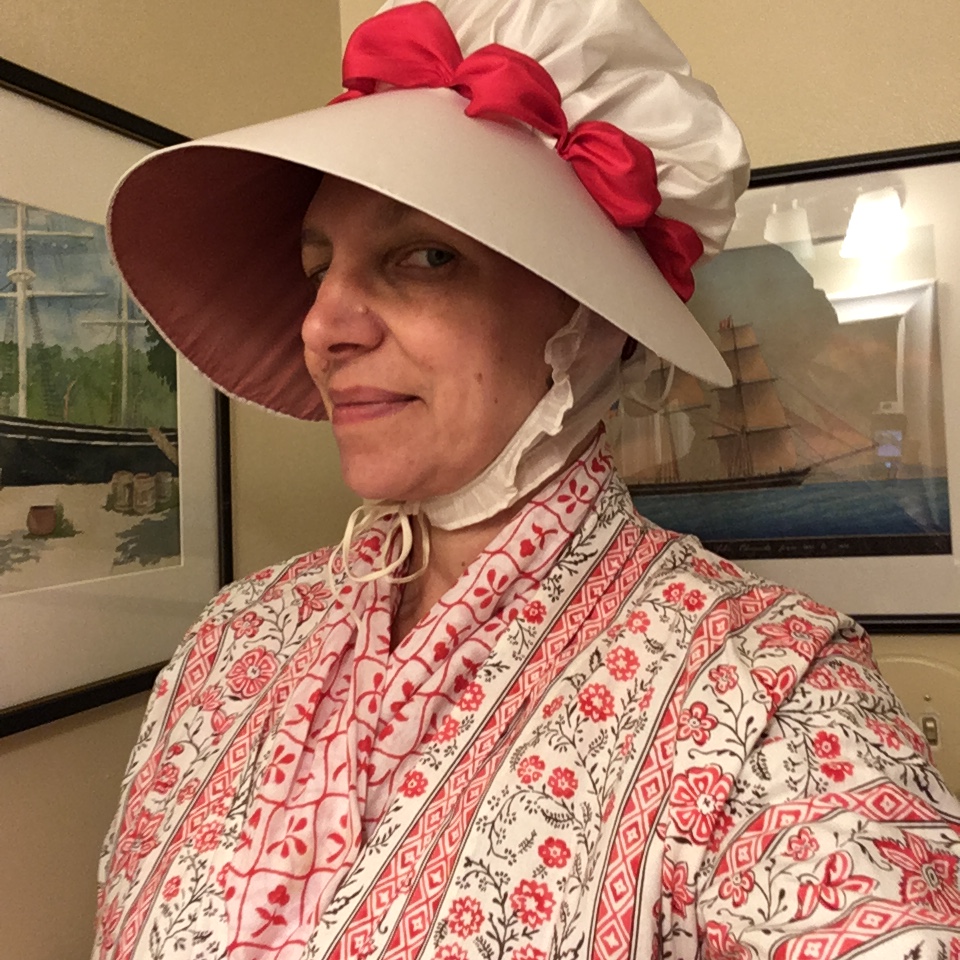
Because I’ve seen so many instances of sun shade bonnet (herein known as “lampshade,” making one up in that form seemed like a good idea– and the crowning glory to the red and white striped wrapper. 

Now I really need a cherry red silk quilted petticoat to wear with this ensemble. Some other autumn, when I have more space and time perhaps. 

Compare and Contrast

Boston Massacre planning is underway for everyone involved at every level, including me.

I’ve made changes to what I plan to wear, in part because I have a newer gown that fits better and keeps me warmer, and because I have learned more, and looked at more, in the intervening time. Since 2016, I’ve made/upgraded a quilted petticoat (in a bronze silk, a color documented to Rhode Island quilted ‘coats), settled in to wearing my cap tied under my chin, and made both a new apron and a new bonnet.

Cap and bonnet shape and shoes help make time period distinctions between 1777 and 1770; if I could find the wool I made the gown from, I would add the cuffs it desperately needs. The heeled shoes skew earlier than 1770, but they are the only heeled shoes I have….if the weather is wretched, I will wear the flats for safety and comfort.

The bonnet, which I affectionately call “Lampshade,” is meant to have the shape of pre-1770 bonnets as seen in Sandby’s illustrations, and which I have been working on for a while.

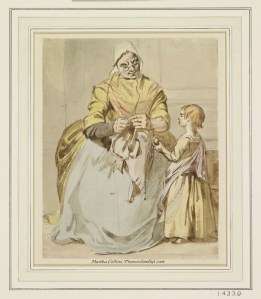
Martha Collins, Thomas Sandby’s Cook. watercolor on paper by Paul Sandby, 1770-1780. RCIN 914339

I know from reading the standards that the understanding of mitt material has evolved, and my time this morning looking for an elusive apron shape raises questions for me as well. Here’s Martha Collins, painted by Paul Sandby. What’s that black thing on her arm? A mitt? An arm warmer? Is it knit, or woven? There’s always more to figure out, and more to make.

Cuffs on my gown don’t seem like a big enough deal to warrant buying wool for a whole new gown (with only six weeks to go), so my choices are live with no cuffs, alter the red gown of 2016’s event to fit properly, or initiate an extensive search for the scraps left over from the green gown…which may or may not be buried in storage. Tick tock.

Squirrel!

It’s astonishing to me, in a way, that I haven’t posted about this before, but shockingly, I have not. Remember the need to keep warm in Princeton? Tested on at Ti? A compromise?

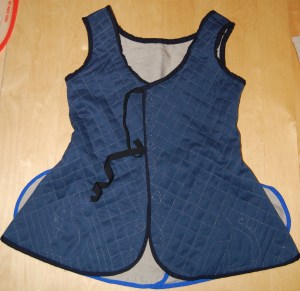
I updated that garment and wore a nearly-completed version at Ti last February but never wrote about the new version: the Squirrel Waistcoat.

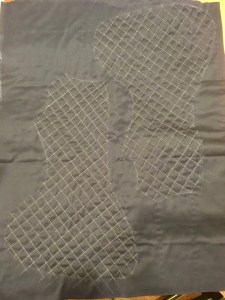
Wool hand-quilted to a wool backing and lined with wool, I wore this almost finished at Fort Ti last February, and found it comfortable and cozy. I had imagined its state to be far worse than it was: with a lining in need of piecing, mangled seams, your worst nightmare come true. But no: all it really needed was some binding adjustment, not surprising considering that I stitched the binding by candlelight while chattering away with friends over cider.

The back pieces weren’t bound at all, but because I’d imagined this needed so much more work than it did, I put it aside until now, when I know I will want it for a weekend in Trenton, and another at Ti in December. All it took was a little time, and accepting that the bindings will not match.

This wasn’t a long, involved project, really, though I spent lunch hours and evenings working on it last January and February. It is, as so many things are, about patience. Patience and good needles.

The construction was based on the quilted waistcoat I made two years ago, with a pattern derived from Sharon Burnston’s research, using fitting adjustments I’d made to an earlier jacket pattern (long since abandoned due to living in New England).

I don’t fully remember how it fits best, over or under my stays, but I’ll get a couple of opportunities to test drive the layers in the next two weeks. And in the meantime? Squirrel!