Half Robe or Jacket: How Do You Wear One?

Half robe, 1790-1800. National Trust Inventory Number 1348749,
Half robe, 1790-1800.
National Trust Inventory Number 1348749,

What Cheer Day is coming, and I hate to miss an opportunity to make a new gown (despite having just made one, and despite needing to make some waistcoats and trousers for the event). While I lay awake last night, I pondered my options, and whether a half gown would be suitable.

Although I have concluded it probably is not, I was curious about how these should be worn. Where can you wear such a garment? Is it only suitable for at-home use?

This is the robe from Nancy Bradfield’s Costume in Detail, replicated by Koshka the Cat here, and approximately by me, here.

Since I will be a housekeeper again, I think a gown is more correct for me, but that doesn’t stop me thinking about half robes, and whilst scrolling images by year at the Yale Center for British Art, I found this by Cruikshank:

ladies in a lending library
Isaac Cruikshank, 1756–1810, British, The Lending Library, between 1800 and 1811, Watercolor, black ink and brown ink on medium, lightly textured, beige wove paper, Yale Center for British Art, Paul Mellon Collection

There’s a lot to love in this image, even with its fuzzy “between 1800 and 1811” date. Not only do we get an array of reading material (Novels, Romance, Sermons, Tales, Voyages & Travels, Plays), we get costume tips and– special bonus– a dog gnawing its leg.

(If you are curious about some of the books in the Library at the John Brown House, check out this tumblr bibliography. I’ve been using it of late, and the representative genres are quite similar to what we see in the Cruikshank.)

We also get a chemisette on the lady at the counter, along with a very dashing hat, a fancy tiered necklace on the lady in pink, who also carries a green…umbrella? Parasol? With just a veil, that seems likelier than the longest reticule ever.

I like our Lady in a Half-Robe and her deep-brimmed bonnet showing curls at her brow. She and her companions show the range of white and not-white clothing seen in early 19th century fashion plates, and the range of head wear, too.

Undress for August, 1799. Museum of London

The last question I’m asking myself, though, is whether the yellow garment is a half-robe or a short pelisse or a jacket. And can you wear a half robe out of doors? And what did the ladies of the period call that garment?

In this fashion plate (featured by Bradfield on page 84, found by me at the Museum of London), the lady on the right is certainly wearing a short upper body garment, and I’d wager that she’s out of doors or headed that way, since she’s carrying a (green) parasol. Bradfield calls her garment a “jacket,” and until I can find the text of the Ladies’ Monthly Museum for August 1799, perhaps that is the term we should use instead.

While two images aren’t a lot of evidence, it does appear possible to wear a half-robe or jacket out of doors for informal visits in clement weather, and finding two is as good a reason as any to look for more.
Coats and Cooking

And happy not to be walking to Walloomsac, since we can’t leave till Friday.

Before we leave, there’s plenty to done, of course, and most of it in men’s wear.*

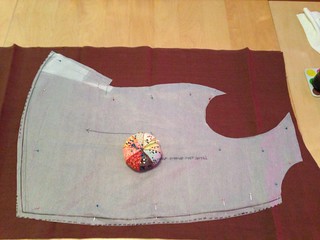
The first piece on brown linen

The Young Mr needed a new jacket, a proper one, with pockets and everything, correct for a scalawag. So that meant patterns and muslins and fittings and questions, until neither of us could really stand the other and his father called me an ambush predator of fittings. The only way to fit these wily creatures is, as they amble through the room, to leap out and toile someone.

With the pattern more-or-less fitted to the wiggly Young Mr, I cast about for fabric: there was not enough of a striped piece for both waistcoat and jacket; waistcoat won, because matching stripes on a jacket seemed too risky in this great a hurry. Instead, I sacrificed the last yardage once meant for a gown.

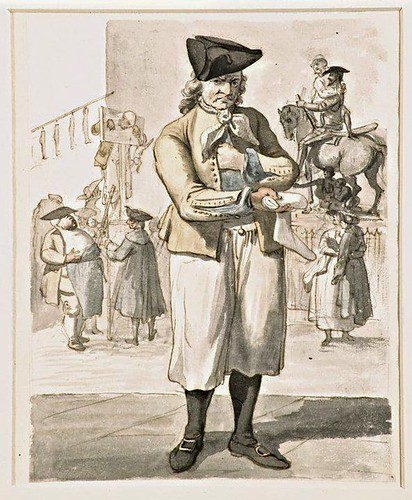
The Stocking Seller, by Paul Sandby, 1759

This is the inspiration for the kid’s new garment, along with Sandby’s fish monger. It seems a plausible garment to work from, and the brown linen is in keeping with the brown linen jacket at Connecticut Historical Society and the unlined linen frock coat recently sold at auction. It will also match his trousers, but this is what happens when you sew from the stash.

One pair of breeches altered, one waistcoat wanting the last seven newly-made buttons, one waistcoat in production, one jacket in production: you’d think that would be enough to get done. But I’m also working to expand my cooking repertoire, as bread and cheese gets tiresome and scrounging broken ginger cakes from the Sugar Loafe Baking Co.— while potentially good theatre–is not a solid plan for sustenance.

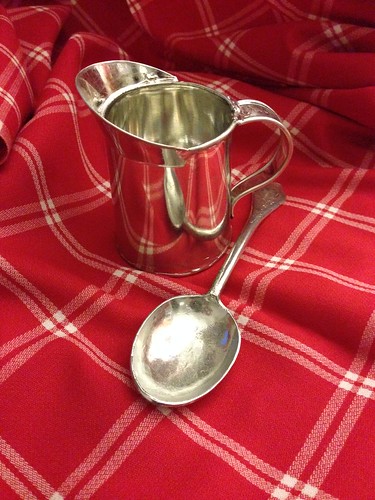
half pint and spoon measures
Half-pint and spoon

Boiling food in summer- sounds awful, right? But it’s an easy and correct way to cook,once you translate recipe measures and control the amount you’re making. I like to use Amelia Simmons’ cookbook, because it is specifically American, and my more skillful friends cooked from it at the farm.

From Enos Hitchcock’s diary, I know that he ate a boiled flour pudding with some venison stew (near the Saratoga campaign, I think) so I consider this a plausible recipe for the field, pending eggs, of course.

A boiled Flour Pudding.

One quart milk, 9 eggs, 7 spoons flour, a little salt, put into a strong cloth and boiled three quarters of an hour.

Simple enough, though Simmons later corrected the receipt to 9 spoons of flour, and boil for an hour and a half. I got out the spoon, and looked online at modern boiled pudding recipes, and will give a modified version a whirl sometime this week (always better to fail at home than in the field). Boiling the pudding in a linen cloth in a stew would make a savory bread substitute…and I really liked the one we had at the farm. Will the gentlemen at Bennington like it? Perhaps we’ll find out. If we’re not cooking with hosewater, almost anything should be edible.

*Yes, it’s a terrible and terribly dated show, but I always hear  this in Mr Humphries‘ voice from Are You Being Served?

Breaking Up By Letter

Mr S, always slightly suspicious

Mr S and I joined other members of the 10th Mass and National Park Service staff and volunteers at the North Bridge in Concord, Mass last Saturday for the postponed reading of the Declaration of Independence. It was one of those perfect New England summer days, breezy blue skies and dry wind smelling of grass and flowers: days like that I finally get the Transcendentalists.*

Some of those present in modern and historic clothes alike had never heard or read the Declaration all the way through; it is one of my favorite documents, and not just because I was in a 5th grade play about the document. Questions of slavery and principles aside, the Declaration is a great poem of a break-up letter. It makes poetry of the list of King George III’s crimes and reminds us of the core principles that undergird our government and that began with the Magna Carta, limiting the power of the king.

Governments are instituted among Men, deriving their just powers from the consent of the governed

Leaning against a tree near the North Bridge, you could close your eyes to the shorts and kayaks and baseball caps and listen to a document being read as it would have been 238 years ago, and imagine what it was like to hear this for the first time (at least until the airplane passed overheard).

I have a complicated relationship with patriotism, which makes me a curious candidate for this living history business. But that moment in Concord reminded me of the enthusiasm I had for history as a child, and the passion I had for what educators now call narrative play, and what some of us now grown up call reenacting, and others call historical re/creation.

There is something we can learn, as participants, and that the public can learn, as we go about this business of re-investigating the past, through making clothing and reading and cooking and re-learning historic processes and crafts. We may not always learn what we expect to about the past or about our selves, but if some in the audience enjoyed the smell of grass in the wind, and heard the true poetry of Jefferson’s text, maybe that’s enough to be getting on with. Because for all the questions about how a musket works, the real point of all of these events isn’t the musketry, it’s the history.**

*They clearly did not wake up to the “what the hell’s that smell?” game tidal canals like to start on summer mornings.

** Sorry, lads, but I think it’s true: wars are about words backed by muskets or other weapons.

Fashionable Friday: Floral Embroidery Galore

Colonial Wedding dress altered 1830
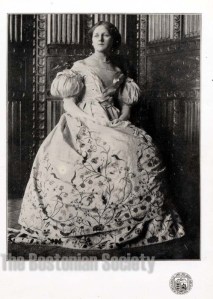
Elizabeth Bull Price’s Wedding Dress. Bostonian Society, 1910.50.35

On Tuesday evening, sensibility won over sense as my friend and I boarded the T for Boston to make a long day longer. The trip was worth it, though, for the One Night Only engagement of Elizabeth Bull’s wedding dress at the Bostonian Society. In truth, I bought the tickets for the event before I was even back at work and navigating our Fair City on my own– and who wouldn’t? That dress is amazing! (Tons more images of the embroidery are in the catalog record.)

Perhaps even more wonderful than the 14-year-old ElizabethBull’s needle skills is that the dress remains with us today. Kimberley Alexander and Tricia Gilrein reminded us on Tuesday of the many ways this dress, and other remnants of Bull’s wardrobe (oh, the petticoat, and the wonderful kerchief) connect us to the past in surprising ways. Elizabeth Bull was wealthy, married to Roger Bull, a Church of England official 22 years her senior: though they lived in Boston, they were British. (They were married in the 1730s, and Elizabeth died in 1780 at about 67.)

It’s a little hard to see past the 1830s alterations, but the embroidery of the gown helps chart that course, as well as the petticoat. As important to remember is that this wedding gown was not white: it has faded from a celadon green to its current off-white color. Wedding dresses weren’t white in the 18th century, or even long into the 19th, and it’s helpful to remember that as we look at what remains and reconstruct this in our mind’s eye.

It’s easy to forget we were British first here in the United States, and that the American War for Independence did not have a foregone conclusion. We forget, too, that churchmen and their wives were socialites as much as they were people of the cloth. Put Mr Collins out of your mind, and remember (my favorite minister & fashion maven) Reverend Enos Hitchcock and his pink satin waistcoat and suits of black silk.

Photograph of the altered gown. Bostonian Society, 1910.0050.057

Like many 18th century gowns, this one was remodeled in the 19th century, its shape altered to reflect the current fashion. We are lucky to have so much preserved, not just in the gown but also in the petticoat. Paths to understanding of women’s education, the customs and habits of Boston’s colonial elite, and the persistence of past can all be found within this object.