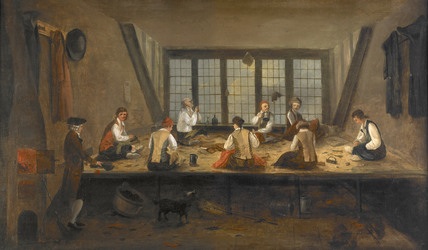
Winter Amusement

Winter Amusement: A View in Hyde Park from the Sluice at the East End.Aquatint, printed in color and colored by hand, 1787.Print made by James Tookey. YCBA  B1985.36.609
Winter Amusement: A View in Hyde Park from the Sluice at the East End.Aquatint, printed in color and colored by hand, 1787.Print made by James Tookey. YCBA B1985.36.609

I count myself among the people sick of winter in New England, but the piles of snow and wretched driving have prompted some comments from the Young Mr, including “Well, it would be worse in the 18th century, right?”

16314413949_fca9e1de44_zHaving recently walked on a combination of cleared, partially cleared, and uncleared walks, I’m not so sure…but I was in modern boots, and not my leather-soled repro shoes, which I prefer not to expose to the variety of modern snow-melting chemicals, though they can be cleaned.

Still: the partially cleared and unsalted walk was easier to walk on than you might imagine, and I suspect that the 18th century tasks of clearing steps and paths to make room to walk or drive carts, wagons and carriages was probably reasonably effective– though the melting must have been more annoying and messy when mud season arrived.

In all this cold and snow, how did people keep warm and stay fashionable? For gents, of course, greatcoats were an option, and cloaks or mantles for women, both in the last quarter of the 18th century and into the 19th. I found documentation for women’s Spencers and greatcoats in the first decade of the 19th century, but what about earlier?

detail,  Winter Amusement, 1787
detail, Winter Amusement, 1787

While I cannot (yet) place the coat at right in New England, you know I covet one.

Tail pleats with back buttons, a possible shoulder cape? I love the menswear styling of this coat, and the drab-and-black color combination of coat, gown and accessories. I don’t have much call for 1787 clothing in my life (actually none whatsoever) but by the time I’ve patterned and made this coat (after many other things to finish), perhaps I will also have created a reason.

Winter frolics, New Year’s Eve party, 1788? Anything is possible, and time is better spent imagining fun than complaining about snow.
Frocks Coats in Providence

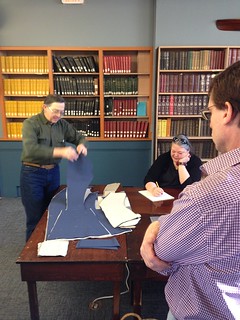
Saturday last saw the launch of History Space, the collaborative project of the Rhode Island Historical Society and the Newport Historical Society designed to help living history practitioners and reenactors acquire the clothing and skills needed to bring the past to life.

Many parts to a frock coat.

Scheduling being what it is, we plunged right in to hands-on work with Easy Grace and Comfort, a two-day man’s frock coat workshop with Henry Cooke. We saved enormous amounts of time in the workshop by having Mr Cooke cut coat kits for participants, and I know it was well worth every penny.

There is much less on-body fitting when Mr Cooke cuts a coat for the kid than when I do. (I think the Young Mr grows while I am trying to figure it out, but Henry cuts fast enough to head him off.)

Buckram and button stands

The most painful part of the whole thing (if fitting is largely done) is stitching on the buckram interfacing and the button stand. The zig-zag stitch as demonstrated by Henry was fairly easy to get the hang of when you caught the rhythm, but the tightness of the Red Edge stand tested my needle and even my fingertips.

There were some complaints at one table, largely voiced by the Fifer Formerly Known as Lambchop, who awaits his 10th Mass name.

Sleevils!

We made it all the way to sleeves, which is impressive, considering that some of the gentleman had not made more than a haversack or knapsack before. But if you can backstitch, and have some help with your fitting, you can make a coat.

I happen to like sleeves, myself, stitching them up and setting them in the garment. I think it’s the three-dimensionality of them that appeals to me– and I like a good challenge.

And here we are: sleevil one.

It’s critical to pay attention, though, so you make one left and one right sleeve, and to keep track of them as you set them to the garment body. I sometimes mark mine with chalk, and have even pinned notes to the pieces when feeling especially daft.

I’ve made it to an assembled coat body and sleeves, with one sleeve basted on. Before Saturday, I plan to baste on the second sleeve and test fit sleeve set on the boy. I’ll also try to get pocket flaps made. Since I have a talk to write and a bedgown to finish as well, I’m probably dreamin’ big.

When this suit is done, the Young Mr will have a very nice blue ensemble that includes breeches (join in the fun here) and a waistcoat. I think he’ll look rather nice, and better than he has previously. I still want to make lower-class* clothes for him, but first he does need a nice suit.

*I said urchin, but Mr Cooke said urchins can’t be over 6 feet tall. Basking sharks are big, but in this blue-grey suit, perhaps the Young Mr will finally be a grey reef shark.

The Unbearable Sameness of Dressing

One of the arguments I hear against changing the way people dress as civilians at reenactments, particularly the women but sometimes the men, is that “if we all use the same pattern, we’ll all look alike, and that’s not how people dress now or then.”

I have news for you: that is how we dress[ed].

I know, we can’t apply modern thinking to the past– that’s crap historiography. But why do we resist using the same correct patterns for historic garments when we are clearly dressing alike today?

I’ve not yet read a paper on the similarity of women’s dress in Robert Feke or John Copley’s portraits that really convinced me, but if you look at enough of them, you might think there’s only one woman and one dress in all of British North America, because Badger and Greenwood are painting her, too.

Even if those clothes are studio props, what does it say that the sitters wanted to be portrayed in the same clothes? Look, if that’s the only means of getting myself into a Charles James, you bet I’d take it. Or, for a more contemporary analogue, Alexander McQueen.

Luxe et Indigence. Le Bon Genre, 1817

Dressing is about status as much as it is about self-expression, and in the 18th century, dressing signaled refinement, sensibility, and status through the quality of fabric as much as through the cut of clothes. Air Jordans do the same thing today, or North Face jackets, or Kate Spade purses. They show what you can afford, even if you’re eating oatmeal for dinner behind closed doors.

We dress the same now, and we dressed the same then, with variations according to pocketbook. We can’t all afford K&P superfine wool today any more than we could have bought the best wools or prints in the 18th century. But using accurate patterns and fabrics appropriate to our station will create the best impressions possible– even if my gown is cut to the same pattern as my wealthier acquaintance’s.