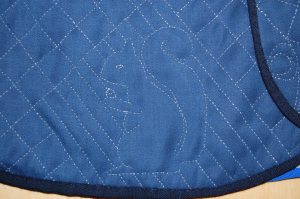
Squirrel!

It’s astonishing to me, in a way, that I haven’t posted about this before, but shockingly, I have not. Remember the need to keep warm in Princeton? Tested on at Ti? A compromise?

I updated that garment and wore a nearly-completed version at Ti last February but never wrote about the new version: the Squirrel Waistcoat.
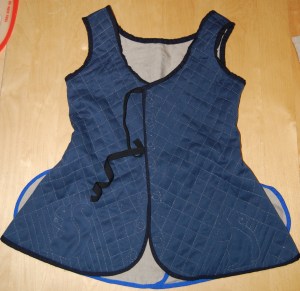
Wool hand-quilted to a wool backing and lined with wool, I wore this almost finished at Fort Ti last February, and found it comfortable and cozy. I had imagined its state to be far worse than it was: with a lining in need of piecing, mangled seams, your worst nightmare come true. But no: all it really needed was some binding adjustment, not surprising considering that I stitched the binding by candlelight while chattering away with friends over cider.

The back pieces weren’t bound at all, but because I’d imagined this needed so much more work than it did, I put it aside until now, when I know I will want it for a weekend in Trenton, and another at Ti in December. All it took was a little time, and accepting that the bindings will not match.

This wasn’t a long, involved project, really, though I spent lunch hours and evenings working on it last January and February. It is, as so many things are, about patience. Patience and good needles.
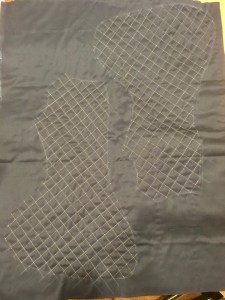
The construction was based on the quilted waistcoat I made two years ago, with a pattern derived from Sharon Burnston’s research, using fitting adjustments I’d made to an earlier jacket pattern (long since abandoned due to living in New England).

I don’t fully remember how it fits best, over or under my stays, but I’ll get a couple of opportunities to test drive the layers in the next two weeks. And in the meantime? Squirrel!
I Fall to Pieces: Extant Garment Fragments

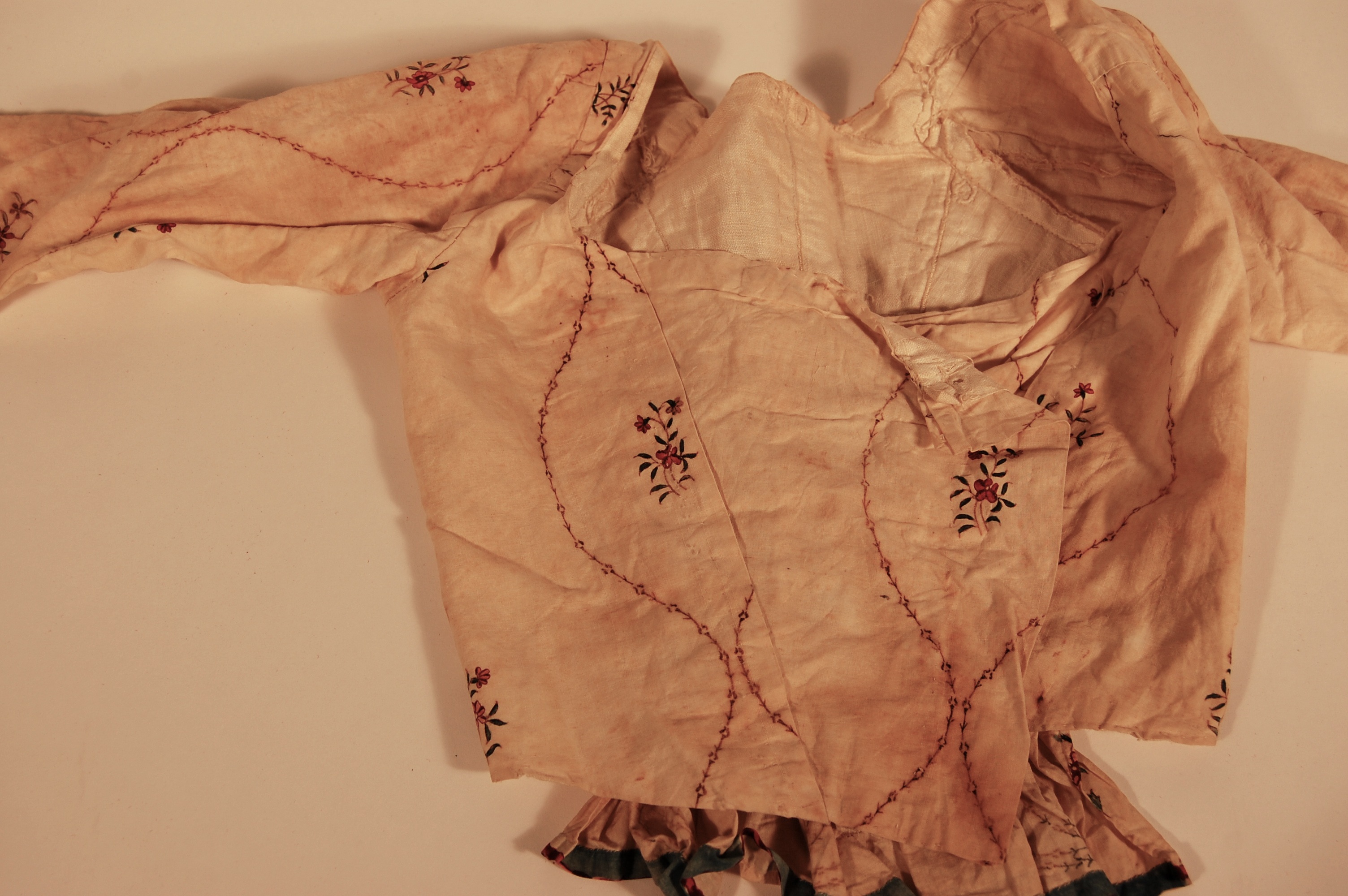
Bodice, painted Indian cotton, 1780-1795 RIHS 1990.36.27
Bodice, painted Indian cotton, 1780-1795
RIHS 1990.36.27

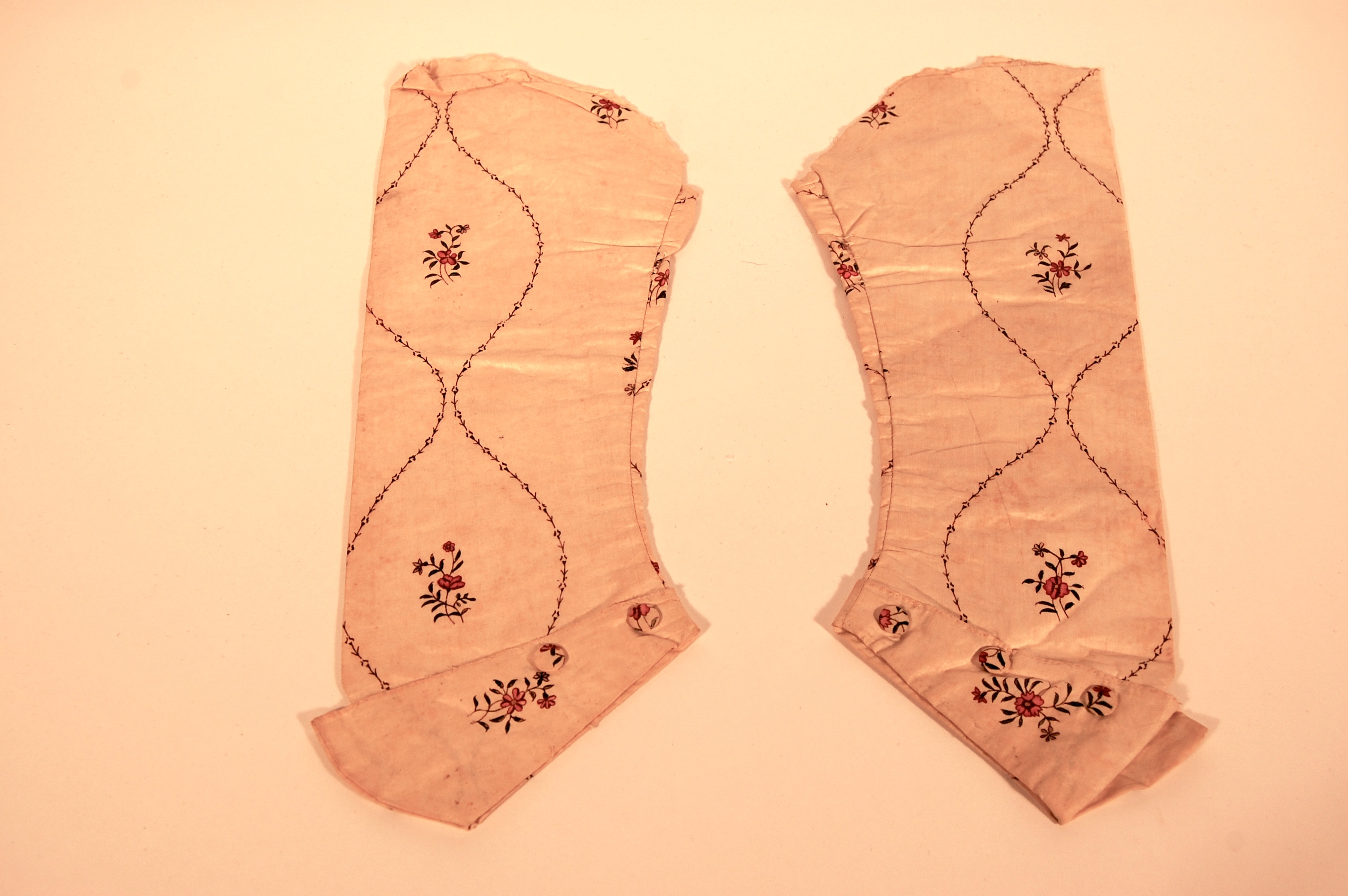
Once upon a time, not very long ago, when I worked in a historic house museum, I was asked to present at a conference in Worcester. I chose to talk about these fragments, and I still like to think about them. The delicate fabric was saved as a pair of sleeves, a bodice with a tiny peplum, a skirt.

Sleeves, removed from bodice 1990.36.27. RIHS 1990.36.25A-B
Sleeves, removed from bodice 1990.36.27.
RIHS 1990.36.25A-B

The pieces appear to have been part of a pieced-back closed-front gown with a matching petticoat circa 1785. I think someone decided (quite rightly) that the style was too passé for 1795, and altered the gown significantly.

Not only is there evidence of new sleeves being fitted into the gown’s armscyes, we have the sleeves-that-used-to-be. And my dear! No one is wearing sleeves like that this season!

I find these garments in limbo really fascinating. Was that bodice finished and worn with a matching petticoat? (Yes, there’s a panel of that left, too; what a lovely hem!)

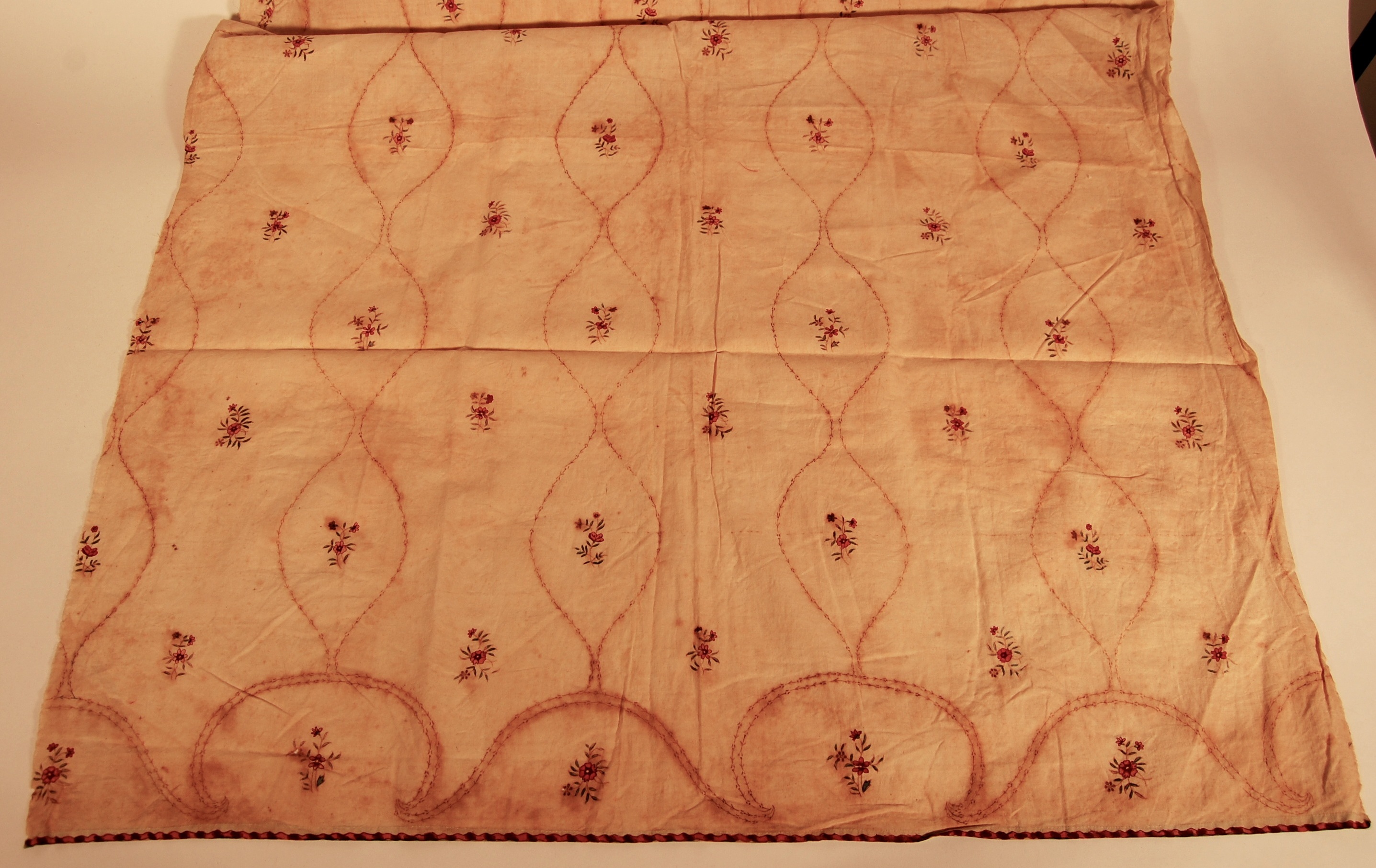
Skirt panel, painted Indian cotton. RIHS 1990.36.33
Skirt panel, painted Indian cotton.
RIHS 1990.36.33

Who wore the gown? Was it Sally Brown, born in 1773? And did she alter it, or did her sister’s mantua maker, Nancy Smith? We can only guess at this point, as so many documents remain in private hands. The alterations are not as finely done as the original gown, so I think there are two hands at work here– whose were those hands? There’s always more to think about and learn.

In case you’re wondering, thanks to the Met, we can see what the gown probably looked like in its first incarnation, and then what the alterations were meant to achieve. (Link to the gown on the left; link to the gown on the right.)

The ‘Nancy Dawson’ Dress

Miss Nancy Dawson, aquatint print. Victoria and Albert Museum. E.4968-1968

Hat tip to Mr B for pointing out the resemblance; I know the print and never connected it to this fabric.

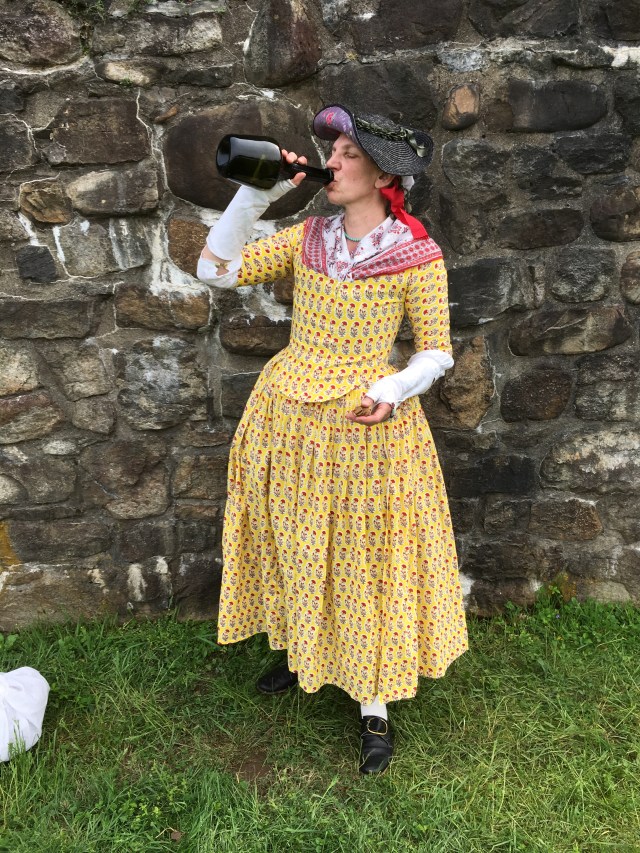
It’s been almost a year in the making, this bright yellow billboard of a gown. I’m not sure why I dawdled over the making; usually I’m pretty quick with a needle, but perhaps it was in part because the goal kept changing: first December, and then, it seemed, never, would I have an occasion to wear this. Federal exploits intervened, work intensified, things changed. But late April presented itself as an opportunity, so finally I had a goal, a deadline.

It was hot. And humid. That’s only water.

And I met it, with Drunk Tailor’s help (setting hems by yourself is a pain).

This is a fairly straightforward affair. I did use the Larkin and Smith “fashionable gown” pattern because I know how it fits me, but the front is modified to a simple closing and the skirts aren’t meant to be drawn up. This gown aspires to pretensions– though you can tell I’m fairly prosperous by the number of different prints I’m wearing.

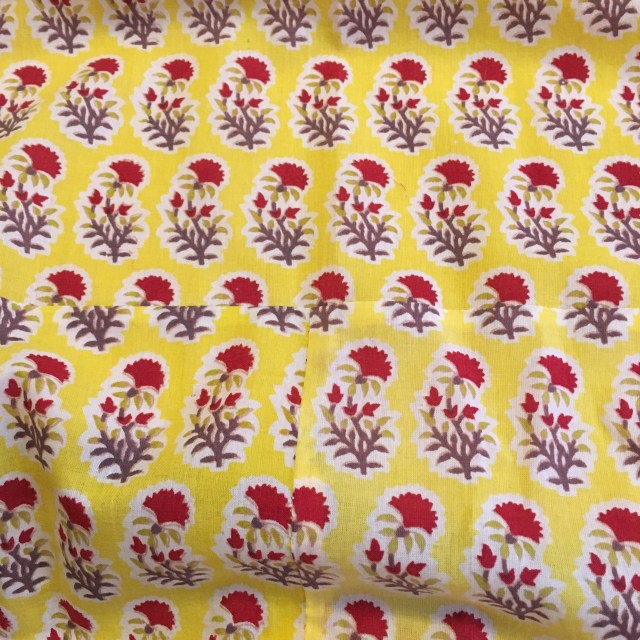
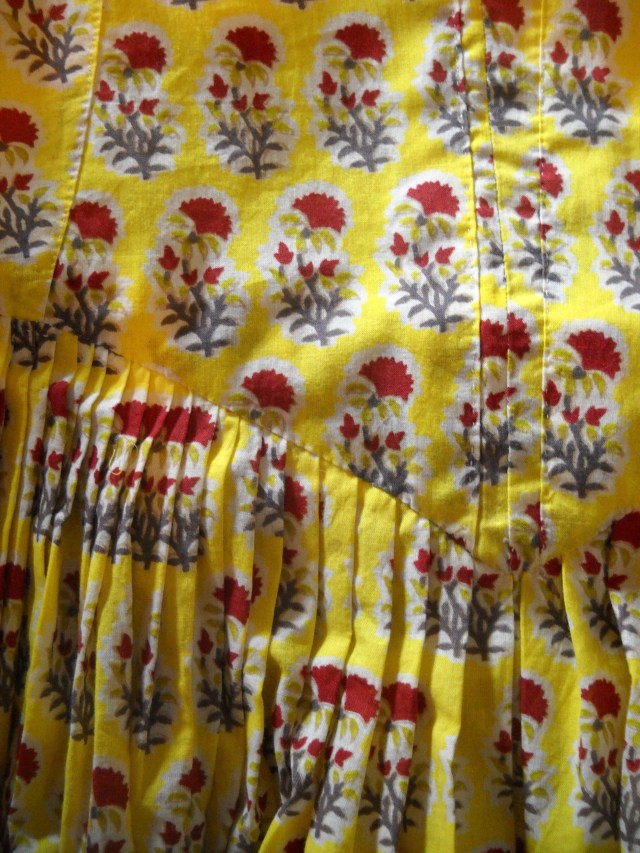
The petticoat did require piecing– at my height, 44 inch wide fabric often needs to be pieced to achieve the lengths or width I need in historical skirts.

Happily, the piecing matches and doesn’t match, in a fairly satisfactory way. When this fabric arrived on my doorstep, I determined that it needed to be used in the most obnoxious manner possible– and since I’m not a small woman, a gown and matching petticoat seemed the best possible use. (I have other obnoxious fabrics for later time periods).

I did take care as I made it up, though, stitching with white thread and trying to make the pleats small and correct to the fashion and fabric. Any failures or flaws make it, to my eye, better as an article of aspiration to a rank and style I really can’t pull off.

One thing I forgot to pack was a bum roll– though wearing that on the drive to Fort Frederick would have been extra interesting– which was unfortunate, as it is truly required. These new (they’re a year old, and I expect to call them “new” for a long time to come) stays make a different shape in the back than the old stays, and now my own padding no longer negates the need for a bum roll. Still, I’m pleased with the result, even if it still wants cuffs. Not bad for eleven months of work.

Mrs Pabodie, I presume?

Mrs William (Jane) Pabodie. oil on canvas, 1813. RIHS 1970.60.2

Remember Mrs Pabodie? She appeared a week ago today in Providence after an intense sewing effort left your author with numb fingers. The process was as straightforward as these things ever are, manipulating fabrics to do your bidding once you think you have the right materials.

It took more rounds of white muslins from Burnley and Trowbridge than I care to count, and a variety of book muslins from Wm Booth Draper, just for the chemisette and cap. The laces came from Farmhouse Fabrics in the most expensive small package I’ve yet ordered that did not contain antique jewelry.

Mrs Pabodie attempts to remember when she was born (1771). Photo by J. D. Kay

The gown is a wool and silk blend remnant from Wm Booth Draper, just enough to make a gown (even at my height) though I admit the front hem will need some piecing or a ruffle to give it the proper length. Still, the thing more or less works, though as I compare the details to the original painting, I admit we’re still in beta.

I was joined by three friends from different eras (because you know me: if it’s not didactic, we’re not doing it): a sailor who on the run from a Newport press gang in 1765; Reverend Enos Hitchcock of the Beneficient Congregational Church in 1785; and Sissieretta Jones, soprano of Providence, around 1880. Each of the characters described their lives and their clothing, and I will admit that the Annual Meeting audience may not have been fully prepared for some of what they heard– I’m not certain they had ever considered how apt “balancing a sheep on my head” might be in describing Reverend Hitchcock’s wig.

Mrs Pabodie points out East Side landmarks to a visitor examining the theatre curtain backdrop painted around 1810. Photo by J. D. Kay

In the end, they were entertained, and may even have learned something, as we celebrated 2016’s interpretive theme, Fashioning Rhode Island.